
MARIA ZHUMAGULOVA: “WE BELIEVE THAT SUCH A COLLABORATIVE EFFORT ALLOWS FOR ACHIEVING THE BEST RESULTS”
OCA Magazine: Please tell us the most important things about yourself and your creative work. What is your creative, life credo and motivation for your creativity?
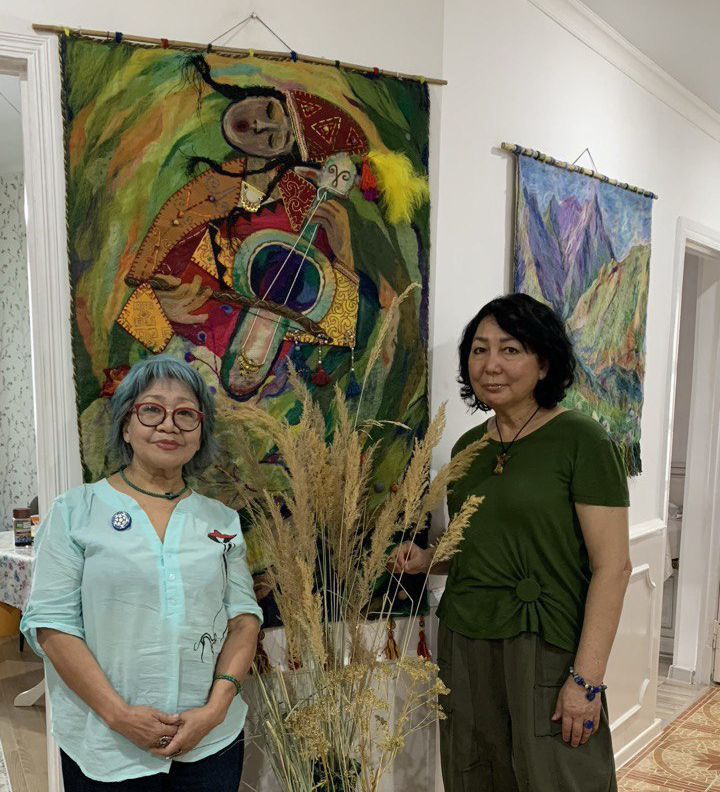
Maria Zhumagulova: By profession, I am an art historian. I also identify as a curator of art projects, a journalist (a member of the Union of Artists and Journalists of Kazakhstan), a museologist, a local historian, a lecturer, a theatre critic, and a publicist. All these roles together form my creative facets – vital expressions of the human spirit and soul. In our turbulent times, the preservation and development of the accumulated global cultural heritage of humanity is especially relevant. My guiding principle is to use my abilities to influence people’s positive mindset; to involve them in a creative atmosphere; and to encourage their participation in these processes. I strive to create original artistic work myself, to derive intellectual, aesthetic, and artistic pleasure from art, and to share this with my contemporaries.
OCA: How did you choose your path and who is your role model in the creative field or in life?
MZ: Choosing my path was quite challenging and, in many ways, almost unrealistic. I was born in a small provincial town where the profession of art historian was virtually unknown. At that time, Kazakhstan was part of the USSR, and this specialty was not taught at all in our republic. I received my education at a Russian university affiliated with the USSR Academy of Arts in Saint Petersburg. This was influenced by my acquaintance with a person whose roots lie there — Inna Klyavina, who had just started an art history circle and shared literature on the subject with me. Due to the nature of my interests, I have a wide circle of acquaintances, including notable figures who have influenced the country’s historical development. Among them are one of the country’s top officials, Ozbekali Dzhanibekov; the archaeologist and art historian Alan Medoev; the musicologist Yuri Aravin; the artist Sergey Vasilyevich Kukuruza, and others. Undoubtedly, encountering them, maintaining personal contact and being involved in their work has been a constant source of new experiences, fresh knowledge, special inspiration, and a driving force for continuous progress and responsibility for the quality of my work in the projects I undertake.
OCA: What is your main achievement(s) or positive impact on the world in 2024–2025?
MZ: I am engaged in quite an intensive creative activity. Just over the course of 2024–2025, I can list some of my endeavours: participating in two academic-practical conferences related to history, art, archaeology, and ethnography in Kazakhstan, held in the cities of Shymkent and Aktobe, with published papers; curating an exhibition of an artist at the Presidential Cultural Centre in Astana; presenting an exhibition of artists from Akyubinsk in Turkestan; taking part in the International Scientific Forum dedicated to issues of national heritage at the Central State Museum in Almaty; involvement in the artistic segment of the international Rotary Club; organising art projects for the Creative Bohemia of Asia; conducting research and publishing works in connection with the 120th anniversary of Abylkhan Kasteev; participating in the book launch of American writer Lara Prodan, which relates to the ancient history of nomads in Kazakhstan, among others.
I also travel across regions to provide professional support to galleries and art museums (as of now, there are no art historians in any of the regions); I promote creative activity in the country through television, newspapers, magazines, Instagram, and Facebook. We are currently implementing our own very topical project — organiser of ArtEl of Arts — an ONLINE campaign ‘Against Sexual Violence Towards Children’. All this expands the global audience’s understanding of Kazakhstan.
OCA: What is the main feature that makes you and your art/work unique?
MZ: I have accumulated extensive experience communicating with a wide range of audiences, taking into account age, gender, and social differentiation. Face-to-face interaction remains the most important form of communication, although I also strive to utilise modern technologies. Being actively engaged in the flow of events, not missing pressing issues in contemporary art and cultural phenomena, and responding promptly — these are essential. I keep my finger on the pulse.
I find common ground with any audience and pay close attention to regional events. I also value engaging with highly professional individuals who are at the forefront of their fields. I never tire of learning — everything changes so rapidly. I make sure not to lose the diversity of my interests and actively apply my knowledge in practice. I am curious about everything. I have not lost the ability to be inspired and to learn. Mobility and readiness to participate in projects across a broad spectrum — without becoming fixated on a single profession — are important to me. It is enthusiasm that helps me achieve the desired results, because, above all, emotions and empathy come into play.
OCA: Please tell us about the events or projects of the Eurasian Creative Guild (London) and projects you have already participated in and how does ECG influence your creativity and success in your work?
MZ: I have been a member of the Guild since 2019. I took part in an international project — an exhibition dedicated to the anniversary of Chingiz Aitmatov in Bishkek, held at the State Museum of Arts of Kyrgyzstan, where I served as curator, moderator, and press secretary. I published a piece in the project booklet and arranged coverage on Kyrgyz television broadcasts. I also wrote an article about the work of Guild member Elena Bezrukova. Later, another article I authored about her was published in a book about her creative work. An article by me on the unique Kazakh artist Rauza Yeralieva was published in Osa Magazine, along with a piece on contemporary trends in Kazakh sculpture titled “Beyond Stereotypes”. In 2002, I was awarded the Savitsky Prize, winning the XI Open Eurasian Literature Festival & Book Forum in the category of ‘Publicism’.
The Guild has enabled me to broaden the scope of my creative collaborations and the range of my projects. Participation in competitions helps me refine my professional skills and inspires the desire and ability to achieve high results across a wide geographical area.
OCA: How do you think the creative professions have changed and how has the role of art in the development of the world changed in the face of modern realities?
MZ: With the development of new technologies and global communication opportunities, the informational component of art has greatly expanded, achieving comprehensive coverage. This has stimulated the exchange of innovations occurring worldwide, as well as direct participation in them. Access to connections and information is now creating a generation of individuals with versatile abilities. They do not confine themselves to a single profession but have the opportunity to express themselves across many creative fields.
The problems existing in contemporary society have become shared issues anywhere on the globe. There is a rapid consolidation of positive forces aimed at resolving the complex spiritual challenges that have accumulated. This is accompanied by a search for ways to realise these solutions, inevitably leading to the emergence of interesting, sometimes unexpected, forms of creative expression. New types and genres of art continually appear, along with new technologies and materials, making the field increasingly attractive and drawing more and more participants into its sphere. As a result, creative potential is growing rapidly both in quantity and quality. On the other hand, one cannot overlook negative manifestations: increased aggression, intolerance, and divisions within society which also find expression in contemporary culture. All of this generates a need for sound analysis of ongoing processes, conducted with the utmost tolerance, objectivity, and professionalism.
OCA: What would you wish for the members of the Guild and other creative people who are just starting their careers?
MZ: The Guild fulfils a vital role in uniting creative forces across the globe to improve our surroundings and enhance the microclimate of the entire Earth. I would like to wish for unity in carrying out this noble and rewarding mission. Young people should study the Guild’s many years of experience, try it on for size, not be afraid of the unknown, and take their first bold steps in their creative paths! It is an exciting process with great prospects: discovering new things, testing their skills and abilities in healthy creative competition. This provides a strong impetus for personal development and helps promote the Eurasian Creative Guild, of which you are a member.