
CARDS REMIXED FOR THE NEW ‘GREAT GAME’
THE SILK ROAD’S NEW REALITY
In 2013, China’s newly nominated President Xi Jinping gave a much-heeded speech in Astana, Kazakhstan’s brushed-up capital. His main concern focused on nothing less than how to invigorate the ancient Silk Roads, „in order to promote people-to-people friendship“. – After eleven years, in 2024, jointly with Kazakhstan’s President Tokayev, Xi Jinping inaugurated the China-Europe Trans-Caspian Express Route.
Xi’s (geo-)strategically planted “One Belt, One Road policy (OBOR)“ was targeted at building “an Economic Belt and a Maritime Silk Road“ that would soon be renamed as “Belt and Road Initiative (BRI)“, reaching out far beyond the ‘Eurasian’ continent, into Africa, the Americas, the Arctic – even to outer space and cyberspace. “The mantra of the Silk Roads supersedes all division: all should follow the ‘Silk Road spirit of peace and cooperation, openness and inclusiveness, mutual learning and mutual benefit and seek greater synergy’ in pursuit of ‘national renewal’“, analyses Peter Frankopan in his blockbuster book ‘The New Silk Roads – the Present and Future of the World’ (2018), quoting China’s Foreign Minister Wang Yi.
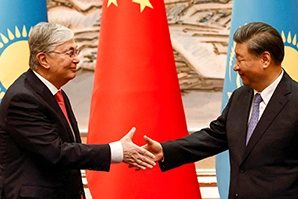
Xi Jinping calls for investments in roads, rails, harbours, energy and global trade – and a great deal of ideology and political and economic power. From this angle, the cooperation acronym of ‘BRICS’ for Brazil, Russia, India, China and South Africa looks like an extension of ‘BRI’ – the Belt and Road Initiative – China’s geo-economic configuration of the multi-polar world.
A GLANCE TO THE REARVIEW MIRROR
Overindulging past experiences has a strong tendency to block a somewhat balanced viewpoint to perceived mainstream fads. The Silk Road topic, broaching the issue of the vast Eurasian trade network as the ‘crossroads of cultures’, has always provided the ideal carpet woven with narratives of adventure and bravado, venture and exploration, boldness and perseverence, tragedy and serendipity, fate and destiny and – war and peace.
Over the centuries, the Silk Roads have evolved, linking an area of rich ethnic diversity, dramatic landscapes, and a cultural heritage of colourful traditions and awesome architectural highlights. The Silk Roads remind us of an example of early globalization, as traders, philosophers, missionaries, envoys took off to either direction, powerful armies fought their battles, and a network of spies kept an eye on the area and on one another.
The notorious ‘Great Game’ of the 19th and early 20th centuries saw a competition of both political intervention and archaeological exploration. They tell the history of exploration, including the destinies of outstanding European and Asian players of the ‘Great Game’, weaving the fabric storytelling lives from. Today, the revival of the ‘Great Game’ is in full swing – under different auguries, though, and with different political and commercial actors.
The old Silk Roads were multicultural, but, rather than being absorbed in a ‘melting pot’, they largely kept identities like the ingredients of a ‘salad bowl’. Watchtowers alongside the routes were not ivory towers for scholars in splendid isolation, often they served as lighthouses to show caravans the direction – caravans and voyagers, spearheaded by the likes of Marco Polo the merchant, Ibn Batuta the pilgrim, Xuanzang the monk, Zheng He the admiral.
Since the break-up of the Soviet Union, Silk Road Tourism was on a constant rise – despite chaotic conditions in the earlier years of the awkward age of the young ‘-stan’-countries, with civil war in Tadjikistan and Afghanistan, terrorist attacks in the Ferghana Valley, exacerbating effects of climate change, and an emerging US-Russian rivalry in ‘near-abroad’ countries, as Russia would refer to the Community of Independent States – still considering them as its geostrategic front court. There were a lot of opportunities given in those times, to build a ‘European common house’, but they were fatefully missed.
RAILWAYS CRISSCROSSING THE SILK ROADS
Following a period of stagnation, including the standstill caused by the Covid-19 pandemic, China identified the Central Asian states as first-hand clients to share the idea of rejuvenating the Great Silk Roads, with a focus on revamping and installing a network of road and railway connections unheard-of. Politicians could scarcely resist China’s proposition to build a commercial network (road, rail, sea, air) that is meant to connect places and people, towns and cities, airports and harbours, countries and continents.
Today over 3,600 high-speed trains connect 550 cities in China, keeping the world’s largest high-speed rail network covering over 46,000 kilometres of length (Wikipedia). And trains are gaining momentum in Central Asia: As part of BRI, a new railway connection is under construction between China, the Kyrgyz Republic and Uzbekistan (CKU), linking land-locked Kyrgyzstan with the Eurasian rail transport system – and cutting the transit line China-Europe short of almost 900 kms, with eight days less duration.
Another example: Uzbekistan’s „Central Asia Regional Economic Cooperation Corridor 2 (Bukhara-Miskin-Urgench-Khiva) Railway Electrification Project“ – CAREC adds “electrification, signalling and telecommunication, and traction power management systems to the recently built railway line between Bukhara, Miskin, Urgench, and Khiva. In terms of tourism development, CAREC will promote a regional approach to sustainable tourism development to maximize economic opportunities and to safeguard ecosystems.
Travelling the Silk Roads has always been demanding. Whoever today is lured by the tales of bold fearnoughts, yet who appreciates the comfort of guided tours have turned into travellers’ highlights: The Orient Silk Road Express links Tashkent – Dushanbe – Samarkand – Bishkek – Almaty, including Kyrgyzstan’s Lake Issyk-Kuls. Luxury accommodation is also growing providing all-inclusive luxury and services.
THE DELUSION OF HEAVENLY PEACE
There is a basic misunderstanding about a kind of automatism between trade and peace: The Silk Roads were by far not always peaceful, although they formed the arteries of trading goods, exchanging ideas and news, and spreading religions. Admittedly, amongst criminals there were serious international scientists and explorers, ‘children of their time’, though, in search of strange civilizations and their remnants as part of our joint cultural heritage. They were eager to learn about former peoples’ lifestyles and their wisdom. The famous scientist and voyager Alexander von Humboldt who travelled throughout Russia, put education and formation (‘Bildung’) to the top-agenda of humanness, in order to create “the basis of a free and happy society“.
In 2018, China’s Foreign Minister Wang Yi evoked the ‘mantra of the Silk Roads’. All should follow the “Silk Road spirit of peace and cooperation, openness and inclusiveness, mutual learning and mutual benefit and seek greater synergy“ in pursuit of “national renewal“ (Peter Frankopan, The New Silk Roads). Properly speaking, this is no less than the shiny template of a win-win scenario – intriguing words for curious political audiences. How about the deeds? – In the meantime there is some concern about the perceived “dichotomy … of an empire being built by design or by default“ (Frankopan) – a renewed China whose aim is to be “the principal advisor to all humanity“ (Henry Kissinger).
Twelve years after the evocative address of China’s President Xi Jinping in Astana, in September, 2025, representatives of the world’s main religions gathered in Kazakhstan’s capital. Justice, dignity and equitable evolvement have been identified as basic factors to create human unfolding, consolidation of peace and interreligious cooperation.
These factors are human rights, universally understood and formed in common sense, though not man-made. Common sense has become rare in today’s world in turmoil. Is it not what people feel missing after having bought in to so many failed attempts of secular blessings? More and more people sense that the pivot of a sound cultural development is trusting in God. Everything else will be, rather than peace, a mere truce, ending up in a bitter delusion of ‘Heavenly Peace’ (Peter Scholl-Latour).
25 years ago, the Kyrgyz Republic propagated the country’s ‘Silk Road Doctrine – the Diplomacy of the Great Silk Roads’, based on the ideas of humanism and tolerance. It was the time, when the concept of “our common house” went viral in capital cities of Europe and Central Asia, as economic cooperation started to bloom, to the better and to the worse. Marlboro advertisements showed a Red Army officer’s smoky indulgence to “Test the West“, and thousands of used-cars – German, Japanese and French – were flocking overland, direction East. Today, the Russian Army tests the West, while brand-new Chinese BYD e-cars are crammed on huge cargo ships bound oversees, direction West. While tourists use the Silk Roads as the backdrop for selfies, the cards of the new ‘Great Game’ are remixed.
By Max Haberstroh, Senior Trainer MTC
(Meaningful Tourism Centre),
International Senior Consultant
on Sustainable Tourism