
NATALLIA THOMPSON: LIFE IS CREATIVITY, A CONTINOUS
INTERACTION WITH THE WORLD AND WITH PEOPLE
tant things about yourself and your creative work. What is your creative and life credo and motivation for your creativity?
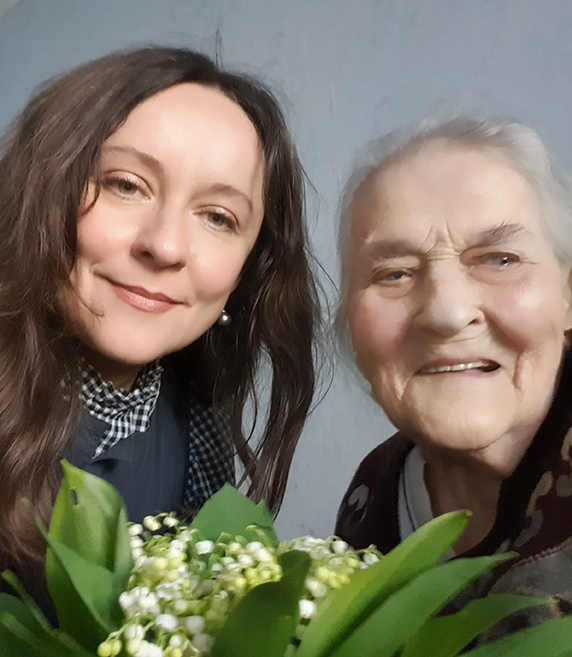
Natallia Thompson: I’d like to clarify that it’s not quite accurate to say I represent Belarus and the United Kingdom. I currently live on the island of Guernsey, one of the Channel Islands, which is a separate jurisdiction.
Moving here felt like a kind of return to childhood, when I spent all my holidays at my grandmother’s village home in Belarus. I was very fortunate to have that magical world — with its old traditions, handwoven towels, the warm ledge on the stove, and a corner in the choir loft where my grandmother used to sing on Sundays — in a church that never closed, even during the toughest times for religion, thanks largely to the priest and my grandmother, who served as the church warden.
And now, many years later, here on the island, I’ve been able to catch the scent of birch trees after the rain — just like back home in Belarus.
My creative credo, I suppose, is about being here and now — creativity and life are inseparable; life is creativity, a continuous interaction with the world and with people.
OCA: How did you choose your path and who is your role model in the creative field or in life?
NT: I must admit that I have yet to create a tangible and significant creative legacy. My current project is called Rhymes of Everyday Life. It’s a kind of mosaic made up of a little bit of everything: poems, translations, inspiring conversations, and travels.
The most important example in my life is my mother — loving unconditionally and without any context, unyieldingly strong and infinitely gentle.
In the hardest of times, her presence in my life saved me, inspired me, protected me, and helped me grow wings.
OCA: What is your main achievement(s) or positive impact on the world in 2024–2025?
NT: It’s a lovely feeling to realise that I’ve inspired those close to me — some to perform music, others to write poems or paint, and some even to indulge in sweet little quirks that add colour and joy to everyday life.
I’ll keep on working my magic.
OCA: What is the main feature that makes you and your art/work unique?
NT: Perhaps it’s easier to see from the outside. Those who have read my poems often appreciate their “lace-like lightness,” vivid imagery, and multi-dimensionality.
I also simply adore fairy tales and love creating a magical, joyful atmosphere — otherwise, life feels very sad.
For example, in one of my older poems, which I almost forgot because I hadn’t written it down, there are these lines: “Ah, inventing a fairy tale is not hard — if only one could learn to live within it! Noticing golden grains of happiness in a cracked nutshell and the thoughtful tinkling of raindrops on an indifferent lunar wheel…”
I love watching the thoughtful smiles bloom on the faces of my listeners.
OCA: Please tell us about the events or projects of the Eurasian Creative Guild (London) and projects you have already participated in and how does ECG influence your creativity and success in your work?
NT: The very first event I attended at the invitation of the Guild — with truly life-changing consequences for me — was a creative evening with Gennady Gorovoy.
In him, I found a wonderful friend and source of inspiration; thanks to that, I even dared to take part in the anniversary festival in Kazakhstan.
OCA: How do you think the creative professions have changed and how has the role of art in the development of the world changed in the face of modern realities?
NT: It’s natural that “everything flows, everything changes.” However, in my view, art — despite its sensitivity to the influences of events and moods — serves as a kind of guarantee of stability and a binding force across layers of time and space.
Here, I would like to share my translation of The Girl from the Tavern by Novella Matveeva — a text that inspired me more than fifty years after the original was released, and thousands of kilometres away from the place where this song was born.
Please, do not be afraid of my love-
It is not at all scary:
For loving heart it is enough
To see you happy and merry.
And when you’re out to see Her
Or maybe just for a walk,
For loving heart it was enough
To see your coat on a wall.
When you decided to leave and go
To look for a new life,
To see this lonely hook on a wall
Was enough for a loving heart.
Days fly, and the years change,
Rain and wind and fog –
There is a tragedy in my home:
Even the hook is gone.
Fog and wind and noise of the rain –
Days fly, and the years go.
For loving heart it was enough –
The familiar mark on the wall.
Painter’s hand on the scruffy wall –
Here came final loss…
For loving heart it is enough
To remember, how all it was.
So, do not be afraid of my love –
It is not at all scary:
For loving heart it is enough
To see you happy and merry.
Timpani joy and violin cry
Floating in warm air,
Like fading trace of undying love
That lives in my heart forever…
OCA: What would you wish for the members of the Guild and other creative people who are just starting their careers?
NT: Don’t be afraid to start, don’t hesitate to show yourself, and never doubt the value and importance of your creations — it is in the creative process that the very beauty that will save the world is born.