
SUSTAINABLE DEVELOPMENT IS A NATIONAL STRATEGIC CHOICE
Sustainable development in Kazakhstan is not an abstract policy aspiration. It is a deliberate strategic choice that shapes our domestic reforms, our regional engagement in Central Asia, and our partnerships with the European Union.
As emphasised by President Kassym Jomart Tokayev at the National Kurultai–2026, sustainability forms the foundation of a renewed social contract grounded in justice, responsibility and long-term vision. In today’s environment of geopolitical volatility, economic fragmentation and accelerating climate risks, development must be measured not only by growth, but by resilience, inclusiveness and institutional strength.
For Kazakhstan, the transition towards sustainable development represents a shift from a predominantly resource driven model toward diversified, innovation based and environmentally responsible growth. Over more than three decades of independence, our country has built a strong economic foundation. The next stage requires qualitative transformation: strengthening manufacturing, modernising agriculture, expanding transport and logistics corridors connecting Asia and Europe, and accelerating digital transformation.
This transformation has both a regional and a European dimension and sustainable development is the bridge between regions. Central Asia is becoming increasingly interconnected. Stability, water security, climate adaptation and economic diversification are shared regional challenges. At the same time, the European Union is one of Kazakhstan’s largest trade and investment partners. The EU accounts for a significant share of foreign direct investment in Kazakhstan, and our Enhanced Partnership and Cooperation Agreement provides a comprehensive framework for cooperation across trade, green transition, transport connectivity and governance reform.
Kazakhstan’s commitment to achieving carbon neutrality by 2060 aligns with the European Union’s Green Deal objectives. We are expanding renewable energy capacity and improving energy efficiency, while exploring opportunities in green hydrogen, critical raw materials and sustainable supply chains. Belgium and the broader EU are key partners in advancing technology transfer, regulatory standards and green finance instruments.
Climate change and water security further underscore the importance of international cooperation. The tragedy of the Aral Sea remains a reminder that environmental mismanagement transcends borders. Kazakhstan actively promotes regional water diplomacy in Central Asia and supports coordinated approaches consistent with international best practice. European expertise in water management, circular economy and environmental governance represents a valuable contribution to these efforts.
Transport and connectivity also illustrate the convergence of interests. The development of the Trans Caspian International Transport Route strengthens links between Europe and Asia, enhances supply chain resilience and contributes to diversified trade flows. For the European Union, reliable connectivity through Central Asia is not only an economic opportunity, but a strategic investment in stability and partnership.
Equally important is the human dimension. Sustainable development ultimately depends on education, innovation and societal trust. Kazakhstan is investing in human capital, digital literacy and scientific research, while deepening academic and cultural exchanges with European partners. The strengthening of people-to-people ties between Kazakhstan, Belgium and the wider EU contributes to mutual understanding and long-term cooperation.
From my perspective as Ambassador of Kazakhstan to the Kingdom of Belgium and the European Union, sustainable development is, therefore, not confined to domestic policy. It is the organising principle of our external engagement. It defines how we approach investment, climate dialogue, trade diversification and regional cooperation.
Thirty-five years after independence, Central Asia is entering a new phase of consolidation and confidence. Kazakhstan’s strategic commitment to sustainability reflects political maturity and a clear understanding that national modernization and regional stability are inseparable from international partnership.
By aligning domestic reform with responsible regional leadership and constructive engagement with the European Union, Kazakhstan contributes to building a more resilient, interconnected and forward-looking Eurasian space. Sustainable development, in this sense, is not only a national choice. It is a shared responsibility and a common opportunity.
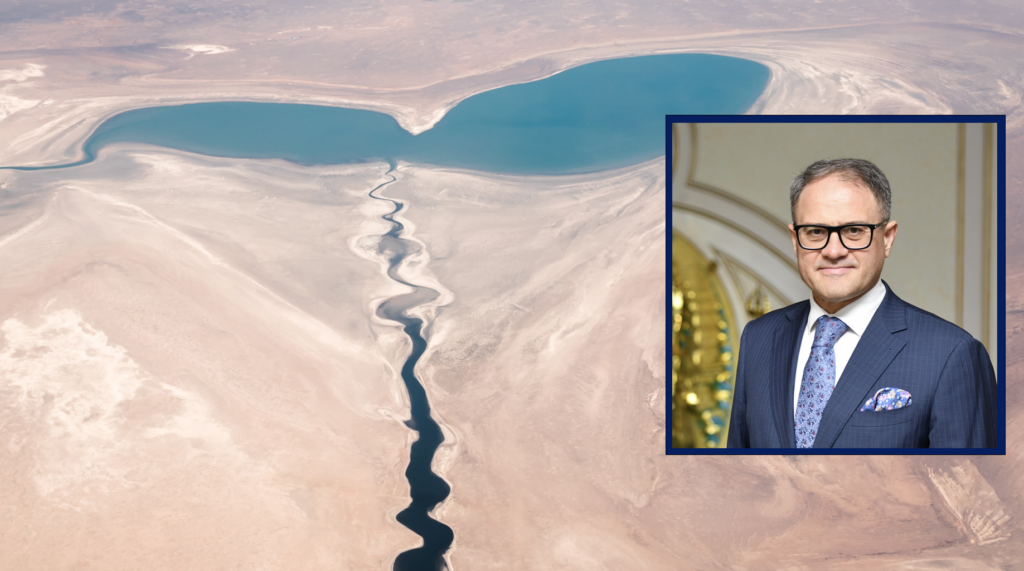
Roman Vassilenko
Ambassador of the Republic of Kazakhstan
to the European Union