
INTERSECTING INTELLIGENCE AND CREATIVITY IN THE AGE OF TECHNOLOGY
“Technology does not create depth – it merely reveals the level of human thinking.”
As sustainable development is increasingly shaped not only by environmental factors but also by intellectual and technological ones, a new type of leadership is emerging – leaders capable of rethinking the future of education. Elena Savchenko, Doctor of Technical Sciences, Professor, and Rector of the International University of Kyrgyzstan, is one of such figures.
Her work focuses on integrating artificial intelligence into educational systems and shaping new models of thinking required for life in the digital era. Operating at the intersection of science, management, and creative practice, Savchenko views AI not merely as a tool for analysis, but as a new language through which humans engage with the world. At the core of her approach lies a human-centric model in which technology enhances human potential and becomes an integral part of sustainable societal development.
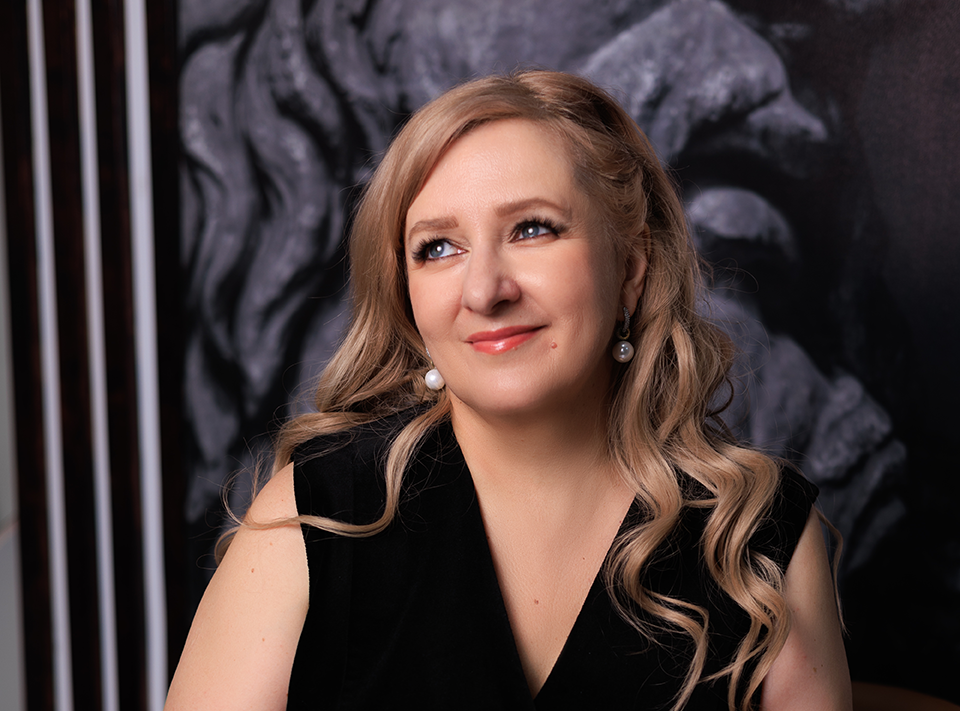
OCA Magazine spoke with Elena Savchenko about how artificial intelligence is transforming not only education but also the way people think, why the future belongs to an integrative mindset that combines analytics, intuition, and creativity, and what role technology plays in shaping sustainable societies.
OCA Magazine: Your image combines intellectual rigor with creative depth, but how would you describe yourself – a manager, a researcher, or an artist?
Elena Savchenko: I do not separate these roles, because in today’s world they no longer exist independently. For me, they are parts of a unified whole that reinforce one another and create a more holistic perception of reality. Management requires systems thinking and responsibility; research demands depth and analytical ability; creativity calls for freedom and the capacity to move beyond the obvious.
Today, it is no longer possible to be purely rational or purely intuitive. The world requires integrative thinking, where logic and feeling, structure and freedom come together. It is precisely at this intersection that ideas emerge – ideas that carry meaning and long-term value.
OCA: When did creativity first enter your life?
ES: Creativity has always been part of my life, although for a long time it remained unexpressed. A professional environment fosters discipline, precision, and a results-oriented mindset – and this is important. But over time, I realised that this alone was not sufficient for inner development. It was a gradual awareness: without creativity, it is impossible to move forward – either as an individual or as a leader. With the emergence of artificial intelligence, I saw how these two dimensions could converge. AI became a new language for me – a way to express ideas, states, and meanings.
OCA: How have technologies influenced your perception and creative process?
ES: Technology has significantly reduced the distance between an idea and its realisation. What once required time, resources, and often faced technical limitations has now become more direct and accessible. This opens up new opportunities, but at the same time demands a higher level of awareness. Technology does not create depth in itself – it simply reveals the level of thinking and inner content of the person using it. The same tool can produce entirely different outcomes depending on who is working with it.
OCA: What do you aim to convey through your work?
ES: For me, it is important to convey a state. Not just to create a visually appealing image, but to evoke an inner response – a sense of stillness, depth, strength, or transformation. I want my work to pause the viewer, to create a moment for reflection and feeling. This, for me, is the value of creativity – as a form of communication at a deeper level, where words are no longer the primary medium.
OCA: AI is increasingly becoming a tool for creativity. How do you work with it in your projects?
ES: For me, AI is a space for exploration and expression. It allows one to move beyond familiar forms and to see ideas in new visual and conceptual dimensions. In my projects, including the creation of visual imagery, I use AI as a medium of dialogue: I define direction and meaning, while the technology helps to reveal them more precisely and deeply. It is not a replacement for the creative process, but its extension. It is a way of integrating analytical thinking and intuitive perception, where technology acts as a conduit rather than a source of meaning.
OCA: Does creativity influence your management decisions?
ES: Yes, significantly. Creativity changes the very way one thinks – it expands perception and allows for a wider range of solutions than purely analytical approaches would permit. In management, this manifests as the ability to sense trends, anticipate developments, and make decisions under conditions of uncertainty. Today, a leader needs balance: analytics, intuition, and contextual awareness.
OCA: How do you see the role of humans evolving in an era of rapid technological development?
ES: I do not believe that technology should replace humans. Its purpose is to expand human capabilities, freeing up space for more complex tasks: thinking, creativity, and decision-making. The will future belong to those who can integrate intellectual, technological, and inner dimensions. Routine functions will be automated, but the ability to create meaning and take responsibility will remain uniquely human.
OCA: What would you say to those who remain cautious about technology today?
ES: What one should fear is not technology, but stagnation. The world is changing rapidly, and ignoring these changes is no longer an option. It is not enough to just use technology – we must understand its role. The real question today is not about technology itself, but about a person’s willingness to evolve alongside it.
Based on an interview by Raza Syed