
THIRTY FIVE YEARS ON: DOES THE FOUNDING FATHERS’ MODEL OF THE POST-SOVIET STATES STILL WORK?
The collapse of the Soviet Union is rarely seen as a deliberate project. Rather, it is viewed as a crisis or a chain of events that spiralled out of control. Yet, when the early years of independence across the post-Soviet space are examined through the lens of sustainable development, it becomes clear that this period laid down the core governance models, economic strategies and political instincts that continue to shape the region to this day.
The figure from whom this discussion inevitably begins is Mikhail Gorbachev. His policies of “perestroika” and “glasnost” were not intended to dismantle the system, but they created the space in which the Soviet republics were able, for the first time, to act independently. Within this window of opportunity, new political actors emerged – Boris Yeltsin in Russia, Leonid Kravchuk in Ukraine, Nursultan Nazarbayev in Kazakhstan, and Islam Karimov in Uzbekistan. Gorbachev was not the architect of the collapse, but he was the architect of the conditions that made it inevitable. What followed were distinct national trajectories. It is precisely here that the differences between regions become particularly revealing.
CENTRAL ASIA: STABILITY AS A GOVERNING
PHILOSOPHY
In Central Asia, the first leaders of the newly independent states – Nursultan Nazarbayev, Islam Karimov, Saparmurat Niyazov, Askar Akayev and Rahmon Nabiyev (later Emomali Rahmon) – were almost without exception drawn from the Soviet nomenklatura. They inherited not only administrative structures but also the logic of governance itself: vertical power, prioritisation of control and a cautious approach to change. Their core decision was broadly the same: a preference for stability over radical reform.
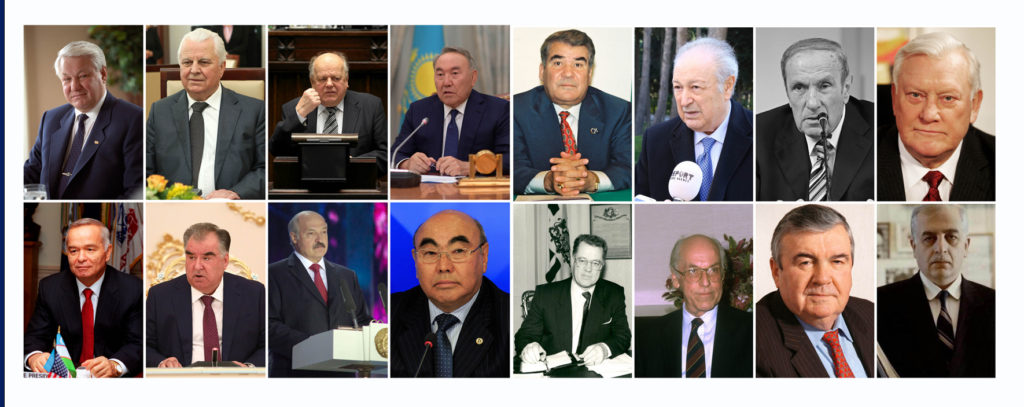
In Kazakhstan, Nursultan Nazarbayev constructed a model of “managed modernisation”: a gradual transition to a market economy combined with strong presidential authority. Economic liberalisation was accompanied by political centralisation – a compromise that ensured both investment inflows and relative stability.
In Uzbekistan, Islam Karimov pursued a more closed model: tight control, limited external influence and a slow pace of transformation. This helped the country avoid the economic shocks of the 1990s, but it also delayed institutional development. Meanwhile in Turkmenistan, Saparmurat Niyazov established an overtly personalist system, in which the resilience of the state became directly tied to the figure of the leader.
Kyrgyzstan, under Askar Akayev, initially attempted a path of liberalisation, yet weak institutions led to chronic political instability. In Tajikistan, where Rahmon Nabiyev became the first president, statehood emerged in the context of civil war, and the subsequent model under Emomali Rahmon entrenched the primacy of security over reform.
Despite their differences, the overarching vector was clear: the state as the principal architect of development and guarantor of order.
THE SOUTH CAUCASUS: INDEPENDENCE THROUGH CRISIS
While Central Asia pursued stability, the South Caucasus forged its statehood through conflict. In Armenia, Levon Ter-Petrosyan came to power during the war over Nagorno-Karabakh. This shaped national priorities: security, resource mobilisation and political consolidation. Economic and institutional development continued, but always in the shadow of conflict.
In Azerbaijan, following early instability – from Ayaz Mutallibov to Abulfaz Elchibey – Heydar Aliyev emerged as the key figure, establishing a durable model built on a strong vertical of power, reliance on the oil and gas sector, and an active foreign policy.
In Georgia, Zviad Gamsakhurdia began with a wave of nationalist mobilisation, but the country quickly descended into internal conflict. Later, under Eduard Shevardnadze and then Mikheil Saakashvili, attempts were made to stabilise and reform institutions.
Unlike Nursultan Nazarbayev or Islam Karimov, who prioritised control and continuity, the leaders of the Caucasus operated in an environment of constant turbulence. This produced systems that were more dynamic, yet also more fragile.
EASTERN EUROPE AND RUSSIA: A RAPID BREAK WITH THE PAST
In Russia, Boris Yeltsin opted for a radical transformation: privatisation, liberalisation and the dismantling of the Soviet economic system. Ukraine, under Leonid Kravchuk, and Moldova, under Mircea Snegur, pursued more cautious paths, balancing reform with the need to preserve stability.
Belarus represents a distinct case: following the collapse of the USSR, the country was de facto led by Stanislav Shushkevich as head of parliament, while the presidential system was only later formalised in 1994 under Alexander Lukashenko, who chose to retain a strong role for the state.
The Baltic states – Lithuania (Algirdas Brazauskas), Latvia (Guntis Ulmanis), and Estonia (Lennart Meri) – moved swiftly towards integration with Western institutions, a decision that defined their long-term trajectory.
Yet even in Russia, a subsequent shift toward a more centralised model took place. In this sense, its trajectory partially converged with that of Central Asia: the state once again became the dominant actor.
HAS THE VECTOR CHANGED?
More than three decades on, the central question remains: has the course set by the first leaders changed?
In Central Asia, the answer is largely no. The models established by Nursultan Nazarbayev, Islam Karimov and Emomali Rahmon have certainly evolved, but not fundamentally transformed. Kazakhstan, following Nazarbayev’s departure, demonstrates attempts at gradual reform: the rhetoric of change has intensified, yet the core model – a strong state combined with controlled liberalisation – remains intact. Uzbekistan under Shavkat Mirziyoyev stands out as perhaps the most notable example of evolution. The economy has opened, business climate has improved, and foreign policy has become more proactive. However, these changes are still driven from the top, without a fundamental redefinition of the state’s role, while the consequences of rapid growth remain a subject of debate. Kyrgyzstan continues to function as a laboratory of political turbulence, where frequent changes of power do not translate into institutional consolidation. Tajikistan and Turkmenistan maintain highly conservative models.
In the Caucasus, trajectories remain more fluid, yet fundamental challenges – security concerns and dependence on external factors – persist. This is particularly evident today in the context of a global redistribution of influence among major geopolitical actors.
In Russia, Boris Yeltsin’s initial liberal course has been replaced by the consolidation of a vertical power structure, once again aligning the model with that of a managed state.
In other words, the vector set by the first presidents has not so much changed as adapted. The core paradigm – the prioritisation of stability over competition – continues to dominate.
THE COST AND LIMITS OF STABILITY
The emphasis on stability provided the region with time and governability. At the same time, it constrained institutional development, reinforced dependence on individual leadership, and slowed economic diversification.
Today, sustainable development requires a different balance – between control and competition, between stability and flexibility.
In this context, the legacy of Mikhail Gorbachev, Boris Yeltsin, Nursultan Nazarbayev, Islam Karimov, Levon Ter-Petrosyan and other “founding fathers” becomes a defining question:
Is it the foundation for the next stage – or its limit?
by Marat Akhmedjanov