
A NEW-GENERATION UNIVERSITY:
THE TRANSFORMATION OF SCIENCE AT KAZNU
In today’s era of global change, universities are no longer merely institutions for the transmission of knowledge. The world’s leading universities are transforming into intellectual hubs where breakthrough technologies emerge, digital agendas are shaped, and the foundations of economic resilience are established. Kazakh National University named after Al-Farabi, ranked 166th in the QS World University Rankings, clearly demonstrates how the country’s oldest university can become a leader in technological modernization.
Under Rector Zhanseit Tuimebayev, KazNU has undergone a profound transformation, responding to the national agenda to strengthen human capital and integrate artificial intelligence into all spheres of life.
RESEARCH UNIVERSITY
The university’s designation as a research university in 2022 marked the starting point of a major transformation. Today, KazNU’s scientific ecosystem includes eight research institutes, thirty-nine research centres, and more than 140 laboratories. Together, they host approximately 400 research projects, creating a highly concentrated environment for scientific inquiry and applied innovation.
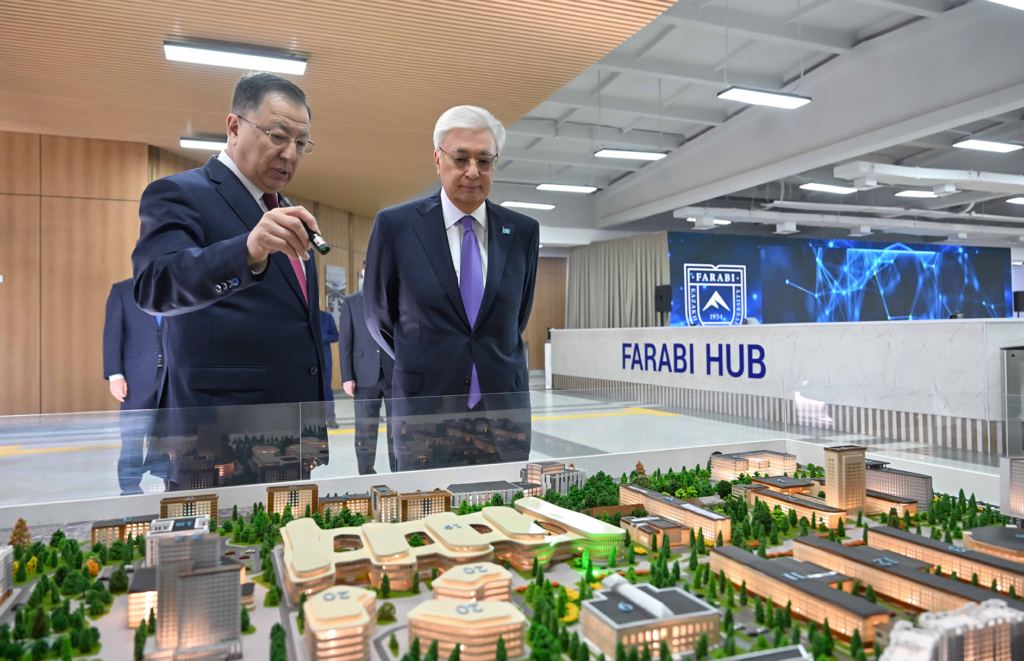
Investment has been central to this growth. In preparation for the university’s 90th anniversary, approximately USD 110 million was directed into scientific infrastructure, enabling the creation of more than fifty state-of-the-art laboratories and innovation platforms.
A central component of this ecosystem is the Farabi Hub High Technology Centre, one of the university’s largest innovation clusters, covering nearly 7,000 square meters and supported by investments totaling USD 20.55 million. The centre hosts joint projects with global technology leaders, including ZTE, Ericsson, CNRS, Huawei, Samsung, NVIDIA, and BASF.
KazNU also established the FARABI ROBOTICS Engineering Competence Centre, specializing in industrial robotics and Industry 4.0 technologies. Supported by a USD 1 million World Bank grant, the centre focuses on training and retraining highly qualified specialists. The platform provides opportunities for studying, testing, and demonstrating robotic solutions for industrial processes and startup projects.
To strengthen international integration in robotics and digital technologies, KazNU established the International Institute of Digital Technologies and Robotics. The decision to create the institute was made during the Kazakhstan–China Business Council meeting in Beijing with the participation of President Kassym-Jomart Tokayev. The institute includes educational and research laboratories, multimedia classrooms, and experimental facilities equipped with industrial and service robots.
Another strategic initiative is the Innovative Unmanned Aviation Centre, established jointly with Chinese partners from Aerial Solutions LLC and Northwestern Polytechnical University (Xi’an). This is the first facility of its kind in Central Asia, dedicated to the development of unmanned aerial vehicles (UAVs), aerospace technologies, testing infrastructure, and dual education programs.
The Scientific Centre for Sustainable Development and Rational Environmental Management conducts comprehensive research on the natural-resource, socio-economic, and environmental systems of Western Kazakhstan. The centre operates within the framework of the Ministry of Science and Higher Education’s program “Sustainable Development of the Natural-Economic and Socio-Economic Systems of Western Kazakhstan in the Context of Green Growth.” In late 2023, geographers from the faculty secured a mega-grant from the Science Committee worth USD 7.6 million.
KazNU is also home to the PolyU-KazNU Centre for Sustainable Development of Central Asia, which systematically implements interdisciplinary research projects focused on regional sustainability, social processes, and tourism development. The research is conducted through joint teams from Al-Farabi Kazakh National University and The Hong Kong Polytechnic University (PolyU).
In 2024, the Kazakhstan–China Joint Laboratory of Remote Sensing Technologies and Their Applications was established as part of the implementation of President Tokayev’s directives on strengthening university science and research infrastructure. The project attracted an almost USD 2 million grant from the Xinjiang Institute of Ecology and Geography of the Chinese Academy of Sciences. The laboratory focuses on climate change, droughts, land degradation, and water scarcity in Central Asia.
Researchers at the laboratory currently conduct comprehensive assessments of environmental and natural hazards using remote sensing data, unmanned aerial vehicles, high-precision LiDAR surveys, and artificial intelligence methods. Among its achievements is the development and testing of an integrated scientific approach to assessing and managing landslide risks in foothill regions.
Another strategic initiative is the Farabi Chem Science cluster, supported by investments of USD 6.5 million. The cluster comprises nine laboratories conducting research in ecology, energy, medical chemistry, petrochemistry, and materials science. Research ranges from analytical chemistry to electrochemical production technologies, nanomaterials, polymeric and inorganic materials, pharmaceuticals, and medical equipment. Scientists are developing innovative products, from fire-resistant coatings for metal and wooden structures to medical hydrogels and advanced wound dressings based on synthetic and plant-derived materials.
The International Research Centre for Central Asian Studies “ZooStan” at KazNU was established in May 2024. The agreement to create the laboratory was signed between France’s leading scientific organization, the National Centre for Scientific Research (CNRS), and Al-Farabi Kazakh National University. The French government allocated USD 1.05 million to support the initiative.
Recent research conducted by the international ZooStan laboratory has significantly expanded our understanding of the early historical development of Central Asia. One of the most notable achievements of the 2025 field season was the discovery of fourteen additional archaeological sites featuring ancient rock art.
Another key institution is the Brain Institute, established with USD 5.7 million in investment. It advances both fundamental and applied neuroscience, with a focus on translating findings into practice — particularly in the early diagnosis and prevention of neuropsychiatric disorders.
In partnership with the Ministry of Energy, KazNU has also established an Industry Technology Competence Centre bringing together twelve R&D divisions, covering areas from hydrocarbon processing and hydrogen energy to cybersecurity and AI.
At the same time, KazNU is moving to the forefront of next-generation science. In 2026, the university initiated the establishment of the Kazakhstan–Singapore Centre for Quantum Technologies. Its activities encompass quantum computing, quantum communications, sensing technologies, and advanced materials—key areas in the emerging global technological competition.
INTERNATIONAL INTEGRATION
AND A GLOBAL ACADEMIC NETWORK
Internationalisation has become a strategic priority. KazNU has built partnerships with more than 700 universities worldwide and has evolved into a major educational hub for Central Asia. Today, more than 7,000 international students from 54 countries study at Al-Farabi Kazakh National University, creating a multicultural academic environment and strengthening the global competitiveness of its graduates.
KazNU is expanding its international presence through educational centres in Bishkek, Istanbul, and Omsk, and hosts branches of leading institutions including the National Research Nuclear University MEPhI and China’s Northwestern Polytechnical University — enabling specialist training across fields from nuclear physics to advanced materials science.
ARTIFICIAL INTELLIGENCE
AND DIGITAL TRANSFORMATION
Digitalisation has become a key driver of the university’s modernisation. At KazNU, artificial intelligence has evolved from a standalone subject into a foundation of both teaching and research.
Programmes in Big Data, intelligent systems, robotics, and analytics are now offered across all levels of study, from undergraduate to doctoral. AI courses run across all faculties, from introductory modules to advanced topics such as neural networks and deep learning.
At the heart of this transformation is Central Asia’s most powerful supercomputer — a USD 23 million investment delivering 2,000 TFLOPS of performance, supported by 400 CPU servers and 30 GPU servers.
The supercomputer is being used to develop a large Kazakh-language model (LLM) — a step toward digital sovereignty — and supports climate modelling in collaboration with Kazhydromet, reducing calculations that once took weeks to a matter of hours.
Generative AI technologies, online proctoring systems, and intelligent digital assistants have also been integrated into the educational process.
Al-Farabi Kazakh National University is demonstrating a sustainable model that combines academic tradition, cutting-edge technology, and global ambition.
The university is not merely adapting to change — it is shaping the future of science and education across the region. Its focus on artificial intelligence, digital transformation, international cooperation, and research commercialisation continues to strengthen its position as one of Eurasia’s leading intellectual centres.
In an era of rapid global transformation, universities like KazNU are key drivers of economic, scientific, and social progress — and KazNU is moving confidently in that direction.