
SUSTAINABLE DEVELOPMENT AFTER THE END OF THE FAMILIAR WORLD: WHAT UNIVERSITIES MUST LEARN AGAIN
In the spring of 2026, I attended two international conferences on sustainable development and the role of universities. The first was the GREEN.DIGITAL.SMART Forum 2026 in Dushanbe, organised by the International University of Tourism and Entrepreneurship of Tajikistan. The second was SOCIAL WORK IN ACTION: Interdisciplinary and Global-Informed Strategies for Sustainable Development in Central Asia, hosted by Al-Farabi Kazakh National University in Almaty.
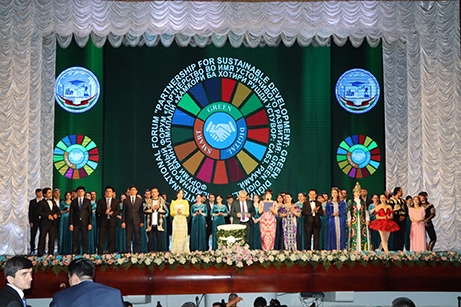
Though both events shared the same overarching theme, they differed in atmosphere. The Almaty conference followed a traditional academic format, focused on research and scholarly findings. The Dushanbe forum was considerably more diverse and interdisciplinary, extending beyond education and science into technology, digitalisation, tourism, environmental issues, and human capital development — with open discussions that were willing to address difficult and uncomfortable questions.
The most significant outcome of both conferences was not any individual presentation, but the questions they raised — questions increasingly heard across the professional community.
Virtually all participants agreed on one point: universities are attempting to integrate the UN Sustainable Development Goals into their operations — but in a world radically different from the one for which those goals were designed.
The SDGs were adopted in 2015 — a world before COVID-19, before widespread AI, before today’s level of geopolitical tension and institutional crisis. Digital transformation was only beginning to accelerate, and most people had no daily interaction with AI.
That world no longer exists. Yet paradoxically, the goals themselves have become more important than ever.
Humanity finds itself in a state of growing fragility. Social polarisation is increasing, labour markets are changing, new forms of inequality are emerging, and technology is advancing faster than society can fully comprehend its consequences. The question is no longer whether the SDGs remain relevant. The question is how they should be reinterpreted for a new reality — and it is here that universities bear a particular responsibility.
Traditionally, a university was an institution for generating knowledge and preparing qualified professionals. In the twenty-first century, that is no longer sufficient. The modern university has become a complex ecosystem that must engage simultaneously with students, parents, employers, government bodies, international organisations, and local communities. Society increasingly expects universities not merely to produce trained specialists but to nurture individuals capable of adapting to uncertainty, using AI without abandoning critical thinking, and navigating a rapidly changing world. Over the next decade, this expectation will largely determine which universities survive and which thrive.
Universities can no longer exist in isolation. Engagement with society has moved from a secondary activity to a fundamental condition of institutional survival.
A second challenge is the erosion of boundaries between the physical and digital worlds. Artificial intelligence, generative technologies, and deepfakes are reshaping our understanding of reality. Anxiety disorders and burnout are rising, in part because trust in institutions — schools, governments, media — is declining. Universities face an urgent version of this challenge: not just how to integrate AI into education, but why, and on what terms.
We now consume more information in a day than previous generations encountered in decades. Simply informing an audience is no longer enough — motivating it has become nearly impossible. What is required instead is the communication of meaning. Why does this university exist? Why should a student choose to study here? Why should society continue to fund science? These questions demand genuine answers, not institutional boilerplate.
The challenge for many universities is that they confuse improvement with impact. A well-designed campus, modern equipment, and new laboratories are valuable — but they are improvements, not transformations.
True impact begins when a university’s activities visibly and tangibly improve people’s lives. The history of science offers countless examples. Students are often taught that Al-Khwarizmi is the father of algebra. Far less frequently mentioned is that his famous work, Al-Kitāb al-Mukhtaṣar fī Ḥisāb al-Jabr wa al-Muqābala, was largely devoted to legal and spiritual matters and focused on a highly practical issue: the distribution of inheritance. The complexity of legal and property relations at the time required the development of entirely new mathematical tools.
Society expects universities to solve concrete problems. But for that to translate into respect and trust, a handful of publications and a formal media presence are not enough. Trust is built through long-term cultural practices: sustained participation in public discourse, active alumni communities, and ongoing engagement with business, government, and civil society.
In essence, universities must create their own ecosystems of trust.
This is why public communication is no longer optional — it is a strategic resource. The university of the future will compete not only for students and grants, but for attention, trust, and the right to help shape the future. That requires continuous, meaningful dialogue with society.
The most important lesson from the sustainable development discussions of 2026 may be this: sustainability does not begin with reports or rankings. It begins with the ability to create meaning, bring people together, and explain to society — convincingly, compellingly — why education remains one of its most vital institutions.
by Taina Kaunis,
Advisor to Silk Road Media