
Higher education was once built around libraries, dependent on lecture halls filled with the lecturer’s voice, and handwritten notes, and the slow discipline of understanding. Today, when almost everything has shifted online, students increasingly move between screens, prompts, instant summaries, and AI-generated responses, reflecting not merely a technological transition, but a deeper transformation in how human learning itself is being experienced.
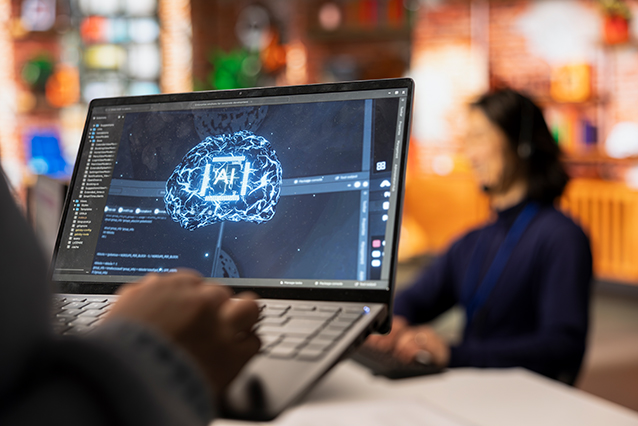
Artificial Intelligence has almost taken over higher education at large. The channel of communication from black board to white board, to Projectors, TV screen have upgraded the classroom setting in around twenty years, though the AI’s rapid acceptance is visible in students learning. Students swiftly integrated AI support in the classroom starting from recording lectures, notes then writing assignments and reflective learning. This has completely transformed the education system.
Ministries to monasteries are moving towards the AI’s verdict of success and growth. The Universities have been forerunner in adapting and training students with the recent technologies to match industry’s prime requirement of Artificial Intelligence based skillset.
Higher Education is advancing with generative artificial intelligence, and Simulations. Students have adapted technology quickly by devising solutions for assignments through intelligent prompts, reading books through instant summaries, and preparing presentations with automated reflections.
For generations, affluent societies have always outsourced physically demanding and time-consuming tasks in pursuit of convenience and efficiency. Similarly, Nowadays, students have enhanced their convenience gradually by outsourcing their cognition to Artificial Intelligence.
In the Higher education environment, the ever-changing technology has rampantly dominated the utilization of physical books, boards and teaching pedagogies, with its increasingly optimized speed, convenience, and instantly generated accurate outputs.
Technology is empowering us with multiple tools to acquire more in less time. However, with the overutilization of such supportive AI tools, the learners may slowly become unfamiliar with the real-world challenges and intellectual discomfort through which deep cognition, creativity, independent thought, and reflective maturity are developed.
Emerging concern is not about the successful implementation and precise application of AI in classrooms, but the deeper question of whether, in the current age of cognitive outsourcing are we gradually losing the very cognitive struggle through which the learning, reflection, and individual thought were developed. In the race toward technological growth and adaptation are we optimizing learning while weakening cognition by losing the space of reflective struggle? If education is to be seen only as an output driven process, then the duration of degrees may eventually become merely a process to delay employment rather than a meaningful journey of intellectual and human growth.
The utmost modernization of higher education is no longer optional but industry’s global strategic necessity. The rapid expansion of technology-enabled education is the reflection of how institution and nations are preparing for the future. This can be seen from the strategic vision of smart education and innovation ecosystems of United Arab Emirates to Europe’s emphasis on digital transformation and intercultural learning, and India’s rapid expansion of technology-enabled learning ecosystems.
The uncertainties within the real conversations remain a necessary part of developing cognitive maturity. This is closely associated with emotional intelligence, disagreement, observation, teamwork, failure, cultural immersion, and human discomfort. This is where experiential learning becomes critically important for future readiness.
Immersion within varied cultural environments, industry interactions, community engagement, collaborative problem-solving, and human-to-human experiences continue to shape qualities such as empathy, adaptability, ethical judgment, emotional intelligence, and reflective maturity which no prompt may assist us with. While technology may accelerate access to information and bring the world closer through our devices, authentic human experiences continue to shape real cognition.
by Dr. Amit Verma,
Ph.D., IIM-A,
Assistant Professor,
Symbiosis International University, Dubai, UAE
Symbiosis International (Deemed University), Pune, India