RETURN TO THE GREAT STEPPE

One family’s return to Kazakhstan to visit the birthplace of their ancestor

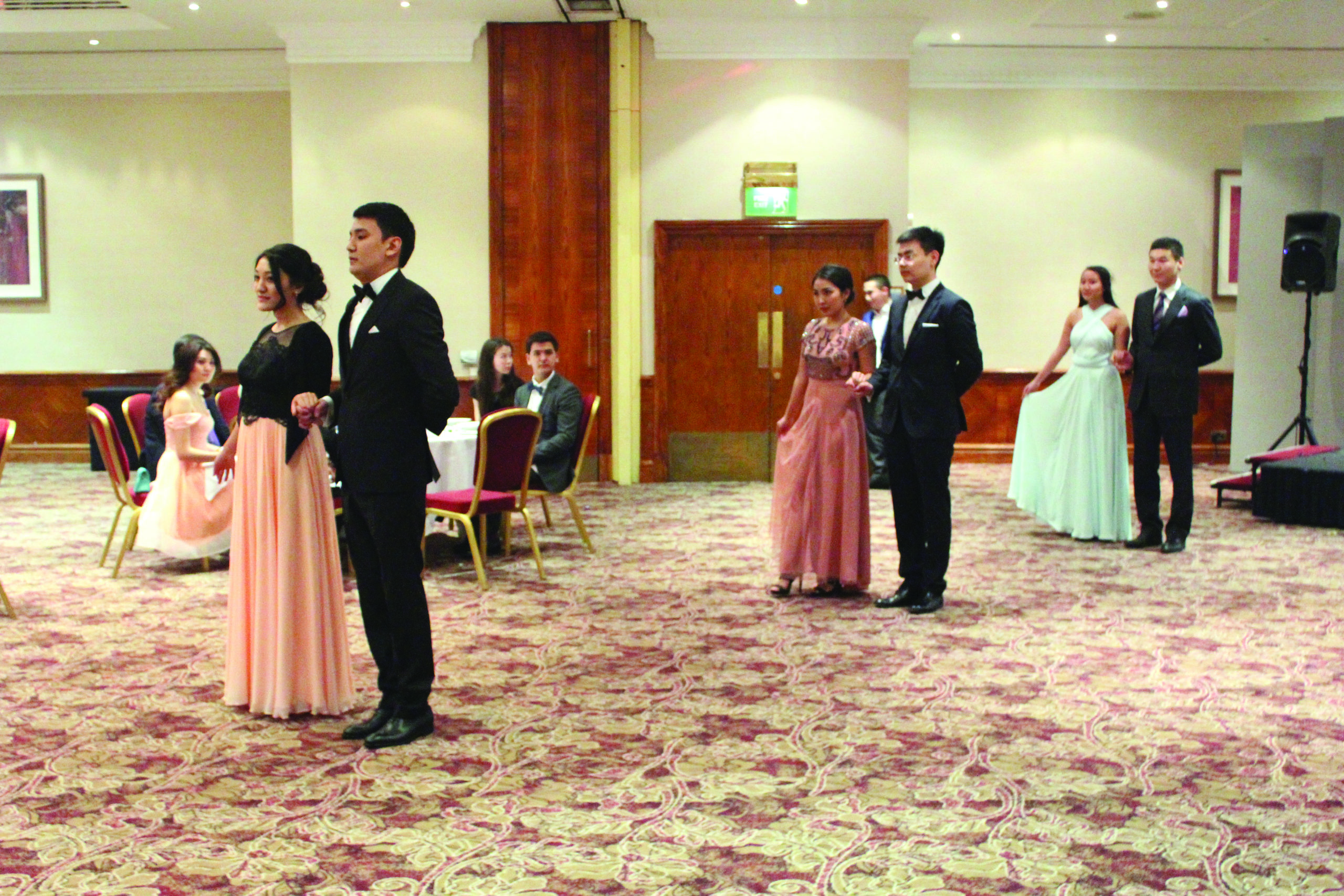
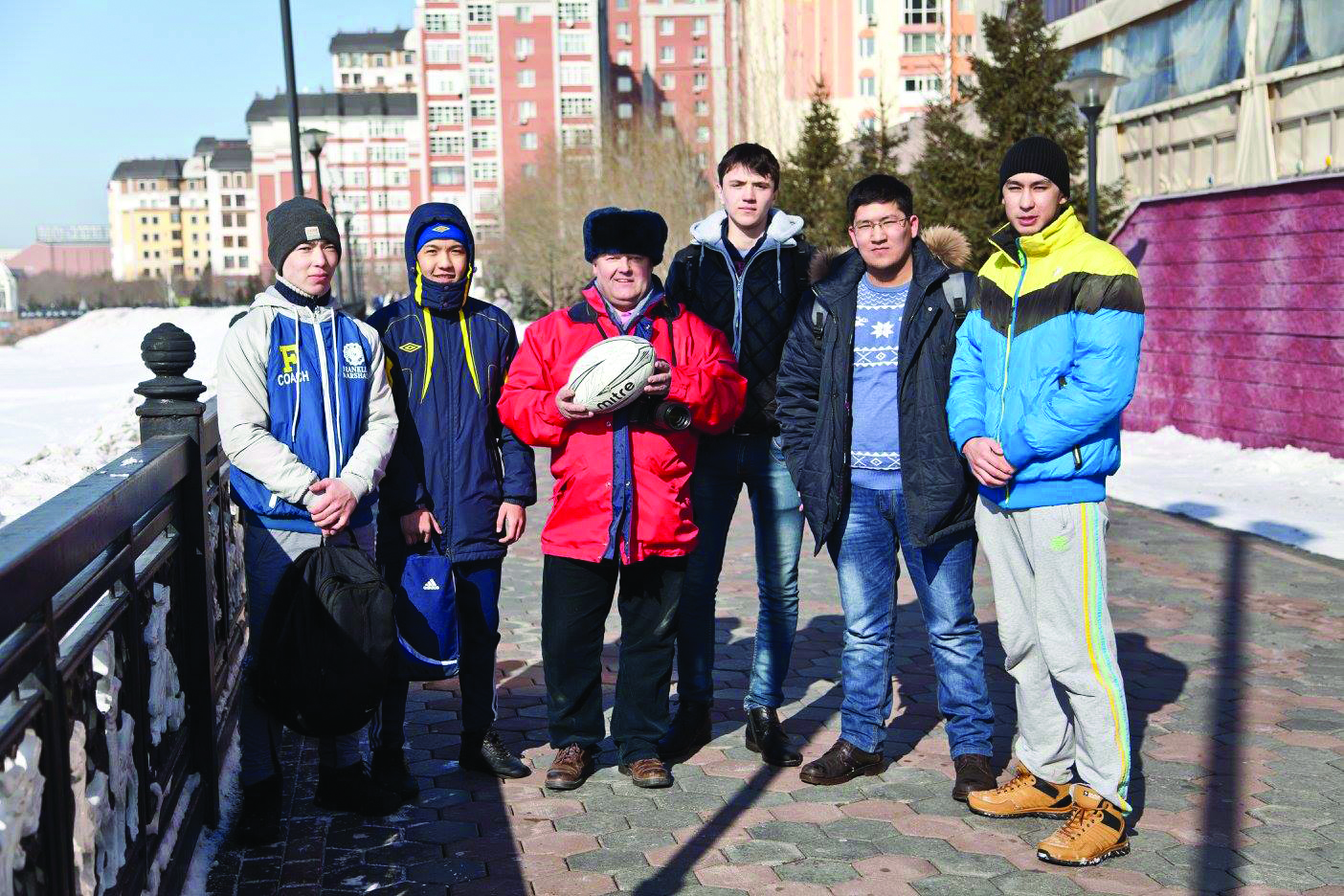
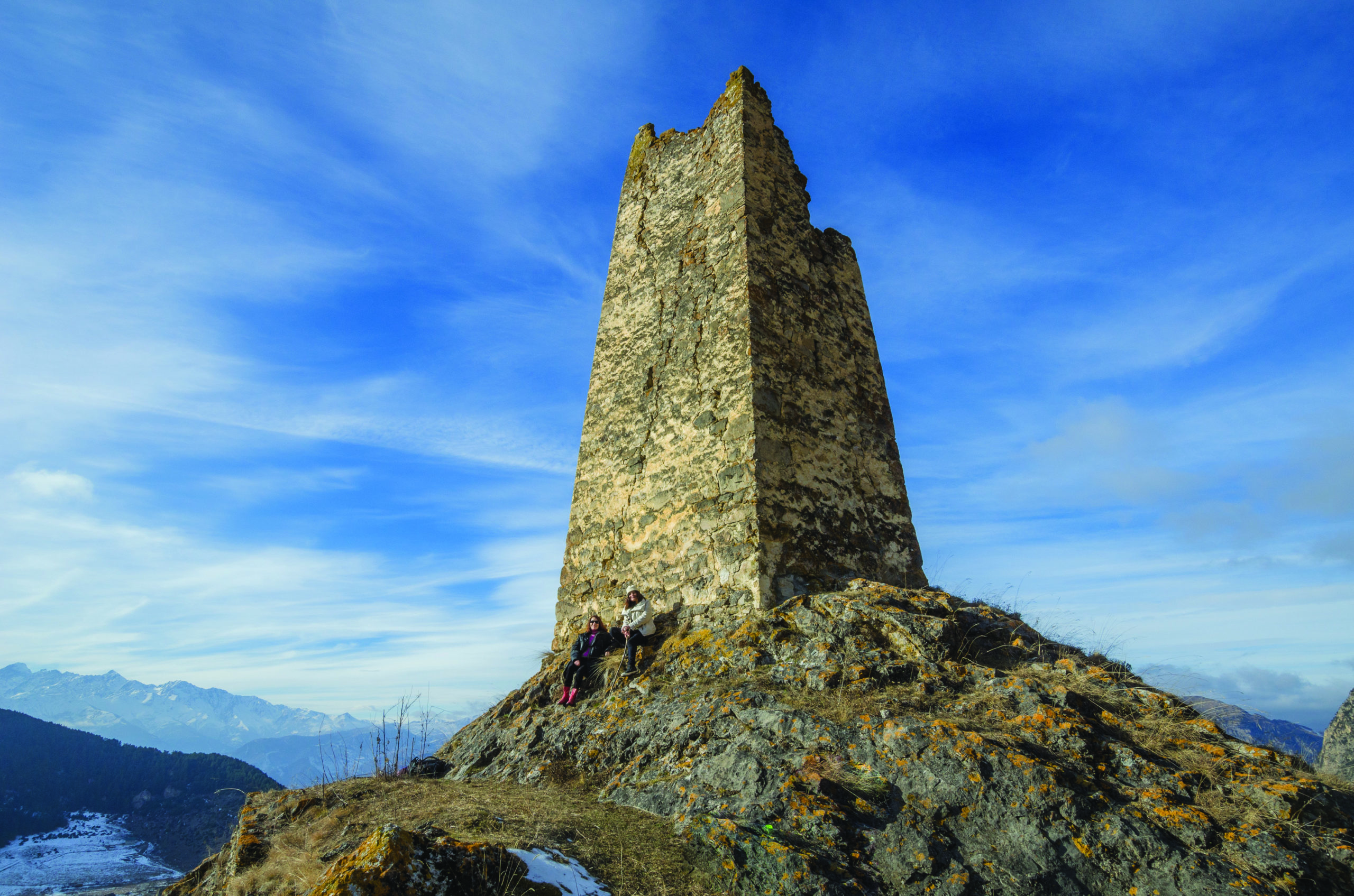
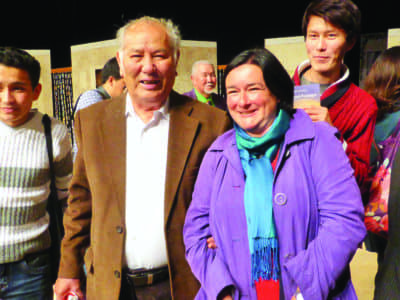
Alatau Tamchiboulac Atkinson, the son of British explorers Thomas and Lucy Atkinson, was born on 4th November 1848 in the tiny settlement of Kapal in the Zhetysu region of what is now Eastern Kazakhstan. 168 years later ten of his British, American and New Zealander descendants returned to Kapal to visit the places after which he had been named. This is the story of that remarkable visit.

Return to the Great Steppe
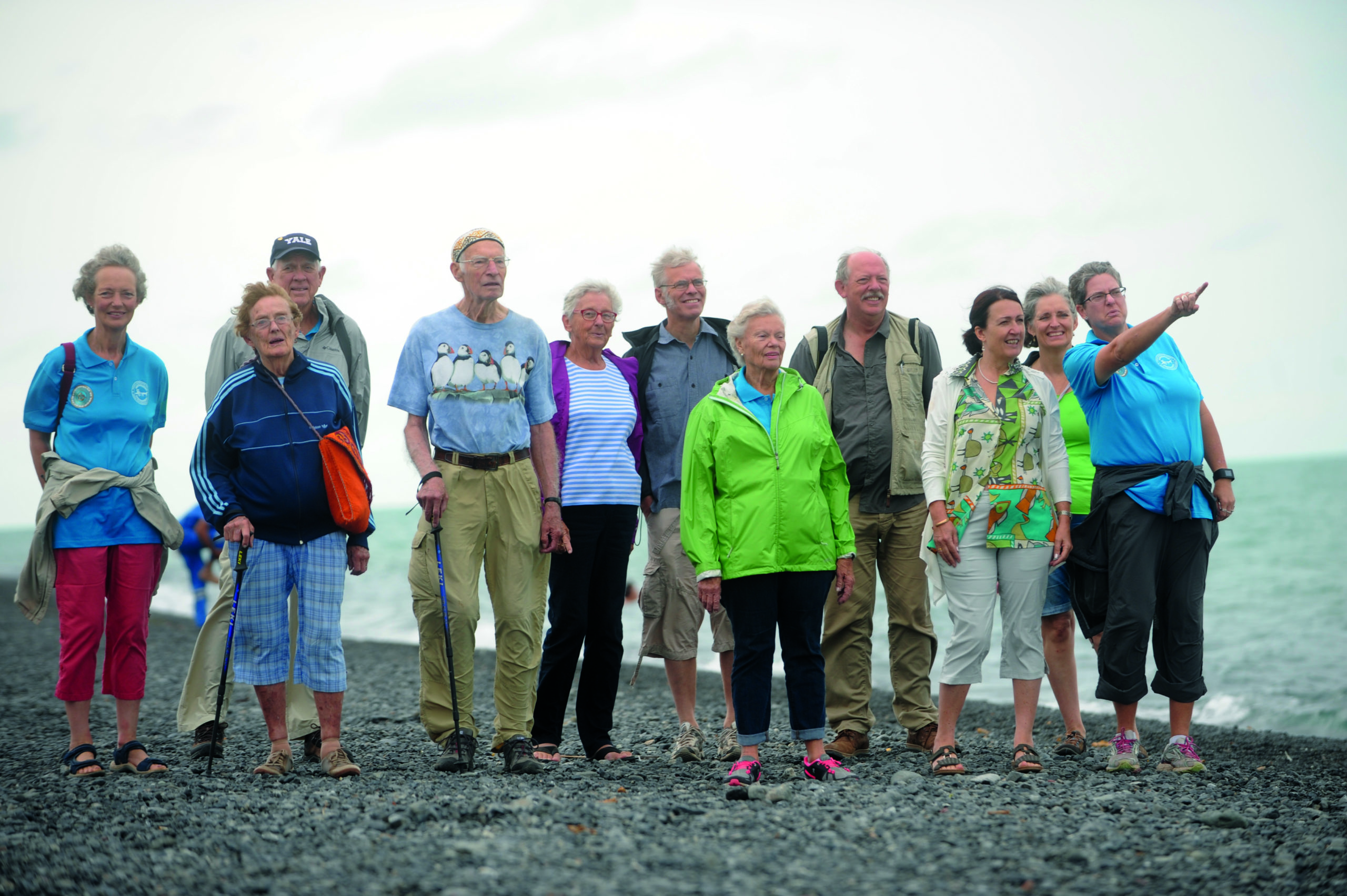
In July 2016 ten descendants of the British explorers, Thomas and Lucy Atkinson, travelled to Kazakhstan to visit the place wherein November 1848 Lucy gave birth to a son, whom she called Alatau Tamchiboulac Atkinson. Five descendants from England, three from Hawaii and one each from Florida and New Zealand decided to join the group.

From the moment we arrived at Astana airport, it was clear that this was going to be a special trip. We were greeted with songs, dances and special sweets and bread, organised by Mrs Umutkan Munalbayeva, general director of the National Academic Library.
Our first day was spent sight-seeing. Several members of the group were also taken to a meeting with Kazakh Prime Minister, Mr Karim Massimov, who told the family how delighted he was that the Atkinson delegation had arrived in Astana. As the meeting got underway, one of the relatives, Paul Dahlquist, gave a traditional Hawaiian greeting which was highly appreciated by the gathering.
Our second day started with a meeting with the mayor of Astana, Mr Asset Assekeshev, who told the delegation that he would be interested in discussing the possibility of opening a special museum dedicated to the Atkinsons. Two members of the Atkinson family delegation dressed in character as Thomas and Lucy Atkinson for the meeting, wearing costumes they had obtained at the National Theatre in London.
The meeting with the mayor was followed by the launch of South to the Great Steppe at the National Academic Library in front of an audience of around 150 people. Press interest was overwhelming, with dozens of journalists covering the event.
Following a slide-show presentation of the book, numerous Kazakh academics and experts – including Director for the Institute of State History of the Ministry of Education of Kazakhstan, Mr Burkit Ayagan, and renowned writer, Sharbanu Beisenova, as well as Mr. Darkhan Mynbay, Mr Sherubay Kurmanbayuly.
Mr Zhambyl Artykbayev – spoke to express support for the book and its importance for providing new information about the early modern history of the Kazakh people. Leading ideologue Professor Myrzatay Zholdasbekov said it was important that the book was translated into Kazakh and Russian so that young people could learn about this important period in history.

Arrival in Almaty
On Tuesday 26th July, we flew to Almaty, courtesy of Air Astana. Outside the airport we were greeted with vans decked out in special livery and by the KazGeo representatives all wearing special T-shirts marked with the slogan ‘Alatau Tamchiboulac: From Great Britain to the Great Steppe’.
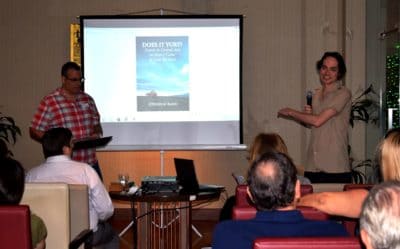
From Shymbulak it was on to the British Council in Almaty where Nick Fielding gave a slide presentation based on his book to a packed room. Most of those attending had responded to a social media campaign informing them about the talk.
There followed a long journey by road to Taldykorgan, a large city close to Kapal, the little town where the following day we were due to commemorate the birth of Alatau Tamchiboulac Atkinson in 1848.
Celebrations in Kapal –
Thursday 28 th July
Before leaving Taldykorgan for Kapal, the descendants met with Mr Amandyk Batalov, the governor of Almaty region who was well informed about the story of the Atkinsons and spoke of his honour in receiving their descendants as guests. He told the family members that Kazakhstan’s president, Nursultan Nazarbayev, had taken a personal interest in the story and asked rhetorically if it could be the case that the Atkinson family members were in fact Kazakh citizens, as their ancestor had been born in the country. He then presented a beautiful dombra – Kazakhstan’s national instrument – to the party, as well as books extolling the landscape of the region, in particular the Djungar Alatau National Park.
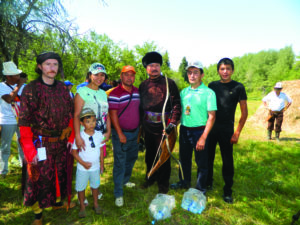
The meeting with the governor was followed by a press conference at which all the national networks were present.Then it was time to make the 75km journey to Kapal. On the way the party stopped at the statue of Batyr Kapal, the founder of the town, for a photograph. Once again Steve Brown and Pippa Smith were in costume, this time with the added surprise of a ’babe in arms’.
Nothing could have prepared the group for the sight which met their eyes as they drove into Kapal, now a mainly agricultural village, tucked beneath the Djungar Alatau Mountains. A large crowd had assembled in front of the covered memorial, which was flanked by a display illustrating the lives of Thomas and Lucy Atkinson. A group of dombra players stood on one side of the memorial, as the master of ceremonies and two assistants, all splendidly dressed in national costume, stood on the other side.
Women in traditional costume handed out a special bread and threw sweets into the crowd. Speeches were made and Paul Dahlquist was asked to cut the ribbon on the imposing monument commemorating the birth of Alatau Tamchiboulac Atkinson. Over two metres high and carved in solid granite, the monument’s inscription in Kazakh, Russian and English says: ““Alatau Tamchiboulac Atkinson, the son of Thomas and Lucy Atkinson, who were the first British explorers to come to Kazakhstan in the 19th century, was born here on 4th November 1848.”
From the newly installed memorial, it was only a short walk to the Tamchiboulac Spring, after which Alatau was named. For the next hour or so dozens of people crammed into the space around the spring, where the water falls directly from the rocks in front of you, tasting the water and bottling it to take away.
Once they had visited the spring, the descendants were in for a shock. They had no idea what was still in store for them. Close by, the inhabitants of Kapal had prepared a wonderful shildekhana pageant detailing the story of the birth of Alatau. Performed by actors, singers and dancers, it was fully choreographed and even included a splendid example of horsemanship.
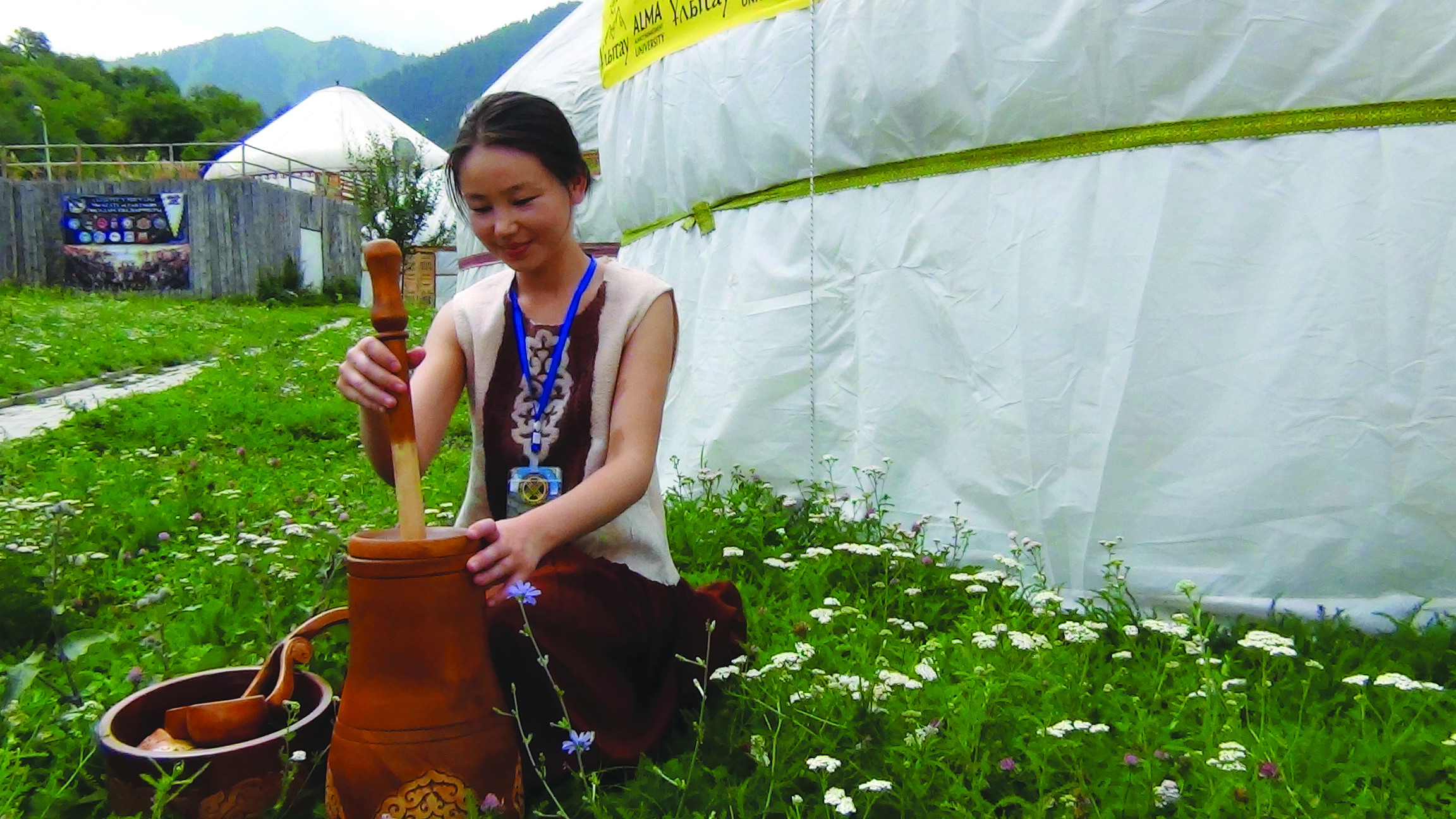
We were then invited to take part in a special feast, given in celebration of the birth of a child. Dish followed dish, including Kazakh favourites such as beshbarmak, manti, chorba, laghman and, of course, koumis – the slightly alcoholic drink made from fermented horse milk.
A fine feast had been prepared for the descendants, accompanied by singers and musicians. Soon after, we said our goodbyes and left Kapal, and we headed north-east towards Sarcand, travelling along the same road used by Thomas and Lucy Atkinson as they left in the spring of 1849. We passed through Arasan where the residents of Kapal had held a party for the Atkinsons and where Thomas had bathed in the hot springs for which it is famous. And we were able to take in some of the glorious views towards the Djungar Alatau Mountains. Everywhere we looked we could see the mounds of kurgans – ancient burial chambers built more than 2,500 years ago that testify to the long period of occupancy of this remote region.
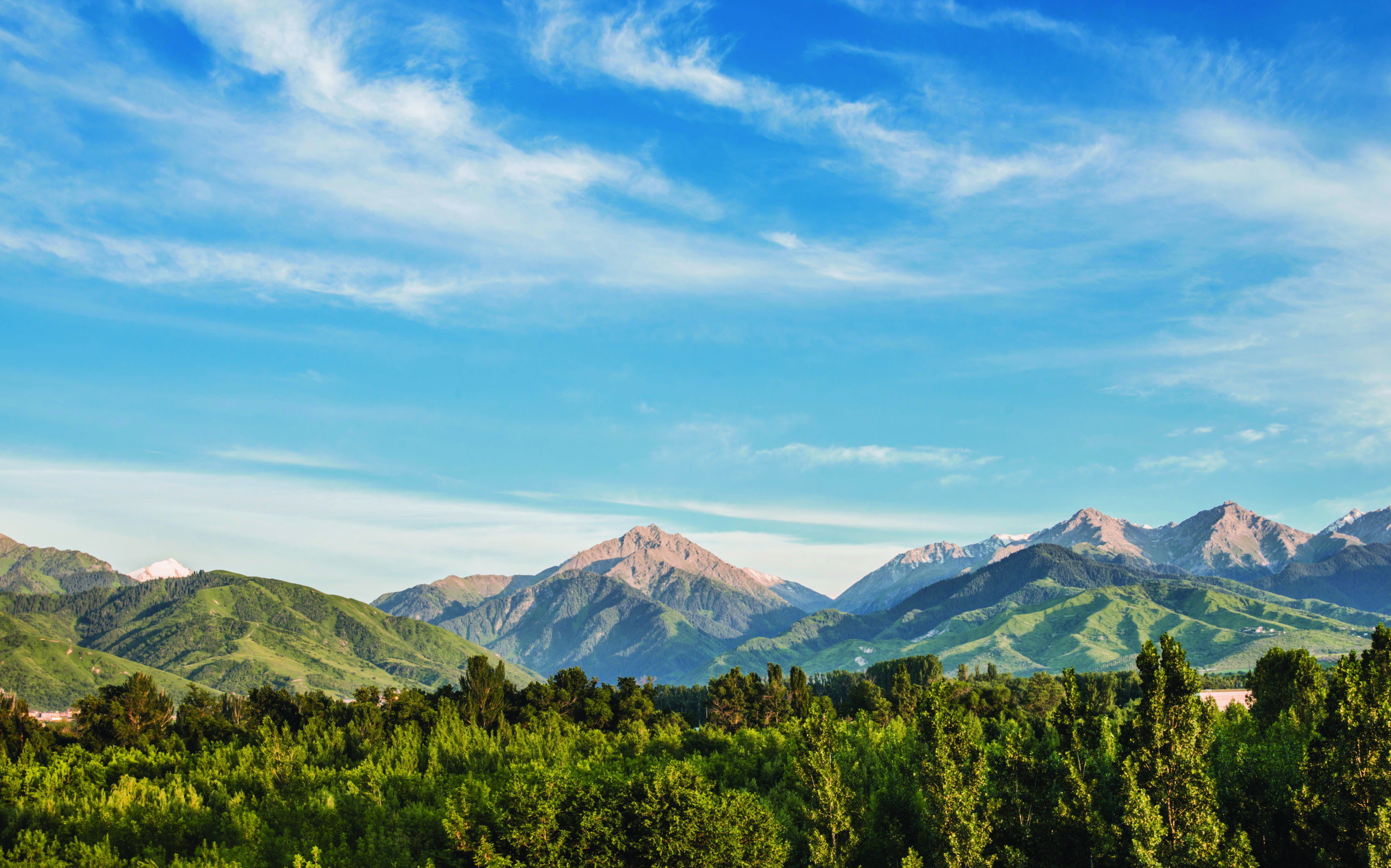
Soon we were crossing the Hasford Pass on an unmetalled road, heading toward Zhansugarov and then on to Sarcand, where we arrived at our hotel late in the evening. We were now in the heart of the Zhetysu (or Semirechye) region, the home of the seven rivers. Thomas and Lucy, along with the baby Alatau, had systematically explored each of these river valleys during the summer of 1849 and we were here to see something of the sights that greeted them – almost unchanged today, despite the passage of time.
Zhetysu – 29th July
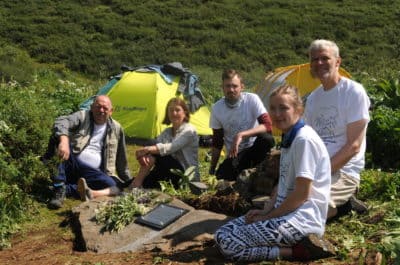
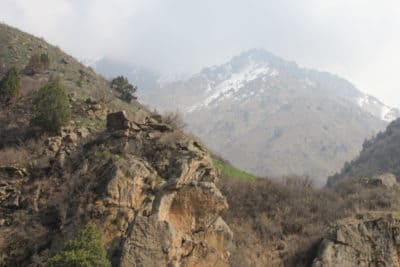
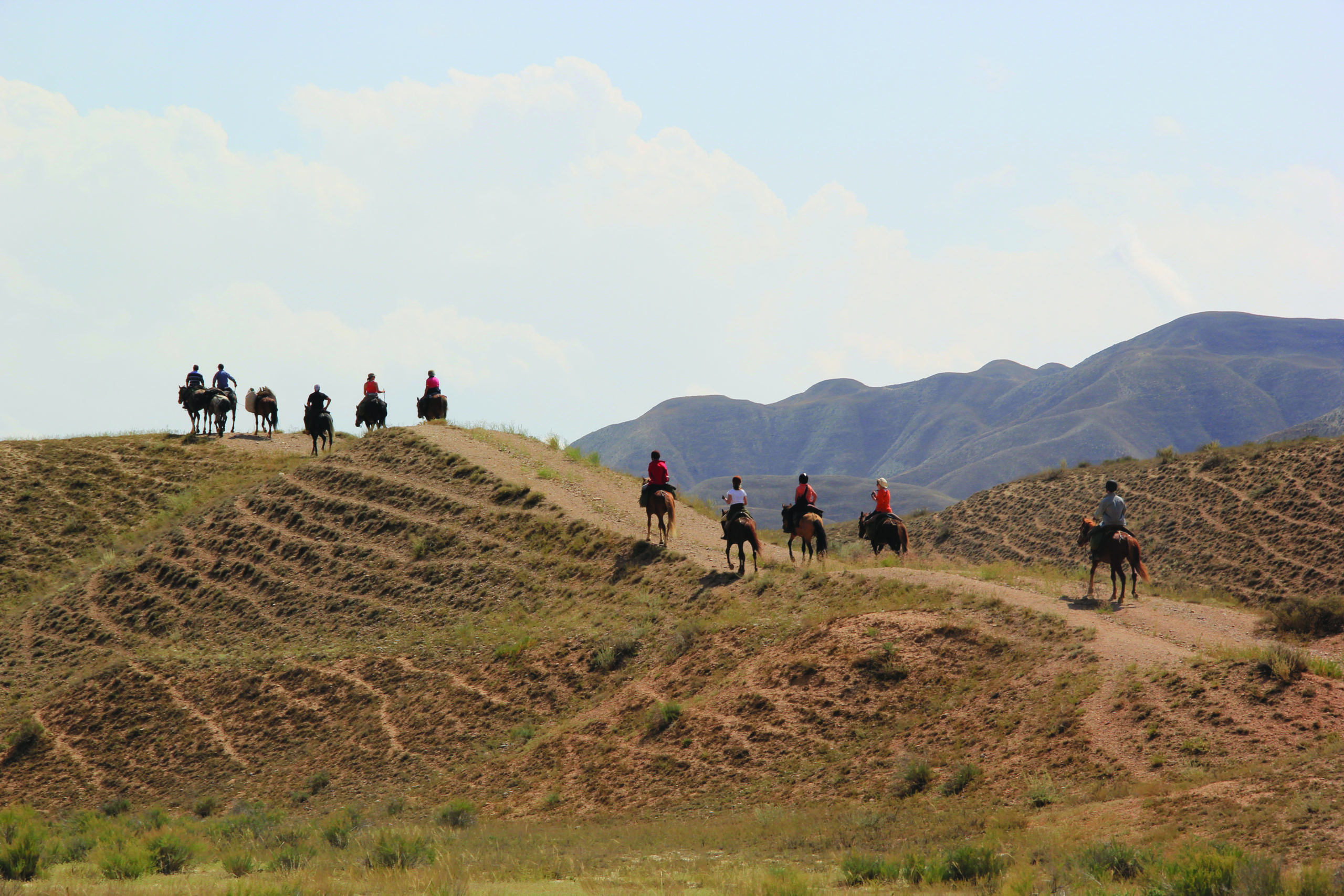
Sarcand is home to the headquarters of the Djungar Alatau National Park, a remarkable wilderness covering tens of thousands of hectares and stretching up from the steppe to snow-capped peaks of around 4,500m. Large parts of the lower slopes of the mountains are covered in dense apple forest, home of the famous Sievers apple, which is thought to be the ancestor of all eating apples. We drove out to the Terekte River – painted by Thomas Atkinson – where some of us mounted horses, whilst others took to jeeps to ride deep into the apple forest to visit a lodge. It was a spectacular ride, at first though open ground and then in the dense forest.
Soon after we headed north-east to Lake Alakol, the most northern part of our journey, where we arrived late in the evening of Friday 29 th July.
Lake Alakol – 30th July
As we had arrived on the shores of Lake Alakol, it was clear that the weather was going to be a problem. The clouds had darkened and it was beginning to rain. By the following morning, the bad weather had set in and we decided to adjust our plans. We had originally intended to spend time on the black beaches of the slightly salty lake, but that was now unthinkable. Instead, we went to the shoreline to take in its sheer size – 1,020 sqms.
By the time Thomas and Lucy reached the lake in the late summer of 1849 they had traversed much of the Zhetysu region, watching and travelling with the nomads as they took their herds from their winter pastures alongside Lake Balkash high up into the pastures of the Djungar Alatau. From now on they would be facing the flat steppelands as they made their way north to the Altai Mountains and Barnaul, the town where they would spend the following winter.
We stayed in Kazakhstan for another two days, but to all intents and purposes this was the end of our journey. The days had been filled with wonderful sights and fascinating meetings that it will doubtless take some time to digest. Thank you Kazakhstan for making this such a memorable and moving experience!

WWW.OCAMAGAZINE.COM #23 AUTUMN 2016  

A Question of Religion in Ossetia

The North Caucasus is characterised by quite some religious diversity, since the region is ethnically diverse and has many cultural and political ties with the peoples of the East and the West, and is situated at the crossroads of European and Asian civilisations. Currently, the North Caucasus is dominated by Islam, but since old times the Caucasus has been a region of Orthodox Christianity.

Despite Islamisation and Christianisation of the Caucasus, to paraphrase Florensky one can say that mountaineers’ religion formed due to the interaction of three forces: the monotheistic religions, brought by the rulers from the outside, paganism and the Caucasian character, which in its own way adapted and reworked them.

The most interesting, full and peculiar extent of these beliefs are expressed in Ossetia. Syncretism (combination and interchange of beliefs) here has its most outstanding features – they remain committed to various kinds of ceremonies and national traditional beliefs which go back to ancient pagan cults: community, family and the clan (in most cases they took the form of worship of the hearth and home which symbolises the family) and associated funerary rites, the cult of ancestors and of the dead.

The funeral cult merged with the family and clan, and is very developed among the Caucasian peoples. In South Ossetia it took excessively complicated forms, however. It is a common belief that even after their death, ancestors remain invisibly present around their descendants and impact their life on earth. If the ancestor is pleased with their descendant, they will grant them wellbeing; therefore the descendants pray to their ancestors and remember to present them the gifts that they loved in life. Ossetians still preserve the tradition to regularly feed the dead, according to which a funeral feast with an abundance of food is arranged, because all that is eaten is done in commemoration of the deceased. A large number of people attend the funeral feast and hearty meals are served.

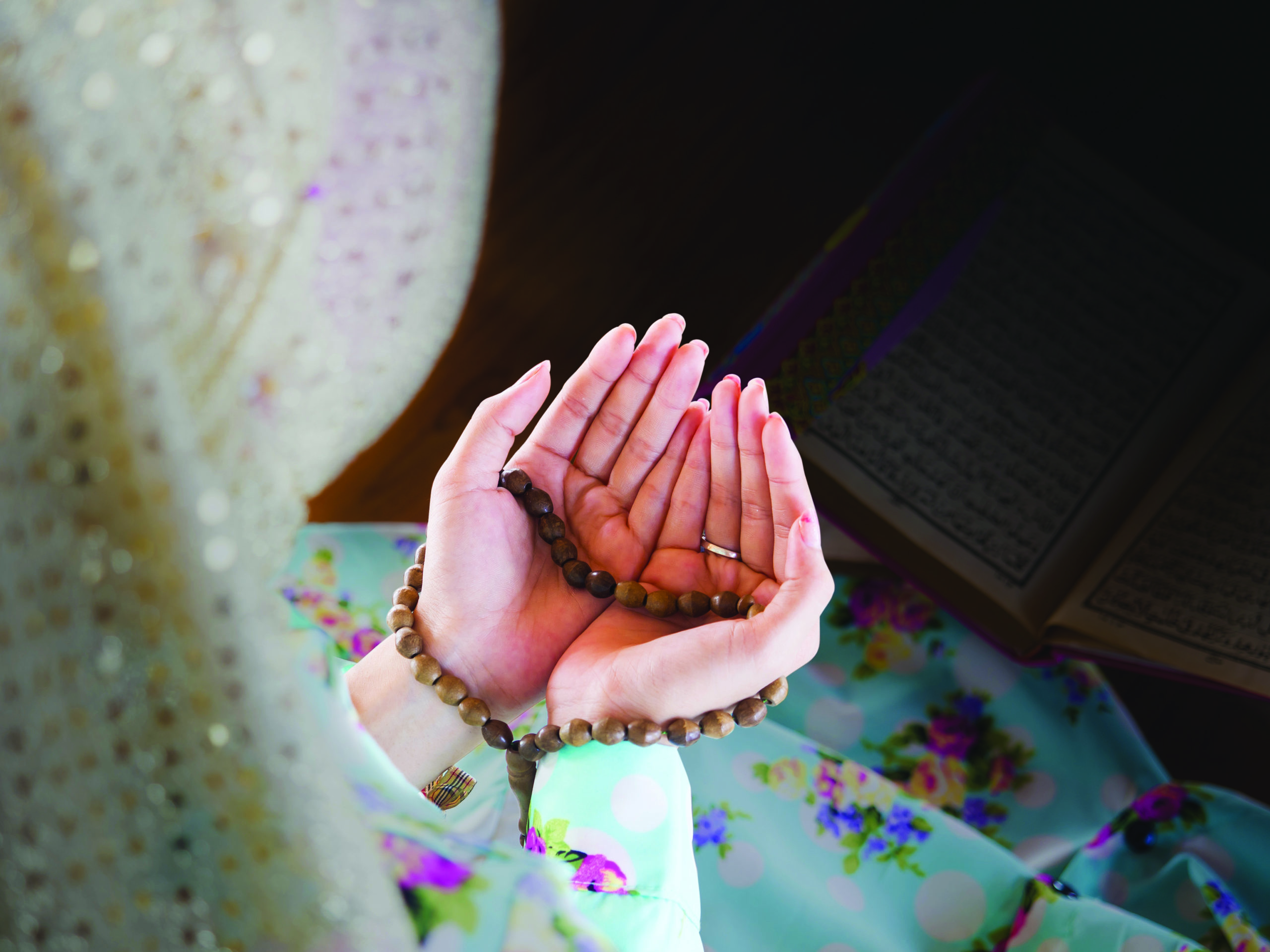
The cult of the Sun and Fire have always been in the foreground of Ossetian religious life. The main elements of the cults are sacrifices to the gods and common meals, which are called kuvds. Kuvd is a prayer which includes a ritual of blood sacrifice. The Ossetians usually slaughter ox or sheep for the sacrifice because the pig is considered an unholy animal.

The cult of the community patrons is tied to the local sanctuaries, where the rituals are performed. Typically this is an old building, sometimes a former Christian church, and sometimes just a group of sacred trees, stones or a meadow. In the sanctuary, before the slaughter a cross is drawn on the head of the sacrificial animal. Cooked animal meat is cut into pieces and his head is being placed on a separate plate. Three types of sacrificial cake must be present on the table as well. Each family in course of the year should organise at least one kuvd. Regional newspapers print advertisements about family kuvds. They are carried out in specially designated meadows.
In addition to the clan, funeral ceremonies and kuvds on major holidays, some regions have their own traditional kuvds. As a rule, all Ossetian rituals begin with a toast-prayer, addressed to the head of the Ossetian pantheon – Huytsau. Huytsau is not a personal name and refers to the concept of God. Ossetians believe and believed before the adoption of Islam and Christianity in one supreme God who dwells somewhere in heaven and rules the world. While Huytsau is inaccessible and abstract, the Christians and Muslims who participate in kuvds believe that they are praying to their Biblical or Koranic God and don’t feel themselves as apostates. Afterwards a toast in honour of other deities (saints) is proclaimed in strict sequence.

The most worshiped saint is the patron of men and travelers Uastyrdzhi (in the Ossetian folk tradition it eventually became associated with Saint George under the influence of Christianity). The Ossetians never start without a prayer to him. For women, his name is banned, and they euphemistically call him “the patron of men.”

So the Ossetians pray to ancient gods (Huytsata), the saints (dzuarta) and the spirits (daudzhita). One can say that a mixture of various beliefs and concepts in Ossetia formed a peculiar religion, which is remarkably comfortable for all Christians, Muslims and pagans alike.

WWW.OCAMAGAZINE.COM #23 AUTUMN 2016  text by Tatiana Lari


Abai Rules Again in Kazakhstan

The writer of a new book, entitled, “Abai and the Future of Kazakhstan” is no stranger to local audiences. Orazaly Sabden is best known, perhaps, as a scientist and public figure: an academician, as well as a winner of the State Prize of the Republic of Kazakhstan as best new author. Looking back, of course, Abai’s literary rubrics have been leading humanity to spiritual values for two centuries, which is why Abai has become a symbol of free speech and open-mindedness.

The book outlines, therefore, the author’s intention to solve textual problems in the XXI century originally raised by this renowned thinker two centuries ago: issues proving relevant to this day.
Hence, the great Abai still inspires contemporary readers through his spiritual intelligence and insights. Each a phenomenon known, honored, recognized, and loved, by young and old, rich and poor, alike. Overall, readers will find answers to a number of important questions first addressed by Abai, accompanied by reviews from famous scientists and acknowledged experts.
A book for everyone
One cannot but admit that O. Sabden’s book “Abai and the Future of Kazakhstan” is greatly surprising in a positive way. Indeed, within his text, the author suggests that the XXI century will be an age wherein a “humanisation of society” occurs. A time when Abai’s advice “created for the people” will finally be reflected in the spiritual values of humankind at large. Reminiscent, therefore, of M. Auezov’s novel “The way of Abai”, it is reassuring to us (as researchers of his artwork), that O. Sabden contends his main goal is realized in the implicit need to tread a path to civilization by dint of Abai’s heritage.
Additionally unique is Orazaly Sabden’s insistence that searching for mechanisms to implement the ideas of Abai, while offering a number of new recommendations and projects (such as the regulation of a global currency; models of management and the regulation of global processes), will propel his project into ever more deeply engaging modes of discourse and comparative understanding. With this in mind, it is interesting to read that O. Sabden proposes to create, in Kazakhstan, a new form of the Great Silk Road, “The Theological Academy Named after Abai», which can also serve as a centre for studying the spiritual heritage of Abai. As such, eastern philosophy – allied to a special vision of Eurasian space – could contribute to the development of future civilizations. Hence, this proposal serves as a moral reorientation in our current attitudes, partly explaining why the author makes an attempt, to outline fundamental ethical principles in the XXI century, answering questions such as “what will moral codes be like in the XXI century?” Of course, these are intellectual, as well as scientific issues: all reflecting higher-consciousness and the possibility of a humane education. So, the potential transition from quantity to quality in our society is carefully examined.
One observes that in some sections new technologies are defined as vehicles of radical change – a veritable second Industrial Revolution – as the general evolution of consciousness increases. Undoubtedly, as the author comments, only then will humankind be able to enjoy the fruits of peaceful progress. With such thoughts in mind, it is clear that this book is written for a global readership, which is appropriate since it associates Abai ideas with concepts from other planetary geniuses like Confucius, Nostradamus, etc. Thus, a commonality is introduced between the thoughts of Abai and the greater world community.
There is one rather striking and original concept worth mentioning too – the idea of building – in the “Valley of Turkestan” – a new spiritual-technological cluster. Phrased differently, Sabden suggests constructing a city intended to become the spiritual capital of Turkestan: a veritable Theological Academy. Envisaged as such, this project would include a (planetary) historical and geographical museum, tourism and security. Moreover, this is not just a suggestion, but a specific recommendation to the powers that be: accompanied by financial calculations. Dauntingly, his advisors say this 8 billion dollar project is feasible, although, to date, this megaproject has no analogues. Nevertheless, the author believes his audacious plans will be realized, if not today, then undoubtedly in the future.
All things considered, this intriguing book also presents readers with a huge amount of information regarding the outstanding personalities from our Turkic -Kazakh region. Each name begging the question of preserving heritage for the next generation, while finding in them answers for many of today’s problems. Looking back, the last century took claims by the German Nobel Prize winning physicist Max Planck as guidelines towards such a higher-consciousness. Pundits are coming to believe that the whole world is interconnected by some unseen power. From this angle, the author inquires «fourth edification» into «What is the level of our spiritual values, at what level we are now, how can we upgrade?” Interestingly, in attempting to answer these questions O. Sabden announces, «Spiritual values ​​must be considered incomparably superior to all others. Afterwards convincingly threading this idea through the teachings of Abai and inviting his readers to inquire for themselves. Taken together, this book represents interesting projects, which include original thoughts and philosophical trends – even though his readers should be acquainted with Abai from the outset. Nonetheless, Sabden’s work is innovative. Almost akin to spiritual food. Reminding us that sagacious books of this type are written infrequently. Perhaps, the author aims to present Abai from the point of view of modernity: inclusive of its socioeconomic convulsions. Possibly not! Either way, a strategy for solving present day crises within the sciences arises within these pages. Ailed, as they are, through being unable to break free from the chains of false atheistic and materialistic assumptions. To conclude, Sabden’s book shows us a better ideological path to follow, whilst suggesting ways to actually develop a world civilization.

Abduali Kaydar – academician of NAS RK Kakishev Tursunbek –
critic, scientist, academician Mekemtas Myrzahmetyly – academician

WWW.OCAMAGAZINE.COM #23 AUTUMN 2016  

World politics Along the Silk Route: A Quarter Century of Foul Play

This year, it is a quarter century ago that the former Soviet republics along the ancient Silk Route got their independence – unasked for by most, following the implosion of the USSR. It has degraded them to post-colonial economies, in sharp contrast to what western propagandists “promised” populations after their “liberation”. A book, written in early 2015 by Dutch author Charles van der Leeuw and published over summer the same year, explains the way western power-brokers have abused the situation to trigger “revolutions” in ex-Soviet states in order to keep their economies cash-strapped. Only now it emerges how true that all was, and still is, making the book worthwhile re-reading.

In “Cold War II: Cries in the Desert – or how to counterbalance NATO’s propaganda from Ukraine to Central Asia”, the author describes how Washington’s industrial-political clique in power had hoped to “monetarise” the USSR first after the Second World War and after Stalin refused to take part in the Marshall Plan once more in the 1980s and early 1990s when the Soviet Union was “brought on its knees” – or so it was thought. But Russia once more refused to sell out its resources and instead set up its own capital-generating mechanism. This kept the so-called bipolar world, now stripped of all ideological display, intact. It became tripolar with the entry of China in the global economy as an independent force, but in any case a unipolar world is off the agenda while western sharks lick their wounds and Central Asia’s ex-Soviet republics are having a little comfort.
“The hero-versus-villain rhetoric made in USA and copied in Brussels has come back to the surface in full flood after everybody was made to believe that it had been buried following the break-up of the USSR back in 1991,” Mr. Van der Leeuw’s book reads. “Buried alive, that is: it is simply impossible to make nearly half a billion people in the world change their minds overnight and throw a deep conviction which may have its faults but was and still is profoundly based on human solidarity and prosperity sharing through communal harmony rather than internal struggle falsely dubbed competition down the drain without much further thinking. Now, the vampires have crawled out of their coffins once more. Championed by the United States of America, or rather its ruling elites since within America’s society there are plenty who still rightly refuse to believe Washington’s propaganda machinery, the much-trumpeted “western victory” sealing the end of the Cold War did not end in a lasting peace.”
Events into the new century have made it clear that “the West” does not want to give up its quest to reduce the former USSR to post-colonial vassal economies. “Today, like it or not: with Cold War II in full swing, economics and business have become more political than ever, and attempts by corporate enterprises to stay out of the Dirty Information War accompanying it have remained by and large futile,” in the book’s words. “It all began on the very first day of the so-called Maidan Revolution, which was to result in the violent overthrow of the government of Ukraine. Ever since, the western Brotherhood of Hatred has subsequently bombarded audiences around the globe with propaganda under the guise of so-called information, full-heartedly aided by both traditional news media and new, mainly cybernetic outlets. Throughout the process, reactions from Russia and other former Soviet republics remained by and large cool and even today the ferocious attacks preaching hell and damnation over the former USSR are merely shrugged off by politicians and commentators in the region alike. As a result of this, as well as the rise of critical movements versus the US/EU war trumpeting machinery in Europe and the Americas, a propaganda war between media outlets themselves seems to have broken out, with some of them accusing others of spreading biased information under the guise of news and analyses on the payroll of various parties in the ‘New Great Game’.”
The solution to the threat does not consist of beating the enemy but disarming it. Barricades and “regime changes” (real ones, not artificial ones) are needed in America and to lesser extents in the EU, the author argues. “The message, made in USA, is clear: there is no future in the way USA and (to lesser extents) the EU try to bully Central Asia to maintain a political spearhead in an area that finds itself at the heart of the Russia-China-India triangle,” the book reads in its conclusion. “In the eyes of hawkish parties in the USA, that spearhead should consist of Ukraine, the southern Caucasus and from there straight across the Caspian to the very gates of China. The more Washington hangs on to that illusion and fails to heed its critics at home, the stronger resistance on the ground against it is bound to become. The trouble seems to be that the target of American criticism stretches all over the two Democrat and Republican mainstreams, both dominated by reactionary elements leaving serious opposition without political clout and ever on the losing end of the ‘democratic’ system. As long as the absence of a political pendulum in that system persists, so will the illusion, leaving little hope for the return of a friendly rather than an ugly American in Central Asia.”
Charles van der Leeuw is known for his books on the Middle East, the Caucasus and Central Asia. His work goes far back into history. Throughout his writings, he has consistently looked for “the other side of the story” – e.g. was Kuwait all that innocent and Iraq all that guilty when the first clash between the two oil powers occurred? Were the Armenians “only defending themselves” when they attacked Azerbaijan, taking one-sixth of its territory, killing tens of thousands and chasing over a million from their homes? And now, are “the Russians” threatening to suppress the poor honest Ukrainians and are the western “capitalists” the heroes to preserve the latters’ “freedom”? Arguments by western media outlets and commentators may have been taken for granted by western media initially, but in the end they all fall through. Mr. Van der Leeuw’s books all prove it – maybe in a provocative tone of voice but in the end the message of the tune prevails over it.

NOTE: Charles van der Leeuw’s book is available in London from Stanford Books, Covent Garden; Daunt Books, Marylebone; Pushkin House, Bloomsbury Square; and Arthur Probsthain, Great Russell Street; as well as at bookshops, hotels and souvenir shops throughout Central Asia, and online at www.discovery-bookshop.com, www.amazon.com, www.abebooks.co.uk.

WWW.OCAMAGAZINE.COM #23 AUTUMN 2016  

Belt and Road Initiative: Theory and Practice

Nowadays the Belt and Road Initiative (B&R Initiative) is a large-scale initiative which forms a new paradigm of economic and geostrategic development. More than 60 countries with a general population of 4.4 billion intend to participate in the implementation of this strategy. It constantly attracts new followers. Over $ 1 billion US dollars has been already invested in the project.

The new realisation of the Great Silk Road has no clear geographical framework. Beijing supports open doors policy in this project, as it was stated in the report by the State Council of the Peoples Republic of China “Great Perspectives and Practical Realization of the Belt and Road Initiative in the 21st century”.

Main directions of the B&R Initiative:
It is planned to create seven “zones”:
• Transport and Logistics
• Energy
• Shopping
• Information
• Science and Technology
• Agricultural
• Tourist
The main characteristics of several “zones” are described below, with focus to the transport and logistics.

Transport and logistics zone
“In order to become rich – we must first build roads”. This old saying is often used by Chinese experts who discuss the main directions of the Belt & Road Initiative strategy.
The high-speed rail network, which connects all provincial centers in China excites the whole world. Its length exceeds 19 000 kms, which is 60% of the total length of the railways in the world.
The second most important in the Road & Belt Initiative strategy is the energy zone. A significant shortage of energy resources is peculiar for most of the Eurasia territory. That is why there is te need to create new generating capacities everywhere. Such projects are available and the applicable financial resources will make them feasible. The emphasis is supposed to be on the “green energy”.
The most radical proposal is to create a unified energy system for the B&R countries. It is a network of interconnected gas and oil pipelines, and electricity networks to cover the whole territory of Eurasia and join the forces of both producers and consumers.
A more rapid effect can produce the formation of the tourist zone of the B&R. In 2015, more than 100 million Chinese tourists travelled abroad. They spent over 150 billion dollars travel money. Russia is entering a highly competitive Chinese tourist market with a significant movement in this direction. Serious progress has been made in 2013-2014, during the years of tourist exchange between the two countries.
A special place in the B&R Initiative Strategy in reserved for the science and technology zone. The B&R Initiative Strategy consistently plans closer scientific and technological cooperation. Recently, the Chinese Prime Minister Li Keqiang said that this can be done “only by close cooperation in the innovation sphere.” Recently China has overtaken many advanced countries by a number of indicators in the field of scientific and technological progress. The first step is the planned creation of a Russian-Chinese High-Tech Park “Silk Road” on the basis of Skolkovo. The Innovation Center will house research departments of leading Chinese companies.

Specifics of participation of particular countries in the B&R Initiative
First of all, the strategy of the B&R Initiative received unconditional support in Central Asia, especially in Kazakhstan and Kirgiz Republic. That is why Xi Jinping has chosen these countries to promote the initiative.
Almost all other CIS countries supported the strategy. It is planned that not only for the countries of Central Asia, but the Caucasus countries as well: Armenia, Azerbaijan, Georgia, Abkhazia, South Ossetia will participate. The B&R Initiative strategy attracts European countries as well.

Partnership between the EAEU and the B&R Initiative

On May 8th 2015 the Russian Federation and the People’s Republic of China signed the Joint Statement on cooperation between the Eurasian Economic Union and the Road & Belt Initiative. However, the actual structure of the EAEU started to work on January 1, 2015 and has not yet gained the necessary tempo of work. With limited financial resources, EAEU does not have sufficient weight to implement the projects.

Major projects Announced High-speed railway Moscow-Beijing
One of the top priority projects is the construction of the high-speed railway Moscow – Kazan, with the expansion to the South and the East (Beijing and the Pacific Ocean), and to the West (Rotterdam and the Atlantic Ocean). It is planned that in 2016 high-speed railway from China will reach the border with Kazakhstan. If from Kazan it will be routed through Kazakhstan, then in fact it will essentially limit transportation on the Trans-Siberian and the Baikal-Amur Railway, and this is not beneficial for the Russian side. If it will be pointed through the territory of Siberia, then Kazakhstan will be left unreasonably aside. Most experts believe that the most appropriate is to construct the road in both directions at the same time.

Arctic zone of the Silk Road
The Arctic zone of the Silk Road is one of the most serious and large-scale projects proposed by Russia in the B&R strategy. The Arctic region of Russia currently provides 90% of the Russian nickel and cobalt production, 60% of copper, 96% of platinum-group metals, 80% of gas and 60% of oil and has a great potential for development of new deposits. Chinese companies already actively participate in Arctic projects. One of the largest Chinese companies CNPC joined the “Yamal LNG” project with a share of 20%.

Financial and banking security of the B&R Initiative
The creation of a solid financial base testifies that the intentions to implement the B&R Initiative strategy are serious. In a short period of time (2014- 2015) three powerful financial institutions were created: the Silk Road Foundation, the Asian Infrastructure Investment Bank (AIIB) and adjacent the New Development Bank (NDB), formerly referred to as the BRICS Development Bank.
The Silk Road Foundation will play the leading role in these processes. China invested into this Foundation some $40 billion US dollars. On June 29th 2015 in Beijing representatives of 57 countries signed an agreement establishing the AIIB. It was announced that the financing of the first projects for the Bank will begin in the third quarter of 2016.
Although the NDB does not directly declare its participation in the R&B Initiative strategy, but the leading bank participants – China, Russia and India, will undoubtedly promote their projects.

This concerns as well the other shareholders of the Bank – Brazil and South Africa, which at the same time were among the founders of the AIIB.
Currently, there is no clear implementation plan of the B&R initiative. The initiators study the reaction of potential partners, analyze the proposed projects, and carry out a large number of conferences, meetings, and round tables. Most likely, this strategy is being developed through trial and error. The points of view of the partners and the participants of the strategy influence this development.

text by Vladimir Remyga

WWW.OCAMAGAZINE.COM #23 AUTUMN 2016  

Off the Beaten Path Christopher Schwartz

When I first met Andrew Wachtel during an unseasonably warm April day in 2015, what struck me most about him – that is, besides the flash of chrome gray hair, pearly white short sleeves and electric blue plants – was his combination of ambition and realism with a sense of self and mission.

Now, sitting together during an unseasonably cool August day in 2016, he still strikes me as groomed and no-nonsense, yet off-beat, as the saying goes: following the tune of his own drummer. That tune has led him all the way to Kyrgyzstan, and I want to find out where it may be taking him next.
“Surprisingly, coming from America out here to Kyrgyzstan has made me unemployable back home,” says Wachtel in a way that almost sounds like the drummer has bumped headfirst into a tree.
Off-beat, and as it turns out, off the beaten path.
From Berkeley to Bishkek
Wachtel began walking his path as an undergraduate at Harvard University, where he earned a Bachelor of Arts in History and Literature in 1981. Six years later, he completed his Doctorate of Arts in Slavic Languages and Literature at the University of California-Berkeley.
After three years at Stanford University, he was offered a tenured position at Northwestern University in 1991, eventually becoming the chair of the Department of Slavic Languages and Literature in 1997.
Wachtel’s years at Northwestern proved formative for his career. By 2002, after writing and editing numerous academic volumes and articles on topics ranging from themes of death and resurrection in Lev Tolstoy to the dissolution of Yugoslavia, he had become Northwestern’s Bertha and Max Dressler Professor in the Humanities.
Then in 2003, Wachtel was elevated to the deanship of Northwestern’s Graduate School, a position he held until his move to AUCA in the Autumn 2010 semester. During this period, he carved out time to simultaneously serve for six years as the director of Roberta Buffett Center for International and Comparative Studies, as well as chairing numerous committees.
What stands out in Wachtel’s curriculum vitae is not actually his administrative experience, but how he managed to combine his duties with scholarship: eight authored books, 11 edited and translated volumes, 17 editorials and policy papers, 57 interviews and book reviews, and a phenomenal 91 articles and book chapters according to the most recent summary of his works on the AUCA website.
What seems to be the core of his research interests – the former Yugoslavia and Soviet Union; the role of history, especially the theme of origins, in the imagination of Slavic authors; the connections between authors and cultures during transitions – suggest a mind intrigued by construction, collapse and reconstruction. It seems the path Wachtel’s drummer has brought him down leads to ruins.
Amidst the ruins
It is a fascination I share. Ruins are nothing to fear or lament; to the contrary, as much as they may embody a failure, they also signal a promise. Think of them as nature’s great cyclic principle whispered within human history.
This sense of promise was one of the reasons that I found myself out here in Kyrgyzstan. After all, where else does one find the choicest ruins than on the edge of the map?
Wachtel clearly was already onto this notion long before it occurred to me.
“It would have taken me a decade or more in America to climb the pyramid,” he explains. “Even then, it might not have happened. So I thought to myself: why stay on that pyramid? Why climb it?”
“But it was also never just that, and it’s still not just that,” he adds. “What gets me up every morning is this feeling, knowing that I am building some kind of future here in the lives each of my students.”
Henry Kissinger once remarked about academia, “Never have the politics been so vicious for stakes so small,” and I have heard these words applied quite disparagingly to Wachtel by others. Yet, the man speaking to me right now could not be further from Kissinger’s snide dismissal.
Wachtel does not mince words with himself, noting, “I am too good at making enemies,” and when he talks about his students, he is all the more genuine, not to mention idealistic.
“My students are very professionally inclined – in a good way. They understand the harsh realities ahead of them, and they want the knowledge and skills necessary to have meaningful adult lives. And many of them will have such lives; many of our alumni already have.”
The stakes are indeed quite large for Wachtel. “This region has so many problems. It is really only through education that it will have any chance.”
This immediately brings to mind Kyrgyzstan as the choice for Wachtel’s hopes. Its neighborhood of authoritarian and teetering regimes is notorious to say the least. Is this country in any way special?
“It is true that Kyrgyzstan is the most open country in Central Asia and one of the most open in the former Soviet Union. Why that is the case is debatable. The Soviets’ mental mapping was very consistent across all these societies, so trying to argue about an essential element in Kyrgyz culture is dubious. Nonetheless, the choices that were made here since independence were certainly different.”
Wachtel pauses, thinks for a moment, then comes to the essence of the matter: “Whatever the reasons behind how Kyrgyzstan evolved, it presents a unique opportunity in this region. I can build something here.”
Building anew
Wachtel and I are in the new campus of the American University of Central Asia (AUCA), and all around us are those themes of rebuilding from wreckage.
The original facility was in an ancient, some would even say somewhat dilapidated, Soviet-era government building in the heart of downtown Bishkek. Professors and alumni from that period of AUCA’s history still remember fondly the old murals of Vladimir Lenin and Karl Marx on the walls. Indeed, the old campus was nothing less than a relic.
The new facility is enormous and fresh: an 180,000 square foot rectangular cuboid housing 60 classrooms within its nickel-on-ash checkerboard facade and angular gabled rooftop. Designed by Henry Myerberg, principle architect of the New York City-based firm HMA2, according to the company’s official statement of design philosophy, the new campus “speaks to nature and culture”, combining “local nomadic traditions of mobility and hospitality” with “an American style liberal arts education”.
However, for Wachtel, “It is also about light and transparency. There are hardly any enclosed offices here, a high proportion of the walls are made from clear glass, there are no true corridors but instead wide walkways. Everything is open – literally.”
Indeed, the heart of the building is a 5,000 square foot multi-purpose atrium. Natural light pours in from above and all of the major walkways revolve around it.
“This is an important statement in a country and in a region that has serious problems with corruption and dim ‘behind-closed-doors’ deals, not just in government, but in education, as well,” he explains.
The new campus is nothing short of an achievement, and without meaning to sound sycophantic, I cannot help but feel that it is a monument to Wachtel’s own character.
No wonder, then, that he is frustrated by his professional prospects in our mutual homeland.
An “aloof outpost”
In a bullet-point hidden away in Wachtel’s online curriculum vitae he writes about his time as president of AUCA: “Changed image of AUCA from aloof outpost of American values to partner in making a better Kyrgyzstan.”
Indeed, having steered the university for approximately the past five years, one would naturally expect that an ambitious man like Wachtel might already be itching for new endeavors. It is through this question that the topic of America arises.
“The system back home is really risk-averse,” he explains with the tone of a man surprised by his own insight. “Presidents are selected from what turns out to be a very small pool of people – provosts or vice-presidents of Ivy League and Big Ten universities and places like that.”
Fair enough. As any good historian would know, as empires mature and consolidate they tend to increasingly look inward for their human resources. Gradually, they develop a mainstream leadership culture that re-creates itself through institutional means. Yet, the United States is not a normal empire, more Athenian than Roman in character. One would expect it to be far more open to difference.
Alas, this is not the case, says Wachtel. “The decision to come out here is seen as crazy by my colleagues in the United States. The reasons to come out here were and remain clear to me, but not to them.”
“Not only is Kyrgyzstan in their perspective a backwater, but because it’s got a ‘-stan’ tacked onto the end of its name, it’s also somehow a weird and dangerous place. Anyone who would willingly come out here, not just as a visiting researcher but really to have a career, must be by extension a weird and maybe dangerous person.”
American power encompasses the globe, which itself is increasingly, inexorably interconnected in no small part due to the enormous inventiveness and open-mindedness of American culture. Surely American society cannot afford to be so introverted, especially considering the myriad ways, from immigration to terrorism to transnational economic integration, that it is continually pried open?
“Being a provost or vice-president of some well-established American university is simply more intelligible to them than being the president of a small liberal arts institution in a distant country,” Wachtel replies with a shrug. “It’s a signifier of professional distinguishment, respect for an established system, ability to work within and navigate that system, and so on.”
“Look, I obviously don’t agree with them. It’s their problem.” A pause. “Although, unfortunately, because it’s their problem, it becomes our problem, too.”
And as Wachtel says this, he looks at me.
Tulgan jerdin topu…
If at the age of 57 Wachtel is facing the final crest of his career, by dint of my younger age I am further behind in the trail, facing the first significant crest of mine – getting my first decent journalistic publications in some years while entering the academic hierarchy as a full-time lecturer at none other than AUCA itself.
I also came to Central Asia to build. Yet, like Wachtel, I do not just want to help build the human terrain here, but also dig out the path of my own life.
It is thus a little bit daunting to hear that our similar professional choices may have inadvertently run the risk of exiling ourselves far from home. Immediately, the Kyrgyz proverb comes to mind: Tulgan jerdin topu-ragy altyn – The sand of one’s homeland is as valuable as gold.
“Well, alright, in any given academic year there’s something like 150 American colleges and universities looking for new presidents,” Wachtel says after seeing the look on my face. “I’m sure that one of those would hire me. The real question is: would I really want to work there after here?”
And he is right. Of course, a key part of a scholar’s life exists beyond time and place. For the other parts that are firmly rooted in the tangible, Central Asia has so much to offer. For all of the famed American discourse on innovation and flexibility, the actual structure does appear to be remarkably crystallized.
“As president of AUCA, I have to be involved in every aspect of the operation, from human resources to fundraising to the design of the campus,” says Wachtel. “If I was the president of some small liberal arts college in the United States, my job would be very clear and fixed. It is just more challenging and interesting to be in a context like this.”
Beyond the ruins
Speaking of challenges, we finally come to the crucial question: what lies ahead on the path?
“I don’t know,” he says bluntly. “I’m keeping my eyes open for what may be beyond Kyrgyzstan, but I’ve still got a lot to do here.”
Wachtel’s hoped-for projects seem to rouse him as much as his students. He talks at length about two important ones, both still in the negotiation phase: incorporating the Kyrgyz Institute of Seismology into AUCA and establishing a medical school, replete with a modern hospital.
If these projects are realized, then AUCA will have firmly established itself in Central Asia as an institution of higher education in the fullest sense and provide crucial services to Kyrgyzstan in particular.
“There are at least two really critical bodies of knowledge that are needed for a mountainous and economically struggling country like Kyrgyzstan,” explains Wachtel. “Earth sciences, like geology, hydrology and seismology, and health sciences, especially medicine.”
Regarding the seismology institute, who is AUCA’s immediate neighbor here in its new campus, Wachtel sings its praises, commending it as “Kyrgyzstan’s sole true scientific body,” with reputable peer-reviewed publications in important journals. He is of a radically different opinion regarding the current state of Kyrgyzstan’s healthcare system, including its medical schools: “It’s a horror.”
Both of these projects are ambitious, and by now one would expect nothing less of Wachtel. They are also the type of endeavors that require long-term commitment – and he knows it.
“I’m coming to a crossroads. There’s definitely no going back, but if I don’t turn left or right, I must continue going straight.”
As Wachtel says this, I can sense that if his path does continue straight, he would be deeply content with such a fate. And when I look ahead at my own path, with all its unknown twists and turns through ruins and beyond, I find that I am very much looking forward to the journey.

WWW.OCAMAGAZINE.COM #23 AUTUMN 2016  

In the Memory of Kazat Akmatov 1941–2015

Born in 1941 in the Kyrgyz Republic under the Soviet Union, Akmatov has first-hand experience of extreme political reactions to his work which deemed anti-Russian and anti-communist, resulted in censorship. Determined to fight for basic human rights in oppressed countries, he was active in the establishment of the Democratic Movement of Kyrgyzstan and through his writing, continues to highlight problems faced by other central Asian countries.

This year Kazat Akmatov would celebrate his 75th anniversary, but regretfully he passed away one year ago. But he left great heritage to be remembered.

The “Howl” is a beautifully crafted novel centered on life in rural Kyrgyzstan. The theme is universal and the contradictory emotions experienced by Kalen the shepherd must surely ring true to young men, and their parents, the world over. Here is a haunting and sensitively written story of a bitter-sweet rite of passage from boyhood to manhood. ISBN 978-0993044410

Munabiya is a tale of a family’s frustration, fury, sadness and eventual acceptance of a long term love affair between the widowed father and his mistress. In contrast, Shahidka is a multi-stranded story which focuses on the ties which bind a series of individuals to the tragic and ill-fated union between a local Russian girl and her Chechen lover, within a multi-cultural community where violence, corruption and propaganda are part of everyday life. ISBN 978-0957480759

“Arhat” caused a wide resonance at home and was awarded by a number of national and international awards as well recognized the best novel and the “National bestseller of 2007”. In the novel, it is a deal of the destiny of the Kyrgyz boy – the reincarnation of the great Tibetan Lama and poet who lived a thousand years ago… ISBN 978-1910886106

This novel is the most recent book by internationally acclaimed author and National Writer of Kyrgyzstan, to be translated into English. Based on a real incident which occurred in his country some ten years ago, it also references Akmatov’s own conflict with USSR officials, who accusing him of producing anti- Russian and anti- Communist literature, censored much of his early work at the beginning of his career. ISBN 978-0957480766

KYRGYZSTAN FOCUS: INVESTMENT IN TOURISM

WWW.OCAMAGAZINE.COM #23 AUTUMN 2016  

Imagine an opportunity to turn the clock back and invest in the developing tourism sector in Switzerland 60 years ago. A time when investments were reasonable, and investors were afforded significant returns on investment. Now fast forward to the Kyrgyz Republic. Kyrgyzstan has on numerous occasions been referred to as the Switzerland of Central Asia and this comparison is not with good reason. The countries share similar topography, both being landlocked countries at the heart of their respective regions, with a majority of mountainous terrain. Kyrgyzstan also shares much of the natural beauty of Switzerland.

Kyrgyzstan is a new country. About to celebrate its 25th Anniversary of Independence, tourism is just beginning to grow. Statistically, Kyrgyzstan lags behind global norms. As a member State of the United Nations World Tourism Organization, it experiences 4.1% economic contribution from the tourism sector versus a global average of 9.5% of contribution to Gross Domestic Product. Similarly, if one compares another country with similar topography, New Zealand, the economic contribution of tourism jumps to 17.4%.
Thus the Kyrgyz tourism industry has strong potential for growth. And with what is termed “feeder markets” or sources of tourist growth from India and China, the two largest markets in the world, the industry in its current form has a long term shortage of necessary infrastructure. With warming political and economic ties as well as direct air links with its two large neighbors, there is now the ability to tap into markets that are three billion people strong.

Issyk-Kul Lake is the tenth largest body of water by volume and the second largest Alpine lake in the world. With the surrounding mountains, this makes for an alpine wonderland and the area has been designated as a UNESCO Biosphere for its diversity. At present, the lack of infrastructure provides a limited season for the tourism sector, but this is changing rapidly with projects aimed at prolonging the season in a sustainable fashion.

One priority at present is to develop the Issyk-Kul Region. With Tamchy Airport recently commencing operations and Karakol Airport under re-development, the area now can accommodate air links with regional markets. With international funding, facilities continue to evolve, increasing the connectivity of people and businesses to local and global services, markets and opportunities across borders.
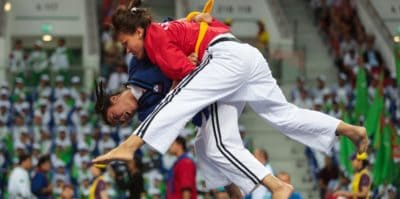
First and foremost is the development of the facilities for the World Nomad Games. These facilities comprise of an internationally rated Hippodrome, with a track designed and constructed by French experts; and the Gazprom Sports and Convention Centre, which incorporates Kyrgyzstan’s largest pillar-less ballroom, capable of facilitating functions of up to 700 guests. Privately funded, these facilities are a start to developing the Region to its fullest potential. The sporting facilities are the first phase of world class venues for year round training for international sports teams.

The focus of the Complex will be the Convention Centre. With MICE business (Meetings, Incentive, Conference and Exhibition) growing and ever-seeking new and exotic locations, Issyk-Kul fits this requisite perfectly. Already booked prior to opening is a Global Economic Forum for May 2017 with an attendance of 350 global Chief Executive Officers planned, including multiple billionaires and Senior Heads of State, organised through the world-renowned, Horasis – The Global Visions Community, an economic think tank based out of Switzerland whose Forums have been called a mini-World Economic Forum by the New York Times. This conference will present the opportunities of Kyrgyzstan as a gateway to the Eurasian Economic Union and Russia, and will place the area on the map for foreign direct investment.
One of the largest infrastructural projects in the region is the Issyk-Kul Water Park and Hotel Complex. Being developed by BHI Hotels in conjunction with Russian based Kvarsis Group and Kyrgyz property developer, Premium Developments, the Complex will provide Cholpan-Ata, the main town on the North Shore of Lake Issyk-Kul with year round tourism facilities. The centerpiece of the development will be a 22,000 square metre enclosed water park with adjacent 100 room three star international branded hotel, thermal centre and spa with a total built up area of 35,000 square metres. Located in the vicinity of the Hippodrome, the development will provide synergy to the operations of the conferencing facilities of the Sports and Convention Centre.
Further east, near the provincial capital of Karakol, is the planned Karakol Ski Cluster consisting of five international standard ski resorts. As skiing and snowboarding become more popular in the Region, the Ski Cluster will afford extensive pistes over several mountains in scenery that rivals the best of Europe. Utilising the latest European technology, and with the re-development of the Karakol Airport, the area will be a new destination for the winter sports markets of both Europe and South East Asia.
With an aggressive long term strategy from the Department of Tourism under the Ministry of Culture, Information and Tourism, there is a positive dynamic between the public and private sector emerging. Tourism development-friendly policies are making this the opportune time to invest in not only the Issyk-Kul Region, but Kyrgyzstan as a whole. The government has set the sector as an economic priority and understands that sustainable economic development will be strongly enhanced through growth of Tourism and preservation of environmental resources. Investors have strong support through the Investment Promotion Agency under the Ministry of Economy as well as a number of international consultancy and law firms which guide the investor through the processes. Thus Kyrgyzstan is ripe for investment.

About the Author:
Stiphan Beher heads the Hotel and Lodging Association of the Kyrgyz Republic and serves as Chairman of the Tourism Committee under the International Business Council as well as Advisor on Foreign Direct Investment to the Presidential Affairs Office of the Kyrgyz Republic.

THE BIG INTERVIEW: Shamsh Kassim-Lakha

WWW.OCAMAGAZINE.COM #23 AUTUMN 2016  

Shamsh Kassim-Lakha is the Executive Chairman of the Board Executive Committee of the University of Central Asia (UCA), leading the planning and building of UCA’s three campuses in Tajikistan, the Kyrgyz Republic and Kazakhstan. He has a long association with UCA and developed the concept document for the University with His Highness the Aga Khan. In 2014, Kassim-Lakha was appointed diplomatic representative of the Aga Khan Development Network to the Kyrgyz Republic. Open Central Asia went to find out more in this exclusive interview.

OCA: Please give us an introduction to the work of AKDN.
Shamsh Kassim-Lakha: For more than 60 years, the Aga Khan Development Network (AKDN) has been building institutions and delivering essential services by creating schools and hospitals, newspapers and electricity generation plants, and social programmes helping improve the lives of hundreds of millions of people in places as varied as Cairo, Kabul, Delhi and Bamako. AKDN has been operating in Central Asia since 1995. Cooperation between Tajikistan and the Kyrgyz Republic began earlier, however, following the famine in Gorno Badakhshan Oblast (GBAO), Tajikistan. At that time, His Highness the Aga Khan was requested to supply food and basic resources for the region which was in great need. The Kyrgyz Government was instrumental in AKDN’s relief efforts by facilitating this aid delivery through its territory because poor infrastructure from Dushanbe to Khorog required transport through the Osh, Kyrgyzstan corridor.
In principle, AKDN only undertakes development programmes when invited by a country, so we came to the Kyrgyz Republic at the invitation of the Government. The Kyrgyz Government appreciated the outcomes of AKDN’s efforts in Tajikistan, and in 1995 when His Highness the Aga Khan came to Bishkek to thank the Government for its assistance in famine relief, the authorities requested AKDN to assist the newly independent country with economic, social and educational projects. His Highness responded very positively to this request from a friendly nation. Similarly, the Government of Tajikistan also requested His Highness to help in fields of education, financial services and rural development as AKDN has considerable experience in all these spheres of development. Be it in northern Gilgit-Baltistan in Chitral provinces of Pakistan, in India or in Africa, we have extensive experience working with rural communities to promote development through self-help community based programmes that focus on sustainable interventions. For example, in rural development, AKDN offers scientific support for animal husbandry or agriculture and engineering training in irrigation for water infrastructure. The eventual outcome of the request by the Kyrgyz Republic was the establishment of the Aga Khan School in Osh, which is now 15 years old and the establishment of the Kyrgyzstan Investment and Credit Bank (KICB), now the second largest bank in the country. We also established the First Micro Finance and Credit Company (FMCC) headquartered in Osh, which operates around the country.
In Tajikistan, we have similar financial services institutions as well as the Aga Khan Lycee and Family Medicine and Diagnostic Centres in Khorog. Dushanbe also has a similar health centre, as well as the Serena Hotel, which is part of the Serena chain, with locations in Pakistan, Eastern Africa and Kabul. The Aga Khan Foundation’s programmes in the rural areas of Kyrgyzstan and Tajikistan are amongst our most successful programmes in Central Asia. AKF’s programmes for improving early childhood education, self-governance in the rural community, and advice to farmers to diversify their crops have now become role models for many others including civil society organisations. For example, greenhouse crops were not grown or very well known in Kyrgyzstan, so we introduced green house technology a few years ago. This model has since become ubiquitous, like wi-fi, and farmers are now growing cucumbers all year round. Earlier, we never had cucumbers or tomatoes in the month of March. Now these farmers enjoy good profits because nobody can typically find cucumbers or tomatoes in March and April. So this greenhouse technology has significantly enhanced farmer incomes.
AKDN’s largest single investment in the region is the University of Central Asia (UCA). It is an institution established by the Governments of Tajikistan, Kyrgyz Republic, Kazakhstan and the Ismaili Imamat under an International Treaty signed in 2000, ratified by the respective parliaments and registered with the United Nations. Under its Charter UCA as a secular, not-for-profit, private University and will offer an internationally recognised standard of higher education, especially to meet the needs of the mountain societies in Central Asia.
OCA: Why does AKDN focus on the mountains?
SK-L: Globally, many universities are focusing on desert, coastal regions and islands, but mountain regions remain underserved. If you look at high altitude societies around the world, there is a common phenomenon: the higher the altitude where people live, the higher the level of poverty. This is because remote communities lack the means to earn an adequate living during the short seasons and face challenges in accessibility to education, health and other services that keep them marginalised. There is a greater risk for people in these marginalised societies to become radicalised. If you can bring that marginalised population into the mainstream by providing access to high quality education as well as professional and vocational skills, they will become job creators and not solely job seekers.
Take a look at Switzerland. Switzerland is a mountainous region, which experienced similar limitations: snow in the winter, where you can’t grow anything. As a consequence in the past, many Swiss migrated, much like Central Asians who now migrate to Russia and elsewhere in search of livelihoods. But Switzerland no longer has those levels of outwards migration. Thanks to high quality education, they have strengthened their human resources and diversified their skills and talents. Now Swiss youth are in engineering, banking and pharmaceutical industries. The Swiss discovered ways of making a living through tourism, earning income while confined to the mountains during winter months. People go to the mountains to ski in the winter, hike in the summer, buy cheese and local products, and enjoy mountain air and scenery. So we believe that promoting entrepreneurship and offering the highest standards of education will support the people of Central Asia’s mountain regions to shape their own destinies. Our objective is to help create the capacities and opportunities for economic and social development through jobs and businesses that suit the culture and environment of these unique communities and turn current liabilities into future assets.
The UCA Campus in Naryn, in the Kyrgyz Republic, has already admitted its first undergraduate residential students and offers degree programmes in Computer Sciences as well as Communications and Media. In Tajikistan, UCA will specialise in Economics, especially for small and medium businesses, and in Earth and Environmental Science. UCA selected these majors following a detailed market survey established demand for these specialisations. We have not chosen them randomly; we want UCA degree programmes to have strong ties to the job market and prepare graduates to be gainfully employed professionals. Recently, when some people learnt that UCA would be in Naryn, entrepreneurs from Bishkek indicated plans to set up a software development company nearby, allowing businesses to employ our Computer Sciences students as interns in the summer. The study of Earth and Environmental Science is also vital to the future of the region.
Climate change has a significant effect on Central Asia. The more severe climate change becomes, the greater the likelihood of extreme weather events such as heavy rain, floods and avalanches. These events result in much loss of lives. Earthquakes are very frequent and can trigger avalanches in the mountains. Part of UCA’s objective is to teach students how to study, research and predict some of these climate related changes to minimise their impact on society.
OCA: How do you select locations for your organisation and why Naryn?
SK-L: For reasons explained earlier, sites for the main campuses in Naryn (Kyrgyzstan), Khorog (Tajikistan) and Tekeli (Kazakhstan), all in mountain regions, were put forward to the three Presidents during deliberations on establishing the University in 2000. The Presidents and His Highness the Aga Khan agreed that because the capital cities of each country had multiple institutions of higher education, the greatest impact of this new university would be felt if campuses were located in mountain regions of each respective country where communities suffer from lack of good quality education. Inhabitants there have access to fewer resources and are more socially vulnerable than citizens living in large cities. In these mountainous regions, high levels of poverty often leave populations marginalised, creating an environment where radicalism can gain a foothold. In Naryn, the collapse of the Soviet Union meant a collapse in local economic life. But despite being one of the most economically depressed places in the country, Naryn is also the fountainhead of many cultures and heritages in the Kyrgyz Republic. It’s good to be in a place with such a storied history of diversity, exchange and new ideas.
OCA: When will the University admit its first undergraduate students?
SK-L: Classes at the Naryn campus begin this September for 72 students, admitted entirely on merit from the three Founding States and a small number from Afghanistan and Pakistan. The Khorog campus opens in Fall 2017 and Tekeli is to follow a couple of years later. This is just the first of four phases at each of the three campuses. When fully completed, the cost of each campus is estimated at US$500 million, a total regional investment of US$1.5 billion. In Naryn, UCA has already made additional investments to improve citizens’ quality of life of by strengthening social infrastructure. A town park, a Family Medicine and Diagnostic Centre and a Centre for Early Childhood Development are the first to come on line.
OCA: What is the language of instruction and mode of communication at UCA?
SK-L: After an extensive review of many countries, including the needs in Central Asia, the Founders of the University came to the conclusion that English should be the medium of instruction. Today, English is not only the language of the United Kingdom but of the world. In Europe, English is a predominant language of research on the Internet and in books, magazines and academic articles; in Russia you will find many universities teaching courses in English, for example at the Higher School of Economics, Moscow. The big challenge of locating campuses in mountain areas is the recruitment of the right quality of teaching faculty, because living in small mountain communities is a significant commitment. But we are truly an international institution, and we continue to attract candidates from universities in Central Asia, North America, Europe, South Asia and elsewhere. We have already sent 42 Central Asian scholars abroad to obtain their PhD degrees and prepare to be teachers and researchers at UCA.
Among the other major challenges UCA faces is the incoming students’ level of preparedness. In the UK, for example, students enter universities after completing 12 grades of education; in Kyrgyzstan and Tajikistan, high school students graduate after 11 grades. So we need to prepare our students for a rigorous university level education. To achieve this, we introduced a one-year preparatory programme focussed on upgrading science, critical thinking, English and maths skills. A minimum standard of English is required of all students who apply to UCA.
OCA: Are you satisfied with UCA’s progress and where do you see the University in the next five years?
SK-L: We signed the agreement in 2000 with the three governments and then selected campus locations in Naryn (Kyrgyz Republic), Khorog (Tajikistan) and Tekeli (Kazakhstan). We put forward a proposal to the three Presidents and made the collective decision to open this university. Then came land selection and appointment of architects. This process is now in its 16th year with our doors opening this September. This progress is not only limited to the University’s campus site; we are also helping to transform Naryn into a vibrant university community. We are building a Smart Park in the heart of Naryn, offering green space, exercise areas and wireless Internet to create a public space for use by all residents. We are also improving the quality and access to health care with the newly established Family Medicine and Diagnostic Centre, Centre for Early Childhood Development. We are also helping Naryn authorities with town planning. It is very difficult to build in these areas, so opening the UCA Naryn campus is a significant accomplishment in scale and scope; UCA has employed hundreds of local employees and engaged local and regional contractors. The cost of construction in Naryn is around US$85 million, and a bit more expensive in Khorog and Tekeli because of logistics and higher construction costs. We are satisfied with our progress, and while there is always room for improvement, as an academic institution we have the good fortune of documenting these experiences and learning from our successes and setbacks. Of course, the opening is just the beginning: Oxford is 800 years old and Harvard is 375 years old. It will take time for UCA to gain global recognition.
Fortunately, we have some experience building universities. I myself was appointed by His Highness to build and operate the Aga Khan University (AKU) and its large teaching hospital in Karachi, Pakistan. We went on to build and operate campuses in Africa, in Kenya, Tanzania and Uganda, and established a campus in UK, for the AKU-Institute for the Study of Muslim Civilisations. AKU programmes are working in Egypt, in Syria until recently and in Afghanistan, where we have quality health service and education facilities. Medical and nursing graduates of AKU are highly recognised in North America, Europe and elsewhere. So we have experience offering quality higher education. It took almost 20 years to achieve that status, and required a significant level of commitment and sustained hard work. I hope it will take less time for UCA, but this only be possible with hard work and dedication to towards high quality research, teaching and service to the community. And in five years, we will see our inaugural class of undergraduates from across Central Asia complete their degrees and graduate, while new students continue to enroll and receive a world class education at each UCA campus in Tajikistan, Kyrgyz Republic and Kazakhstan. Our results can only be judged on the basis of the performance of several graduating classes as they enter their professions and demonstrate their creativity and entrepreneurship.
OCA: How will you best prepare students for the future?
SK-L: The opening of UCA’s first campus in Naryn is only the first phase. Undergraduate students will be heavily engaged in community service, developing social projects in our campus towns and launching student businesses. During summer breaks, students will complete a compulsory internship placing them in positions within businesses, government departments or non-governmental organisations. These vital real world experiences will be attractive to employers and prepare the graduates to transition into the job market. Our goal is to develop our students into entrepreneurs with the skills and experience to become job creators and unlock the region’s economic potential.
In the coming phases, UCA will work with the Founding States to further strengthen the public education system and improve the quality of their secondary school graduates. This is a major challenge given resource constraints but we are encouraged by our partnerships with the Founding States, which are strongly committed to improve school education. Meanwhile, UCA will continue to offer a five-year undergraduate degree programme so that students are adequately prepared for the University’s rigorous international academic standards.
OCA: How do you see UCA’s growth in the coming years
SK-L: It is too early to predict UCA’s growth trajectory at this early stage. However, we are already undertaking studies and consultations to determine the next phases of growth in terms of new disciplines, introduction of graduate studies and strengthening of UCA’s research capacity. After all, an important aspiration of UCA is to become a leading research university that is recognised for its contribution to creating knowledge.

Building a Nuclear Weapon Free World

WWW.OCAMAGAZINE.COM #23 AUTUMN 2016  

From 29th to 31st August, in Astana (Kazakhstan), the international conference “Building a Nuclear Weapon Free World” was held and dedicated to the closing of the Semipalatinsk nuclear test site.

In one place parliamentarians, representatives of international organizations, civil activists, scholars as well as mayors and media from more than 50 fifty countries gathered. Nuclear disarmament was discussed amongst the Under-Secretary-General of the United Nations and the current the Director-General of United Nations Office in Geneva, the Secretary-General of the Conference on Disarmament and the Personal Representative of the United Nations Secretary-General Michael Møller, Executive Secretary of the CTBTO Lassina Zerbo and President of Inter-Parliamentary Union and PNND Co-President of Parliamentarians for Non-Proliferation and Disarmament (PNND) Saber Chowdhury. The forum was attended by the current President of the Pan-African Parliament Roger Nkodo Dang, the Vice President of Bulgaria, Margarita Popova, the current Speaker of Parliament and Honourable Senator of Rongelap Atoll, Republic of the Marshall Islands, Kenneth KedI and the Deputy Speaker of the Fiji Parliament, Ruveni Nadalo among many other dignitaries.
The conference was organised in plenary session and four panel sessions on the themes: “Security without nuclear weapons or war: Manifesto “The World. The 21st century”, “A nuclear test ban and the role of the UN in achieving nuclear disarmament”, “National prohibition and nuclear-weapons-free zones”, “Initiatives and campaigns – legislators, religious leaders and civil society”.
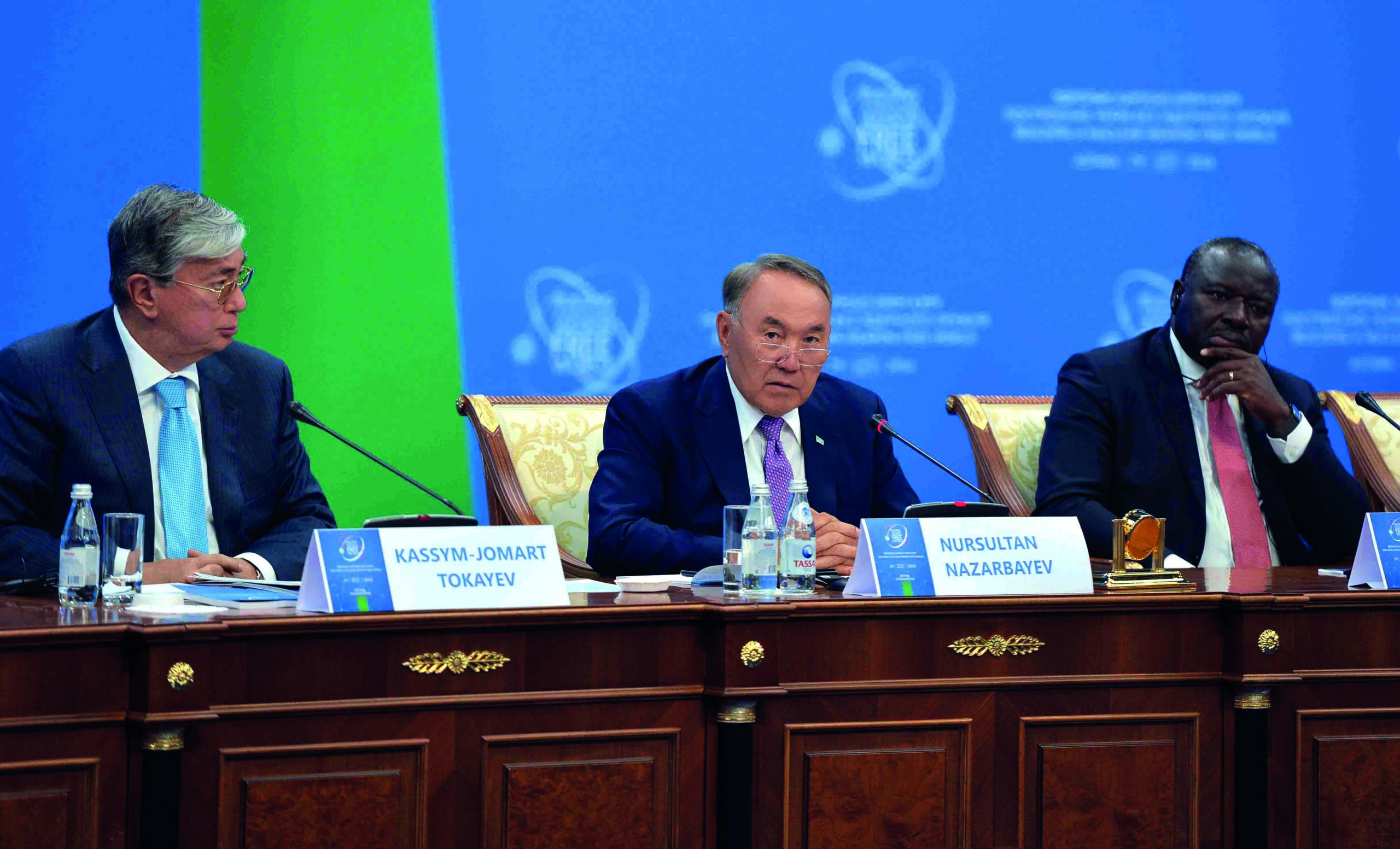
On 29th August 1991 the President of Kazakhstan, Nursultan Nazarbayev, officially closed the Semipalatinsk nuclear test site, which was a major site for testing nuclear weapons for the Soviet Union. It was one of the first steps in the history of world nuclear disarmament. It is worth noting that the people of Kazakhstan voluntarily renounced the fourth largest nuclear arsenal and joined the Treaty on the comprehensive prohibition of nuclear tests.
In the 25 years of independence of Kazakhstan Nursultan Nazarbayev has initiated a number of initiatives in support of achieving a world without nuclear weapons. These have included the repatriation of all nuclear weapons in Kazakhstan to Russia for elimination, negotiations on a Zone free of nuclear weapons with other countries of Central Asia, the proposal of the UN General Assembly on the International day against nuclear tests, the creation of the ATOM project to teach the world about the humanitarian consequences of nuclear weapons and the beginning of a universal Declaration for a world free of nuclear weapons which was adopted by the UN General Assembly in December 2015.
In the spring of 2016 Nursultan Nazarbayev acted in accordance with the Manifesto “The World. XXI Century”, which

Interview with the Ambassador of Kazakhstan

to the United Kingdom of Great Britain and Northern Ireland, H.E. Mr. Erzhan Kazykhanov
WWW.OCAMAGAZINE.COM #23 AUTUMN 2016  

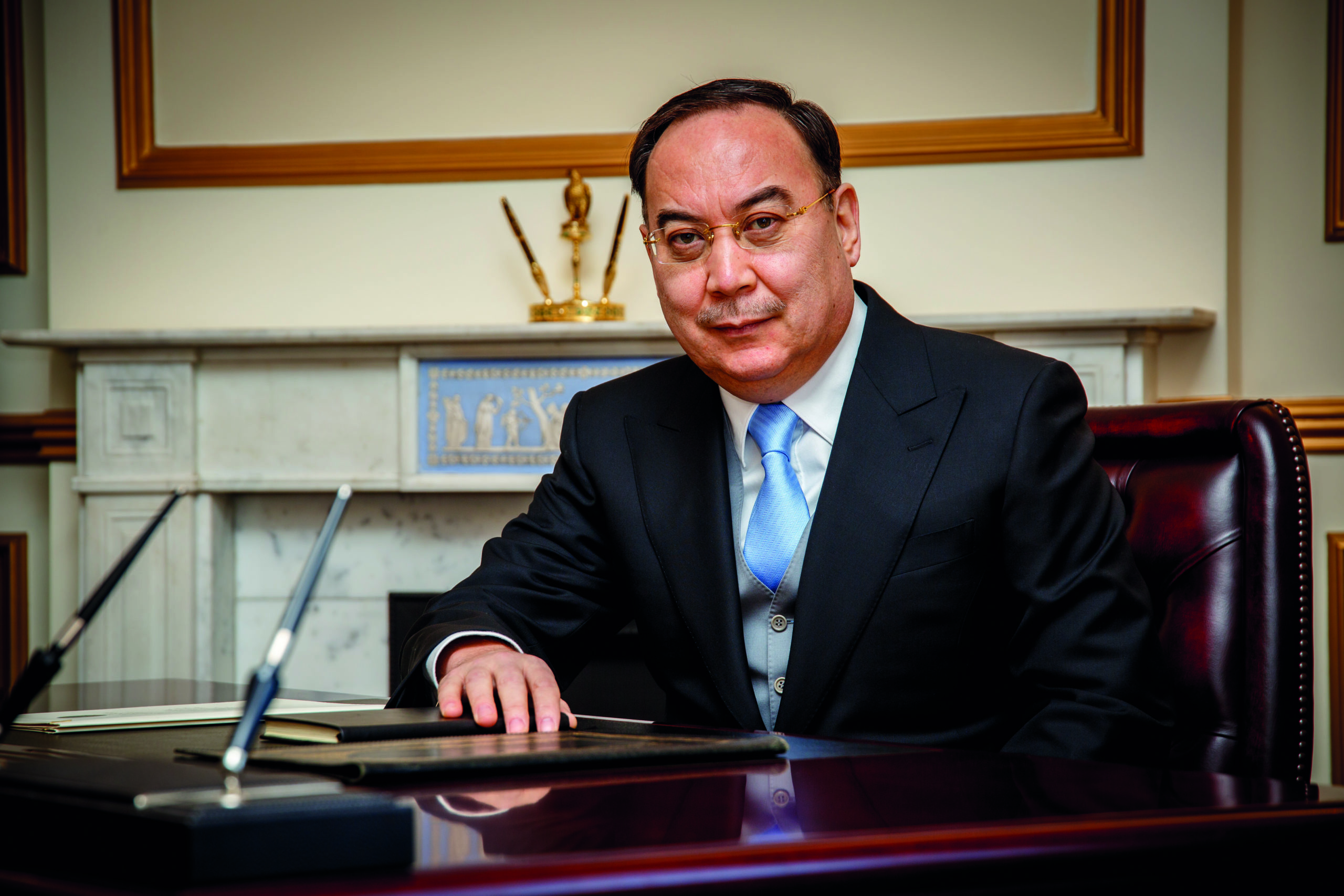
Formerly Assistant to the President of the Republic of Khazakstan in 2008 and 2012-2014, His Excellency Mr Erzhan Kazykhanov has been privy to many of the recent developments in Kazakhstan’s political and economic arenas. Amongst a number of roles in the Ministry of Foreign Affairs and as Permanent Representative of Kazakhstan to the United Nations, he is a very experienced diplomat currently assigned to the United Kingdom as Ambassador. Open Central Asia went to find out more…

OCA: Your Excellency, what are the recent successes and current priorities that you have for developing UK-Kazakh relations?
EK: Since their establishment, diplomatic relations between Kazakhstan and the United Kingdom have been developing dynamically and today have reached the level of a strategic partnership. The relationship of the two countries is based on the numerous bilateral documents and has always been supported by the heads of the two countries. For example, David Cameron was the first serving UK Prime Minister to visit Kazakhstan in 2013.
President of Kazakhstan, Nursultan Nazarbayev’s visit to London in November 2015 opened a new page in the history of our partnership, giving a powerful impetus to the broadening of Kazakh-British ties. The leader of Kazakhstan had a meeting and official lunch with Her Majesty Queen Elizabeth II and met with the then Prime Minister David Cameron at 10 Downing Street. The visit was also marked with the signing of a number of key documents, such as the Mutual Legal Assistance Treaty, an MoU on co-operation between civil services, and an agreement on the UK’s participation in Astana EXPO-2017. In addition to this, a huge package of commercial contracts worth 13 billion US dollars were also signed.
It should also be noted that Nursultan Nazarbayev was one of the first world leaders to congratulate Mrs. Theresa May on her appointment as UK’s new Prime Minister.
There is no doubt that trade and economic co-operation is the main priority in Kazakh-British bilateral relations. The UK became one of the 6 biggest investors to the economy of Kazakhstan, and has invested more than 10 billion US dollars over the last ten years. Kazakhstan has been chosen as one of 14 priority countries for the UK to develop trade relations. Moreover, last year, the UK Government appointed Lord Astor of Hever as a Special Trade Envoy to Kazakhstan, who has already paid his first visit to our country.
In turn, Kazakhstan included Britain in the list of 6 priority countries for attracting investment, and opened up a visa-free travel scheme to its citizens.
Institutional ties are also being strengthened. The Intergovernmental commission on trade-economic and investment co-operation started working last year and the Kazakh-British Business Council has been operating successfully. Existing structures such as the Kazakh-British Trade and Industry Council, the British-Kazakh Society and the British-Kazakh Bar Association also play a significant role in strengthening bilateral relations.
OCA: It is approaching 25 years of independence for Kazakhstan. How would you assess the progress of the country in that time and what evidence would you point to that shows it is a stronger country now than under the Soviet Union?
EK: First of all, over that short period of time, Kazakhstan has proved its political and economic self-sufficiency and self-sustainability. The country has gone through the big way, having overcome the political and economic difficulties followed by the collapse of the Soviet Union. Despite the global challenges, Kazakhstan, thanks to the wise and far-sighted policy of its leader, President Nursultan Nazarbayev, has actually provided sustainable economic growth and preserved political and social stability and peace.
It is with huge pride that Kazakhstan is the home to over 130 different ethnic groups and the followers of all the great faiths who live together in tolerance and harmony. One can say that our country’s model of inter-ethnic and inter-religious peace and concord became an example for the whole world.
Another key achievement of Kazakhstan is its contribution to nuclear non-proliferation and strengthening global nuclear safety. Since the beginning of independence, our country has become an active proponent of disarmament and non-proliferation of weapons of mass destruction. Closing the Semipalatinsk nuclear test site, the withdrawal of nuclear weapons from its territory, and creation of the ATOM project and Zone free from nuclear weapons in Central Asia under the initiative of President of Kazakhstan Nursultan Nazarbayev serve as a clear evidence of the successful policy run by Kazakhstan over the years of independence.
Very successful reforms have been conducted in the economy. Kazakhstan has made a huge jump from a middle income country to a modern and fast developing state with a diverse and dynamic economy. Over the past 25 years, its economy has increased 21 fold, the incomes of the population – 19 fold. The GDP has increased 16 fold. Over 200 billion US dollars of FDI have been attracted to the country’s economy during this period.
25 years of independence is also marked with meaningful international processes, initiated by the President. The Conference on Interaction and Confidence-Building Measures in Asia (CICA) and the Congress of Leaders of World and Traditional Religions are the major international initiatives of Kazakhstan aimed at enhancing security and peace both regionally and globally. Positive results were achieved during Kazakhstan’s chairmanship at the Organisation for Security and Cooperation in Europe (OSCE) in 2010. No less successful was Kazakhstan’s chairmanship at the Organisation of Islamic Cooperation (OIC) in 2011-2012. During its chairmanship, the financial ties of the member states of the organisation were strengthened, efforts on rehabilitation of the grounds of the Semey nuclear test site and Aral Sea were undertaken. The organisation itself was renamed from the Organisation of Islamic Conference to the Organisation of Islamic Cooperation.
One of the key international economic initiatives that had been implemented was the establishment of the Eurasian Economic Union in May 2014 and Kazakhstan’s joining the World Trade Organisation in 2015. The Astana Economic Forum, which is held annually, became a dialogue platform aiming to find effective solutions to major economic and social challenges of the contemporary world.
These are only a few of the main successes that Kazakhstan reached during the years of independence. The country has set ambitious plans to become one of the most advanced states in the world. In particular, Kazakhstan aims to enter the top 30 most developed countries by 2050 and go through the modernisation process as was done by the OECD member states. The large-scale structural economic reforms under the “Nurly Zhol” programme, offered by President Nazarbayev and the National Plan with 100 concrete measures to realise these strategic reforms have the goal of being implemented according to OECD standards. One of these key reforms being undertaken is the privatisation of national companies.
OCA: As EXPO 2017 nears, can you update us on what preparations you have been making from the UK side to support this significant event for Kazakhstan?
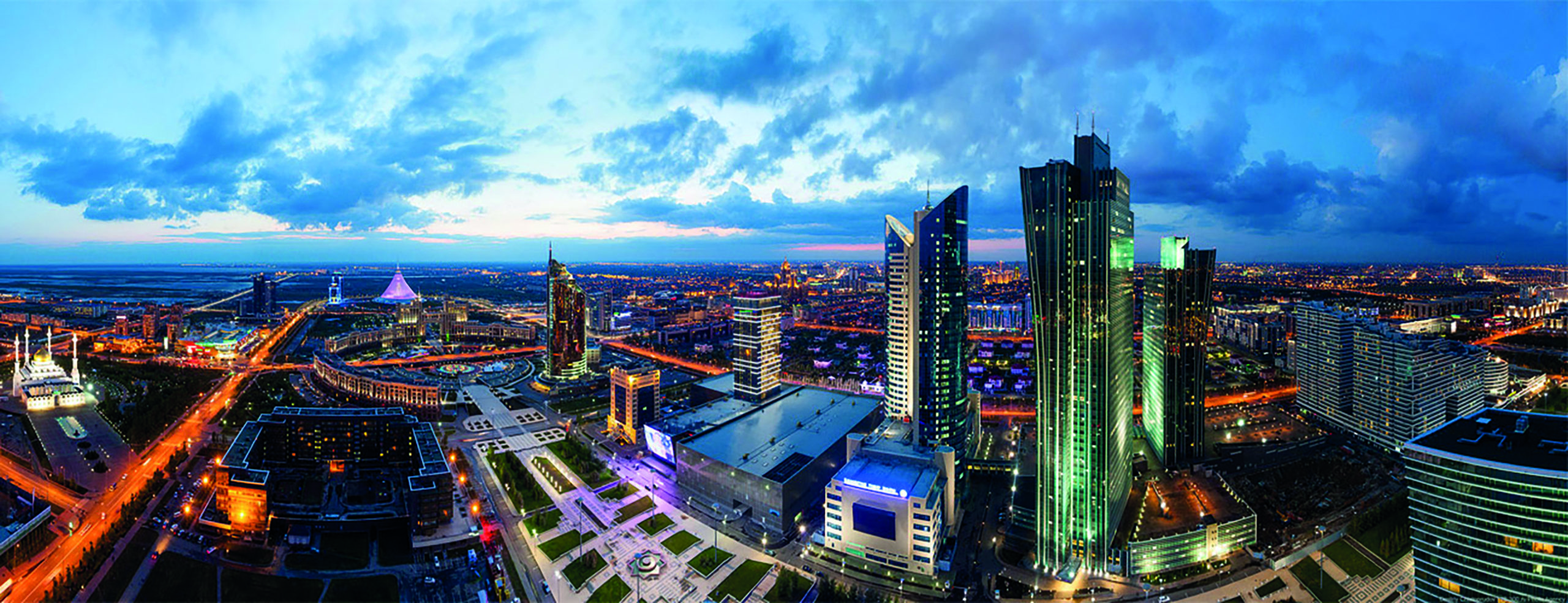
EK: The Astana EXPO 2017 is one of the key national projects of Kazakhstan. The idea of holding such a large-scale event belongs to President Nazarbayev. The preparatory works are under way and the country will try to hold it at the very high level.

One should note that Kazakhstan is the first country among the post-Soviet states to hold the international specialised exhibition in its territory. It will take place from 10th June to 10th September 2017. It is expected that 100 countries and 10 international organisations, as well as over 2 million people will attend it.
The exhibition, which has the theme “Future energy”, aims to research strategies, programmes and technologies to develop sustainable sources of energy. It should give a powerful impulse to help diversify the national economy. Preparing such a large-scale event will involve small and medium size businesses, including the construction of exhibition facilities and infrastructure.
The United Kingdom has already confirmed its participation in EXPO 2017. The British pavilion, which is being constructed, promises to be one of the most visited facilities during the exhibition. The UK’s Royal Dutch Shell became the global partner to Astana EXPO 2017.
OCA: In June, Kazakhstan was elected as a non-member at UN Security Council for the years 2017-2018. What do you expect to see resulting from this Kazakhstan’s membership?
EK: Since the first days of its independence, Kazakhstan has been playing one of the key roles in supporting international safety and global peace. This is not only about Kazakhstan’s contribution to the international nuclear disarmament and non-proliferation, but also its ability to enhance global multicultural and inter-religious dialogue.
Over recent years, Kazakhstan has proved to be a platform for solving a range of international problems. In 2010, our country chaired the Organisation for Security and Cooperation in Europe (OSCE), becoming the first country among the post-Soviet states. Under the motto of Four Ts – Trust, Tolerance, Transparency and Tradition – Kazakhstan gave a new impetus to the organisation and to hold its first summit in 11 years in Astana.
Kazakhstan was the main initiator of the proclamation by the United Nations of the International Decade for the Rapprochement of Cultures (2013-2022), aimed at promoting solidarity among all the peoples of the world, through equality, inclusiveness, as well as cultural diversity.
One should note that Kazakhstan made a significant contribution to the solution of Iran’s nuclear programme and the Syrian problem, having provided its territory as a platform for dialogue between representatives of the Syrian opposition.
Since 2003, Kazakhstan has hosted the Congresses of Leaders of World and Traditional Religions. The country abandoned the world’s fourth biggest nuclear arsenal and closed one of the hugest nuclear test sites in its territory. President Nazarbayev’s recent Manifesto “The World. The 21st Century” which gained the status of the official document of the UN General Assembly and Security Council, also calls for the preservation of global security and peace.
The global community knows Kazakhstan as an honest and peace loving country. Its membership at the UNSC may play a positive role in regulating tensions between the conflicting countries. Our country’s global initiatives may contribute to the establishment of inter-ethnic, inter-cultural, and inter-religious dialogue.
Therefore I believe that Kazakhstan will start its mission as a non-permanent member of the UN Security Council with a bulk of proposals to the international agenda.
OCA: Your Excellency, Kazakhstan has launched another ambitious project – the Astana International Financial Centre. Could you provide more information about this centre?
EK: The Astana International Financial Centre has been created in accordance with the Plan of the Nation – the 100 concrete steps to implement the five institutional reforms of the President of Kazakhstan, Nursultan Nazarbayev, in order to establish a favourable financial environment to attract foreign investment into the economy of Kazakhstan.
In addition to this, the AIFC is designed to focus on ensuring development and an effective management of capital market, equity and welfare of individuals, and is set to develop Islamic finance. The centre will base its development on the experience of the world’s top financial centres, such as Dubai, New York, London, Hong Kong and Singapore. It aims to turn Astana into one of the top 20 financial centres in the world.
One of the major advantages of the AIFC is that it will have an absolutely independent international court based on English Law and arbitrage centre. AIFC will also have a new regulator and administrative authority. The courts will be independent in their activities and separate from the judicial system of Kazakhstan. The official language of the AIFC will be English.
One should note that Kazakhstan possesses all necessary internal and external competitive advantages to achieve this ambitious goal. The country’s geographical location, economic and political stability, favourable tax climate, significant public funds available for management – all these factors can be used to establish a world-class financial centre.
Implementation of this project will give a fresh impetus to diversification of the economy of Kazakhstan. The formation of a fully-fledged financial system in addition to the banking sector, further integration of Kazakhstan into the global economy as well as strengthening the position of Astana as the financial hub of Central Asia.
The most important social effects will be the creation of highly skilled jobs, improved transparency of the business environment and observance of the ethical business standards, as well as the attraction of highly skilled workforce from abroad, and improvements to living standards in Astana.

YOUNG TALENTS OF KAZAKHSTAN CONQUER LONDON

OCA #22 SUMMER 2016 WWW.OCAMAGAZINE.COM

Maide Akan is a young writer, illustrator and eco-designer of Astana, Kazakhstan. She is just 11 years old and composes, writes and illustrates stories about Aysu who is a brave Kazakh girl who not only loves nature and animals, but also leads a bitter struggle with the environmental problems of our time.

In anticipation of Expo 2017 in Astana, in the autumn of this year, the British publishing house “Hertfordshire Press” will publish the first book by Maide Akan under the name «Aysu and the Magic Bag». The book tells the amazing story of Aysu, a girl whose life is no different from ordinary children, until one day Aysu meets a magical bird. The bird is a fairy of nature, and tells Aysu about the many problems with environment, eventually asking for her help.

That is how the amazing adventures of Aysu begin as she seeks to protect nature and win the struggle for a clean environment. The book launch will be held as a part of the “V Open Eurasia and Central Asia Book Forum & Literature Festival”.

In addition to attending school, like any other child, and her literary activity, Maide Akany is founder and designer of her own brand: eco-AYBAG. The company manufactures environmental bags for children and adults with a unique design from one of Maide’s illustrations. The eco-brand was created under the slogan “Protecting environment is a task not only for adults, but also children”.

WARWICK BALL

OCA #22 SUMMER 2016 WWW.OCAMAGAZINE.COM

Despite being far from their motherland, Kazakh students in the UK are among the first to celebrate the 25th anniversary of Independence of the Republic of Kazakhstan. Thus, the alliance of Kazakhs abroad “KazAlliance” organised an annual spring ball at Warwick University, one of the top universities in the UK. Young man and women dressed in Kazakh ethnic gowns were there to welcome the arriving guests attracted most of the attention, striking the imagination of the multicultural audience with unique and colourful style of their attire. The deputy ambassador of the Republic of Kazakhstan and the representatives of the Ministry of Education and the centre of international programmes “Bolashak” were also among the guests of the Warwick Ball. The ball was officially opened with a traditional “Shahu” ceremony, which is associated with great celebrations in Kazakh culture. The traditional performance of debutants accompanied by the Kazakh Waltz was incredibly beautiful and eye-catching, because they had been practicing for over a month prior to the event to hone skills they were honored to demonstrate that evening. Then followed a quiz on the history of Independent Kazakhstan and its outstanding personalities, such as Alikhan Bukeikhanov, Amir Kashaubayev, Hiuaz Dospanov and other big names who have hugely contributed to Kazakhstan’s gaining independence and promoted the image of the great Kazakh steppe. There was also a competition of future brides – “kelin”, where young ladies were to demonstrate the knowledge of Kazakh national customs and culture. As to young men, they participated in a powerlifting competition – “kotermek”. In the end everyone in the room, all the guests and participants performed an ancient nomad dance “Qara zhorga”. It is worth noting that previous Spring Ball of Kazakhs in the UK was dedicated to the 550th anniversary of Kazakh khanate and gathered over 130 guests from all over the UK.

text & photos by Yerkenaz Arinova

NATURAL WONDERS OF SOUTHERN KAZAKHSTAN SAYRAM-UGUM NATIONAL PARK

OCA #22 SUMMER 2016 WWW.OCAMAGAZINE.COM Text by Eugenette Morin

It is calm, silent at the end of the Tian Shan mountain range in the Sayram-Ugum State National Park of South Kazakhstan. That won’t last as the sun rises early, snowy peaks glisten and birds break out into song. The view is breathtaking, bathed in the colors of another beautiful day.

The camp wakes slowly as people stumble out of their tents; whispering good morning to each other and adding a layer to ward off the temporarily fresh, cold air. It is chilly this morning… we are in the mountains after all.

While one of us fills the kettle with sparkling, clear water for coffee from the rushing Sayram Su river, others collect wood, start a fire and get out the breakfast kit for us to fry some eggs before we separate for the day.

The sun comes up over the mountains quickly and those going up Mount Altus, 3020M high, start their hike early. They will return in the early evening; exhausted but euphoric, stunned by the hidden beauty of the hostility surrounding them and awestruck by the demanding terrain set in such splendour. The guides from the Alpinism Federation of South Kazakhstan are instrumental in the success of this excursion.
The climb is difficult with an uneven shale terrain and tall grasses; but the views, the wind and exertion make one feel alive. The smells of sage, mint and wild garlic give this expedition an almost tasty, gourmet flavour. This mountain is a feast for the senses.

A few have decided to trek and picnic at concealed locations, protected by the Sayram Su gorge about 1.5 hours trekking away from camp. Clear, crisp and cold water awaits them at the end of their journey. The lakes are exquisite. The peace and tranquility of nature here is communicative and restorative.

The gorge is amazingly beautiful with sharp, jagged edges. Just follow the river, listen to it as it meanders gently and trickles through fallen logs. The terrain slowly becomes rockier, slightly treacherous but the view will more than reward the efforts of the trekkers. Some flowers do well in this harsh environment and add a dash of red or yellow to the see.
The lakes are clear and you can see right to the bottom, enjoying bright blue surrounded by the hues of grey, beige, brown and green from the gorge. The scene is delightfully inviting and relaxing.

As early evening approaches, activity resumes at camp. While the fire is relit, and water put on to boil, the group gathers to prepare a meal together. There are many stories to share, sharing gratitude for this day in time and space, thankful to have basked in the splendor of Sayram Su; even for a short time.

The evening will pass quickly, sharing stories and laughter around the fire before retiring into an exhausted slumber, perhaps one of the best sleeps ever in the silence and majesty of natural, unspoiled beauty.
Tomorrow, everyone will slowly break camp, relax and breathe in the peaceful serenity of this magical place before returning to the hectic beehive of the city of Shymkent, approximately 50 km away.

We are a small group of 10 people passing through Shymkent who decided to take a few days to get away from the city and enjoy the local mountains. The diversity of activities to do is one of the highlights of Sayram Su. Some of us stayed at camp, lazed around, caught up on some reading and went on short walks along the river, while others indulged in more strenuous exercise.
Weekends or 3 day-2 night excursions of this type are entirely possible at reasonable prices with the Alpinism Federation of South Kazakhstan. Rental of tents, sleeping bags and other camping and/or climbing gear is also available. Guides are absolutely necessary (and very welcoming) for a successful and memorable experience.

This is only one of many possible sportive or cultural expeditions available in South Kazakhstan.

Useful information:

Olga Dashko, President of the Alpinism Federation of South Kazakhstan, is the person to get in touch with at olgadashko77@mail.ru. Olga doesn’t speak English but if you write to her, she can always google translate it or send it to her translator.

She will answer in Russian or have her translator answer your questions. You can also get in touch with the Association for the Development of Tourism in the South Kazakhstan Region at: +7 702 902 5609
or stictourism@gmail.com.

The entrance to the park is approximately 5 km away from the camp itself and you need to pass through a fenced area built in 2010-2011.

Because cars need to be registered with the park authorities, the Federation has cars and drivers that are listed all the time. If you want to bring your own vehicle, you need to get in touch with Olga.

At camp, there is a cafeteria, shower and electricity for those who prefer to concentrate on sports instead of relaxation.

DREAMING OF THE SEA

OCA #22 SUMMER 2016 WWW.OCAMAGAZINE.COM  Story by Stephen M.Bland

Unable to make our desired destination understood, my brother and I disembarked beneath a boundless sky on the outskirts of the ghost town of Moynaq, a place described by painter, archaeologist and art collector, Igor Savitsky – founder of the State Art Museum of the Republic of Karakalpakstan – as the ‘wasteland of the Soviet dream.’ It was fifty degrees Celsius in the shade, except there was no shade to be had. Dogs barking heatedly, shoeless children circled us, wanting to shake our sweaty, luggage encumbered hands.

Colourless tumbleweeds danced idly across the town’s single road as we ploughed onwards. Stopping to ask the few people we chanced upon the location of the gastnitsa, most just stared back blankly, those that did respond invariably pointing in opposing directions. The way throughout Asia, it was better to give a misleading answer than to offer no information at all.

Burnt and dehydrated, we’d been walking for an hour and three-quarters when I tripped on a rock, my bags coming down on top of me. Prostrate upon the ground with grit in my mouth, I was about ready to wilt, when like a mirage a purple ZAZ-966 appeared, sparks flying from its exhaust as it scraped along the asphalt. From this vision of a vehicle a rotund, Weeble-like man emerged, and then another, and another, until there before us stood seven men, gigantic in girth if not height.

And they spoke English.

‘My name is Big Rashid,’ the first introduced himself. ‘These are my brothers: Gennadiy, Viktor, Yuri, Lavr, Arkhip and Adolf.’
‘I’m Stephen and this is my brother Stan,’ I said, clasping his outstretched hand. ‘We’re looking for the hotel,’ I explained as he hauled me upright.

‘Da, the Oybek,’ Rashid nodded knowingly. ‘Come,’ he added, taking pity on us after scrutinizing my dishevelled state.

The nine of us somehow ramming ourselves into his car, I perched upon Adolf’s lap with my head wedged between the front seats.

‘We’ve been looking for ages, but nobody knows where the hotel is,’ I wheezed, craning my neck to avoid being hit by the gearstick.

‘But why would anyone in Moynaq know?’ Rashid snickered. ‘They will never stay there.’

It was a valid point.

‘But there’s no sign for the hotel,’ Stan protested from his writhen position in the footwell.

‘Ha,’ Big Rashid scoffed. ‘In Oz’bekiston you must pay extra to have sign.’

Rashid and his brothers, it transpired, were ethnic Russians from Kyzylorda in Kazakhstan. I asked what they were doing in Moynaq, but my query met with stony silence and darkened expressions, it was obviously a question too far.

Minutes later we parked outside a long, nondescript edifice, literally bursting out of the car as its doors swung open. From behind a tall iron fence, a mongrel growled its welcome, drooling as it bore its teeth.

‘Oybek, go,’ Rashid said, motioning for us to enter the compound.

Lining up to wave us goodbye, the seven siblings cast imposing shadows in the late afternoon sun.

We’d come to Moynaq to visit the Aral Sea, or rather the ship graveyard where the sea used to be. Draining of the Aral dates back to the US Civil War, when finding his supply of American cotton under threat, the Russian Tsar decided to use the sea’s tributaries to irrigate Central Asia – Uzbekistan in particular – to create a Russian cotton bowl. As early as 1908, the geographer and climatologist A.I. Voekov referred to the Aral as ‘a mistake of nature,’ a refrain the Soviets would later come to embrace wholeheartedly in their hunger for the white gold. Each bale of cotton soaking up 1.8 million litres of water, the sea’s trunks were siphoned off in leaky pipes which rarely reached their destinations, the Aral shrinking to one-tenth its size between 1960 and 2007.

At its peak, Moynaq was home to sixty thousand people, mostly fisherman and their extended families, the Aral Sea producing up to thirty percent of the Soviet catch and saving Russia from widespread famine in the 1920s. Accessible only by air and ferry well into the seventies, the town also served as a popular beach resort for bureaucrats, its airport hosting fifty flights a day at its peak. By the eighties, though, tourism had dried up. Digging channels through the sand in pursuit of the diminishing sea, Moynaq’s fishermen discarded their ships where they became grounded. The sea’s major source, the Amu Darya River no longer reaching its historic terminus, a local saying goes: ‘When God loved us, he gave us the Amu Darya, when he ceased to love us, he sent us Russian engineers.’

Today, the town’s population number less than two thousand, the remnants of the sea almost two hundred kilometres away across the manmade desert from which a billion tonnes of salt and dust are blown into the atmosphere every year. A spate of NGO interest which followed the collapse of the Soviet Union led to another saying: ‘If every scientist and journalist who visited the Aral Sea brought with them a bucket of water, the sea would be filled again.’ Unable to overcome corruption endemic throughout the region, most NGO’s have long since given up on the Uzbek portion of the Aral. As the last of the so-called Large Aral Sea quietly dies, the people of Moynaq have found themselves left to their fate.

Atop a bluff behind the hotel stood a concrete monument to the disappeared inland sea, a line of ships laid out on the former seabed below. The sheer scale of the sand-salt desert was stupefying. The hulks on the seabed played out their lingering demise, all rust and graffiti with only the buzzing of insects to break the silence. Huge dragonflies patrolling the exsiccated tract which offered nothing but loss and decay, the extent of the tragedy was immediately palpable.

Striped sunlight spilling through the skeletal ribs of their hulls, sun-baked trawlers lay slowly oxidizing. Animated by history, these inert objects took on an ethereal vitality in opposition to the overwhelming sense of desolation surrounding them. Thorny grey and fuchsia pink thistles destined to become tumbleweeds shook as brackish gusts whipped across the vast emptiness once so teeming with life. With the sea gone, the region was subject to searing summers and freezing winters, five hundred species of bird, two hundred mammals, a hundred types of fish and countless insects unique to the region all now extinct.

At dusk, children came out to play on the jagged boats, devising games with sticks and discarded cans, serrated metal and broken glass peeking through the sand around them. With the sun setting behind the promontory an aurora pink light fell across the desert, a chill wind whistling through the ship cemetery, itself an extension of the other-worldliness which pervaded the whole town.

Back at the hotel, with nightfall the regular power cuts became more conspicuous. At dinner, we sat around the bare candlelit table, our hirsute, barrel-chested host directing as a babushka and her daughter dished up manty, ravioli style dumplings in a broth to be soaked up with lepyoshka.

Our room being the only one occupied, as midnight approached the pitch-dark floor took on an eerie aspect, shards of broken glass rattling in the windows. The town abandoned to packs of wild dogs, vehicles passed at a rate of less than one an hour. With no light pollution, the stars glistened with a rare lustre. It was just us, the dogs and grandma belching at the edge of the world.

TAJIKISTAN: CASA-1000 PROJECT OFFICIALLY LAUNCHED

OCA #22 SUMMER 2016 WWW.OCAMAGAZINE.COM

The launching ceremony of the Central Asia-South Asia transmission line CASA-1000 project was held on May 12th in the city of Tursunzoda in the Republic of Tajikistan with the participation of the President of Tajikistan Emomali Rahmon, Prime Minister of the Islamic Republic of Pakistan Muhammad Nawaz Sharif, the Chief Executive of the Islamic Republic of Afghanistan Dr. Abdullah Abdullah and Prime Minister of the Kyrgyz Republic Sooronbay Jeenbekov.

The launching ceremony was also attended by official representatives of international and regional organizations and financial institutions. In a solemn ceremony, the heads of governments by pressing a symbolic button, gave an official start to the regional transmission line CASA-1000 power project.

President Emomali Rahmon stressed that today’s official launch of the CASA-1000 Project will be a historical milestone for each of us as a symbol of the start of real cooperation among the countries of the wider region of Central and South Asia. Prime Minister of the Kyrgyz Republic, Sooronbai Jeenbekov, Chief Executive of the Islamic Republic of Afghanistan, Dr. Abdullah Abdullah, Prime Minister of the Islamic Republic of Pakistan, Muhammad Nawaz Sharif, and the Vice-President of the World Bank for South Asia Ms. Annette Dixon also delivered speeches.
CASA-1000 is the first inter-regional joint project of the Central and South Asian countries, which will connect the power grids of the Republic of Tajikistan, the Kyrgyz Republic, the Islamic Republic of Afghanistan and the Islamic Republic of Pakistan.

This project will reduce the energy deficit, will contribute to the formation of a new energy market, the establishment of trade co-operation of partner countries, and the creation of new jobs, taking into account a number of economic, social and environmental benefits. A feasibility study of the project was completed in 2009, and in 2011 the project was approved commercially.

This project for Tajikistan and Kyrgyzstan creates favourable conditions for the export of surplus electricity in the summer and will yield a real profit, as well as satisfaction of the needs of the population and the economy of Afghanistan and Pakistan with ecologically clean electricity.

It is expected that exporters of electricity, Tajikistan and Kyrgyzstan in May and September will deliver to importing countries, Afghanistan and Pakistan, up to 5 billion kW / h, including Tajikistan for 3 billion kW / h.
The implementation of CASA-1000 project is the first step in implementing a set of measures and co-operative arrangements to strengthen communication and infrastructure links between the regions of Central and South Asia, which in the future will create conditions for the development and welfare of the peoples of the region.

The total cost of the CASA-1000 project is estimated at 1 billion US dollars. To implement this project, Tajikistan attracts 320 mln US dollars of investment, Kyrgyzstan – 209 million, Afghanistan – 354 million and Pakistan – 209 million US dollars.

It is expected that the first phase will build a high-voltage 500 kilowatt power line with a length of 477 km from Datka of Kyrgyzstan to Khujand of Tajikistan, and then begin construction of high-voltage transmission line from Tajikistan to Afghanistan and from that country to Pakistan with a length of 750 km of power transmission lines.

FLAGS OVER BERLIN TRUTH WIL COME OUT

OCA #22 SUMMER 2016 WWW.OCAMAGAZINE.COM

First ever Kazakh-British feature film has officially been hatched this spring with a working title ‘Flags over Berlin’. It’s a Second World War spy-flick with loads of action scenes, espionage, suspense, and … Love!

We had a sneak preview of the first paragraphs of the film’s extended synopses courtesy of Dauren Toleukhanov and Zarina Kadylbek, a writing duo, working on the film story.

‘Flags over Berlin’ is the story of one of the most important intelligence missions of the World War II.
A British ‘Task Force’ operative must go to the besieged Berlin in mid-April 1945 under orders from Sir Winston Churchill. He must do so wearing the guise of a newspaper correspondent writing a story about the frontline units of the Red Army preparing to storm Berlin.

His real objective is to prevent Soviet Allies from obtaining Berlin-held copies of Nazi Nuclear Program documents as final part of top-secret ‘Operation Alsos’. He must also try to prevent Hitler from escaping capture during the Battle of Berlin as well as to identify and eliminate the SS ‘Werewolf’ die-hard operatives as they plot to kill Churchill.

He will be the only Brit in Berlin for a while surrounded by millions of Soviet and German troops. The mission is hard and extremely dangerous, but he must prevail for his country and His Majesty The King.

The mission will see him assigned to the 150s Rifles Regiment of the Red Army. The official Flag of Victory is given to this regiment by Marshall Zhukov in order to be hoisted over the Reichstag by a Georgian soldier as Stalin is Georgian. The battle weary soldiers are encouraged by their officers – whoever hoists the first red flag over the Reichstag will become a ‘Hero of the Soviet Union’.

Our hero quickly bonds with private Gregory Bulatov and an oriental-looking lieutenant Rakhimzhan Koshkarbaev. Rakhim is very vocal about his Kazakh ethnicity and proud of his nomadic culture. The ‘three musketeers’ become brothers-in-arms during hand-to-hand combat with Nazi die-hards on the streets of Berlin, saving each other’s lives a number of times, with unforeseen consequences for the Mission…’

‘Flags over Berlin’ is based on a true story: Koshkarbaev and Bulatov were sidelined as true heroes by Marshal Zhukov in favour of sergeants Kantaria and Yegorov to please Stalin. They were denied their status of ‘Heroes of the Soviet Union’ three times – by Stalin, Brezhnev and Gorbachev. Recognition came to Koshkarbaev only with Independence: there countless are schools and streets baring his name in contemporary Kazakhstan.

This remarkable story is definitely screen-worthy for anyone coming from Kazakhstan but the idea was to make it into an international film. Thus, a central British character based on the likes of Ian Flemming and other T-Force operatives was introduced to the plot. This main hero will witness the storming of the Reichstag and the first red flag hoisted by Koshkarbaev and Bulatov making the story shine.

The first scene from the movie will be filmed over the summer as a student project of London University of Arts graduating class.

THE RENAISSANCE OF RUGBY ON THE KAZAKH STEPPE

OCA #22 SUMMER 2016 WWW.OCAMAGAZINE.COM

Having Welsh descendants the glorious sport of Rugby is in my blood. My playing days are long gone but the enthusiasm and excitement of supporting a team and watching a live match still gets the adrenalin flowing.

To my dismay when I arrived in Astana five years ago it was as if Rugby did not exist – the sports bars would not show it, the sports shops had never heard of an oval ball and the playing of Rugby was something probably done in the south!
So three years ago, in early March, as part of a weekend of Welsh celebrations a mad idea was formed – to play a game of Rugby on the frozen River Isil. The morning of the match dawned, bright sunshine, pure blue skies and crisp white snow and a rag tag band of people gathered from a wide variety of nations – it was to be Wales Versus The Rest of The world!

There were representatives, including a few watching Ambassadors, from South Africa, Norway, France England and of course Wales but sadly no Kazakhs.

That is until another Kazakh miracle happened; jogging along the walkway by the river came three young men passing a Rugby ball between themselves, focused on their throwing and catching they were oblivious to the sea of different coloured shirts and the spectators lining the river. I stopped them mid throw and asked if they had come to play? How did they hear about the match? Were there others?
They were confused – they were on their way home from training and decided to come along the river for a change! They did not know about the game but yes they wanted to play and they wanted their friends to play too. Frantic phone calls led to scores of players coming from every angle and they played, they played well!.

True warm friendships were made and the spirit of Rugby was reignited on that frozen patch of snow-covered ice at minus 30 degrees. Hot mulled wine and traditional Welsh cakes finished off the event but also started a chain reaction.

Over the coming months different forms of Rugby started to evolve in Astana. A tag Rugby team at Haileybury School, a touch Rugby group , two junior teams at local schools and a development of some amateur local teams but it was not until one year later when many of the elements came together, this time through hearing of the legendary ‘Rugby on the River’ and the intervention of the British Embassy.

Two different young Kazakh men, who turned out to be both players and junior coaches, made contact with the embassy to find out how they could be involved in this years ‘Rugby on the River’ and so a new chapter started and a more formal approach had to be taken. Permission from the Mayors office, selection of a new venue when an early thaw made the river too dangerous and even sniffer dogs to check the pitch were all required and this years event was a wholly Kazakh affair with teams coming from Karaganda, Shatinsk and Astana and a junior competition too!

With the stunning backdrop of Astana’s futuristic skyline and the Presidential Palace four hours of rugby took place with great competition, humour and camaraderie and there was a thirst for more.
Over the next few weeks the momentum gathered pace with meetings of the Kazakh Rugby Federation and a small conference to plan the future of Rugby in the Astana region. And so it emerges !

It is true that Rugby was always in Kazakhstan – indeed the country competes well in the International Rugby Sevens and the womens team have a high world ranking – this year sees the fiftieth anniversary of Rugby in Kazakhstan and this gives an opportunity for greater cohesion, communication and involvement in the game. With the Kazakh psyche for physical sport involving strength and stamina it should natural that Rugby has a foothold here – hopefully with recent developments and the continued enthusiasm this will be the case. We will attract players, followers and hopefully sponsors so that this can be the new emerging Rugby capital for the Central Asian region – it will only take another Kazakh miracle and I know that those happen!

text by Gareth Stamp
photos Anastassiya Palagutina

UZPROMSTROYBANK: A UNIQUE INVESTMENT OPPORTUNITY

OCA #22 SUMMER 2016 WWW.OCAMAGAZINE.COM

Over the past few years, the government of Uzbekistan has undertaken comprehensive measures to reduce state presence in the economy in order to attract foreign investors and create favourable conditions for their active participation in corporate governance.

The Republic of Uzbekistan is currently of great interest to foreign investors. The investment appeal of Uzbek market comes from its access to natural resources, large size of the market, strategic location in the region, as well as a stable internal political situation and appropriate legal framework. There is a broad spectrum of legal guarantees and preferences for foreign investors and a developed system of measures to encourage foreign enterprise. The state guarantees and protects the rights of foreign investors which carry out investment activities within the Republic of Uzbekistan. Measures introduced by the Government for the improvement of the investment environment have fostered a significant increase of foreign direct investments into the country.

When foreign investors make reference to Uzbekistan and its financial system they often come across Uzpromstroybank as a gateway to Uzbekistan because every significant project that has ever been implemented in Uzbekistan was done with the participation of Uzpromstroybank. Now is the right time to benefit from unique investment opportunities with a top bank of Uzbekistan by obtaining shares of authorised capital which are now free to be released to foreign investors.

As the oldest bank in the country, with an almost 95-year history, Uzpromstroybank has been the flagship of the industry with a sustained competitive edge across all market segments providing full-service to corporate, SME and retail banking clients.

Today Uzpromstroybank is a recognised leader of the Uzbek banking sector with sound financial standing. The bank plays a significant key role in the social and economic life of the country, having secured the status of most innovative and reliable bank, which has gained international recognition.
Over its history, large corporate clients have been the pivot of Uzpromstroybank’s business. The bank serves as a major financial partner of tens of thousands of businesses in all key industries throughout the national economy – from oil and gas, chemical, energy, metallurgy and machine construction to agriculture.

The core direction of the bank’s operations is an active participation in structural reforms of the economy, implementation of projects on modernisation, technical and technological re-equipment of industry, support and financial recovery of enterprises, as well as a dynamic increase of the resource base.
The bank’s services to large corporate customers are based on industry specialisation. Uzpromstroybank pays great attention to thorough research of each economic segment, its key players, trends and requirements. This approach enables bank to enhance and optimise its terms of services, as well as to maintain a single credit, interest and fee policy.

Moreover the bank is an expert in developing SME, private sector and retail banking through its diversified strategy and policy. It’s no surprise that the bank is priority choice for SMEs across Uzbekistan meeting clients’ needs for high-quality banking services, providing maximum efficiency and individual approach. Uzpromstroybank has established value propositions and customised financial solutions which give business opportunities for revenue generation and cost reduction to small and medium enterprises.

Uzpromstroybank offers classical and modern banking services to nearly 42,000 corporate and 1.2 million retail customers through its market leading and efficient distribution platform. The bank operates over 400 points of sale, including 44 branches, 42 mini banks, 55 savings desks, 90 FX offices and 151 payment offices.
For many years Uzpromstroybank has been at the top of Uzbek banking rankings by the main financial indicators. Uzpromstroybank holds top position in loans to industry and interest income, second position in assets, equity, total income, loans and non-interest income among other banks.

As at 01.01.2016 Uzpromstroybank’s equity reached USD 351 mln, total assets USD 3 934 mln., loan portfolio USD 3 259 mln., ROAE 10.4%, Cost/Income Ratio 38.2%, net profit USD 33.8 mln.
In view of the Bank’s strong reputation as a reliable partner, letters of credit and guarantees are accepted by all leading banks of the world on account of the Bank’s limits and credit lines that exceed USD 400 mln. Uzpromstroybank continues active cooperation with world-class foreign financial institutions and leading local banks.

Uzpromstroybank’s reliability is reflected in its ratings from leading independent rating agencies. The bank has been traditionally awarded with the highest rating within the Uzbek banking sector of “uzA+” with “positive” outlook on a national scale by local rating agency Akhbor Rating. International rating agencies Fitch Ratings and Standard & Poor`s also assigned Uzpromstroybank the highest possible ratings for Uzbek banks on a par with the country ceiling.

The ratings of Uzpromstroybank consider high recognition of the brand within the country and beyond its borders, an adequate level of capitalisation, high quality of assets, a stable client and resource base, the systemic importance of the bank, as well as the significant scales of its credit and investment activities.

The Bank operates a policy of timely and full disclosure of reliable information including financial highlights, economic performance and ownership structure, thereby giving shareholders and investors the opportunity to make well-informed decisions.

Uzpromstroybank’s corporate governance system is based on the principal of full compliance with the requirements of best international practices. Uzpromstroybank has also set up an effective system of internal control of its financial and economic affairs as a means of safeguarding the rights and lawful interests of its shareholders.

Additional information can be received by contacting the Uzpromstroybank Investor Relations team
at investor.relations@uzpsb.uz
or by phone on +99871 140-79-64

KAMAL HASANOV WINNER OF OECABF – 2015’s NEMAT KELIMBETOV AWARD IN VIDEO FILM CATEGORY

OCA #22 SUMMER 2016 WWW.OCAMAGAZINE.COM

OCA: Kamal, please briefly tell us about yourself and your film making.

Kamal Hasanov: I was born and raised in Azerbaijan, in Baku but I received my higher education in America. After returning, I began to work at the Central Bank of Azerbaijan and after four years working as a prudential policy and methodology specialist. But this is only from nine till six. After work, I, in the literal and figurative sense, take off my white collar and am engaged in creativity. I write short stories, novels and screenplays and periodically make short films.

OCA: You are the winner of the OCABF-2015 contest in the category “Video film”. Please tell us more about the film you made and why you decided to illustrate the story of Elshan Mamedli “Mantis”?

KH: “Mantis” is a story about my good friend, Elshan Mamedli, and is a modern interpretation of the classical story by Nikolai Gogol called, “Viy”. This short work, from the very first line, caught my attention with its interesting plot, deep dialogue about religion and philosophy and unexpected denouement and ending that makes pause for thought. In my video film, I wanted to show the ravishing passion and uncontrollable desire of every person to prove their truth, which can bring with it tragic consequences and destroy the lives of many people around.

OCA: How do you think self-expression is portrayed differently through film versus other literary methods of information transfer?

KH: Maybe it will sound strange coming from the mouth of the writer, but I think that film is a great medium in that it can be used to convey the whole atmosphere and the point of what is happening without any words. I always try to make my work memorable with nonverbal details – a singular aura, characters or emotions. Besides, in our days the most effective way to transmit information for Generation Y is through the screen.

OCA: You are also the author of numerous novels (co-authored with Samuel Gilbert), poems, short stories and plays. Do you have a favourite type of composition?

KH: I’ll tell you a funny story. One day I was talking with my friend Samuel about religion and we discussed the creation of universe. I jokingly said that God and the Devil were a married couple, and all earthly troubles were due to their divorce which meant that they cannot make peace with each other. By the end of the evening I developed a comic idea in a rather serious and multifaceted storyline, which formed the basis of the book “Columbus was a Smoker”. Sam felt a great desire to write a book together, and so this became our first collaboration and was a finalist in the category of best “literary work” at OECABF-2013. So I guess this one has to be my favourite work because through it I found my true mission.

OCA: What message would you give to our readers?

KH: Read books. No matter what parts of you worry or which of your inner feelings disturb you, these themes have all been written about before. Just find the right books to read and a decision will come to you of its own accord. And whoever does not find this applies to them has to write about their own unique case. This is the way that literature masterpieces are born.

DOWNWARD IS HEAVENWARD

OCA #22 SUMMER 2016 WWW.OCAMAGAZINE.COM

It was a strangely cool July night just beneath the mountains around Karakol, and my insides were grinding with food poisoning. My skin seeped with hot sweat while my arms and legs shivered as though I had been bathed in freezing snow, and my skull thundered. My Kyrgyz compatriots first force-fed me modern medicine and then gave me a large dose of ancient animism: they laid me down in the tör of a yurt, wrapped me in heavy woollen shïrdak rugs, and then, lifting my head, had me drink an entire chainik of green tea. Then all save one, a mysterious man who called himself a baqshï, a healer and a shaman, exited.

Middle-aged with a gravely voice, weathered skin, and deep eyes, he leaned over me and, gripping my hands and gently compressing my forehead, began to chant a prayer in Kyrgyz. He invoked the name of the Kyrgyz people’s ancestor-leader, Manas, and he called upon the cosmos and the divine creator Himself. I remember feeling somehow both inside and outside my pain, almost as though it were a kind of searing pleasure, an embodied feeling so intense that I was disembodied. Most of all, I remember feeling cared for. Western medicine can often be so sterile, heartless; this ancient method, by contrast, was so warm, attentive. And it was sublime. I managed to whisper, “Sonun” – “Beautiful” – to my chanting compatriot. I could sense him smile in reply, and he gently rubbed my forehead. I thought to myself, If I die, this is a wonderful way to leave this world.

I did not die, and the next day as I recovered – with more than a few expunges, so to speak – the sage quietly announced to me that I had entered a new stage of my ömür, my life-path. Scribbling numerological codes on a piece of paper (that I subsequently have used as a bookmark in my ornate copy of the Epic of Manas), he explained how the body is a symbol, both in the microcosmic sense of mirroring the universe without, and in an even more microcosmic sense of mirroring the spirit within. Were this not enough, he added, the body is also a symbol of the relationship between these two, between soul and cosmos – as he put it, it is the chain-link between sky and earth.

My chain, he remarked, had been strongly linked to the heavens, with only the faintest tether to the ground. That was rapidly changing. I would still dangle from the stars, but now I would be hooked into the dirt and clay below. I would, in a sense, reconnect with the soil of my ancestors and my deepest origins. And yet, he noted, if one really thinks about it, downward is still heavenward, for ultimately the dust of the earth came from the stars above.

And indeed, nearly a year later, it very much feels as though heaven is now as much the dirt trails and the broken pavement of Bishkek beneath my feet as it is the vast Central Asian night-sky overhead. For the great force of Change, usually such a taskmaster – slow, arduously so, giving no promise of either success or, if you do finally crawl your way to victory, satisfaction – has come at me like an alpine avalanche. And the torrent of snow has been exhilarating and refreshing (if, as my analogy would suggest, also quite exhausting).

All at once, in September 2015 I found myself with a steady job, a steady salary, a steady place to live, and even a steady girl, all here in Bishkek. The last traces of adolescence seem to finally being knocked away like so many pebbles on a mountain slope, and long-awaited adulthood appears up ahead, a pass through jagged edges and cascading waterfalls.

Still, my ömür snakes before me, twisting and turning; I must find my way. Where shall I end up? How shall I get there?

Ever since I was a child, I have wanted to be connected with transcendental things – ideas, forces, mysteries far greater and far older than the individual human being, entities and concepts and realities that were here long before me, and will be here long after me. Yet, I am awful at science, and hence endeavours such as geology and cosmology are beyond my reach. However, lately I have been realising that perhaps not all transcendence is outside of us.

As an adult, embarking upon a career as an inquirer or investigator – a teacher, an academic researcher, a journalist (perhaps one day, were I to attempt to make real one of my wildest notions, even a private detective?) – I am beginning to find that the human mind somehow has a quality, like the shaman’s notion of the earth itself, of originating from something far older than our own individual consciousness, and like a geological or cosmological force, something of it will still be “there” long after we are each gone, slowly taking newer and more powerful shape. Yes, perhaps inward is also heavenward.

What, then, was adolescence? I would say that it was a phase in my life in which heavenward was a fairly straightforward, if very painful, concept: it was up, and only up, stripping off the earth, leaving behind any kind of groundedness, stability, clarity and launching into constant unknown. Now to go heavenward, I must be earthbound – at least for a time, and at least more than I was before.

Yes, the next stage of my ömür seems clear in its ambiguity, and I now trek forward, toward the vaunting Alatoo mountains, soon to descend into the valleys and gorges and caverns hidden therein.

text by Christopher Schwartz

AN INTERVIEW WITH HOLLYWOOD PRODUCER CYRUS YAVNEH

OCA #22 SUMMER 2016 WWW.OCAMAGAZINE.COM

OCA: Tell us about your background and biography?

Cyrus Yanveh: My father Zalmon was born in a small Jewish hamlet in Belarus. He was conscripted into the Russian army at the age of 14. My mother Anna was born in Palestine, a Sabra one of the first girls born in what is now Israel.

Her parents immigrated from Romania through arrangements made by Baron Rothschild. In the wake of World War 1, its dangers and upheavals, both my parents made their way to Ellis Island. They met in Prospect Park Brooklyn. I am the youngest of five first generation Americans. My dad was a prominent Cantor of one of the largest Orthodox congregations for fifty four years.
went to public schools, Music and Art High School and the City College of New York. My interest was music, sports, theatre, writing and having a good time, much to my detriment at times. I worked as a dance band musician, Las Vegas major showroom stage manager, apprentice actor, film technician and chief cook and bottle washer for a traveling magic illusionist show. I was very fortunate to experience the last of the vaudevillian age. At twenty-five I decided it was time to get a real job, by that I mean a weekly paycheck. I was hired as assistant production manager in the New York office of Rose-Magwood. At that time the biggest international TV commercial production company. I learned well. Fourteen months later I was hired as producer – production manager for the very successful high fashion Len Steckler TV commercial company. In 1970 I joined the Directors Guild of America and decided to take my chances freelancing. In 1974 I moved to Hollywood to pursue a career in features and TV which I continue to do to this day.

OCA: When did you first start to produce major motion pictures?

CY: My first TV drama series was “Lou Grant” 1977 staring Ed Asner. I was the First Assistant Director, however my first feature film was “Jennifer,” 1978, staring Lisa Pelikan directed by Brice Mack. I directed and produced the feature documentary, “These Here Are My Feet An American Celebration Of Old Time Music” which was released in 1984 and my first network pilot and series producing credit was “Michael Nesmith In TV Parts” for NBC, directed by Alan Myerson in1985. I’ve produced or production managed about 40 features and TV movies, 20 TV pilots including the just completed “MacGyver.”

I’ve been the recipient of numerous awards and nominations. Included are The Producers Guild Of America Producer of the Year Award, Emmy and Golden Glove nominations for “24,” The Peabody and the Humanitas awards for “Nothing Sacred” created by David Manson and Bill Cain. Two Christopher Awards for the TV movies “Baby” staring Farah Fawcett, Keith Carradine, Alison Pill and Jean Stapleton directed by Robert Alan Ackerman, “Eye On The Sparrow” staring Mare Winningham and Keith Carradine written by Barbara Turner and directed by John Korty. “Son Of The Morning Star” a four hour miniseries produced by Preston Fischer and myself that won five Emmy’s and the Golden Reel award.
OCA: Was working with some of Hollywood’s greatest stars inspiring?

CY: The short answer is “Yes.” There are so many wonderful talented actors. Being an actor is a great profession if that’s who you are. I admired Charlton Heston. He was always first on set, line perfect and very sociable off screen. A great professional and a lovely man. I loved Lee Remick too. We did a big package of commercials together. Rex Harrison was great. I was an assistant director and the only person other then his personal dresser he allowed in his trailer. I had to make sure all his special treats and wines were completely fresh at the start of each day. Anything opened was not allowed. Needless to say at the end of the day my crew and I had wonderful parties with slightly opened one hundred and fifty dollar bottles of champagne.

John Houston was one of my heroes. I was fortunate to work with him for two days. I have a great photo of us together on set and he autographed his book. Willie Nelson, Kris Kristofferson, Bill Bixby, were so much fun on “Another Pair Of Aces.” Claudia Cardinale and I became set pals on the mini series “Princess Daisy” in France, produced by Lillian Gallo and directed by Waris Hussein It’s the show I met my wife Lynne Hockney on. Lynne was the choreographer. John Cusack and Debi Mazar in “Money For Nothing,” Kiefer Sutherland “24,” Charlie Sheen “The Arrival.” Pauly Shore in “In The Army Now” directed by Dan Petrie Jr. all very talented and a pleasure to work with.

OCA: Are the demands of working with TV networks significantly different?

CY: All the networks, studios and production companies have their own dynamic., their own global overview, their own demographic targets. Producing a one hour drama series, week in and week out for 150-200 days requires incredible stamina. You are writing, prepping, shooting and editing on several different episodes simultaneously, its goal is to get ratings.

Doing a pilot and creating its tone that all the ensuing episodes, if picked up, will follow is arduous. The process of defining the characters usually requires continuous script revision. It’s an intense 10 to 15 day sprint. Its goal is to get picked up. Hopefully the creator of the show, its director, executive producer and studio person have a clear cohesive point of view.
Doing a feature film is completely different in its approach to pilots or series. There is more time to prep, execute and complete. On a feature, the director is king or queen, in charge. A bit like a feudal system. The collective energy is funneled through the director to make film literature. A finished product that will make lots of money and have an enduring shelf life.

OCA: Have any Central Asian or Russian movies influenced you?

CY: Sergei Eisenstein’s “Battle Ship Potemkin” created new ways of filming, new ways of seeing and editing. Andrei Tarkovsky’s “Andrei Rublev” is considered one of the greatest films ever made. I was introduced and chatted briefly with Sergey Bodrov about his magnificent “Mongol: The Rise Of Genghis Kahn.” One of my favourite documentaries is “Genghis Blues” about Tuvan throat singers directed by Roko Belic.

OCA: Do you have any Central Asian colleagues?

CY: I was preparing the feature film “I’ll See You Again” for Steven-Charles Jaffe a few years ago with Gaukhar (Gia) Nootas one of the producers. Gia is the Honorary Kazakhstan Consulate for Los Angeles.

OCA: What are your plans for 2017?

CY: I am hoping to open my play “SMP” a three act social comedy about a playwright who has led an adventurous early life but has fallen into a bit pudgy male middle age and a young eccentric twenty-three year old woman casting assistant who wants to do everything. They see themselves in each other. Britain’s David Parry will direct it.

My musical comedy “Zalmon and Anna” is a universal story, true today as it was then about the dangerous journey they endured, their meeting in Prospect Park in Brooklyn after WW1 and their life together as immigrants raising a large family in a new land.

To begin production on “Indian English” (working title), a major film which I am producing with Jillian Haslam and Alan Cox. My script is based on Jillian Haslam’s book “Indian English A Memoir.” It tells the almost unbelievable but true story of a very young Caucasian girl and her family living in the most horrific impoverished slum in Calcutta, who managed to become a wealthy international philanthropist who’s life’s mission is to educate and feed the most poor and ill treated.

To have a new instillation of our continuing art show “MaryAnn Liu and Cyrus Yavneh A Journey From Doodle To Bronze” Google it.

by David Parry

A MUSLIM IS NOT A TERRORIST A TERRORIST IS NOT A MUSLIM

OCA #22 SUMMER 2016 WWW.OCAMAGAZINE.COM
DRAWING PARALLELS BETWEEN JIHAD AND TERRORISM

The role of a human’s life is central in the purest religion of Islam. God created male and female in the finest manner whether to their physical, moral or spiritual qualities (At-Tin 95 / 4-5). Human as the most wonderful creation of the Almighty is the vicegerent of Allah on the Earth (Al-Baqarah 2/30, al-Fatyr 35/39). Everything in the heavens and on the Earth are in favour of the human (Luqman 31/20, al-Jassem 45/13) – the descent of Adam, which was honoured to be placed on the pedestal by the Creator (Al-Isra 17/70).

All human beings have great value to God and, therefore, the religion of God, regardless of their race or faith. When building your life or changing it for the better you should always remember that each of us is sublime and unique in the eyes of Lord. Hence, all the canons of Islam were established by Almighty God for humans not to forget their true path and live their lives in happiness, comfort and safety, while preparing for eternal life.

For this reason, Islam forbids encroaching on the rights, life, property, mind and religion of a human, considering it a crime. The Quran says: “On that account: We ordained for the Children of Israel that if anyone slew a person – unless it be in retaliation for murder or for spreading mischief in the land – it would be as if he slew all mankind: and if anyone saved a life, it would be as if he saved the life of all humanity” (Al-Ma’idah 5/32). In the last preaching, which was sent to all mankind during the last Hajj of Allah’s Messenger (Sallallahu Alaihi Wasallam), he declared that all people, being the descendants of Adam (aleyhis-salaam), are brothers and announced the inviolability of their property, life, honoor and that every person is protected from any kind of attempt on his life (Sahih al-Bukhari, al-Mukhtasar Tajwid Sarih, IL / 76; X / 401-404).

It is worth noting, that pro-Western media, while inculcating their ideology, created a certain stereotype, where the holy terms of our religion became far from the true religious meaning. For instance, a purely spiritual and moral religious term “Jihad” is presented by the media to the whole of mankind in the colours of bloody terrorism, creating scenarios by the hands of pseudo Muslims that stand at the head of Muslim ignoramuses. In addition, unfortunately, even practicing Muslims of today consider “Jihad” is synonymous with the bloody terrorism. Lack of education and inexperience in the field of Shariah provided enough space in the minds of Muslim people for the successful realisation and assimilation of pro-Western ideology.

As a result, “terrorism” generated by the basest qualities of non-believers, suddenly becomes the same meaning with “Holly Jihad” for some of the amateur Muslims. “Jihad” is holy, without a doubt, because Jihad is the establishment of the Most High Allah, which should be understood only through the prism of Sharia and talked about rejecting all the non-religious stereotypes. It should be considered only in the light of Muslim, not the pro-Western interpretation. There can be no shade of the terrorism in Jihad as the root of the latter has no religious character. And identifying terrorism with Jihad is logically impossible. To understand the above, it is necessary to draw parallels between these two terms, and to answer the following questions: What is actually the jihad? What is terrorism? And finally: What should be the attitude of a true believer of Allah’s servant to the ‘Western Jihad’, which is actually called “Terrorism”?.

THE TERM “JIHAD”

The word jihad is translated as effort; application of force; the use of all opportunities and making every effort to achieve the desired result or purpose. And in Sharia law this word has the following definition: “Jihad is to learn and teach others the commandments and prohibitions of religion, to build a life in accordance with the Sharia, to work in the command of good and prohibition of evil, to try to convey Islam, as well as to fight against his nafs (basest human qualities such as envy, laziness, lying, pride, arrogance, etc.) and the enemy from outside.” In the Holy Quran the word jihad means gaining Allah’s benevolence (al-Furqan 25/52), being able to sacrifice your property and soul on the path to Allah (al-Hujurat 49/15), the battle and the war (al-Baqarah 2/41). However, to a large extent the word “Kitale” (murder), not jihad, is used for the expression of the war or the battle in the Quran.

After reviewing all the ayahs and the hadiths regarding this issue, one can easily understand that jihad is the battle not only against the enemies of Islam, but also expresses the struggle of a person between eradicating all kinds of evil and spreading goodness throughout his life. And the hadith: “The true Mujahid (fighting man) is one who struggles with himself (against their base desires)” (Musnad Imam Ahmad, 6/20 clearly states that). Therefore, in the broad sense jihad should be understood as fulfillment of the Allah’s decrees, putting into practice slavery to Him. In that way one should counteract the forbidden desires of the ego and fight against Shaitan, while practicing the universal principles established by Allah and His Messenger during the whole life. And through representing the Ummah one should convey these concepts and Islam in general to our society. This is the term that integrates all the tools, which save the Muslims from all sorts of dangers and various unjust attacks. It unites the actions of heart, tongue and hand of a man, which are expressed through different instruments, such as voice, books, virtue, ethics, aesthetics, and (only in the last instance) the battle. Briefly, jihad is a kind of a Muslim model explaining human behaviour, which is initially far from the model presented today by ISIS and other similar pseudo-religious organizations, including all of those who follow them.

In Islam, war is evil because it destroys society and human life. As already noted, a human is always sublime in the eyes of the religion. According to the religion, war is only permitted for the defence against the enemy attacks. It is only permitted to protect the right to freedom of religion and freedom of man. In Sharia doctrine the war is used not for harassment and violence, but for the protection of human rights and freedoms. Thus, the war is not a dogma or tenet, it is a necessity of the last resort, which should not go beyond the permitted area of use. Moreover, most of scientists unanimously state that a Muslim can participate in a battle or in a military operation only in case when the non-Muslims declared war against Islam and Muslims and only when the enemy attack was made. This implies that no one should die for the disbelief and contradiction to Islam, just as it is impossible to declare war against those who fight against Muslims.

All Western and pro-Western sources claim that Islam has an aggressive character. Orientalists also claim that the Quran gives priority to the war against non-Muslims until the whole world accepts Islam. The truth is that Islam prohibits war except for the purpose of protection, and there is no compulsion in Islam. In other words, no Muslim has the holy right from the name of the religion to force somebody to accept Islam. Even during the battle, it is prohibited to kill children, the elderly, the blind, the disabled, priests, worshipers in churches and synagogues. It is prohibited to cut down trees, to destroy the fields, to crop and to kill animals (al-Zaylai, Tabin al-Hakaik, VI / 104; Ibn Nudzhaym al -Bahr al-RAIK, V / 84). So, who will remain after all that? Only those who took the weapon, sending it against you, and you have no choice but to defend yourself. During one of the battles, the Messenger of Allah (sallallahu alayhi wa sallam) saw the dead woman and said, “After all, this woman did not participate in the battle,” and commanded Khalid ibn Walid radyyallahu anhu not to touch women and children (Ibn Majah, Jihad 30; Ibn Hisham, as- Syrah, IV / 100).

After all that we have said, I think it would be appropriate to raise the topic of terrorism and how it is related to our peaceful religion Islam.

THE TERM “TERRORISM”

There are more than one hundred definitions of terrorism. Any of those definitions always involves cruelty, violence and intimidation. And in particular, it is used for achieving political goals, when all kinds of cruelty, violence and intimidation are directed against ordinary citizens. Speaking about the word’s meaning, one can state that “a terrorist cannot be a Muslim, a Muslim can not be a terrorist.” Since ancient times, abuse and violence found their place among people. And as for today we have terrorism, so the roots of the past appear in a different way and scale. In fact, cruelty and violence were never approved among the peoples of the world, however still we haven’t managed to get rid of this social disease.

All religions, including Islam in particular, forbid terrorism. The principles of Islam are based on peace, integration and tolerance. While promoting unity and respect, love and brotherhood, it strictly prohibits cruelty, crime and violence. In particular, it never allowed bringing any kind of terrorist movements to life, property, the mind and the religion of innocent people, elders, women and children, taking away the soul given by Almighty Allah. Islam forbids such barbarity and violence in any form and by any name. Terrorism has no race, nationality, religion, and especially God.

The Messenger of Allah (sallallahu alayhi wa sallam) forbade people to cause harm and to oppress them. He taught us to show mercy, saying: “Over those who did not have mercy on the people, and Allah does not have mercy” (al-Taj, V / 17). In other hadiths He (sallallaahu alayhi wa sallam) taught us to show mercy, not only to people but to all living beings on earth. Stressing that the achievement of Allah Mercy is at our mercy to all the inhabitants of our planet (al-Taj, V / 17).

Islam is the religion of peace and kindness, which prohibits followers from playing with the honour and dignity of a person, to offend his personality, to mock him, to look down upon him, to swear at him, to gossip about him, to make psychological pressure on him and to be cruel with him. Islam does not allow and, moreover, does not cause terrorism, cruelty or violence. Islam prohibits the infliction of any physical abuse to a human, to torture, to stir him and, finally, to take away his life.

Therefore it is impossible to link the holy term “Jihad”, being a true slave to Allah, the fight on the way against your own base desires and Shaitan, the implementation of the universal life principles in the life of the individual and society, the spread of Islam through ethics and aesthetics, the protection of Muslims and the whole country from all kinds of threats and attacks against terrorism, which aims to shed innocent blood, and the violation of the social values through cultivation of fear, violence and cruelty for political and self-serving purposes. On the contrary, the true holy “Jihad” can treat society from this curse by God and the angels “terrorism.”

The Imam of the Abdul Kerim Satuq
Bogra Khan Mosque,
Honoured member of the International Association
“Generals of the World for Peace”
YUSUPOV Farhad Ilahunovich

THE ARCTIC ZONE OF SILK ROAD

OCA #22 SUMMER 2016 WWW.OCAMAGAZINE.COM

In the modern world one of largest scale initiatives is abruptly changing the face of the world, forming a new paradigm of economic and geo-strategic development and is revitalizing a zone of the Silk Road by land and sea. The project has been named “One Belt One Way.” The intention is that more than 60 countries with a combined population of 4.4 billion people will participate in the project and more than 1 trillion US dollars has been devoted to its cause.

Participants of the Eurasian Economic Community (EAEC), which include Russia, have confirmed their involvement and support in the project and its plans to connect the Eurasian Economic Union and the Economic Zone of the Silk Road in a formal document, signed with China in May 2015. As President Vladimir Putin said, “In essence, in the long term we are talking about a new level of partnership, involving a common economic space on the entire Eurasian continent.”

One of the most serious and large-scale projects proposed by Russia in this regard is an intriguing project focused on the the Arctic zone of the Silk Road.

The Arctic region of Russia currently provides 90% of Russia’s production of nickel and cobalt, 60% of its copper, more than 96% of the platinum-group metals, 80% of the gas and 60% of oil production, with great potential for growth from new fields.

The Arctic Zone of the Silk Road is a multipurpose and multifunctional project. It consists of a number of relatively independent but closely related parts.
1. Transportation of goods along the Northern Sea Route (NSR).
2. Construction of infrastructure along the NSR.
3. Completion of the construction of Sabetta port (Yamal), including the construction of a terminal for the transshipment of bulk cargos.
4. Construction of railways between Bovanenkovo and Sabetta (including transport crossing over the river Ob).
5. The joint development of oil and gas fields along with construction of transport routes.
6. The creation of large oil and gas chemical complexes for processing of raw materials close to the fields.

The transport of goods to Europe via the Northern Sea Route has great interest for the Asian countries. It is shorter and, perhaps most importantly, a much safer route. If the distance travelled by ships from the port of Murmansk to Yokohama Port (Japan) through the Suez Canal is 12,840 sea miles, the Northern Sea Route is only 5,770 sea miles.

There are a lot of problems for transportation along the NSR, not least the fact that the season is only a few months long and requires special ice-class vessels to traverse safely. Recently, however, all these problems are being resolved gradually.
But, one of the major problems is the lack of infrastructure along the Northern Sea Route. Existing ports – Igarka, Dudinka, Dikson, Tiksi, Pevek, Provideniya are not fully equipped with modern facilities and need significant investment for renovation. And these ports serve not only the NSR, but also transshipment of cargos through the largest Siberian rivers. The length of navigable river routes adjoined to the NSR is about 37,000 km. Therefore the development of these ports will give a powerful impetus to evolve the economic circulation of the richest reserves of the whole of Siberia. Without the development of the NSR development, these reserves would not be extracted.

Some progress has been made with the construction and exploitation of Sabetta port on the north-eastern coast of the Yamal Island at the mouth of the Ob River. The first cargo ships moored at the port in October 2013. In this regard Yamal became the de facto centre of the Russian Arctic Zone. Sabetta has the largest airport in the Arctic, able to take a variety of Russian and international longrange aircraft.
However, there are problems. Sabetta Port is not connected by rail with the existing railways. A 173km railway section is to be built between Bovanenkovo and Sabetta as well as the Northern latitudinal route (which is over 700 km). All this will make it possible to provide efficient transportation of goods along the Northern Sea Route. It will create a global system of production, processing and transportation of raw materials and products. Ultimately it will lay the foundation for strategic cooperation between China and Russia in the Arctic region.

Chinese companies are already actively participating in Arctic projects. One of the largest Chinese companies, CNPC, entered the “Yamal LNG” project taking a share of 20%.

“We believe “Yamal LNG” is one of the most competitive LNG projects in the world and therefore we are interested in becoming its shareholders. We hope that our entry into the project will promote external funding for the project and the further development of Chinese-Russian cooperation in the energy sector”, said the president of the Silk Road Foundation, Wang Yangji.

The “Yamal LNG” project provides the construction of a gas liquefaction factory on the basis of the South Tambeysk field on Yamal Island. There are three LNG trains with the capacity to process 5.5 million tons per year. An important part of the project is the construction of Sabetta port, the operation of which is aimed at solving the logistical problems of the project. The first phase of the plant is expected to be launched in 2017 and the project is estimated to cost $26.9 billion. Its shareholders are Novatek (60%), France’s Total (20%) and China’s CNPC (20%).
On September 3rd 2015 an agreement between the Silk Road Foundation and the Novatek was signed to acquire 9.9% of the shares of this company. In additional the Foundation provided Novatek a loan of €730 million for 15 years.

Following the Chinese investment, other Chinese companies are expected to join in Arctic projects. China’s largest diversified company “Dalian Port” has already agreed to cooperate with Sabetta port, as well as generally to the Arctic projects.

Speaking about the construction of the Sabetta port President Putin commented, “It is very important, if such a huge terminal is built it will be great to make it multipurpose, so that apart from shipping liquefied natural gas production it will also ship a variety of other products”.

THE FAILED INTEGRATION OF CENTRAL ASIA…SO FAR…

OCA #22 SUMMER 2016 WWW.OCAMAGAZINE.COM

Since the collapse of the Soviet Union, and the proclaimed independence from it by the republics of Central Asia, the region has had a hard time intergrating its past into its future. A region that was once on the crossroads of great empires, from Alexander the Great’s invasion of Bactria (in modern day Uzbekistan and Tajikistan) to being conquered by the Russian empire in the 19th century. The history of the region involves a constant tale of displacement and transition. The 5 republics that occupy the territory formerly known as Turkestan did not exist a century ago. Their creation is as a result of a project of tinkering and tampering by the Soviet communists.

After the Bolsheviks came to power, they inherited a region with a complex situation, that was as diverse culturally as it was politically, and also faced complex problems with language and religion. The danger lay in independent groups like the Basmachi movement, who could seize upon any situation and assert their own control over the territory and set a precedent for other parts of Russian empire that were thriving for secession and self-control. It was important to spread the doctrine of communism and establish the idea of socialism among the now defunct Russian empire, to create a society that would share ideals, principles and goals, and where the cultural and religious differences were minimised.

Different strategies were developed to establish the Bolshevik’s power. They tried to integrate different cultures and ethnicities under one common idea, imposing a common language (Russian) that would break cultural and nationalistic boundaries and establish an easier path to literacy as education would become transformed from being accessible only to the privileged to being available to all. It took huge effort to educate a region that is believed to have had a literacy rate of just 2-3% of the population. However those achievements came at a cost, since the main goal of the Bolsheviks was the development of communism, which required the reduction of its people’s national self-awareness in order to make their languages and cultures less relevant.

Another policy that had an impact on Central Asia were Agro-Water reforms. It was a project that brought a lot of positive economic impact as land that was seized by Russian imperialists was given back to farmers under certain guidelines. The Bolsheviks provided a larger part of the region with electricity and industrialised and urbanised other smaller cities. In all, the Bolshevik reforms bought a lot of good to the region: they educated the people who were otherwise illiterate, gave women an equal presence in society and industrialised and developed the republics economically.

However with all this good also came pain, none more so than after the collapse of the Soviet Union. Suddenly the region faced a political vacuum that had to be filled when the republics declared independence. The newly formed states (Republic of Uzbekistan Republic of Kazakhstan, Kyrgyz Republic, Republic of Tajikistan, Republic of Turkmenistan) faced a period of great uncertainty and instability as the newly formed states had no blueprint for self-governance. After the declaration of independence, the states held presidential and parliamentary elections where the only people that had the platform to be elected were the same communist bureaucrats that were in power administratively before the collapse. It is unsurprising reflecting back that this should be the case as no-one had known anything else under communism. These leaders have faced serious challenges as the borders of their states were disputed, their resources were unevenly distributed and their spheres of influence constantly disturbed.

Today after twenty-five years of independence all of these states have, sadly, failed in addressing these issues, besides the bilateral relationships between the republics, there are very few positive examples of an integrated relationship in the region. The trade of products and goods between the five states accounted only for 10% of the trade in the region as a whole. There are no day to day functioning economic or military unions between the states, and the only unions that the countries are part of are maintained by their bigger brothers like China and Russia. Asking for stability is asking for a lot from states that were a cut out of the Soviet vision, and while their existence is now close to three decades, it is fundamentally clear that the biggest path for success in Central Asia would be integrating the countries, creating unions and blocs that would develop more co-operation between the states, reform the governments and tear down the borders that suffocate the free flow of goods. The main path for integration lies in democratisation and economic cooperation of the region, but as of now they are still stuck in political transit, where every country’s individual strategy is directed towards the internal problems of social and political development.

SUPPORTING CLOSER TIES BETWEEN EUROPEAN AND EURASIAN UNION

OCA #22 SUMMER 2016 WWW.OCAMAGAZINE.COM

AN OPEN LETTER FROM THE RUSSIAN EMBASSY IN LONDON

As Russian President Vladimir Putin said in his interview to the Italian newspaper, “Il Corriere della Sera”, in June 2015, “we have always proposed a serious relationship to Europe. For a long time we have been talking about the need to deepen Russia-EU co-operation, and it seems that today nobody objects. But in practice we face many obstacles created by our European partners and EU bureaucracy. For us it is absolutely clear that the relationship should be built on a long-term basis not in the atmosphere of confrontation, but in the spirit of mutually beneficial co-operation.”

Being the largest geopolitical entities on the European continent, the Russian Federation and the European Union are naturally interdependent in many ways, linked by their common civilizational roots, culture, history and future. Russia and the EU are two major political and economic power centres on the continent. The development of a strategic partnership with the EU has always been one of Russia’s foreign policy priorities.

It’s true that Russia and the EU currently have different positions on some international issues, including the Ukrainian crisis. But that does not mean that the sides should limit their political dialogue, diplomatic contacts and practical cooperation.
We believe that the “point of no return” has not been passed yet and will never be, and we are ready to work together with the EU and all of its member-states on topical international issues, provided the principles of equality, respect for each other’s interest and truly collective action are observed.
Traditionally, the EU has been our main economic partner. Bilateral trade exceeds EUR 300bn a year. Russia is the third biggest trading partner of the EU. The EU is the largest consumer of our energy exports. Russia firmly holds the position of the EU’s number one supplier of natural gas, satisfying the EU overall demand by a quarter and remains the second most important exporter of crude oil and oil products to Europe. European businesses are broadly represented virtually in all areas of Russian economy. For instance, we make new high-speed trains in partnership with “Siemens”, build cars with “BMW”, “Volkswagen”, “Renault”, agricultural machinery with “Fiat” and pharmaceutical factories with “AstraZeneca”

Moscow is ready for an even closer cooperation with Brussels and other European capitals. This is why Russia strongly supports an eventual economic integration between the Eurasian Economic Union (EEU) and the EU. That will be the integration of integrations. We believe that there are no contradictions between the two models of cooperation, since both of them are based on similar principles and norms, including those of the WTO. The two unions could effectively complement each other. Direct dialogue and practical cooperation between the EEU and the EU would contribute to the resolution of many urgent global and regional issues. In a volatile world with uncertain global development scenarios, regional integration based on pragmatic principles of a trade, customs and market union presents a most prudent and successful way to promote our common interests in the new global environment.

The state of the European integration project is also a case in point. Current difficulties will take time to sort out. It is obvious, too, that expansion of the EU as a chief vehicle of regional integration has its own limits. To move forward we have to use this pause and need for adjustment in a creative way.

The idea of integration between the EU and the EEU reflects an initiative, expressed by President Putin concerning the creation of a common economic and humanitarian space from Lisbon to Vladivostok – a continental market worth trillions of euros, based on the principles of equal and indivisible security, which would encompass both members of integration unions and nations that do not make part of them. Common goals, such as political stability, social justice and economic prosperity, make the EEU and EU natural partners. The EEU is open and inclusive, fully in line with the concept of pan-European economic space. We welcome the emerging diplomatic support for closer ties between the EEU and EU on the part of some European leaders, in particular, those of Germany and France, and hope that the rest would follow suit.

Text by HE Aleksander Yakovenko
Ambassador of the Russian Federation
in to United Kingdom

BRITISH AMBASSADOR TO KYRGYZSTAN

OCA #22 SUMMER 2016 WWW.OCAMAGAZINE.COM

INTERVIEW: ROBIN ORD-SMITH

From the age of just 14, Robin Ord-Smith has known that he wanted to be a diplomat, representing British interests abroad. His love of languages, culture, history and politics combined to serve him well in his ambitions and he joined the Foreign Office in 1989 after studying German, Swedish, Danish, Norwegian and International Relations at Surrey University. Among a number of postings Ord-Smith has worked in Romania, Algeria, Iraq and Tajikistan as well as in business, on secondment to BAE systems. One of his roles also involved working at Buckingham Palace as Private Secretary to HRH The Duke of York. His career has had an incredible breadth of experiences and challenges and his last posting in Tajikistan, from 2012-2014, has set him up well for his latest role as Ambassador to Kyrgystan, which he took up in 2015. Open Central Asia finds out more.

Open Central Asia: You were previously Ambassador to Tajikistan prior to becoming Ambassador to Kyrgyzstan in June 2015. How has your previous role helped you settle into your new role?

Robin Ord-Smith: It always helps having had experience of a similar job. But I think many aspects of my career have helped prepare for this role: I have worked in most parts of an Embassy during my career, have seen the Foreign Office from the outside while on secondment, have seen how the private sector operates and have been able to learn from all these experiences. With respect to Tajikistan, there are of course some similarities, but there are also many differences. I would say my many previous visits to Kyrgyzstan were more helpful in terms of settling in as I already knew quite a lot about Bishkek and the Kyrgyz Republic when I took up my appointment.

OCA: What are the main differences you see between the British government priorities in Kyrgyzstan compared with Tajikistan?

RO-S: As I am no longer Ambassador to Tajikistan, it is really for my successor Hugh Philpott to comment on current priorities. But I can say I see a lot of similarities from my time in Dushanbe. Here we seek to support the government and people in developing a stable, prosperous and democratic Kyrgyzstan. We admire the very impressive achievements of the past few years, but also believe we have relevant expertise and experience that can help the country develop further and be more prepared to face remaining challenges – our work and key projects are designed to do just that. We also hope to further build trade and investment links between our two countries, work together in international fora to combat today’s global challenges, and also build the people to people contacts through educational, Parliamentary, cultural and sporting links.

OCA: The Kyrgyz political system is perhaps one of the more advanced democratic systems in Central Asia, but it is a fairly new concept in the country. Would you agree and what do you see as being required to improve this further?

R O-S: Kyrgyzstan has made very impressive strides towards a fully functioning parliamentary democracy in recent years. Last year’s Parliamentary Elections, where I and colleagues were observers, was a very significant achievement that clearly established on the day the principle of “one person one vote”. I and the UK government admire the very real commitment towards a robust parliamentary democracy shown by President Atambayev, the government and people. But we should recognise the scale of the task for countries in transition and understand that it can be a painstaking and lengthy process. It would be unrealistic to expect this to be achieved overnight.

A continuation of the commitment to democracy is essential to ensure Kyrgyzstan’s further democratic development. The Presidential elections in 2017 represent the next stage of that journey.
Given the UK’s long history of democracy, I have been keen to help foster stronger links between our Parliaments. Already this year two groups of Kyrgyz MPs have visited their counterparts in London, and DfID Minister Desmond Swayne MP and Baronness Stern have been in Kyrgyzstan. I believe that this is an area where the UK has a role to play to help Kyrgyzstan further develop and strengthen its parliamentary democracy.

Such links between our countries can help Kyrgyzstan’s efforts to strengthen the rule of law, respect for human rights and promote transparent and accountable governance for the good of all.

OCA: From your travels through the country, what have been your highlights? What things would you like to see most improve in the next few years?

R O-S: In the short time that I have been here I have already seen enough to appreciate the beauty of the country and to realise the great potential to develop the tourism sector. I was just in Osh province to open a bridge in Kara Kulja – a project supported by the UK that will further the economic development of the region by providing better access to pasture lands. Each time I travel it makes me want to travel and see more of this incredible country. The Kyrgyz Republic remains relatively unknown to the UK, yet combines stunning mountain scenery, fascinating history and a wealth of activities. I would like to see greater understanding of this part of the world and more tourists from the UK and Europe. Further infrastructure development would help increase capacity for visitors and also help to build the economy. I have met many entrepreneurs who, despite the challenging business climate, are building successful businesses. This is an encouraging sign. There are important opportunities in sectors ranging from the extractives sector to agriculture, financial, legal and business services. I would like to see all these areas develop. And for Kyrgyzstan to continue to reform its judicial systems, and further improve the business and investment climate, which will in turn attract e more investors And help to build a strong economy and offer a better future for young Kyrgyz.

More widely I would like to see two things. As Ambassador I of course want to see us further developing the bilateral relationship and working more closely together, including in the international arena such as the UN and Organisation for Security and Co-operation in Europe. Secondly, I see Kyrgyzstan’s current membership of the Human Right’s Council as a real opportunity for co-operation and for the Kyrgyz Republic to use it as a vehicle to showcase their commitment to the promotion and protection of human rights.

OCA: Throughout your varied career, what is the best piece of advice someone has given you in regards to working and living abroad?

R O-S: Never forget that however long you have lived and worked somewhere, you are a guest.

THE BIG INTERVIEW: MINTIMER SHAYMIEV FIRST PRESIDENT OF THE REPUBLIC OF TATARSTAN

OCA #22 SUMMER 2016 WWW.OCAMAGAZINE.COM

Born in 1937, Mintimer Shaymiev was the first person to hold the title of President of Tatarstan, an autonomous republic within Russia, when he was elected in 1991. An ethnic Tatar, he was relected three times serving until 2010. His background is nothing extraordinary, hailing from the village of Anyakovo, in the Aktanyshsky District of the Tatar ASSR. Later he graduated from the Kazan Agricultural Institute in 1959, and worked as an agricultural engineer, joining the communist party only in 1963 where he was deputy head of the regional agricultural department.

His rise through the ranks was steady and by 1983 he was the first deputy chair of the Tatar Council of Ministers, before becoming first secretary of Tatarstan’s Communist Party organization in 1989. In April 1990 he was elected speaker of Tatarstan’s Supreme Soviet who later that year proclaimed the sovereignty of Tatarstan that led to his election as President in 1991. His tenure brought about great change and freedoms for the Tatar people as they emerged a separate autonomous region within Russia, but by 2010 he felt a new generation of leadership was required and, proposed to then President Dmitry Medvedev that Rustam Minnikhanov was his preferred successor who took the helm on January 27th 2010. Open Central Asia had the privilege of finding out more.

OCA: Mintimer Sharipovich, please tell us a little about you and what are you doing now?

Mintimer Sharipovich: After retiring from the post of President of Tatarstan, I became State Counselor of the Republic of Tatarstan. This status is stated in our law, which was specially adopted in March 2010 by the State Council. The position was established for the full use of the experience and knowledge of the President of the Republic for the good of the republic. Within my power I do have the right to initiate legislation. I think the existing forms of interaction between the leaders of the higher authorities of the republic are quite effective. Therefore, a special need for active participation in the daily management of the republic is not required. Sometimes I meet with the President of the Republic and exchange views on current issues as well as the longer-term problems.

Nowadays I mainly focus on realizing a large-scale project to revive the ancient town of Bolgar and the island-town of Sviyazhsk located in the territory of the republic, on the beautiful banks of the great river Volga.

Personally, in my daily routine, almost nothing has changed, except that I have one more day off! At the beginning I could not get used to the fact that on Saturday I do not go to work. With this new free time one of my dreams came true which is that I got a dog. He is a West Siberian husky puppy named Mahmaem, which is the nickname from a poem of our great poet Tukai. We have long walks with him on weekends.
And as always, every day I go swimming as well as keeping up sailing, in which during the past year I sailed 540 kilometers. Of course, my life passion is chess. And I still visit games and watch sports on TV. I love sport: football, hockey, biathlon, basketball and volleyball. I have always paid great attention to the development of sport and for Tatarstan to become recognisable throughout the world for its sporting achievements. We founded the hockey team, “Ak Bars”, a football team, “Rubin”, a basketball team, UNICS, volleyball teams, “Zenit-Kazan” and “Dinamo-Kazan” and others. We successfully hosted the World Summer Universiade in 2013 and the World Championships in Aquatic games in 2014. In the capital of the republic, Kazan, we completed the construction of a modern football stadium, which will be a host to the World Cup games in 2018. Only through sport can unite people! In my opinion, there is no more powerful ideology than sport.
OCA: Tell us more about the project for the restoration of monuments of Tatarstan in the ancient towns of Bolgar and Sviyazhsk?

MS: It was my old dream and I’m glad I have the opportunity to realise it now. At the end of 2009, when I decided to leave the post of President of the Republic, I described the history and significance of these monuments to Vladimir Vladimirovich Putin, and explained that the funds allocated by the federal budget for the preservation of monuments was not enough to prevent their natural degradation. The idea of the revival of Bolgar and Sviyazhsk was supported by the country’s leadership. We agreed to solve the problem of the restoration of these historical objects by equal funding from the federal and republican budgets.

And in March 2010 we started the revival of the ancient Bulgar (a Muslim civilisation of the tenth century), and the island-town of Sviyazhsk (an Orthodox civilization of the sixteenth century). For our country, where national and inter-religious values are honoured, this is especially important and I sit as the Chairman of the Board of Trustees for this “Revival” fund. We did same when we restored the Kazan Kremlin. The success of the project has identified widespread support, thanks to which the revival of heritage has become a national cause. The Republican Fund “Revival” has as its motto, “from the heart and to the heart” and is supported by people of different professions, different ages, different ethnicity and religious affiliation.

A huge contribution to the project comes from investors of large-scale enterprises, which have committed themselves to the restoration of historical objects as well as the creation of infrastructure to benefit local residents. World experts on the protection of cultural monuments are part of the International Expert Council that is headed by the rector of Kazan Federal University Ilshat Gafurov.

I must say that this cause has completely engulfed me. Over the past six years, much has been done and the case for the revival of historical and architectural monuments of the cities Bolgar and Sviyazhsk is gradually coming to the end. We have achieved international recognition from the World Heritage Committee and the UNESCO World Heritage List. But in my opinion, the most important thing is that the revival projects make us spiritually richer, and as I always say, “our society finds spirituality”.

OCA: Mintimer Sharipovich, you were President of Tatarstan for nearly twenty years. During this time Tatarstan reached new heights, both in politics and in social and economic development as well as in the cultural sphere. What would you say has been your greatest achievement?

MS: I think the main achievement is that over the years we have managed to raise the authority of Tatar people and strengthen the national consciousness. All the events of the post-Soviet years have proved that the Tatars are a peaceful, creative people, who have played a huge role in maintaining the integrity of the Russian Federation. It has cardinally changed the attitude to our people. Compared to other nations, the attitude to Tatars has often been ambiguous. The whole ideology of the Soviet Union and the history books unfairly interpreted the role of the Golden Horde and the Tatar-Mongol irruption.

In the life of Tatarstan’s people there have been many positive changes. We managed to hold large-scale international events that allow our multinational country to become more recognisable in the world. We reached inter-ethnic and inter-confessional consent in Tatarstan.

Tatarstan’s socio-economic policy is aimed at improving the living standards of the population, bringing it closer to European standards. It has allowed us to realise complex large-scale social projects in the hard post-Soviet years, such as the Programme of liquidation of wreck housing, make available social mortgages and provide the gasification of settlements among many others. The celebration of the 1000th anniversary of Kazan in 2005 and the holding of the 2013 Summer Universiade were a couple of these successful projects that improved the quality of life in Tatarstan and created a positive image of Tatarstan across the world.

Of course, today we have new approaches to the solution of contemporary problems on the basis of what has been achieved in recent years. This is largely a departure from dependence on raw materials, the creation of innovative products, based on the available scientific, technical and industrial potential of the republic. A prime example is a satellite city of Kazan, Innopolis, which is one of the few new Russian cities. We call it Science City. It was created for the development of innovative IT and high technology within a special economic zone.

In general, the creative work of Tatarstan over the last twenty-five years has allowed us to introduce to the world community a successful “Model of Tatarstan” as an example of a unique way of state-building within the framework of the Russian Federation. This direction remains unchanged even today, in the new socio-political situation in the country.

OCA: How do you keep in touch with Tatars who live abroad?

MS: We, Tatars, are one of the most mobile people. We have a very popular proverb, “Hereketke – bereket”, which means “In mobility is well-being”. Therefore, at the present time Tatars live in every federal state of Russia. Scientists and anthropologists acknowledge that it is not only such qualities as diligence and inventiveness, but also a unique phenomenon of Tatars – tolerance. Throughout our history, Tatars did not initiate any conflict on ethnic and religious grounds. It’s real, tolerance is a fixed part of the Tatar national character. Today, when the world is open to us, we are open to the world and it is possible, perhaps, that there is no country in the world, where no Tatars live.

Since the beginning of the post-Soviet years Tatars living abroad rushed to us to see their native land with their own eyes. Therefore, by Republic of Tatarstan Presidential Decree in June 1992 the First Congress of the World Congress of Tatars (WCT) was convened, in which we decided to establish the organisation “World Congress of Tatars” and its executive committee. The congress was attended by delegates from Tatarstan, the Russian Federation, CIS countries and abroad. Since then, this has provided the main link between us and Tatars living in the Russian regions as well as in the near and far abroad.

Tatarstan has significant experience in supporting the Tatar diaspora abroad. This activity is carried out within the framework of Russian state policy in support of compatriots, in accordance with Article 14 of the Constitution of the Republic, according to which “The Republic of Tatarstan will assist in the development of national culture, language and preservation of the identity of Tatars living outside the Republic of Tatarstan”. The work of the executive committee of the WCT with foreign compatriots coordinates with the International Affairs and Human Rights Commission. Today, the International Union of Public Associations “World Congress of Tatars” unites 140 Tatar national-cultural organisations in the near and far abroad. Our main aim is unite the Tatar nation around positive goals and creative tasks of their historical homeland – the Republic of Tatarstan and, in general, the Russian Federation.

The WCT regularly holds its congresses, they were held in 1992, 1997, 2002, 2007 and 2012, as well as major forums with the involvement of various categories of Russian Tatar population abroad. For example, in many foreign countries, there are official representatives of Tatarstan, who, on behalf of the Republic, assist in the organisation of the “Sabantuy” national holiday in foreign countries. Therefore, in recent years, this festival has become a global phenomenon, recognised by all peoples of the countries in which Tatars live.
Much is being done and on the state line. From the first years of my presidency, we laid a good tradition: in each foreign country we visited on official business I met with representatives of the Tatar diaspora. Now this tradition has successfully continued with the current President of the Republic, Rustam Minnikhanov. This means that our compatriots have the opportunity to address their requests and suggestions directly to the first person of the country. At the instruction of Rustam Minnikhanov we opened a unique internet project of distance learning for the Tatar language “Mother tongue” as well as several educational portals, such as “Belem.ru” and Tatar Social Network “Tatar Ile”.

In earlier times, we even could not even dream about these achievements. I remember when we saw our compatriots from abroad in the early 90s when they arrived at the first Congress of Tatars. And now the world is open – to communicate, share experiences, ask advice, to meet and to cooperate!

OCA: We know how sincerely admired your work is by Ravil Bukharaev, but what do you think about his work and about him as a person?

MS: We are proud of Ravil Bukharaev. He is a worthy son of the Tatar people. He may be in the last years of his life, living and working away from homeland, in a completely different cultural environment, but, despite this, it is not easy to find a man more Tartar than Ravil Bukharaev. And not only because of his brilliant poetry and prose that are always present showing the native images of Kazan and Tatarstan. By showing the world the verses of our great poet, Gabdulla Tukai, and other classical poets, and our story in English, he has actively promoted our history and culture to the entire planet. Of course, this is a fine example of loyalty to his people, his religion and role model for the younger generation. I like especially his translations of the Tukai poems. Tukai was translated and converted by many prominent poets, but Ravil, knowing the Tatar language perfectly, translated these immortal poems into Russian and English directly and thus preserved the national character and profound wisdom. He had all his life followed the instructions of the great Tukai, which in his own translation is: “Love life, love the motherland and all that which is related to the life of your native people”, that is worthy of deep respect and admiration.

I am glad that I was lucky enough to not only communicate with him, but also to be the hero of his books. Even during his lifetime, I repeatedly thanked him for his interest in my work as the first President of Tatarstan. His view on the recent history of his native land has uncovered new meanings and aspects of important events for the republic, in which I had to directly take part. Ravil Bukharaev is a unique human. His talent has absorbed a big world, but at the same time, he has managed to keep a touching love for his roots and to his homeland.

REMINISCING AROUND A DASTARKHAN IN LONDON

OCA #21  SPRING 2016  WWW.OCAMAGAZINE.COM

A special event with a truly Central Asian flavour of music and dance was held in London in December. The event was aimed at providing an informal and enjoyable occasion for students and researchers following Central Asian Studies at London Universities as well as for anyone else with a love and interest of the Central Asian Region. The idea for a special get-together came up spontaneously, after a lively on-line discussion by followers of the popular Facebook group ‘SOAS Vostok Society’ organised by PhD students at the School of Oriental and African Studies, University of London. The Group, with about 280 members, represents a student-led forum where the academic community and general public discuss and share new research and academic events related to the culture, history, economics and politics of Central Asia and the Caucasus. The Group’s members are passionate about this part of the world and happy to share latest news about the Region.

The idea about a Central Asian get-together around a dastarkhan was born during a very lively discussion about London places, where you can taste authentic food from Central Asia and Caucasus. Following an active exchange of information amongst the Group’s members, the choice was made with a small but very hospitable and cosy restaurant called ‘Pasha’ in South-East London. The restaurant can be seen as a small oasis, away from the hectic centre of London, giving you a real feel and touch of Central Asia, thanks to its friendly atmosphere, hospitality, music and, most importantly, food!

The group of about 20 people gathered on 4th December to enjoy famous Central Asian salads, delicious plov and manty, and a conversation about various engagements, both academic and personal, with the Region. The guests were entertained by lively singing performances by the famous ‘London Uyghurs Ensemble’ and its soloist, singer Rahima Mahmut. Sardor Mirzakhojaev, a well-known singer from Uzbekistan, was also there keeping everyone on their feet thanks to his ample dancing music and charming songs. Rakhima Mahmut put his heart into an authentic Uyghur dance. Guests enthusiastically joined the singers, dancing along with the memorable Central Asian music.

The event proved to be a wonderful occasion where people with an interest in Central Asia could meet each other in an informal friendly setting, and share their knowledge and experience on the region. Authentic food and great music were the perfect ‘ingredients’ to make it a really enjoyable and exciting evening. It is very much hoped that this initiative will be continued with other similar events in the future.

Text by Rosa Vercoe, Projects and Operations
Manager at London Centre for Social Studies

MAKING IT TO THE TOP

OCA #21  SPRING 2016  WWW.OCAMAGAZINE.COM

INTERVIEW WITH ACTOR RASHID SHADAT

Uzbek actor, Rashid Shadat talks to OCA’s Aleksandra Vlsasova about his life as an international actor. 2015 saw him involved in many well known films and television programs, including 24 (TV series), Star Wars: The Force Awakens, Mission: Impossible – Rogue Nation, Now You See Me 2, Spectre (James Bond), City of Tiny Lights, Bourne Sequel and A Streetcat Named Bob.

OCA: Please tell about your background and biography?

Rashid Sahadat: I was born in October 1975 in Tashkent (Uzbekistan). In 1995 I studied Drama and Cinema at the Uzbekfilm Cinema Studio, Tashkent, followed in 1996 by studies at the Theatre and Cinema Faculty at Tashkent State Art Institute. At the same time, I was working at the National Drama Theatre of Uzbekistan and the Yuldosh Ohunboboev Republican Youth Theatre.

I have taken part in many international theatre festivals in Tajikistan, Egypt and Germany and have been awarded number of prizes for my performances. Between 2001-2007 I had my own daily morning radio show on Avtoradio Hamroh, FM-102. I have starred in many adverts, music videos and films.
I have also been a producer on a number of films including The Wolves (2007) and “Hoja Nasretdin – The Game Begins” (2006). Now living in London, I have maintained my interest in acting and directing theatre and film.

OCA: When did you first appear in a movie?

RS: My first screen role was a music video where I played the hero. In 2002, director Scan Multi invited me to play a lead role in the video for a song called Don’t cry sweetheart (Anvar Sanaev – Yiglama Jonim). It was very funny and interesting – there was a fight scene where I had to spin in the air – like one of the characters in The Matrix. After this video they started to call me the ‘Uzbek Matrix’. Since coming to London I have been involved as an extra in lots of big productions. In 2015 I WAS in Star Wars, Spectre, Mission Impossible, Now You See Me 2 plus some others. I have also just completed filming for a big budget Hollywood production, which comes out later in 2016 – I can’t tell you the name just yet, though, as they are still filming it.

OCA: Can you remember first movie in which you played the lead role?

RS: The first film where I was a lead was called “Test of Love 2” (Muhabbat Sinovlari 2). I went for dinner with my friend and there were a few actors and directors there. One of the directors was very interested in my appearance and we had a chat and he asked me if I would be interested in taking part in his film. I said yes without having thought about it. But it went very well and was very memorable for me.
OCA: How do you get all these parts? What is your approach?

RS: For the big budget film productions I am registered with some of the main acting extra agencies in London. They manage most of the big name films. For TV roles, you also have to register with some of the more specialist agencies. Of course, you also have to keep up contacts with people to hear what is going on and when.

OCA: What should one expect from such a job? What is a typical day’s filming like?

RS: It’s tiring work, sometimes filming throughout the night or outdoors in bad weather. However it’s a lot of fun and you will meet a whole range of interesting people. I have been lucky enough to meet some of the big names during 2015 – JJ Abrahams, Tom Cruise, Alec Baldwin, Daniel Craig, Jeremy Renner, Oscar Isaac, John Boyega and Christoph Waltz.
It’s very interesting watching a big production film being made – nothing really prepares you for the amount of detail and time they take to get things right.

OCA: What are your plans for 2016?

RS: At the moment I am short listed for a new big budget film production, which starts filming in February. I’m not allowed to reveal the name just yet.

To improve my skills further I am starting an acting course at Pinewood Studios – you always need to keep refreshing your skills.

I am taking part in a tour of Turkey in May, performing traditional Central Asian dance with a team from the US. I will also be giving some dance master classes while we are there. I am also going to Greece in July to take part in the Edipsos Folk Dance Festival. It’s going to be a busy year.

THE GUARDIANS OF TIME: CAUCASIAN TOWERS

OCA #21  SPRING 2016  WWW.OCAMAGAZINE.COM

The beauty of Caucasus is charming. Many historical, cultural and natural attractions there attract people from all over the world. For me the Caucasus has always been associated with towers. They are an integral part of the highland scenery. This is the world of towers. Their simplicity of form, rigorous elegance, conciseness, monumentality reflect the spirit of mountaineers – courage, self-esteem, pride and cohesion. The construction and architectural craftsmanship of these unique towers is striking. Each is individual, since every master had his own style and methods of work.

According to one of the stories, from the early Christian era, the caravan routes that connected East and West used these towers as a lookout and signaling instrument. Tower complexes played an important role in the protection of the “Great Silk Road”

There is also no unanimity among scientists in dating the first appearance of the fortifications. It is believed that the oldest was built in the 8 or 9 centuries AD. The real dawn of tower building falls in the Middle Ages, when the typical style of Caucasian towers with the characteristic and peculiar features of each nation had emerged.

The towers were used in transmission of signals to warn of a military threat against strategically important places such as roads, bridges or gorges. They provided shelter to withstand a siege and a stronghold to defend from. Generic towers could only be afforded by wealthy people of high social status. The cost of construction (if it was a family tower) was around 50-60 cows, and it took one year to build. In case of danger, the family hid in their defensive tower while a guard of usually 4 to 6 soldiers patrolled.

The entrance to the combat tower was located in a remote place, at a height taller than a human’s height. The towers were five to seven levels with loopholes and machicolations. The wall thickness at the bottom reached up to one meter. Defenders of the tower controlled all the approaches, making it very difficult to storm.

Sharaf al-Din Yazdi (“The Book of Victories” (1424-1425)) wrote about the Caucasian towers: “… fortresses and defenses on the top of the mountain, and to go there was extremely difficult due to their height, which was so great that the beholder’s eye blurred and the hat fell from the head … “

Such towers have been built since ancient times. “And they said: we build us a city and a tower, whose top may reach unto heaven; and we will make us a name, before we would be scattered all over the earth” (Bible, Old Testament. Genesis, chapter 11). Worldwide, similar towers can be seen in Ireland, Italy, China, Tibet, India, North America, but the Caucasian towers have their own unique architectural style and harsh charm. Their power and inviolability are a stunning symbol of the Caucasus.

Text and Photos by Tatiana Lari

THE LEGACY OF THE SILK ROAD CELEBRATIONS, HERITAGE, AND TRADE

OCA #21  SPRING 2016  WWW.OCAMAGAZINE.COM

The Silk Road was a “highway”, which ancient China used to reach other realms in order to trade. Nomad and Mongol hordes rode and reached Europe. Central Asian Emperors developed a military and intellectual nest from where science, mathematics, philosophy and medicine “travelled” and enlightened the medieval world. Tribal warlords conquered the greater part of the then-known Euro-Asian land. Once upon a time it brought extraordinary wealth to Europe, measured in silk, precious stones, spices and medicinal plants. Today The Silk Road continues bringing profit through the supply of the most in-demand products: gas, oil, minerals, cotton, water and other products, also art and craft inspired and delivered from their rich regional heritage.

The very concept of the Silk Road carries enormous romantic and historic weight in the West to the present day. The concepts of long distance travel and trade, of meeting new peoples and discovering new luxury items, of the transport of silks and other goods thousands of miles across deserts, mountains and seas, are powerful and evocative. In an age of swift air travel, and of the increasing globalisation of international trade, the history and emotional impact of the Silk Road provides a unique cultural basis upon which to build a programme of engagement between the modern nations on the Silk Road networks.

Where it will be presented.

The organisers, Legacy Routes Ltd in collaboration with Pro Art & Co, a leading and experienced cultural and educational non-profit company with a team of international experts, intends to present this project widely across Europe, benefiting from an existing network of European business organisations, cultural and educational institutions, local authorities and media in order to secure venues, funding, digital dissemination, communication with the diverse audiences and multicultural collaboration. The project includes participation of Silk Road and European artists, scientists, social and cultural workers and a wide range of relevant people involved in topical subjects. An additional programme (exhibitions, lectures, discussion cafes, seminars, public talks, trade/investment presentations, TV documentaries and cultural programme, festivals, conferences and mini trade fairs etc.) will accompany this project.

This is an introduction to the Legacy of the Silk Road, with a multidisciplinary and interactive series of events planned over a three year period. The intent is to provide an insight into the regions of Central Asia, the Caspian – The Black Sea, The Mediterranean and to present this concept of the network of the silk routes directed towards Europe. The aim is to explain the present and historically important exchange of trade, experiences, knowledge, from the past to modern times. It will also present sources of wealth and supply of life-sustainable products and energy to million’s of consumers’ final destinations in Europe.

The focus is on the specific heritage, geography, history, science and culture of the Silk Road and the other relevant countries. It will look closely at the important branches of the region’s industries, agriculture and tourism, which are highly dependent on the traditional understanding of relationships, exploitation and development of resources such as energy, transportation, environment, infrastructure and financial resources of the country. The intention is that the project complements and supports existing national and corporate marketing approaches – whether those be attracting tourism or selling products. It is not envisaged that the project directly competes with any of the existing approaches, but rather that it works alongside them to drive their success.

The final events conference subjects will be: the enlargement of international cooperation, improvement of the wider population’s living standard, enhancement of education, future increase of renewable energy sources and appropriate use of revenue from the exploitation of natural, energy and industrial resources for sustainable development with consideration for environmental issues and specific collaboration between multicultural ethnic populations.

The cultural aspect of the project is to celebrate cultural diversity, artistic festivities and food as an essential attraction which will open up the magic of the Silk Road to those who live in different continents, through focusing on past knowledge and the transfer of its oriental mysticism to our time.

Who will benefit

Legacy Routes Ltd expects to engage a wide range of commercial, educational, governmental and cultural organisations as sponsors, advisers and supporters of the programme. We kindly invite you all to examine the presented programme, and to look at possibilities to act and give your voice by letting us know which area you can participate in and contribute to with your expertise. This call is for both European and Silk Road/Central Asian participants and other countries interested in using this opportunity to cooperate on many levels. This is an opportunity to learn, pull resources and present to their population the importance of this ancient route for multicultural collaboration, which did not yet lose its significance in present time. The project will include young people from the region, as a new and educated force, which would carry on with the region’s progress and accumulation of wealth in a more responsible way.

Why sponsorship/involvement is important?

– Build and develop new markets
– Present your company as one of the leading in the region.
– Showcase your activities and expertise.
– Present the opportunities for trade, investment and cultural-heritage exchange.
– Opening excellent networking opportunities
– Developing new professional and personal
contacts
– Increase your profit and other economic benefit

Contact
Vesna Petkovic


IV OPEN EURASIA AND CENTRAL ASIA BOOK FORUM & LITERATURE FESTIVAL – 2015

OCA #21  SPRING 2016  WWW.OCAMAGAZINE.COM

For the fourth year running, the international literary festival and forum “Open Eurasia and Central Asia Book Forum & Literature Festival – 2015”, organised by the publishing house “Hertfordshire Press” together with the Yunus Emre Institute London Turkish Cultural Centre and “ORZU Arts” theatre was held from 6th to 9th November 2015 in London (UK).

The forum, which has alternated between Central Asian countries and the UK since its inception, held 22 events and brought writers, poets, artists, diplomats and politicians together from 20 different countries, including Kazakhstan, Kyrgyzstan, Tajikistan, Uzbekistan, Turkey, Norway, Brazil, Pakistan, Iran, England, Iraq, Netherlands, USA, Russia, Latvia, Serbia, Croatia, Bulgaria, Scotland and Wales.

Spread across 8 different venues both in London and Cambridge, the festival has gone from strength to strength and this year included the wider Eurasian region amongst its topics and participants. It remains the only such festival that seeks to promote the literature of Central Asia, past and present, to new English-speaking audiences.
Opening on 6th November at the Yunus Emre Institure London Turkish Cultural Centre, Turkey’s ambassador to the UK, Abdurrahman Bilgiç welcomed guests and participants of the festival and contest, followed by opening remarks from the Ambassador of the Kyrgyz Republic, Gulnara Iskakova and Her Highness Princess Katarina of Yugoslavia and Serbia, who both wished attendees well for the next few days of cultural immersion. Rounding the evening off, London Uyghur Ensemble performed from their repertoire.

A traditional part of the festival, and indeed the culminating highlight of the proceedings, is the annual competition among writers, poets, translators, artists and filmmakers from Eurasia and Central Asia. The contest is extremely valuable to budding authors and filmmakers not only because of the promotion to their works that it brings but the total prize money of $31,000 is the largest injection of funds to promote Central Asia that is genuinely open to anyone to apply for by submitting extracts of their latest work.

The main prize is a grant of $20,000, which is put towards the publication of the winner’s book in London, followed by a presentation at the London Book Fair 2017.

The Literary Contest 2015 had very strong participation, with entries from some 800 contestants from 28 countries, including Russia, Kyrgyzstan, Kazakhstan, Azerbaijan, Belarus, Uzbekistan, Moldova, Armenia, Israel, Tajikistan, Turkmenistan, Ukraine and Estonia. The number of participants is now five times higher than when the competition began in 2012.

The winners were announced at a glittering awards dinner at Pasha restaurant with Zinaida Longortova from Russia winning the contest with her book titled “XXX”. She was presented her award by renowned author and former Kazakh politician, Mukhtar Shakhanov. Ikhtiyar Hodja from Uzbekistan took first place in the category of literary translation and Nikolay Anisimov from the Ukraine took the winning spot in the category of illustration.

For the second year the Marziya Zakiryanova Prize, worth $5,000, for the best female work was won by Harlampyeva Natalia (Russia) and the award was presented by Tamerlan Zakiryanov. The Arkadiy Bezrukov Prize, worth $1,000, for the best work on the subject of mountains was won by Pavel Shumov (Russia). The prize was handed out by Elena Bezrukova.

Once again the Generals Awards, from the Association of Generals “Generals of the World are for Peace”, were made at the festival. The Association’s highest award, the “Dove of Peace” medal for the best work on the topic of strengthening of peace, friendship and mutual understanding between peoples, was awarded to Gulsifat Shahidy (Tajikistan). The prize was handed out by honorary member of the Association, Marat Akhmedjanov. A number of certificates of merit were also handed out, including to Yuldosh Yuraboev whose Orzu Arts theatre group delighted festival participants throughout the weekend.

The organising committee of the festival continued its tradition of awarding the authors who have made a special contribution to the development and promotion of literature in Central Asia. This year the diploma was awarded to the outstanding Kyrgyz fiction writer, poet, Begenas Sartov (1945-1978). The diploma was received by a niece of the writer, Shahsanem Murray.

In 2015, the festival organizers established tow new awards: “Breakthrough of the Year”, with the diploma went to Kazakh poet and member of the Writers’ Union and the Kazakh PEN club, Raushan Burkitbayeva-Nukenova. “Author of the Year” went to the British historian, Robert Toby Wight, author of “Vanished Khans and Empty Steppes”.

At the heart of the capital, at the University of London (University College London) and the Yunus Emre Institute London Turkish Cultural Centre, there was a presentations of several new books, including last year’s winner, Davlat Tolibshoi for his book “Cranes in the Spring” and Lenifer Mambetova’s poetry, “My Homeland, Oh My Crimea!”.

A round table devoted to the Central Asian literature took place at Cambridge University. The meeting was held with the students of Cambridge University and discussed books by Mukhtar Shakhanov, Sultan Raev and Raushan Burkitbayeva-Nukenova that were also were given to the Cambridge Library.

An important panel discussion on the topic of “Central Asia through the eyes of Western writers” was held at Yunus Emre Turkish Centre. The moderator of the meeting was author of “Friendly Steppes” and Editor-in-Chief or Open Central Asia Magazine, Nick Rowan, who had to be on top of his game to keep an enthusiastic set of contributors under control.

For the first time, a special session of London’s highly fashionable Extremists Club was organised as a part of the overall festival. Participants were invited to share Remembrance Sunday worship at St. Peters church in Clapham as an insight into British cultural life. Following which, they withdrew to the upstairs “Theatre Room”, wherein Mukhtar Shakhanov was asked to speak about his literary work and political views to colleagues from across the capital. As an experimental “arts and politics” club (currently receiving rave reviews) David Parry took his usual position as chair – in his now legendary persona “The Whig” – and led a lively discussion.

With the event taking place over the Remembrance Sunday weekend, several recitals were held in memory of those writers no longer with us: Nemat Kelimbetov (1937-2010), Kazat Akmatov (1941-2015), Ravil Bukharaev (1951-2012), Cengiz Dagci (1919-2011) and Beganas Sartov (1945-1978).
.
David Parry, playwright, poet, and member of the Royal Society of Arts, David William Parry conducted the Nemat Kelimbetov Prize ceremony, awarding prizes to the contestants in the category of “Video Film”, with the winner of the Nemat Kelimbetov Prize (for $5,000) being named as Kamal Hasanov (Azerbaijan).

The extended weekend festival once again proved that there is significant interest in and great authorship from Central Asia and its wider Eurasian sphere. It would not have been possible without the tireless efforts of Marat Akhmedjanov and the Hertfordshire Press, Open Central Asia and Silk Road Media teams. Next year’s festival is proposed to be held in Yakutia, Russia, and will continue to grow from strength to strength if the 2015 festival is anything to go by.

Previous festivals in 2012-2014:

The first OECABF festival was held on 24 to 25 November 2012 in Bishkek (Kyrgyzstan), gathering 1300 guests and becoming the first event of its kind in the region. The festival was opened by the former president of Kyrgyzstan, Roza Otunbayeva. The winner of the literary contest was Galina Dolgaya (Uzbekistan).

The 2013 festival took place from 5 to 9 November in London and Cambridge, providing an opportunity to the British public to get a better idea of the work of artists from Central Asia. The winner of the literary contest was Zaur Hasanov (Azerbaijan).

The 2014 festival was held from 14 to 17 November in Almaty, Kazakhstan. OECABF 2014 was organized by the publishing house “Hertfordshire Press” in conjunction with the National State Book Chamber of the Republic of Kazakhstan, “Elena Bezrukova Centre”, and supported by the Ministry of Culture of Kazakhstan, Almaty city administration and the Kazakh Academy of Sports and Tourism. The festival held 38 events. It was visited by 2,500 people. More than 65 writers from 10 countries spoke with their reports and presentations. The winner of the literary contest was Tolibshohi Davlat (Tajikistan).

The 2016 Festival is currently planned to be held in Yakutsk ( Russia)

HERTFORDSHIRE PRESS
Since 2002, the publishing house “Hertfordshire Press” (London) has specialized in the publication of modern non-fiction literature by Eurasian authors, as well as re-release of important works of previous years, which, despite their undying relevance, currently unavailable in English.

MEET THE MAN: VITALY BONDAR

OCA #21  SPRING 2016  WWW.OCAMAGAZINE.COM

WINNER OF THE OPEN EURASIA AND CENTRAL ASIA BOOK FORUM CONTEST IN THE CATEGORY OF ‘ILLUSTRATION’

No book is ever finished without at least some illustration or artwork. Even the most simple books will have a hint of creative design and that is why the OECABF contest also includes a category dedicated to those in the illustration business. Last year’s winner, Vitaly Bondar of Belarus, gives us his perspective.

OCA: In what field does your work align artistically?

VB: Universalism. Due to the impossibility of unambiguous interpretation of art, just comprehensive assessment forms the objective idea. The ability for different kinds of creativity, breadth of vision, understanding of hidden patterns and multiplication of artisan experience give us great signs that we are developing as an artist.

OCA: Is the fact that you think it impossible for art to be unambiguously interpreted a demonstration of our own human imperfection then?

VB: The imperfection of knowledge puts us into dependence upon the solemn assurances of others. That is why I prefer the designation of basic concepts that characterize my values and antagonism. For example, I am far from the destructive ideas in art, considering the overall humanistic message of religions (Christianity, Judaism, Islam, Buddhism, etc…) is based on the concepts of eternal love and justice. As you know, the problem in their interpretation. Hopefully, the therapeutic, healing qualities of art play an important role for each individual.

OCA: Which artists do you admire?

VB: I enjoy the works of many artists starting from the Renaissance and ending with representatives of non-figurative art. Among the classics I prefer are John Sargent, Giovanni Segantini, Tavik Simon, Luigi Becky, Guy Rose and William Merritt Chase.
OCA: What effect does literary art have on your work?

VB: Visual art and literature have been inseparable companions since the advent of printing. It looks like literature and philosophy form the artist to a greater extent than their surroundings. The first book that moved me to understand the art experience was “Islands in the ocean” by E. Hemingway.

OCA: What does winning the Open Eurasia and Central Asia competition mean for you?

VB: It is a great honour, because for the creator not only is knowledge important, but also confirmation of selected targets. The Open Eurasia and Central Asia book forum and literature festival allows authors to “be heard” and stimulates the creation of new original works.

OCA: What do you think about contemporary art that are closest to you directions?

VB: Unfortunately, modern art is “on decline waves.” The radicalism of ideological and aesthetic concepts, the amorality of science, environmental pessimism and lack of legal protection of personality all provide serious obstacles to its recovery. In fact the conflict between so-called contemporary art and its predecessors / opponents doesn’t exist, because all have different learning tools.

INTERVIEW: GULSIFAT SHAHIDI

OCA #21  SPRING 2016  WWW.OCAMAGAZINE.COM

Journalist, Author and Narrator, Gulsifat Shahidi, shares an insight into the life behind her words and what she sees for the future. She is the author of recently published, The City Where Dreams Come True, by Hertfordshire Press and took part in the OECABF-2015. OCA sent our reporter to meet this fascinating lady, the mother of three sons and seven grandchildren. Recipient of ‘Golub Mira medal” by the International Association: ‘Generals of the World for Peace’

OCA Magazine: What inspired you to start writing?

Gulsifat Shahidi: Professionally I am a journalist and a narrator by vocation; I have always composed very funny fairy tales for small children and written books for adults. As a journalist I started writing early on and only later did I start having books published. My family has always been foremost in my mind and so have taken much of my time, but now that my children are all grown up I have time to create.

OCA: What drives your inspiration and how do the ideas of your works take form in your mind?

GS: While working as a journalist I had gained a lot of knowledge, impressions and extraordinary memories, which I wanted to share with the reader. It was a fascinating era and we were living in it. My ideas are born for many reasons. World literature, ranging from the ancient to modern, as well as the contrasts of despair and excitement when thinking of today’s world have all influenced my ideas.
OCA: Which writers do you admire? Which book or books would you advise everybody to read?

GS: I can only list some of them: the Tajik-Persian poetry of Rudaki, Firdous, Khayyam, Hafiz, Rumi, modern Tursunzade, Loic, Sattor Tursun, and, of course, world classics such as Byron, Shakespeare, Balmont, Remarque, Hemingway, Chekhov, Dostoevsky and Nabokov.

Also I would advise the following influential books: “Bird Talk” by Hattori, Mesnevi Jalaluddin Rumi, “Master and Margarita” by Mikhail Bulgakov, “The Picture of Dorian Gray” by Oscar Wilde, “Notre Dame de Paris” by Victor Hugo, “War and Peace” by Leo Tolstoy, “Jane Eyre” by Charlotte Bronte, “How to Win Friends and Influence People” by Dale Carnegie and “Crime and Punishment” by Fyodor Dostoevsky. All of the above is just a small selection.
OCA: Do you think do printed books have a future in the digital world?

GS: It’s hard to say … but I do hope they will! I’m an optimist. How can we get on without books? And, besides, presenting an autographed book to someone is better than simply sharing the site where it is printed.

OCA: And how does a creative mind like yours spend their downtime?

GS: I like swimming.. if we can call it a hobby. For leisure I go to concerts and performances with my grandchildren and children. Recently my husband and I went to the opera, “Carmen”, at the Bolshoi Theatre, which was pretty special.

OCA: What are you working on currently for your next publication?

GS: I am writing a book about the fate of women. I know it’s hard, but it seems possible. I would like the book to be presented at the next Open Central Eurasia and Central Asia Festival as part of the contest. I have not even dreamed of the publication of my book in English before. It is for me a gift of fate. I would like the linguistic and stylistic features preserved in the English version.

OCA: Finally, what would you like to wish our readers?

GS: Harmony in the world … that’s all! You can see by yourself what’s going on in the world. I think it’s because people read and understand books less. OCA and Silk Road Media are doing a very important job in printing, translating and publishing more books! I hope that your readers will be faithful to books, as they are the light of learning and education.

WORDS, TENGRISM, AND WITTGENSTEIN

OCA #21  SPRING 2016  WWW.OCAMAGAZINE.COM A personal reflection by David Parry

Words are not as they seem. They neither yield to linguistic analysis, nor allow an uninitiated mind to unravel their secrets. A staggering fact haunting Tamburlaine the Great (died 1405), ultimately frustrating Abai (1845-1904), although stimulating my colleague Sultan Raev (born 1958) in his theatrical productions. Perhaps this is why I have always dreamed of unpacking the word “Tengri”. An exploration (possibly), making me the first European to delve into Central Asian Spiritualism. Indeed, my mind’s eye already watches me dance with regional shamen to interpret the agitated sounds inside a beehive. Or recite tribal songs along with the Bards of Kirghizia and, thereby, share the memories of ancient hero’s from ages past. Undoubtedly, when indulging in such reveries, I can almost feel my drum beating alongside those of young warriors on the endless and anxious steppes. After all, there is so much more to the lexical item “Tengrism” than the simple “animism” or “totemism” belonging to a primitive past. So very much more than merely the primal runes of pre-industrialized Turkic clans bereft of a continuous civilization. Unbelievably more, I suspect, than the type of Paganism, which nonetheless evolved into esoteric knowledge concerning the Breath of breaths – an old Sufi phrase. So conjectured, Tengrism, is akin to a spiritual vocabulary, a lifestyle preserving deep ancestral wisdoms as well as a type of sensual mysticism characteristic of Turkic cultures at their zenith.
Of course, dictionaries attempt to define Tengrism, albeit in a pedestrian sense. Enclosed in their academic covers, these volumes speak of populist views contending Tengriism is a nationalist religion. Described alternatively, they argue this religious ideology is an attempt to discover meaning through harmonious collaborations with our surrounding environment. It is a stance that modern Tengriist devotees are said to embody as poets and wrestlers. Men who understand that by living an upright and respectful life, a human being will keep his world in balance, whilst maximizing personal power. Undoubtedly, other sources claim Tengrism was the underlying philosophy of ancient Turkic States like Göktürk Khaganate, Avar Khaganate, Western Turkic Khaganate, and Eastern Tourkia. One may additionally read in Irk Bitig, that Tengri is Türük Tängrisi (the God of Turks). An epithet revived in contemporary times amid intellectuals advocating the political necessity of a clearly Turkic “language consciousness” within Tatarstan, Buryatia and Kazakhstan. So observed, in decades subsequent to the dissolution of the Soviet Union, Tengrist concepts obviously held their ground in Sakha, Khakassia and Tuva, along with other micro-Turkic populations in Siberia.

All of this is reminiscent, at least to me, of Ludwig Wittgenstein’s (1889-1951), thoughts concerning context and tradition. A position meticulously detailed in The Blue and Brown Books, wherein traces of Wittgenstein’s linguistic radicalization into an independent, highly reflective, and truly analytical thinker, become apparent. Especially, it should be stressed, on issues like grammar, rule-following, and private language. Above dispute, his evolved discernments claim language has a wide range of purposes, each defining a specific “language-game”. In themselves, such “games” include a picturing of facts, despite extending to our sense of self, prayer, soul, poetry, cursing, and ceremonial enactments. Their potential range is endless, because even paradox insinuates a reality beyond itself. Astonishingly, in these latter stages of his inquiries, Wittgenstein abjectly refused to reduce language into a utilitarian functionality or single pattern. Conversely, he discovers significance underneath every type of expression in its own terms. For instance, Sect. 43 Philosophical Investigations says, “For a large class of cases – though not for all – in which we employ the word “meaning” it can be defined thus: the meaning of a word is its use in the language.” Herein Wittgenstein is not offering a general theory that “meaning is use,” as he is sometimes interpreted as doing. Neither does Wittgenstein forget to warn us against rival views, whereby the meaning of a word is directly related to some object it names – inferring the meaning of a word could be disassembled, locked away, or stolen. Undoubted nonsense! Nor is he positing that the meaning of a word is merely a psychological feeling – hinting every user of a word could mean something slightly different by it, or have a vaguely different feeling – making communication tantamount to impossible. Rather, Wittgenstein is suggesting that knowing the meaning of a word can involve grasping many things: to what objects the word refers (if any), whether it is slang or not, what part of speech it occupies, whether it carries subtle overtones, (and, if so, what kind they are), and so on. To know all this – or to know enough of these associations to get by – is to know the usage. Consequently, a “general knowing” of the use means knowing the meaning.

By extension, for Wittgenstein, as one comes to comprehend the nature of the language-game being played within an already given, agreed, situation, philosophical perplexity disappears. Contrarily to wondering what a word represents for a language user, any fair-minded observer will expect to uncover “family resemblances” in its usage among a vast number of possible applications for each word. What is more, these “forms of life” shape our experience. Unarguably then, these inherited structures allow us to orientate ourselves within a given context. So if a camel could speak, Wittgenstein would maintain, none of us would be able to really understand it. One might realise with the course of time “bleat” meant “wolf”, while “bleat, bleat” means “injured wolf”, yet we would not understand camel politics, ethics, aesthetic tastes and such like – if camels enjoy these things. One could never honestly say, “I know what you mean” to a camel, due to the fact understanding someone else involves structural empathy. It demands the kind of intimate familiarity one simply does not have with camels, as well as, sadly, the vast majority of other human beings. At the end of the day, therefore, Wittgenstein would approve of the idea that spoken language is the icing on an extremely fancy cake. Our gestures, surroundings, beliefs and expressions, animating the essential confines of an active language game: a culture, a tradition, a form of life. As a case in point, if a portrait by Thomas Gainsburough (1727-1788) means something, it must mean something to someone. Its meaning is not merely being an objective property of the picture – similar to its size and shape. The same goes for any mental picture. The things one does and says, the way one behaves, our interactions with a given, consanguineous, communication-continuum, all mould our individual and collective meaning.

To conclude, any overview of Wittgenstein, or Tengrism for that matter, inevitably suffers from divergent social timelines and other textual torments. Overall, it is hard to know where to stop, let alone what to edit. For the sake of clarity, this confided, my association with Wittgenstein started as a shared joy in letters. Without question, both Wittgenstein and I love language. Equally, we accept its primacy in human affairs. As such, it endlessly saddens me that Wittgenstein is so often marginalised or misunderstood, especially within the arena of experimental and theological arts. Unarguably, there are notable exceptions, like Fergus Kerr (born 1931) – even though they appear hampered by the majority of Wittgenstein “scholars” who themselves wield a cognitive blunderbuss bequeathed to them by cowardly university faculties eager to denude Wittgenstein’s message – a weapon shooting everywhere, but ultimately hitting nothing. Turning – as they are desperately trying to – Wittgenstein’s work into an instrument of disenchantment and a cause for concern amongst those groups who prize the best of our human endowments – the sanctity and grace of spiritual Tradition. However, Wittgenstein is an unsuspected ally and friend – particularly, perhaps, towards Tengrists. When all is said and done, he is a much more “conservative” man this is often realised, never “a secular mole who lives in a hole”, nor a mystic feared of grappling with the world. Facts making him, maybe, the rarest of philosophical commodities. Instead, he wants to proclaim from the rooftops that we are the way we live – whether wrestlers, poets, adherents of Tengri, Sufi’s, or Spiritualists. Allowing me, in turn, to shamelessly declare analytic Art is the greatest religion. And Tengrism is pure Art. A remark Wittgenstein would have applauded, along with a questing attitude towards Turkic cultures that will inevitably take his work outside the narrow confines of Eurocentric academia into Central Asian fields awaiting the crosspollination of vocabularies.

ARMENIAN HOLOCAUST: HOW A CRIME THE WORLD FORGOT CREATED BITTER ISOLATIONISM

OCA #21  SPRING 2016  WWW.OCAMAGAZINE.COM Text by Dario Colón

What has estranged the Armenian nation from virtually all other nations in the world when it comes to the build-up and maintenance of a national identity? The answer could be: a profound collective conviction of “It’s them or us”. Armenians tend to believe that in the end they have no friends to defend their land and their lives. Hideous experiences coming from having been near the point of near-extinction have hardened Armenians’ point of view to such an extent that giving in means suicide. Nothing else can ever prevail over that.

Each and every Armenian, whether he lives in the poor, barren deep south of Armenia’s deprived rural provinces or in a luxury estate on the coast of California, is ready each and every moment to engage himself in the struggle for the Hay-dat, the Armenian “cause” – even if it means taking up arms for the purpose. Claims to incorporate vast territories outside the present-day Republic of Armenia, stretching from Nagorno Karabakh and surrounding areas in southwestern Azerbaijan (under occupation since 1993) to the east to vast areas including the provinces of Van, Bitlis, Kars, Hamadan and from there westward including the historic city of Trabzon on the Black Sea Coast, are the most visible aspect of the movement. But underneath there is an entire half-mystical world of notions and convictions not as usual shared by members of some sect or congregation, but by a whole nation, scattered over the earth but yearning for one thing only: being free at home, in the lands surrounding Mount Ararat, the place where Noah’s ark is supposed to have landed.
The Armenians are believed to stem from Noah’s son Japheth, and in later times became subordinate to the northern-Mesopotamian, King Bel, the same who ordered the Tower of Babel to be built. In the chaos that followed the Armenians decided to leave the king’s domain and travel north. The campaign itself was conducted by the supposedly legendary leader, named Hayk. After having successfully waged battle against Bel, the people travelled out of Mesopotamia until they found (or conquered) a new homeland which would shield them forever from domination by more powerful nations of different origin. As the nation consolidated in the course of many centuries, it developed under a dynasty of kings into a power to be reckoned with in the region.

The Armenian Church was founded in the early fourth century A.D. Though a member of the Church of Rome, the Armenian Church has been autocephalic (self appointing) from the very beginning and remains so up to this day. Not unlike other Christian communities in the Middle-East, the Armenian clergy has been a hardline defender of its people’s rights and territorial claims throughout its history. In centuries that followed, feudal families took the lead where secular power was concerned. These “erestavis”, as they are known, did a lot to preserve the identity and the lives of the Armenian people under the occupation of (mainly Persian, later in cohesion with the Arabs and finally with Turks come from the east) – but a true, independent fatherland aloof from external threats was something they were unable to offer.
It was only in the course of the eighteenth century A.D. that the ideology dating from biblical times was picked up again by a jeweller from Constantinople, named Mikayel Chamchian (1738–1823), who at a younger age entered an Armenian clergy order and withdrew in a cloister to dedicate himself to reviving the written Armenian language, write an updated and revised version of the History of Armenia, several liturgies and other works. His chef d’oeuvre was the tale of the creation and development of the world – starting from the very beginning up to the day of writing.

It is in this voluminous work that the Hay-dat has elaborated upon. It comes down to the notion that God created the Armenians with a special purpose, namely to preserve His identity and purposes in their purest form, clean from the deviations caused by other faiths (the Georgians have similar beliefs in this context). But this task can only be carried out under conditions of purity, meaning keeping the Armenian nation purely Armenian and the land on which it is living free from outside distortions. This quest has not only spiritual dimensions, but also secular ones now, here on earth.

It was exactly this that must have worried the Ottoman authorities in the late eighteenth and early nineteenth centuries, when the Empire was over its apogee and fears of disintegration were on the rise.

In late 1985, massacres of Armenians broke out in Constantinople and soon spread east to the rest of the Armenian-populated provinces of Bitlis, Diyarbakir, Erzurum, Harput, Sivas, Trabzon, and Van. Estimates differ on how many Armenians were killed but European documentation of the pogroms, which became known as the Hamidian massacres, placed the figures at between 100,000 and 300,000. In the course of the next decade, tensions resulted in a new round of massacres in the east-Anatolian Adana province. The number of Armenians killed in the course of the Adana massacre ranged between 15,000 and 30,000 people.
There is general agreement among western historians that over 500,000 Armenians died between 1914 and 1918. Estimates vary between 800,000 and 1,500,000 (per the governments of France, Canada, and other states). Encyclopædia Britannica references the research of Arnold J. Toynbee, an intelligence officer of the British Foreign Office, who estimated that 600,000 Armenians “died or were massacred during deportation” in a report compiled on 24 May 1916.This figure, however, accounts for solely the first year of the Genocide and does not take into account those who died or were killed after the report was compiled on 24 May 1916. Some tend to claim that hardly more than 100,000 Armenians survived the ordeal.

On numerous occasions between 1895 and 1916 the ailing Ottoman Empire witnessed scenes unseen since the days of Tamerlane in the region: people including women, children and the elderly were dumped from vessels into the sea, raped and cut into pieces, left to rot in the desert of northern Syria, poisoned among other crimes. Not just western witnesses (including diplomats from Turkey’s allies in the war such as Germany and Austria) but also numerous well-educated Turkish citizens showed themselves indignified over the countless mass-slaughters they encountered.

Yet, no member of the Entente appeared to care about the massive atrocities once the war was over about the terrible, and by and large senseless campaign against the Armenians. No justice was sought on any level. Revenge is held equal to survival, pardon equal to surrender and opening the door to new campaigns of extermination. This created the Hay-dat as it is today as an unshakable notion on every Armenian’s mind. This homo armeniensis neither tolerates no argument nor trusts no friend. Reconciliation can be seen as a tactical mover at best: it will never come from the Armenian heart.

THE EEU: TOWARDS A WORLD OF TEAM PLAYERS – ECONOMY MATTERS

OCA #21  SPRING 2016  WWW.OCAMAGAZINE.COM 

He who drives along the motorway from Russia into Belarus or vice versa will see no control posts either for cargo, vehicles or persons at the border. Further southeast, control posts between Russia and Kazakhstan are at an advanced stage of being dismantled. Together with Kyrgyzstan and Armenia, they make up the Eurasian Economic Union, a block of states within which all barriers concerning trade, investment, human employment and other economic transaction are lifted.

“A powerful long-term vector of peace”

“The year 2015 will go down in history as the beginning of the new stage of Eurasian integration. The Treaty on the Eurasian Economic Union that incorporates Kazakhstan, Russia, Belarus, Armenia and Kyrgyzstan, will come into force on January 1. For the first time in history, an economic union with a powerful natural and resource potential, strategically important in terms of global and regional transport, energy and technology systems is being created on the vast expanses of Eurasia on a voluntary, equal and mutually beneficial basis,” Nazarbayev was quoted by the Kazakh independent newsreel Tengrinews as publicly declaring on the occasion. “We have combined our economic potentials in response to the challenges of the XXI century,” the Kazakh head of state continued. “The Eurasian Economic Union is created primarily for the ordinary people and their vital interests. On the vast territory stretching from the Baltic to the Pacific, from the Arctic to the Tien Shan mountains, more than 180 million citizens of the member states are gaining equal opportunities for business, free trade and employment, use of communications, expansion of interregional cooperation and humanitarian cooperation. Today, we are defining a powerful long-term vector of peace, harmony, mutual support and benefits for our countries. At the same time, integrating economically, all member states shall strengthen the immutable principles of political sovereignty and independence, cultural and linguistic uniqueness of our peoples. Of course, volatility of the world markets, economic sanctions, failing trust between the major powers of the world, threats, aggravation of military and political situations – all this will affect the processes of formation of the Eurasian Economic Union. We are taking these challenges into account.” Dixit et fecit.

Goods, services, capital and work force

In spite of what most western mass media have suggested all year long in a lengthy and exhaustive statement published by the Kremlin on the occasion of the signature of the EEU treaty in Astana towards the end of 2014, Vladimir Putin frankly explains the new Union’s advantages but also its limits and restrictions. “The Agreement we signed is a truly historical milestone that opens up broad prospects for the development of our economies and improving the well-being of our countries’ citizens,” the text reads. “Russia, Belarus and Kazakhstan are moving towards a completely new level of cooperation by creating a common space where goods, services, capital and work force can move freely. The three states will follow a coordinated policy in such key branches of the economy as energy, industry, agriculture and transport.” Similar statements have been disseminated concerning the entry of Kyrgyzstan and Armenia, which took place in the course of 2015.

The spectre of a “reborn USSR” on the rise, much-suggested by western political pressure groups and their media outlets is categorically wiped off the table by the EEU leaders and representatives. “A new economic organisation has appeared on the international arena, one that has full juridical personality and acts based on the principles of the World Trade Organisation,” Putin stated. “It is important that the transfer of certain authority to supranational agencies of the Union is of no detriment to the sovereignty of our states. Mutual benefit from integration has already been demonstrated in practice. The economic ties between Russia, Belarus and Kazakhstan are expanding, their trade structure is improving, the share of high-tech goods in the overall trade structure is increasing and our countries are becoming ever more economically competitive in the world. In the past three years trade turnover within the Customs Union has gone up by 50 percent – that is by $23 billion (in 2013 it amounted to $66.2 billion). Belarus and Kazakhstan together come in third in the overall trade balance of the Russian Federation (after the EU and China).”

Keep provisions flowing

The most remarkable thing of it all is that so far the process has taken place in a perfectly serene manner. Thousands of officials in all corners of the Union are working feverishly on the giant task of harmonising quality and label procedures. Especially in cash-strapped Kyrgyzstan, this was needed badly. The country will profit from its entry in the form of support for its state budgets for 2015-2018 to keep the deficit within acceptable limits, prevent debt accumulation and keep basic social provisions flowing.

Meanwhile, the EEU continues to spread its wings and to consolidate its position in the word. Trade pacts with China, Vietnam, Egypt, Israel and the Latin-American bloc Mercosur are expected to be inked and ratified this year, and in repeated statements state leaders have declared that the door for the EU is wide open. Brussels remains under pressure from Washington not to engage with the EEU, but in the end advantages may well prevail over political demagogy. Several European governments are already in such a mood. For Europe, the advantages will be enormous: it will have its food export market back, profitable investment opportunities will return and tourists will come by the million on both sides of the current fence.

Text by Charles Van Der Leeuw
Writer And News Analyst


UIGHURS: BETWEEN CHINA AND CENTRAL ASIA

OCA #21  SPRING 2016  WWW.OCAMAGAZINE.COM Text by Rustam Qobil,journalist, BBC Central Asian service

It was March, and a whole neighbourhood on the outskirts of Almaty, Kazakhstan’s biggest city and former capital, was once again preparing for the spring festival of New Year. Men were handling outdoor tasks while women were chopping carrots for pilaf, the main dish of their Zoroastrian New Year celebration – Nowruz.

The men and women I came to meet with were Uighurs – one of the biggest Turkic-speaking people of Central Asia. Here, in Kazakhstan, they are a minority.

It was a vibrant scene. Women in brightly coloured clothes and small headscarves, worn across most of the Muslim regions of the former Soviet Union, singing traditional songs while chopping the carrots. The older women playing folk instruments, the kashgar rubab and the dutar. The dutar is a two stringed lute and the kashgar rubab traces its origins to the ancient Silk Road city of Kashgar in Xinjiang, China.

Xinjiang is home to at least 11 million Uighurs – a Turkic, Muslim people. It is a vast region of China about the size of Western Europe, culturally and linguistically close to Central Asian nations. The events of the 19th and 20th centuries led to the wider region’s division between China and Russia. As a result, Xinjiang came under full Chinese rule, becoming part of modern China – the Xinjiang Uighur Autonomous Region.
Twice in the last century there were attempts to establish an independent Uighur state in parts of Xinjiang but they were crushed by the Chinese. In the mid-20th century tens of thousands of Uighurs fled China, crossing the borders into the then Soviet Central Asian republics of Kazakhstan, Uzbekistan and Kyrgyzstan. There are now about 350,000 ethnic Uighurs in this region, the majority of them living in Kazakhstan.

Their language and traditions make Uighurs similar to all Central Asians – but they are closest to Uzbeks in their dialect, culture, food and general lifestyle.

“Until recently, the biggest Uighur community was in Uzbekistan,” – says Kakharman Khozhamberdy, an activist I met in a Uighur neighbourhood of Almaty. “But due to this closeness they have assimilated into the Uzbek society.”

In Kazakhstan they may feel close to their historical homeland, but the 250,000- strong Uighur community fears losing their culture and traditions. And even though Nowruz is widely celebrated across Central Asia, today Uighurs are trying to make their festival a little different.

“Everyone celebrates Nowruz. Kazakhs cook gojee and Uzbeks make sumalak. So we Uighurs prepare pilaf – this makes us a little different from them,” says Halima, a dutar player and actress. “We are trying to keep our traditions alive, speak our language and teach our children to respect our culture, but it is very difficult.” She says all her children speak Uighur but the grandchildren prefer speaking Kazakh and Russian.

In recent years Central Asian Uighurs have made a point of displaying their culture to the younger generation during Novruz: women wear their colourful national outfits and hats with golden embroidery. The stalls are piled high with all kinds of Uighur food and musicians play Uighur melodies.

Rooted in Zoroastrianism, ancient Nowruz somehow survived in the region throughout the centuries of Islamic worship, coexisting alongside a strong Muslim identity. In fact, Uighurs “tried” many other religions before becoming Muslim, also including Shamanism, Buddhism and Christianity. Since they became Muslim, Uighurs have been known for a history of practicing a moderate form of Islam.

Uighur dances and songs are of mixed-gender – there is no separation between men and women when Uighurs perform their folk dances and songs. Something non-existent in this predominantly Muslim region, physical contact during the dances – holding hands, putting an arm around a female partner – is part of tradition.
As many Uighurs made modern Central Asia their home, many have lived with a dream of having an independent homeland in Xinjiang. This is an aspiration China fears greatly.

In the early 1990s, when the republics of Central Asia gained independence following the collapse of the Soviet Union, many Uighurs both in Xinjiang and in the wider region were inspired, too. They started organising themselves into political groups, talking about Uighur independence and reviving their cultural traditions. However, independence is rejected, not only in China, but also by other Central Asian states.

China’s economic and political presence is expanding in the neighbouring post-Soviet Central Asia. All the nations here are now members of the China-led Shanghai Cooperation Organisation which promotes Beijing’s political ambitions as well its economic interests.
The Chinese have invested billions of dollars into the Kazakh oil industry. They have built new pipelines to import gas from Turkmenistan and Uzbekistan. The region’s two smallest and poorest countries, Kyrgyzstan and Tajikistan, rely on Chinese investment, goods and services, too. New railways and roads are already bringing this region even closer to China.

Just as for all Central Asians, this is a good opportunity for the Uighurs, too. “We built a big house in Almaty after starting our small business selling Chinese-made industrial and surgical gloves,” says Jahan, a local Uighur woman.

She and her husband travel to China to buy the gloves. With the recent construction boom in Kazakhstan, trade is flourishing. “Everything we have earned so far is due to new trade relations with China, and our family is grateful for this,” says Jahan. “We travelled to China, saw their beautiful cities, and people there are very hospitable and welcoming.”
She doesn’t want to talk about politics. Right now many Uighurs on both sides are enjoying new business opportunities. But most of all – the Uighurs outside China are happy to be able to visit their long lost relatives in their historical homeland of Xinjiang.

“Thousands of Uighurs fled China in the 1950s and almost all of them had relatives left back in Xinjiang,” says Shaymardan Nurumov, an Uighur representative in the Assembly of People of Kazakhstan, the country’s national political body. “Parents were separated from their children, siblings couldn’t even write to each other let alone talk on the phone or meet face to face,” Mr Nurumov says in his office in central Almaty.

“Now Uighurs on both sides of the border have re-established their family ties: we visit each other when there is a wedding or a funeral. People are doing business, interacting with each other. This was not possible until recently.”

But not all Uighurs are happy that what they regard as their homeland is part of China. Violent attacks committed by radicalised Uighurs across China over the last few years have killed hundreds of people. Some say that these attacks are used as an excuse for the Chinese to crack down on Uighur nationalism.

“We haven’t been to Xinjiang and don’t know what these people went through. Maybe their family members were killed and the anger made them violent,” says Sadriddin Ayupov. The young imam whom I met in his mosque in Almaty’s Uighur quarter is dressed in modern clothes and an embroidered Uighur hat. “So these people forgot that Islam is all about patience and peace,” he adds. “They have clearly got the religion by the wrong end.”
Imam Sadriddin is worried that Kazakhstan’s Uighur youth may be radicalised. He is using his mosque to deter them from that path. “We have just finished this volleyball pitch and are now building a basketball pitch,” he told me as he showed me around his mosque which looks more like a sports centre. “With these facilities we can attract young people to our mosque and keep an eye on them so they don’t get distracted from the right path.”

A majority of Uighurs in Xinjiang as well as in Central Asia have a secular lifestyle. But in the age of the internet and global jihadist ideas, Sadriddin Ayupov finds it challenging to make young people listen to moderate clerics rather than the firebrand preachers on the net.

“It is tricky to be an imam,” admits Imam Sadriddin. “We need to deliver the true meaning of religion. But as we preach moderate vision, some brainwashed young people don’t think this is genuine Islam.”

For the Uighurs in Kazakhstan, it is very important to have relations and open borders with their homeland in Xinjiang. In fact, China, too, wants these Uighur people to act as a bridge with its Central Asian neighbours. However, the main question for China as well as Central Asian governments is: Will these trade and cultural relations lead to a new Uighur political and religious activism on either side?

In the meantime, many Uighurs simply don’t want to talk about it.


ONE DOES NOT TRAVEL TO TULA WITH ONE’S OWN SAMOVAR

OCA #21  SPRING 2015  WWW.OCAMAGAZINE.COM Text by Christopher Schwartz Photo: Umida Ahmedova

It is no secret that at present there is growing discomfort with Western influence throughout Central Asia. One can encounter it from elite and everyman alike. From a Western perspective, it is easy and tempting to attribute the emerging difficulties to various cynical forces in the region, just as much as it is easy and tempting from a Central Asian perspective to cast them as an inevitable backlash to ignoble designs from the West. And although the unhappy truth is that there is indeed a lot of ignobility to go around, there are some genuine issues, as well.

One crucial issue concerns the philosophical baggage that Western aid agencies have brought with them to Central Asia. An especially problematic piece of conceptual luggage, one that has been a centrepiece of Western human rights and democratisation advocacy efforts since the region’s independence in 1991, has been their notion of civil society. Specifically, civil society has been, in a sense, iconized in the visage of the non-profit non-governmental organisation (NGO), which is moreover represented by Western agencies, both to themselves and to their local partners, as an entity that confronts government – and in extreme moments, even seeks to overthrow or supplant government altogether – rather than one that checks and holds it accountable, and even assists and counsels it.

This difference in models, which can be loosely described as adversarial versus counselory, is fundamentally a difference in vision about the ethical nature of government itself – namely, whether it is composed of human beings who are either essentially immoral and materialistic, and hence must be compelled to do the right thing, or who are essentially moral and motivated by some sense of public duty, and hence can be worked with. It is similarly a difference in vision about the role of elites, as either puppet-masters or latter-day aristocrats. Put another way, a counselory model of civil society is not blind to the influence of corruption in governance, but it is also not blinded by such difficult and disappointing realities, either. It does not automatically assume officials and elites are inevitably nothing more than egoists.

Besides taking an adversarial approach to government, there is also an often unspoken and even more fundamental notion that civil society is something not native to Central Asia, and hence is something that has needed to be introduced into the region (i.e., in the guise of the NGO). One can discern this assumption not so much by looking at what Western agencies and their local partners do as by what they do not do – namely, their tendency not to work with local alternatives to the NGO. Indeed, I would even go so far as to say that they actively ignore or distrust most of the interesting and unique things that Central Asians can offer as indigneous civil society institutions, some of which have been around for centuries (later in this editorial, I will discuss three examples of such institutions).

In sum, these assumptions come together to engender an over-fixation upon the Western-style NGO as simultaneous source, substance, and supporter of civil society in Central Asia. It also engenders a strange view of the region’s human landscape and the kind of partnership possible between Westerners and Central Asians, according to which the majority of locals constitute what is essentially a passive battlefield between heroic activists and villainous officials.

Such a view is proving to be very dangerous for the cause of human rights and democratisation in the region. The region’s governments and general public, already deeply frustrated by Central Asia’s weak sovereignty and immense economic dependence, are internalizing yet inverting this view into an “ours versus theirs” or “local versus foreign” framework. The further down this path the West and Central Asia go together, the more likely they will part ways at the end.

Consider the example of Kyrgyzstan, whose citizens have been the region’s most active local partners with Western advocacy programs, observers often tout the country’s impressive number of registered NGOs: 14,880 in 2015 according to the International Centre for Not-for-Profit Law. Such numbers translate to an average of approximately one NGO for every 400 citizens in this tiny nation of 6 million. Although reliable numbers for comparison are hard to come by, Kyrgyzstan probably has one of the highest nominal concentrations of NGOs per capita in the world (Haiti is often said to be the world’s “republic of NGOs”, but it has approximately one NGO for every 1000 citizens).

Unfortunately, beneath the surface is a sadder story of an institution becoming alienated from the population it is intended to serve. According to the Association of Civil Society Support Centres, 53% of all NGOs are concentrated in Bishkek, with the rest scattered across the country. Furthermore, the Association believes that only 33% of registered NGOs are even active. More problematically, a 2012 sustainability assessment by USAID, one of the country’s main NGO donors, found that “strategic planning is not a core element in the decision-making processes” of NGOs. Instead, NGOs “often develop their activities based on the agendas of international donors, while neglecting their strategic missions and goals”. Problematically, these donors have often inculcated a vision of civil society, in the words of civil society researcher Ann-Katharin Rothermel, as “the antonym of authoritarianism” and hence as a force that by its very nature must engage in a power struggle with government.

Little wonder, then, that local politicians fear NGOs and recently have been taking forceful legislative steps to curtail their activity. Moreover, the idea that Western-back NGOs not only participated in the country’s 2005 and 2010 revolutions but actively planned and instigated them at the behest of Western donors or governments is nearly universal in the population. And despite all the positive things that these donors have given to Kyrgyzstan through NGOs – ranging from public works projects to schools – public opinion seems inclined to take the government’s side in the perceived conflict: in a September 2015 public opinion poll performed by the International Republican Institute, 59% of respondents positively assess the government versus 43% for NGOs.

Of course, there are many ways to explain such a statistic. Yet, I firmly believe that it is to a great extent the fruit of Western agencies’ confrontation-focused and NGO-centric model of civil society. And what is especially frustrating about this model is not even how defeats itself, but how antiquated it is, as arguably, it can be traced back to the nineteenth-century ideas of G.W.F. Hegel and Alexis de Tocqueville.

Hegel was arguably the first thinker to identify civil society as such, describing it as a zone of competition between government and citizens, and moreover that this competition generates itself perpetually in a kind of cat-and-mouse game. According to Hegel, modernity is the consciousness of this clash, and a modern society is one that actively understands itself as at war within itself. As for de Tocqueville, he was the first thinker to articulate not only the existence of the NGO, which he initially identified during his famous travels to the young United Sates, but also what he perceived to be its function in society. His thoughts on the subject intersected with Hegel’s in that he more or less portrayed the NGO as the embodiment of that zone of competition – and hence, as the sign and engine of modernisation.

Keep in mind that de Tocqueville was visiting what was then the world’s controversial and experimental democratic republic, and he was coming from France, which had been rocked by democratic revolutions and aristocratic counter-revolutions for over forty years. For this reason, the confrontaional power of the NGO made a distinct impression upon de Tocqueville. He went so far as to argue that “citizens joined together in free association might … replace the individual power of noble”, or in other words, the NGO is at its best a revolutionary institution, constituting something of a vanguard comprised of everyday citizens who come together to combat the tyranny of the elites – a tyranny that is exercised through officials.

To be sure, Hegel and de Tocqueville were complex thinkers. However, what is important is not so much what they actually believed as how their ideas have gradually transformed into a vision of civil society – unhealthily fixated upon the NGO and antagonistic toward government – that is still in the back of the minds of many Western agencies.

Simply put, the West needs to do some serious re-thinking about what civil society should look like – and is looking like – in Central Asia. There are a wealth of distinctive institutions in the region, arising from a rich array of deep-historical sources as far and wide as ancient China, Russia, and Siberia, that we could and should consider as indigenous forms of civil society. Take for example the subbotnik, the chaikhana, and the akyn. All of these institutions have long served as interfaces between government and citizens in Central Asia. Even by the confrontational standards of Western conceptual preferences they are quite promising, as they actively contributed to the fall of the communist regime a generation ago. However, it is important to note that their contributions to that world-historical event were done not so much with confrontation as their primary modus operandi, but with akyikattyk (“rectitude” in Kyrgyz), i.e., publicly holding the Soviet government accountable to its own promises.

Unfortunately, these instititions are frequently overlooked or dismissed by Western agencies because of the perceived “taint” of state control that they all underwent during the Soviet era. They thus seem “not serious” to a Western mind. This is a serious mistake, although it is certainly true that some institutions do have legitimacy problems, such as the subbotnik (the Saturday of volunteer community work originally innovated by the Bolsheviks). Although subbotniks should have been organised voluntarily by neighbourhoods, during the Soviet era more often than not they were enforced by authorities (in local slang, “dobrovol’no prinuditel’no”, “voluntarily compelled”). Consequently, subbotniks became associated with a kind of public sphere that in general was experienced as fake. However, today parts of the population are reclaiming this institution from its authoritarian past, using it as an organizational mechanism to maintain apartment blocs and entire neighborhoods. This process of reclamation and repurposing should be interpreted as an important sign of the subbotnik’s ultimate validity and power. In a society such as Kyrgyzstan, in which the ability of government to deliver public services is rapidly declining, could the subbotnik be pointing in the direction of a people ready and willing to take its infrastructural needs into its own hands?

With respect to the chaikhana, the traditional teahouse whose earliest beginnings can be traced to three thousand years ago in China, this appears to be one of those ancient institutions that seem to have a life of their own, confounding authorities since time immemorial. For instance, Soviet architects and urban planners were under the impression that the chaikhana was an apolitical and nonreligious space that they could enlist for their own purposes. They sought to establish “red teahouses” (krasnyye chaynyye, qizil choyxonalar, kyzyl chaikanalar) physically attached to factories that were clean, contained newspapers and musical instruments, and showed propaganda films. The red teahouses were promoted as an example of “proper” Soviet institutional and social culture, although apparently Central Asians flocked to the new institution to use it simply as a place of rest and were disinterested in participating in programs offered to help them better understand communist ideology. One wonders, then, whether the Soviet planners understood the chaikhana to begin with (much less the exhaustions of factory labour).

The chaikhana today continues to resist industrialisation, which is a good indicator of its credentials as a civil society institution. In terms of Western analogues, it bears the most resemblance to the cafe or coffeehouse, which during the Enlightenment era was a crucial institution for the emergence of a democratic public sphere. Yet, unlike the cafe, the chaikhana has not evolved into a knowledge-economy workspace. Instead, it is expanding upon its age-old purpose as a meeting-place, serving the middle class, business class, artists, and activists. Another important difference between the chaikhana and the cafe is postural: chaikhanas do not typically have chairs, but instead carpeted elevated booths for lounging and cross-legged sitting. Such an arrangement immediately invites a deliberative peer-to-peer use of the space much more than the rigid straight-back office-style of the Western chair. Nor has the chaikhana remained a male-only territory as it appears to have been a century ago prior to the Soviet era, as it is increasingly admitting women.

Finally, a very promising local institution from the Turkic tradition is the akyn, the battle-lyricist of the Kazakhs, Kyrgyz, and Turkmen. According to as-yet-unpublished field research by anthropologist Mustafa Coşkun, akyns provide a rapidly growing venue for grassroots civic expression in Kyrgyzstan. Akyns are also translatable into terms familiar to Western culture. For instance, they are readily comparable to the Hip Hop artist, as both improvise lyrics based upon his/her immediate surroundings. The typical setting, an aitysh contest, certainly resembles “rap battles”, even in terms of scale (a single aitysh can draw audiences of as many as 2000 attendees, without any prompting by authorities). And importantly, there is almost always political content in a Kyrgyz akyn’s lyrics, articulated through caricature and sarcasm. Even in government-sponsored aityshes, an akyn may criticise politicians to their very faces, frequently calling them out for a criminal or immoral act.

However, where the akyn diverges from the rapper is that he or she ultimately has the goal not of tearing down the authorities, but of akyikattyk – holding them accountable, even advising them. What is remarkable to an outsider is that, despite numerous brazen performances in which Kyrgyz akyns have publicly reprimanded important officials and elites, they have all so far appeared to be immune from reprisals. This suggests that the modus operandi at work here is shame, honour, and morality, not confrontation and struggling for power. In other words, the assumptions underlying what the audience expects in an aitysh are the exact opposite of the adversarial model of civil society: the ruling class, for all its problems, is seen as constituted by inherently ethical beings who can be convinced to do their duty.

To close, the truth is that the Western model of civil society is not only maladapted to a Central Asian context, but it is increasingly unable to meet the unique challenges of modern Western life, as well. It is hard to imagine how Hegel and de Tocqueville have much to say to us in an era of mass digital surveillance, the intrusion of corporations into individual private life, and the decline of sovereign nation-states vis-à-vis regional and global super-structures. My argument here can be summed up in the Russian proverb, “V Tulu so svoym samovarom ne yezdyat” – “One does not travel to Tula with one’s own samovar” (in the eighteenth century, the Russian city of Tula was famous for its samovars). On the one hand, Western agencies should begin to re-think their engagement in Central Asia in more local terms, but on the other hand, Westerners striving to make a positive change in the world should consider whether there is anything we can learn from Central Asians. Indeed, why would one journey so far from home just to bring one’s own ideas?

AZERBAIJAN – ARMENIA DISPUTE: A FUTURE TOURISM DESTINATION?

OCA #21  SPRING 2015  WWW.OCAMAGAZINE.COM Text: by Dr Shahid Qureshi

For Azerbaijan, after the occupation of its sovereign areas, Armenia has proven to be something of a neighbour from hell, causing harm to the millions of people in the occupied territories and those who are displaced as a result. Armenians are backed by their former Soviet big brother, who seems to be joining in and supporting this illegal occupation. This issue has obviously invited international players into the region. If Russia was a ‘wise elder brother’ it would have helped resolved this issue long time ago. This issue has been going on for over 20 years and had the Russians resolved this issue, there might not be Ukraine on its doorstep. Whilst it is, of course, not as simple as that but it is also not that complicated in that one has to do things the hard way, like it or not.

The UN has, regrettably, become a useless tool for the majority of countries and the UN’s Veto allocated to some members must be rationalised in 21st century. This lollypop of non-permanent attendance of the security council for a limited period is nothing more than a scam. This whole thing is non-democratic and irrational. The UN is good at putting such issues into the deep freeze. Maybe it should be moved to somewhere in Europe or Asia where more people live. So far, it has kicked the issue of Nagorno Karabakh onto the sidelines, which suits both Armenia and its backer, Russia.

Now, one has to find a realistic solution to this injustice and stop the sufferings of the refugees and internally displaced people in the region. These are hotspots that must be handled carefully and wisely. There is no way in which all parties will be happy, so we need to identify the ‘victims and perpetrators’ of this issue. On this the UN has done some work and passed four resolutions. In April and November 1993 the UN Security Council passed four resolutions: numbers 822, 853, 874 and 884 demanding the immediate withdrawal of all occupying Armenian forces from Azerbaijan. Due to the full support of the Russian Federation all UNSC resolutions have been ignored by Armenia.

In a conversation with Mr Hikmat Hajiyev, the spokesman of the Government of Azerbaijan at the foreign ministry in Baku, during press briefing this author gave him an example that: “If you don’t put sugar in your tea, no matter how many times you stir or shake it, it will never be sweet and that is your position with the issue of Nagorno Karabakh which is occupied by the Armenians. You need to do something different and more solution focused with all options open.
Furthermore he was told that: “The UN has become a useless body for Muslim countries especially and it has completely failed to protect the member states and the rights of the people. Having said that: The UN is too quick to resolve East Timor and South Sudan just because they are Christian dominated areas and it suits the security council where not a single Muslim country permanent member with veto powers. 1.5 billion Muslims from over 55 countries are therefore not represented. The issues of Kashmir and Palestine are long standing with UN resolutions since 1948”.

Speaking to people from the occupied territories they are frustrated and angry, saying: “they can take their areas back swiftly from Armenia”. They were forcibly displaced by the Armenians and have become refugees within Azerbaijan. If this issue is not addressed, there might be a movement for the liberation of Nagorno Karabakh. According to the UN charter “people occupied by foreign forces have the right to ‘resist and start armed liberation’ until the occupying forces leave their area”. That is true for Kashmir, Palestine, Iraq, Afghanistan and Syria. Imagine if international players jumped to support the liberation rights of the occupied people? With the ‘Berezniki Doctrine’ in place it would become impossible for big brother Russia to contain and its influence in the region will shrink.

As per the ‘Brzezinski Doctrine’, Turkey is the new Pakistan in the region. As is the US habit, they will put too much pressure on their friend until they collapse, are damaged and destroyed. We have no reason not to believe US President Jimmy Carter’s National Security Advisor, Zbigniew Brzezinski, who reportedly said that the US lured the Soviets into the Afghanistan trap that gave the USSR its Vietnam.

At the same time Zbigniew Brzezinski’s Interview with Le Nouvel Observateur, published in January 1998 makes clear: “The Muslim terrorist apparatus was created by US Intelligence as a geopolitical weapon”.
The collapse of the USSR in 1991 and political instability in Azerbaijan and in Armenia encouraged the Armenians to attack Azerbaijanis in Nagorno-Karabakh, in the city of Khojaly in 1992. Known as the Khojaly genocide, thousands of Azerbaijani residents were killed or captured and Khojaly City itself was destroyed. In his book Black Garden, (2003) British journalist Thomas de Waal published an interview with the President of Armenia and an Armenian field commander commenting on the destruction of Kholjaly. The former field commander said: “Before Khojaly, Azerbaijanis thought they could play tricks with us. They thought Armenians would never touch civilians. We were able to break that myth. In 1993, the Armenian armed forces occupied six districts surrounding Nagorno-Karabakh, resulting in the occupation of almost one-fifth of Azerbaijan’s territory.”

Can we resolve the conflict? If nothing is working for now Azerbaijan can take this matter to the International Criminal Court (ICC), International Court of Justice, and the European Court, and if rules need changing with regards to jurisdiction of the ICC they must. We cannot obviously expect the perpetrators of crimes, in this case Armenia, to accept the responsibility of their actions. Hence rule must be changed to make the ICC a viable and effective body.

The Prime Minister and military and civil officials of Armenia must be put on trial for war crimes and atrocities committed in International court of Justice. If that is not possible then:

(a) Azerbaijan’s Supreme Court must take “Suo motto” and order anopen trial of those responsible for genocide in Nakgorno Karabakh.
(b) The Supreme Court has jurisdiction as crimes have been commented on Azerbaijan’s soil.
(C) The Supreme Court Order Government of Azerbaijan to issue Red Warrants to the Interpol for the arrests of the Armenian leaders involved in the war crimes and genocide of the people of Azerbaijan.

This issue has become a ‘ping pong’ game and talk shop for the international players who could yet resolve it in one day. Arms dealers from various countries have been able to sell arms and equipment to Azerbaijan. On the other hand, officials say that Russian forces are supporting the Armenian army and there are daily exchange of fire causing injuries and deaths. The conflict if very much alive.

According to the latest reports from the region ‘tensions are on the rise’ and the patience of Azerbaijan is likely running out.

Armenia says a ceasefire with neighbouring Azerbaijan over the breakaway region of Nagorno-Karabakh no longer exists, describing frequent skirmishes at the front line as “war”. Artsrun Hovhannisyan, a spokesman of Armenia’s defence ministry, said that Azerbaijan was using “all existing armaments: tanks, howitzers, and anti-aircraft artillery” against Armenian soldiers in the disputed region. “What we have today is a war,” said Hovhannisyan. “We must use the word ‘war’ as there is no ceasefire anymore.”

Azerbaijan responded with counter-accusations, blaming Armenia for the recent escalation. “Ceasefire violations are taking place because of the illegal presence of Armenian forces in the occupied lands of Azerbaijan,” Hikmat Hajiyevm, Azerbaijan’s foreign ministry spokesman, told the AFP news agency.

“Armenia has to withdraw from the seized lands … only afterwards can sustainable peace be guaranteed in the region.” Energy-rich Azerbaijan, whose military spending exceeds Armenia’s entire state budget, has repeatedly threatened to take back the breakaway region by force if negotiations fail to yield results. Moscow-backed Armenia says it could crush any offensive.

Earlier in December 2015, Azerbaijani tanks shelled positions in the Nagorno-Karabakh region for the first time in more than 20 years, the rebel defence ministry said. The Organisation for Security and Cooperation in Europe (OSCE) mediators recently warned “the status quo has become unsustainable”.

Speaking to a few defence analysts of the region, they were very positive about improving relations with Armenia if it let go its ‘nostalgic claims’ that they call the ‘Armenian illness’. One of them was of the view that in case peace prevailed, the Armenian economy would go sky high by just tourism activity alone. He said: ‘if tourists from Azerbaijan and region buy just one bottle of water on their way it will make enormous difference to the economy. Armenians will be able to access the local sea and land routes of neighbouring countries including Turkey, Azerbaijan, Georgia and of course Russia.

MOSCOW SILK ROAD FORUM PROGRESSES CROSS-CULTURAL DEVELOPMENT

OCA #21  SPRING 2015  WWW.OCAMAGAZINE.COM Text by Kristina Glazunova

Over the last few years attitudes to culture, the understanding of its importance and role in modern society, the recognition of culture as one of the most important resources for social and economic development have radically changed. As a result, the implementation of a program of cultural development, giving a special recognition to national cultures of peoples and nations, with specific steps identified is critical.

The role of culture as a driving force of social development is the subject of much discussion in the business community who held a series of activities at different levels in Moscow at the end of 2015. One of them was the II International Cultural Forum of the Silk Road held on September 14-15, 2015.

The forum gathered participants of the SCO countries and representatives of other states located along the Great Silk Road. There were directors of museums, libraries and theaters, scientists and cultural figures, mass media representatives from 16 countries (including China, Kazakhstan, Mongolia, Pakistan, Russia and Turkey), and a representative of Open Central Asia magazine, Marat Akhmedjanov.

This year’s topic was “Development of Partnership: The development of joint projects in the field of cultural cooperation.” During the meeting participants talked about the prospects and the state of cultural exchanges, projects in the field of preservation and development of intangible cultural heritage, the use of tourism resources of the Great Silk Road. The result of the meeting was an agreement on the establishment of cultural cooperation called “Silk Road – Eurasia”.

The Forum’s mission was to provide participants with numerous opportunities for international exchanges and co-operation, promote the development of the cultural traditions of different countries and to develop co-operation in the field of culture between the foreign partners.

The history of the Silk Road shows us just how important it is for countries of this region to keep in touch, maintain and develop their own cultural traditions, to borrow the best in the experience of their neighbouring countries in order to maximize development. Encouraging intercultural dialogue and strengthening co-operation was the outcome of the Moscow meeting culminating in the signing of an agreement to establish a new inter-state structure titled, the “Organization of cultural cooperation “Silk Road – Eurasia””.


MIKHAIL SHVYDKOY RUSSIAN SPECIAL ENVOY FOR INTERNATIONAL CULTURAL CO-OPERATION

Kyrgyz-born Mikhail Shvydkoy is no ordinary diplomat. Since 2008, he has been the Special Envoy for International Cultural Cooperation to President Dmitry Medvedev, which followed a stint as the Minister of Culture of the Russian Federation. Before becoming Minister of Culture, however, Shvydkoy held many prestigious positions, including editor-in-chief of Channel 5 and later Chairman of Russian State Television and Radio Broadcasting Company, Deputy Minister of Culture and General Manager of the Kultura Publishing Complex. Open Central Asia had the exciting opportunity to interview this remarkable man and capture some of his thoughts on journalism and Russian culture. “I was born in Kyrgyzstan and left there at the age of nine months,” Shvydkoy begins the interview. “I returned for the first time more than half a century later, when I was already Minister of Culture for Russia. The Kirghiz have a saying that “you come to die where the first drop of your blood at birth was spilled on the ground.” Kyrgyzstan –a place of my biological attachment, I get a great pleasure when I arrive there. I am pleased with all the positive changes that are taking place at my homeland.” Today Shvydkoy is a distinguished professor of foreign theatre history and a member of the Academy of Humanities. He is also a member of the Russian Writers Union, Union of Theater
Workers, and Union of Journalists having published numerous books, including Drama, Theater, Life; Secrets of Lonely Actors; and Notes on Foreign Theater of the Second Half of the Twentieth
Century. He has authored numerous publications in various newspapers and magazines and over
600 academic papers. “I graduated from the theatre department of The Russian University of Theatre Arts,” he continues. “I started working in journalism since 1967. I changed and the journalism in our country changed as well. In Soviet times I worked in the “Theatre” magazine. It was a “thick” professional journal in which it was possible to deal with professional issues that are not fully reflected on television, radio or newspapers.”

When it comes to the effect that this early career has had on him and the changes it had driven it is
clear that Shvydkoy has a bond to the profession, almost as strong as to his homeland. “Today,
it’s accepted to blame journalism, and, in fact, journalism is an intermediary between the public,
the authorities and the individual. The mission of journalism is very important, but if it is real, profound and truthful journalism.” Shvydkoy has been awarded the Order of Honor from the Russian Federation and L’Ordre du Mérite from the Republic of France. He also holds the title of Merited Master of Culture from Poland. These awards are a sign of the international reputation and regard that he is held in. The idea of Russian culture is easy to promote for a man so embedded
within it. “As you know, since 1993 to 1997 I was the Deputy Minister of Culture of the Russian
Federation, since 2000 to 2004 -the Minister of Culture of the Russian Federation, since 2004 to
2008 I headed the Federal Agency for Culture and Cinematography. So I do not need to convince you
that culture, which is the guardian of tradition, not only provides the identity of peoples, but also is an
important tool for development.”

But the promotion of Russian culture goes further and deeper for Shvydkoy. “Russia and culture
– they are synonymous today, especially when the consumer society in the world is in crisis. It is not so much economic in the value sense but Russian culture takes a special mission. Unlike oil, Russian culture does not change its price – over the years it has increased. Unlike the ruble, it does not threaten devaluation, it’s still demanded. For example, we hold a semi-annual festival of Russian
culture in Japan and the interest of Japanese viewers of different generations is increasing.” He is not fazed by a question about the newly independent states of Central Asia trying to gain their own independent identity, away from Russia and Russian culture, either. “After the collapse of the Soviet Union new states formed on the post- Soviet territory,” he ponders. “Of course, we tried to achieve not only state independence, but autonomy and their own cultures. National identity has become their national idea. But it is important to understand that the Russian language remains the language of communication in the post-Soviet space. But, nevertheless, they lack the education and culture in Russian, as often politicians and intellectuals say.

“Of course, I have no illusions. I know that for a quarter century, the range of the Russian language has decreased significantly. But at the same time it is clear that the reference to the Russian language
in publications is still in harmony. Russian language in the post-Soviet space is important, because
through it, many people are attached to the world culture, to its scientific and artistic achievements.
In the former Soviet Union, Russian classical and contemporary authors enjoy the increased
interest, but not so on the global book market, where Russian books occupy about 2% of the total
circulation.”
Shvydkoy is particularly enthused by the number of projects launched within the framework of
the Year of Russian literature in 2015. “This will be able to change the situation. Russia’s participation in international book fairs should bring positive results. Recently, Russia has adopted a special program for promoting Russian literature abroad. So, in conclusion I want to say that the Russian culture needs no artificial promotion in the world, it is a necessary part of the need for spiritual nourishment, which is inherent in civilized humanity.”

Text by Kristina Glazunova

Latest events from The European Azerbaijan Society

The European Azerbaijan Society (TEAS) is a UK-registered pan-European
foundation dedicated to raising awareness of Azerbaijan and fostering closer
economic, political and cultural links between that country and the nations of Europe.
In addition to promoting the positive aspects of Azerbaijan, TEAS also highlights the
plight of the 875,000 refugees and Internally Displaced Persons (IDPs) within the
country. These people are unable to return to their homes and lands due to the illegal
occupation of Nagorno-Karabakh and seven surrounding regions by Armenia’s armed
forces – in defiance of four UN Security Council resolutions.
TEAS was launched in November 2008, having initially been established as the
London Azerbaijan Society four years earlier. The organisation now has offices in the
UK, Belgium, France, Germany and Turkey, along with a representative office in
Azerbaijan.
TEAS has three main facets to its operations:
 Culture – TEAS raises awareness of Azerbaijan’s rich and vibrant culture to a
worldwide audience by organising cultural events and operating as a
networking centre.
 Business – TEAS supports its membership of European and Azerbaijani
businesses. It provides a platform for organisations to establish links and
strengthen their existing business relationships via a programme of networking
opportunities across the regions.
 Public Affairs – TEAS works to increase awareness about Azerbaijan amongst
key opinion-formers, key decision-makers and other political, academic and
civil society stakeholders.
For more information on all TEAS events, both past and future, go to www.teas.eu

Azerbaijan’s Centrality in the Geopolitical Role of the Caspian

In the context of the refugee crisis and changing relationships between the West with
Russia and Iran – both of which are neighbours of Azerbaijan – this is a pivotal time
for the South Caucasus powerhouse to demonstrate its importance to the region. On
21st October these were highlighted during a panel discussion in Paris at L’Hôtel de
l’Industrie, headquarters of the Société d’Encouragement pour l’Industrie Nationale
(SEIN), located near the Sorbonne University, and the centrepiece of French industry
since 1852. The conference was organised by TEAS France, the International
Geostrategic Maritime Observatory (IGMO) and SEIN, and attended by over 60
delegates, including H.E. Elchin Amirbayov, Azerbaijani Ambassador to France; H.E.
Aurelia Bouchez, incoming French Ambassador to Azerbaijan; and diplomats from
the Iranian, Georgian, Russian and Turkish embassies, amongst others.

Azerbaijan is currently in the midst of an energy revolution. The development of the
Shah Deniz II full-field development has led to the 3500km, $45bn Southern Energy
Corridor, which will see gas piped through the South Caucasus Pipeline (SCP), Trans-
Anatolian Pipeline (TANAP) and Trans-Adriatic Pipeline (TAP) to an Italian
interconnector, thereby representing supply diversity for much of Europe, away from
overreliance on Russian resources. This will initially see up to 16bn m 3  (bcm) of gas
pumped to Turkey per year, and then Europe, by 2018 and 2020, respectively. The
corridor is being constructed at over-capacity, and has the potential to carry up to
31bcm, augmenting Azerbaijani Caspian supplies with those from Central Asia – and
possibly Iran – and transforming Azerbaijan into both a supply and transit country.
After Gilles-Henri Garrault, Vice-President: International Relations, SEIN, opened
the event, Ellen Wasylina, President, IGMO, presented the special edition of
the Geostrategic Maritime Review, which focuses on the Caspian region.
Marie-Laetitia Gourdin, Director, TEAS France commented: “This is an important
time to hear about the strategic importance of the Caspian Sea. Azerbaijan is a major
partner of the EU, located in the Caspian, and has established many business and
commercial relationships with EU member countries. This publication is a very
important addition to the available literature on the country.”
Gulmira Rzayeva, Senior Editor of the Geostrategic Maritime Review – The Caspian
Sea; Associate, Oxford Institute for Energy Studies, and Senior Research Fellow at
the Centre for Strategic Studies (SAM) under the President of Azerbaijan said: “It is
necessary to raise awareness of the countries around the Caspian Sea by organising
events of this type in Paris and other capitals in Europe. Energy is certainly the most
important issue in the Caspian region. EU countries are key customers for Azerbaijan,
as it reduces their reliance on Russian gas. Azerbaijan is developing the Southern
Energy Corridor, and this represents an alterative energy source to Russian Gazprom.
Liquiefied Natural Gas (LNG) will be particularly important in the future. Iran has the
resources, but it will need to produce more gas and oil.”
Dr Efgan Niftiyev, Expert, Hazar Strateji Enstitüsü, who moderated the panel
discussion, reiterated this, saying: “The Caspian is taking centre-stage in global
geopolitics and is central to the former Soviet space. The West is interested in
collaborating with the region in terms of energy security and has been primarily
responsible for the development of resources in the region. Now we are seeing local
companies involved in the development of the Shah Deniz field and construction of
the Southern Energy Corridor.”
Oktay Tanrisever, Professor at METU-Turkey, specialising in Regional Security,
Energy and Environment and Turkish Foreign Policy, commented: “The development
of the Eurasian Economic Union (EEU) since 2012 has resulted in Russia unleashing
its power in the region, and Russia and Kazakhstan – two littoral states in the Caspian
Region – are members of the EEU. However, Baku has demonstrated its ability to
pursue an independent policy.”
Jane Amilhat, Deputy Head of Russia–CIS Unit, DG Trade, European Commission,
continued: “We are in favour of greater economic integration, but this doesn’t really exist in the Caspian Region. The countries need to be integrated with the world monetary market, and Azerbaijan is coming closer to this. The EU is seeking market integration, energy security and supply diversification and hence the Caspian Region is particularly important to us.”

Agathe Thomas, ENGIE Representative in Baku, concluded: “Azerbaijan,
Turkmenistan and Kazakhstan account for 13 per cent of the world’s gas reserves.
With around 18 per cent of total reserves – making it the top potential supplier of gas
– it is possible that Iran will become a major export country, and this will be a
gamechanger. Azerbaijan is an oil producer with huge ambitions for gas and has the
potential to produce 30bcm per annum.”

Rich Palette of Opportunities Brought to the Heart of Brussels
On 14th October, more than 100 businesspeople and diplomats from across Europe
flocked to the prestigious Diamant Conference and Business Centre, near the
diplomatic area of Brussels, for the second Brussels Business Forum to highlight the
investment opportunities available in Azerbaijan. Bylined as Azerbaijan Through the
Eyes of International Investors, the event was organised by TEAS Benelux.
Marc Verwilghen, Director, TEAS Benelux and former Belgian Minister of the
Economy, Development Co-operation and Justice, acknowledged: “Europe has a new
heart – everyone seems to have discovered the ‘new’ Silk Road for which Azerbaijan
will, once again, be the epicentre. Azerbaijan has huge investment potential. The
objectives of Azerbaijan, Belgium, the whole of Benelux and the EU are the same. If
Azerbaijan is in your head, there will be fire in your heart, enthusiasm in your soul,
and dynamism in your body.”
Herman De Croo, Belgian Minister of State and the longest-serving Belgian MP,
spoke from his own experience: “I have visited Azerbaijan twice – in 2011 and this
year. Between those dates there was enormous change in the infrastructure, and I
noticed there has been an ongoing evolution in the receptiveness of the Azerbaijani
people to external business investment from Europe. The successful hosting of the
European Games in Azerbaijan is indicative of the drive of the authorities to be
anchored to Europe.”
The focus of the event was on changing preconceptions about Azerbaijan – a country
renowned for its oil and gas reserves. James Hogan, Managing Partner, Dentons Baku
– a TEAS member company – explained: “We have been active in Azerbaijan for 25
years. Azerbaijani investment policy is very open and, since independence, a stable
legal regime has been implemented. This now includes Special Economic Zones,
aimed at stimulating diversification of the economy.”
Haji Huseynov, Senior Infrastructure Specialist, World Bank, outlined some of the
World Bank-supported projects currently underway in Baku and across Azerbaijan.
He said: “The Baku–Tbilisi–Kars (BTK) railway will become functional by the end of
this year. The physical infrastructure is already built, and the first train completed its
journey in August.”

Axel Enthoven, President, Enthoven Associates, ranks amongst the most renowned
Belgian designers of the past four decades. He explained: “In order to develop,
mobility is extremely important.” He then outlined the options available for
constructing urban and countryside infrastructure, and how the chosen concept can
impact the relationship of the population to their country and their quality of life.
Agriculture is one of the predominant industries in Azerbaijan, employing around 40
per cent of the workforce. Home to 11 climatic zones, and blessed with fertile soil.
Azerbaijani farmers produce a wide range of fruit and vegetables. Manuela Traldi,
President, Italy–Azerbaijan Trade Institute (ITAZERCOM) commented: “Agriculture
has become an extremely important sector in the country. It plays a key role in the
process of diversification, and has the potential to become very important to European
companies.”
As would be expected, the energy session – chaired by journalist Rick Gill, Managing
Director, Natural Gas Europe – attracted a great deal of interest. Dr Urban Rusnak,
Secretary-General, Energy Charter Secretariat, said: “In the 1990s, Azerbaijan was an
importer of oil products, but within a decade was an exporter, and ten years later
became one of the leading producers and exporters of oil and gas and will play an
important role in the future of the EU.”
Vusal Mammadov, Director, State Oil Company of the Azerbaijani Republic
(SOCAR), Belgian Office, spoke on the current status of the $45bn Southern Energy
Corridor, which will bring gas from the Caspian – and eventually Central Asia and
Iran – direct to an Italian interconnector.
Azerbaijan is currently striving to become the information and communications
technologies (ICT) hub of the region. The sector has received $3bn of investment
over the past three years. It is also central to the UN-mandated Trans-Eurasian Super
Highway (TASIM) project, which will bring enhanced-bandwidth services between
Frankfurt and Hong Kong, thereby reducing the digital divide between Western and
Eastern Europe and Central Asia. Zaur Hasanov, Director, TASIM, said: “TASIM is a
challenging and strategic project – passing through Azerbaijan – stretching for around
3000km and connecting the West to the East. It is a project of economic and
geopolitical significance.”
Azerbaijan is currently leading the way regarding the unified provision of public
services. The Azerbaijani Service and Assessment Network (ASAN) service,
launched just under three years ago, provides access to 280 services from 10
government agencies using e-government services. These are supplied via a network
of ASAN Centres, complemented by mobile ASAN services for those in the rural
regions. Kamran Agasi, Director of the Innovations Centre, State Agency for Public
Service and Social Innovations under the President of the Republic of Azerbaijan,
explained: “We have served around 6m of the 9.5m people in Azerbaijan, and
feedback indicates a 98 per cent satisfaction rate.” The day concluded with a series of
lively business-to-business meetings.

Life Celebration Concert Aids Cancer Research UK
Held amidst the impressive historic surroundings of St. James’s Church, Piccadilly –
designed by Sir Christopher Wren, also the architect for St. Paul’s Cathedral – a
concert on 10 November was held to celebrate the life of Fiona Maclachlan, a great
friend of Azerbaijan. The evening featured leading conductor and cellist Dmitry
Yablonsky, alongside composer, educator and pianist Farhad Badalbeyli, Rector of
Baku Music Academy – co-directors of the annual Gabala International Music
Festival in Azerbaijan. Violinist Janna Gandelman, who has brought Arab and Israeli
music students together via her Polyphony Foundation initiative, joined them. The
event, attended by 300 family members, friends of Fiona and of Azerbaijan, was
organised by TEAS and a retiring collection was made in aid of Cancer Research UK.
Alastair Maclachlan, husband of Fiona, whose work brought her to Azerbaijan in
2004, recalled: “This is the kind of evening that Fiona would have enjoyed. She loved
to be with family, old friends and new friends, but most of all she loved to extol the
wonders of Azerbaijan – particularly the music, heritage and culture that has come out
from this marvellous country. This concert was suggested by Dmitry and Farhad, and
I am grateful to them and TEAS for organising it.”
Dmitry Yablonsky commented: “Fiona was, and is, my friend. She probably knew
more about Azerbaijan than anyone else, due to her extensive research and travels in
the country. She was a remarkable woman and is in my heart every day.”
The programme of reflective music began with Czech composer Jan Benda’s Grave,
taken from his Violin Concerto in G Major, in a cello transcription, the deep
sonorities of which summed up the emotional nature of the evening. This was
followed by Robert Schumann’s Drei Fantasiestücke, which are imbued with a
melodious and song-like quality.
Thereafter came a rare performance, featuring Janna Gandelman, of Gara Garayev’s
Sonata for Violin and Piano, written in 1960, and dedicated by this leading composer
to the memory of the pianist Vladimir Kozlov, a long-term friend. Garayev was a
student of Dmitry Shostakovich and applied his modernistic atonal and chromatic
style to the eastern harmonies and microtones of mugham, the national music of
Azerbaijan.
In a surprise addition to the programme, Farhad Badalbeyli performed his best-known
composition, The Sea (Deniz), a rhapsodic and melodious piece for solo piano,
inspired by his wife.
The contemplative theme recommenced with Rachmaninov’s romantic Three
Romances for Cello and Piano, written in 1890 and dedicated to his cousin Vera, and
Janna Gandelman again came to the stage for Debussy’s impressionistic Clair de
Lune, which describes the motion of dancers in the moonlight. The evening continued
with the cello transcription of Rachmaninov’s emotionally-charged Vocalise –
literally a song without words.

Following a standing ovation, Janna returned to play Massanet’s evocative Meditation
from the opera Thais, and the evening concluded with the Largo from Chopin’s
Sonata for Cello and Piano, played by Farhad and Dmitry. This was a glorious
musical celebration of Fiona, a wonderful mother, grandmother and friend of
Azerbaijan, who is much missed.

Azerbaijani Chalet Opens at Mulhouse’s legendary Christmas market

Jean Rottner, Mayor of Mulhouse, opened his city’s famous Christmas market on 20
November – an important annual tradition in the Alsace region of France – which
attracts many tourists from France and overseas. Braving heavy rain and wind, many
people came to hear the Mayor’s opening speech, whilst sipping warming mulled
wine and eating locally-produced seasonal confectionary. The city of Mulhouse, the
second largest in the Alsace region, is twinned with the ancient Azerbaijani city of
Yevlakh, and participation was facilitated by TEAS France, in conjunction with the
Azerbaijani Ministry of Tourism and companies from Gilan Holding of Azerbaijan,
notably the FMCG Group and Gilan Hospitality Group, represented by Elgun
Mammadov, its Deputy Director.
Mr Rottner started his speech by asking the crowd to pay tribute to the victims of the
recent Paris terrorist attacks. He stressed that, although France continues to grieve its
dead, it is important to demonstrate that the country is maintaining its important
traditions, particularly in the light of Christmas, which is a time of peace, family, and
goodwill.
Representatives of other cities and countries were present, including a delegation of
Mayors from New Caledonia. The Mayor of Mulhouse warmly welcomed the
Azerbaijani delegation, which hosted the colourful Azerbaijani chalet and presented
their country’s produce. During six weeks, visitors enjoyed Azerbaijani hospitality
and tasted top-quality Azerbaijani wine, paklavas, cay tea, and pomegranate juice.

Zaki Allal’s Transcendental Concert Emphasises Peace and Understanding
Coming soon after the appalling terrorist attacks in Paris on 13 November that
claimed the lives of 130 people and injured scores of others, the Azerbaijani Cultural
Centre, located in the shadow of the Eiffel Tower, has played host to a Concert for
Peace, performed by the internationally-renowned Algerian pianist Zaki Allal.
Attended on 8 December by around 80 audience members, the event was jointly

organised by the Ulduz Association and TEAS France. Attendees included Ayaz
Gojayev, First Secretary: Cultural Affairs, Azerbaijani Embassy to France; Yamina
Bachir Bouaidjra, Cultural Counsellor, Algerian Embassy to France; and Ayten
Gracco, President, Ulduz Association, who initiated and co-ordinated the concert.
Marie-Laetitia Gourdin, Director, TEAS France, explained the purpose of the event:
“With tonight’s concert, at the foot of the Eiffel Tower – the symbol of France – we
have decided to pay homage to the many victims of terrorism and, above all, those
who died in the attacks in the French capital in November, which shocked the world.
This concert adds its voice to calls for peace in the world, using music, which is its
best messenger.
“Situated between East and West, and Europe and Asia, and rich in cultures,
languages and religious confessions, Azerbaijan has experienced many periods of
war. Many conflicts that impacted the region, following the fall of the Soviet Union
have still not been resolved, to this day. Azerbaijan also suffered badly from terrorism
during this period, and has been involved in the international coalition against
terrorism since 2001. It is the wish of TEAS to create a bridge between the peoples of
Europe and Azerbaijan and pay homage with music – a universal language that has
the ability to touch the heart and spirit, which is common to us all.”
Ms Gourdin went on to dedicate the concert to the victims of the appalling fire on an
oil rig in the Caspian Sea that claimed the lives of over 30 workers during the
weekend.
Following ecstatic applause, Mr Allal performed his delicate Lamentations of the
Heart. He lost a friend in the Paris attacks, and another was wounded. Reflecting on
the significance of the evening, he said: “This has been a concert of my own
compositions, its purpose being to demonstrate that nothing can affect our common
human space. It is extremely important not to forget this today.”
The hosting of the concert at the Azerbaijani Cultural Centre was most appropriate, as
Azerbaijan – a secular nation – is synonymous with tolerance and acceptance, as
enshrined in its constitution. Jews, Muslims, Catholics and Orthodox Christians live
alongside each other in perfect harmony. To find out more on Zaki Allal, go to
www.zakiallal.com.

Upcoming Events
24 February
Khojaly Commemoration (Brussels)
BOZAR, rue Ravenstein 23, 1000 Brussels. 18.30hrs. RSVP to brussels@teas.eu
Organised under the auspices of the Justice for Khojaly campaign, this event
comprises a screening of the independent documentary Endless Corridor
(Aleksandras Brokas; US/Lithuania; 2015) and a concert by Azerbaijani violinist
Nazrin Rashidova.
25 February
Khojaly Commemoration Concert (Paris)

Cathédrale St-Louis des Invalides, 6, boulevard des Invalides, 75007 Paris. 20.00hrs.
RSVP to paris@teas.eu
Organised under the auspices of the Justice for Khojaly campaign in association with
the Association des Amis de l’Azerbaidjan and the Ambassade d’Azerbaidjan en
France. Features the Orchestre Lamoureux performing the tone poem Khojaly 613 by
Pierre Thilloy.
26 February
Khojaly Commemoration Concert (London)
St. Paul’s Church (the Actors’ Church), Bedford Street, London, WC2E 9ED.
19.00hrs. RSVP to editor@teas.eu
Organised under the auspices of the Justice for Khojaly campaign, this concert
features the Deco Ensemble, led by Sabina Rakcheyeva (violin); Nazrin Rashidova
(violin); Jamal Aliyev (cello); Ayyan Salahova and Gunel Mirzayeva (pianos); and
Seljan Nasibli (soprano).

AIWC Almaty Winter Bazaar 2015 Raises 1.5mln Tenge

On Sunday 6th December 2015, the Almaty International Women’s Club (AIWC) raised almost 1.5
million Tenge at its Winter Bazaar 2015. A core team of four volunteers managed to attract ad
select over 40 local craft designers, set up three food stands, a play corner for the children and a
big raffle. The event was coordinated with concerts and live performances all day long in the big
ballroom of the InterContinental hotel, which saw almost 1,200 visitors.
Thanks to generous sponsors, that included Air Astana, Caspian Beverages, Move One, The Ritz-
Carlton, Shymbulak Ski Resort and Six Senses SPA, visitors were rewarded with fantastic gifts before
the holidays. The warm atmosphere provided vendors, volunteers and attendees alike with a
wonderful festive cheer. “They complimented us about the great atmosphere and the good
organization, asking us only one thing: to repeat it again next year!” said Sarah Chenevier-Tardy,
currently President of the AIWC.
Like every charity event of the AIWC, all proceeds from the Winter Bazaar will go to local charities
such as Ark Village (www.u-kovcheg.org), DARA (eng.darafoundation.org), Милосердные руки (in
English “Hands of Mercy”) and Seven-Trees (seven-trees.org). The AIWC has followed and supported
these charities for many years. “Sponsors and the great work made by our volunteers have lowered
the cost of organisation and enabled us to give more to charities,” explains Sarah Chenevier-Tardy.
“This is particularly important for us because through AIWC members giving their hands-on support
to these charities, and visiting them every week, we know exactly the needs and results of each
charity”. This years’ funds will go to support the visit of women in prisons in Almaty, a family
support center in Talgar, over 50 elderly ladies without family in Almaty and several centres for
disabled children in Kazakhstan.

From Scotland, Via The Soviets, To The Stans Interview with Baroness Alison Suttie

Born and brought up in Hawick, in the Scottish Borders, Baroness Alison Suttie is
perhaps not the most likely of fluent Russian speakers you might expect to meet.
However, having graduated from Edinburgh’s Heriot-Watt University in 1990 with a
degree in French and Russian she then went on to study at Voronezh University in
the Soviet Union in 1988, witnessing the time just prior to the great changes that
were about to unfurl as the Central Asian states gained independence one by one.
Baroness Suttie’s career has focused around her love of foreign affairs and
European politics. For 10 years she worked as a policy adviser and press secretary
in the European Parliament and then as press secretary to the President of the
European Parliament, Pat Cox MEP, from 2002 to 2004 during which time she
worked extensively in the countries of central and Eastern Europe in the run up to
their accession to the EU. In 2006, she returned to the UK to become Head of the
Liberal Democrat Party Leader’s office and later as deputy chief of staff to the
Deputy Prime Minister for the first 18 months of the Liberal Democrat coalition
government with the Conservatives.
Although Baroness Suttie now works as a consultant, running a variety of training
courses on effective campaigning and influencing for UK civil servants, NGOs and
charities, she also has begun to explore the once hidden countries of Central Asia.
Open Central Asia finds out more.
Open Central Asia: You studied Russian as part of your course at university and
spent time in Russia. What is it about the Former Soviet Union that appealed to you
then? And why does it continue to attract you today?
Baroness Suttie: Growing up in the 1970s and 1980s against the backdrop of the
cold war, we were constantly being told that the Soviet Union was the enemy. From
the age of about 15 I became determined to go and see the country for myself and
meet the Russian people and to be able to speak to them in their own language. I
was fascinated by the music, literature and art of Russia and the Soviet Union as
well as by its frequently tragic and complex history.
In 1988 I went to the Soviet Union for the first time to study for three months at
Voronezh University in southern Russia and I met students in my hall of residence
from all over the Soviet Union, including from Central Asia. I was fascinated by the
similarities as well as by the differences of culture and was constantly struck by the
warmth and spontaneity of the hospitality.
And so after university I went back to Russia to teach English in St Petersburg
(Leningrad as it was then) in 1990 and 1991. It was the dying days of the Soviet
Union and life was extremely tough. I often had to rely on the friendship and
generosity of my Russian friends at a time when food was rationed and there was
very little in the shops.

The complexities and contradictions of a country that can never quite decide whether
it wants to look east or west continue to fascinate me today.
OCA: You visited the Festival of Language in Kazakhstan in 2014, which was your
first visit to Central Asia. What were your first impressions of the country and its
people?
BS: My visit to Astana in September 2014 was my first time in Central Asia. I was
immediately struck by how modern the Kazakh capital city is with all of its amazing
contemporary architecture. Interest in the arts is clearly a very important part of
Central Asian culture as can be seen by the brand new museums as well as by the
huge new opera house in Astana.
I visited three different universities while I was in Astana and was extremely
impressed by the dynamic, young multi-lingual students that I met.
I also have a powerful memory of our drive out of Astana to visit a former Gulag from
the Soviet era, which has now been turned into a museum. I was struck by the sheer
scale of the country. The physical environment of the steppe obviously has a
powerful impact on the culture and the people.
OCA: What were the objectives and outcomes of the festival?
BS: The festival aimed to promote cultural understanding and highlight the
importance of learning foreign languages through performing the play, “The Transit
Passenger” by Dulat Issabekov, in three different languages – Kazakh, Russian and
English. Each evening the theatre was full with about 500 people in the audience. It
was extremely interesting to see three different interpretations of the play on three
consecutive evenings and to feel the impact that language has on the interpretation
of a play.
The play is about life, love, loneliness and the fear of growing old, which are themes
common to all humans, no matter which culture. But each of the three performances
had a slightly different emphasis, which also illustrated the power of language and
culture.
Through visiting three different universities in Astana, the Kazakh students we met
were able to practise their English and to have debates about cultural and topical
issues. Many of the students also attended the performances of the play.
OCA: You are also a great supporter of Orzu Arts, the first Central Asian theatre
company in the UK. What do you think this theatre group can bring to English
audiences?
BS: I met Yuldosh Juraboev, the founder of Orzu Arts, during our visit to Astana. I
have been extremely impressed by his drive and commitment to introducing Central
Asian writers, dance and theatre to UK audiences. I have had the privilege of
watching several of the cultural events produced by Orzu Arts in London, as well as
being introduced to Central Asian cuisine by Yuldosh! I think that generally speaking,

very little is known about Central Asia in the UK and a theatre group like Orzu Arts
can help to introduce British people to Central Asia through the performing arts.
OCA: Do you have further plans to visit (and/or work with) Central Asia in the near
future? If so, what are they?
BS: I don’t currently have plans to do further work in Central Asia (I am currently
doing quite a lot of work in North Africa and the Middle East) but I would really love
to go on holiday at some point soon to go and explore the sights and sounds of the
Central Asian section of the Silk Route.
OCA: Since the days of the British Empire, the British have played a role in Central
Asia. What role do you think the British Government should play in the region today?
BS: Fortunately the days of the British Empire are far behind us! The British
Government, along with our European partners, can play an important role in
promoting trade between our countries as well as through promoting educational
exchanges between our universities, which I think is vital for the future development
of the countries of Central Asia.
I think that cultural exchanges through organisations like the British Council can also
play an extremely important role in promoting mutual understanding, as well as
through providing English language programmes.
I think through trade, cultural and educational exchanges we can each learn from
each other and will be enriched by a greater understanding of one another’s cultures.

Think Dubna, Think High Technological Business

In the end of October 2015 OCA magazine were invited to Russian Federation, Science city Dubna, Moscow Region, organized by Ross Sotrudnichestvo, Mayor of Dubna city and Moscow region governor and  been introduced ….for different aspects of live in Dubna city, such as high technology, Special Economic zone and it’s benefits, Joint Institute for Nuclear Research, Dubna State University and its students and environment, social life, art & crafts, tourism attractions, and of course beautiful nature. This trip changes our perception for business development in Russia, and how attractive it could be. And we want to share our experience, and information about Dubna.


Dubna is science city, dates from the time immediately after the end of World War II on the bank of the Volga river, 120 km from Moscow, where the Moscow canal joins Volga river.

With population 75.2 thousand people, great and unique environment and the atmosphere for a science city was created. Dubna offers favourable ecological condition, pine and birch forests, river and lakes.


From Moscow to Dubna can be reached by car or bus to Dmitrov highway or rail links from Savelovsky Station (train, express train). The nearest international airport “Sheremetyevo” is located 80 km from Dubna. From Moscow to Dubna also binds the waterway – the Moscow Canal.

The city has modern communication systems and telecommunications (telecommunications, cellular communications, space communications, fiber optic data link).

Twin Cities: La Crosse (Wisconsin, USA), Givat Shmuel (Israel), Alushta (Russia) Lincang (Yunnan, China), Goldap (Poland), Kurchatov (Kazakhstan), Nova Dubnica (Slovakia), in formative stage agreement with the city of Nova Gorica (Slovenia).

Modern Dubna is known worldwide as a center for science and high technology. It is the only city in Russia, which is immortalized in Mendeleev’s Periodic Table, one of the scientists synthesized in Dubna elements with atomic number 105 was named ‘Dubnium’.

History and development of Dubna is directly linked to town-forming organizations and enterprises located in the city. Since 1956. the city grew and developed around a 5-core enterprises: Joint Institute for Nuclear Research (year of establishment – 1956.), Dubna Machine-Building Plant (1939.), Engineering Design Bureau “Raduga” (1951.), Instrument Plant ‘tensor’ (1973. ) and the Research Institute ‘Atoll’ (1976.). By the mid 80s the city was formed, known as the Research and Production Center of Russia. Half of the working population of the city at that time, one way or another been associated with science and high technology.

World famous city received in the first place, as an international research center, in connection with activities on its territory, the Joint Institute for Nuclear Research (JINR) – an international intergovernmental research organization, in which assumes constant participation of 18 countries. On the physical facilities of the Institute made a number of discoveries in the field of nuclear physics, new elements are synthesized. JINR Dubna for many years cooperated with the European Organization for Nuclear Research (CERN) in Geneva, with the physical centers of France, Germany, USA, Italy and other countries.

Since 1994, the city became more and university center in connection with the establishment of the educational institutions of the Moscow region – International University of Nature, Society and Man “Dubna”. In 2001 the university granted the status of ‘University of the Governor’ order of the Governor of Moscow region of 26.07.2001g. N-611 NG approved a program of development for 2001-2005.

A distinctive feature of the city of Dubna since its inception (1956) is that it is developed as a cozy fit for maximum creativity, research and engineering the city. The town has a unique experience of international cooperation. Convenient location of the city, highly skilled workers, advanced communications infrastructure and services, the availability of the city branches of the leading banks in Russia, the customs post, the Chamber of Commerce, beautiful natural conditions make the city Dubna attractive for business development.

By the mid-1950s the world had come to realize that nuclear science could not be locked in secret laboratories and that only wide international co-operation could ensure progress in this fundamental realm of human knowledge and peaceful utilization of atomic energy. In 1954 the European Organization for Nuclear Research (CERN) was established near Geneva to unite the efforts of West European countries in studying the fundamental properties of the microcosm.

About the same time, under the stimulus of the USSR Government, the countries then belonging to the socialist world took a decision to establish the Joint Institute for Nuclear Research on the basis of the INP and EFLAN. The agreement on the establishment of the Institute was signed on 26 March 1956 in Moscow. The same year specialists from 12 countries came to Dubna. The town became international. Investigations in many fields of nuclear physics of interest for research centres of the JINR Member States were launched here.

The history of JINR is associated with such outstanding scientists as D.I. BlokhintsevN.N. BogoliubovH. Hulubei (Romania),L. Infeld (Poland), L. Janossy (Hungary), I.V. KurchatovH. Niewodniczanski (Poland), A.M. PetrosiantsE.P. SlavskyI.E. TammA.V. Topchiev, and many others.

What is JINR today? It is a world-known centre for fundamental nuclear research where scientists unite their efforts to gain better insight into the surrounding world. Besides, here the fundamental research is combined with applied investigations and university education.

For more than 15 years, JINR has been participating in the implementation of the programme to establish an innovation belt in Dubna. In 2005, the RF government signed the Resolution “On the establishment of a special economic zone of the technology-innovative type in the territory of Dubna”. The specific character of JINR has been revealed in the SEZ appeal: nuclear physics and information technologies. More than 50 innovative projects have been prepared by the Joint Institute to be implemented in the special economic zone; 9 companies – “Dubna” SEZ residents have their origin at JINR.

JINR today is an internationally recognized centre for fundamental nuclear studies where scientists unite their efforts to gain better insight into the surrounding world. The fundamental studies under way here are combined with applied research and university education in the relevant fields of knowledge.

Technological Innovation Special Economic Zone “Dubna” was established in the territory of Dubna, Moscow region by RF Government Decree #781 of December 21, 2005. Special Economic Zones of Technological Innovation Type are set up for increase of Russian market share in international markets of hi-tech products and machinery development for concentration of intellectual assets and other resources for solutions of priority tasks in S&T sphere in modern conditions and in definite territory.

Areas of activities developed in SEZ Dubna

– Information technologies

-Nuclear physics technologies and nanotechnologies

-Biological and medical technologies

-Composite materials

-Complex engineering systems

Technological Innovation Activity means creation, production and sale of scientific and technical products, creation and implementation of computer programs, data bases, IC topologies, information systems, rendering services for introduction and support of such products, programs, bases, topologies and systems, production of scientific and technical products.

At present at SEZ Dubna has been registered 96 resident-companies, of them 35 companies specialize in information technologies, 35 companies – in nuclear physics (nano) technologies and bio- and medical technologies, 26 companies – in designing complex technological systems. At the same time 35 companies plan own construction, 41 companies – lease of premises. 15 more applications of the companies for the status of resident are under consideration.

Social infrastructure of the Special Economic Zone

For temporary sojourn of invited specialists and highly skilled specialists 2 apartment-type hostels, a polyclinic, multifunctional sports centre have been constructed, reconstruction of access roads has been done at the expense of the RF budget and the local budget. Specialists of the resident companies have an opportunity to acquire housing on mortgage lending terms and conditions. Construction of a school, 2 children’s day care centres, first apartment houses for specialists of the SEZ resident companies in adjoining territory is in process.

Benefits of being a SEZ resident in Russia

SEZ is a large-scale federal project aimed at regional development by drawing direct foreign and Russian investments to the hi-tech economy industries, import-substituting production, manufacturing, shipbuilding and tourism. SEZs are established for the duration of 49 years and allow SEZ residents to retain the right to buy land at a discounted rate after they start production activities.

These zones provide companies with a unique opportunity to use the full range of Russia’s investment opportunities for manufacturing goods that sell for globally competitive prices while avoiding typical concerns related to non-market business pressures and inefficient administration.

SEZ residents enjoy special guarantees by the Government of the Russian Federation for businesses operating in Russia:

  1. Tax preferences: for the SEZ residents income tax rate is set at 0-13.5% instead of 20%; residents of Technology and Innovation and Tourist and Recreational SEZs (which are combined into a cluster) are exempt from income tax; property and transport taxes are lifted for 10-15 years; at the federal level investors are exempt from land tax for 5-10 years.
  2. Modern transport and social, customs and other infrastructure for business development financed by the state.
  3. Special custom regime of free customs area which means that investors operating in the SEZ territory don’t have to pay customs duty and VAT for foreign goods (it is also forbidden to use prohibitions and restrictions of economic character).
  4. Reduced administrative barriers and access to the qualified personnel resources.
  5. Simplified migration regime for highly qualified foreign staff, involved in the special economic zone.

SEZ mechanism is highly appealing for attracting foreign investors, which allows potential investors to use preferential government support. SEZs have the potential to reduce investor expenses up to 30%.


By Aleksandra Vlasova

CATBIG Hosts Central Asian Ambassadors

On 6th July 2015 British Expertise International held a meeting dedicated to the economic, political and commercial situation in the Central Asian countries. The guests of honour at the event were the British Ambassadors to Georgia, Kazakhstan and Turkmenistan.

Alexandra Hall has been British Ambassador to Georgia since September 2013. Alexandra spoke to CATBIG members last May when she gave her initial impressions of Georgia and this time was able to give a mid-posting update as well as compare to her previous postings in Bogota (Deputy Head of Mission) and prior to that in New Delhi, Washington and Bangkok. Dr Carolyn Browne has been British Ambassador to Kazakhstan since January 2013. She has spoken to CATBIG a number of times, and her insights into the politics, economy and commercial opportunities in this key emerging market, a critical player in energy supplies to Europe, are always most sought after. Sanjay Wadvani OBE has been British Ambassador to Turkmenistan since December 2013. CATBIG has worked closely with Sanjay and his team on a range of commercial initiatives, including the Turkmenistan-UK Trade & Industry Council (TUKTIC), and focus events on technical and vocational education and business resulting from Ashgabat holding the Asian Indoor & Martial Arts Games in 2017.

An Unusual British-Iranian Experience

On 30th July 2015, Hertfordshire Press publishing house held an author talk on the book, “Land of Forty Tribes” by British-Iranian author, Dr.Farideh Heyat. The event took place at the Society for Co-operation in Russian and Soviet Studies. Numerous guests attended, including students from SOAS University of London. The author made an interesting presentation of her new book and shared her experiences of travelling in Central Asia, good and bad. Her “Land of Forty Tribes” book was published in 2015 by British publishing house “Hertfordshire Press” and this latest talk is one of a number by the author. The first presentation was held on May in London, while in July another presentation was held in Bishkek, Kyrgyzstan.

 Kazakh Khanate’s 550th Anniversary Celebrations

On 10th June 2015, the Embassy of the Republic of Kazakhstan to the United Kingdom of Great Britain and Northern Ireland and British company, Silk Road Media, held an author talk on the book, “Vanished Khans and Empty Steppes” by English writer, Robert Wight. The event took place at Yunus Emre Institute London Turkish Cultural Centre and was devoted to the 550th Anniversary of the Kazakh Khanate.

The welcome speech was made by the First Secretary of the Embassy of the Republic of Kazakhstan to the United Kingdom of Great Britain and Northern Ireland, Askar Zhiymbayev. Numerous distinguished guests attended, including participants of the first Kazakh delegation from South Kazakhstan (Shymkent), which was visiting Stevenage on the occasion of celebrating the 25th anniversary of the establishment of twin cities status between Shymkent and Stevenage.

The event was also attended by British publisher, Marat Akhmedjanov, who told the audience about the work of his Hertfordshire Press publishing house. The company specialises in publishing books by authors from Kazakhstan and Central Asia. There was also an exhibition of books about Central Asia published by Hertfordshire Press. “Vanished Khans and Empty Steppes” was published by Hertfordshire Press in London in 2014.


Water For Life: Outcomes of the International Water Conference held in Tajikistan

On June 25th the Embassy of the Republic of Tajikistan in London conducted a round table discussion devoted to outcomes of the High-Level International Conference on the implementation of the International Decade for Action “Water for Life”, which was held in Dushanbe from June 9th to 11th.

The round table was attended by the representatives of the Foreign and Commonwealth Office, representatives of the embassies, which are accredited in London, mass media, experts and specialists from leading organisations in the UK which deal with the related theme.

Ambassador of Tajikistan to the United Kingdom H.E. Mr. Erkin Kasymov informed the participants of the main results of the conference, the provisions of the Dushanbe Declaration adopted at the conference, and the proposal of the President of the Republic of Tajikistan on announcing the new international decade for Action “Water for Sustainable Development”. The high level of international participation at the conference was emphasised, which was attended by the official high-level delegations from about 50 countries and international organisations. UN Secretary-General Ban Ki-Moon personally took part in the conference.

In the course of the round table, the Second Secretary of the Embassy Mr. Asliddin Rakhmatov acquainted the participants with the presentation of global water initiatives of Tajikistan. It was noted that Tajikistan is one of the leading centers of “water diplomacy” in the world where in recent years a number of major international events of water related issues were held with the support from the United Nations. In addition to the international initiatives of Tajikistan the participants were also provided with the information on the role of the country in the regional cooperation relating to the preservation of water resources and the environment in the Central Asian region.

Mr. Richard Taylor, the Executive Director of the International Hydropower Association, made a presentation on the impacts of climate change on sustainable development. Mr. Taylor presented an analysis of the impact of climate change on the conservation of water resources required for the electric energy generated by the hydro power plants in the world. Taking into account the huge potential of Tajikistan in hydropower development, the important role of the country in providing the region with clean and cheap energy in future was emphasised.

Upon completion of the presentations the participants of the round table discussion exchanged opinions on the above subjects related to the conference. The participants highly appreciated the Conference organisation. In particular, Craig Fulton, Deputy Head of Eastern Europe & Central Asia Directorate, Foreign and Commonwealth Office who personally participated in the conference, noted with satisfaction the high level preparation and organisation of the conference.

The High-Level International Conference on the implementation of the International Decade for Action «Water for Life», 2005 -2015 was held in Dushanbe in accordance with the General Assembly Resolution and provided an effective platform for comprehensive discussion of the implementation of the main goals of the Decade. The Government of Tajikistan has organised the Conference in close cooperation with the United Nations and other development partners. The Dushanbe Declaration has become an outcome of the Conference, reflecting the key points of the discussions and a number of important conclusions and recommendations. The Conference also supported the new initiative of the President of the Republic of Tajikistan on the announcement of a new International Decade «Water for Sustainable Development». The Government of Tajikistan will submit the Dushanbe Declaration to the UN General Assembly at its 70th session.

Astana Hosts 2015 Charity Marathon

On 13th September 2015, the British Kazakh Society organised a charity marathon in Astana. The event was held with the support of the Rotary club of Astana.

“BKS Air Astana Marathon 2015” was attended by over 500 athletes, more than 100 of which were foreign athletes from 18 countries. Participating in the event were both the Prime Minister of Kazakhstan, Karim Massimov, and the Mayor of Astana, Adilbek Dzhaksybekov, demonstrating the importance of the event.

Participants had to pay for their place to run and all the money collected is to be allocated to projects of the Foundation “AYALA”. The British-Kazakh Society (BKS) has been organising such events for several years in both Almaty and London. This was, however, the first marathon held in Astana. The Marathon consisted of four distances: 5 km and 10 km, 21 km and 97.5 km.

Astronauts Return as Heroes from Orbital Watch

On 12th September 2015, the “Soyuz TMA-16M” capsule landed back in Kazakhstan. There were 3 astronauts on board: a new space record-holder Gennady Padalka (Roscosmos), the first astronaut of independent Kazakhstan Aydin Aimbetova and the first Danish astronaut Andreas Mogensen.


The crew of “Soyuz TMA – 16M” were taken to the Astana International Airport by helicopter, where the President of Kazakhstan, Nursultan Nazarbaev, personally met the astronauts and congratulated them on their successful landing.

The occasion marks a proud moment for the Kazakh people in celebrating their compatriot. The first cosmonaut of independent Kazakhstan, Aydin Aimbetov, went into space on the “Soyuz TMA-18M” spaceship on 2nd September 2015. On 4th of September the “Soyuz” docked with the International Space Station automatically.

Nursultan Nazarbaev noted that despite the large investments in the astronauts flight, he is confident that this will have a positive impact on the development of the space exploration programme.

Fulfilling Kazakhstan’s Expo 2017 Promise

Interview with the First Deputy Minister
of Foreign Affairs of Kazakhstan, Rapil Zhoshybayev


Although for many the thought of the year 2017 is far away in the distance, for Kazakhstan the hosting of Expo 2017 heralds its first major global event that will be held on its territory as a showcase for more than just politicians or businesses. The Expo marks a turning point in Kazakhstan’s nascent history as a state and with the First Deputy Minister of Foreign Affairs, Rapil Zhoshybayev, visiting London to promote the event, OCA caught up with him on progress.

OCA: How are preparations for Expo 2017 going?

R.Z.: So far so good. Presentations have been held in Austria, Germany and London. I just came back from Spain where about 60 leading companies showed the interest and we made presentations for them. There is a large interest in our country. We are gradually getting everything in place to host this exhibition.

OCA: How do you assess the level of interest in this event?

R.Z.: The response is very positive. At the moment we have more extensive work to do; we are engaging business partners and tourism organisations. We are presenting our country to the world. In particular, our scientific and technological centre “Parasat”, is looking for their partners and planning to hold a major international conference on the subject of “Energy for the future and the usage of alternative energy sources” in 2016. The scientists who work in this direction will be able to find their partners. They also will go to Cambridge, to Silicon Valley in California, to Singapore, and other places where scientists are working on the real energy of the future. Under the banner of energy of the future, I mean alternative sources of energy – a source of water, earth, wind, all those sources that can replace our traditional ones.
OCA: You are heavily involved in the promotion of Expo 2017. Many have criticised these exhibitions as being too expensive for the return they provide. How and why do you think Kazakhstan’s hosting of the event will be different and really provide a lasting legacy for the country?

R.Z.: If you look at the development of our country since independence, you will see how progressive it was in terms of international initiatives. At the presentation in London, it was shown how much the republic is ready to host such kind of events, including major sporting events, the OSCE Summit, Astana Economic Forum, the Asian Games; we even competed for holding the Olympic Games. It shows the growth of the Republic.

We expect 85% of visitors from Kazakhstan, the remaining 15% will be not only from neighboring countries but we expect strong interest from the Chinese People’s Republic, the Russian Federation, Central Asian countries, and of course the countries where we are connected by air travel. Recently the president announced his open sky policy. We keep not just national carriers, but all the airlines companies that have interest. For example: Austria, United Kingdom, and we already have opened a direct flight to Paris. I have been to Madrid lately and they are interested as well. It gives us a great economic impact. Today we have a visa-free regime for many countries. This is a big plus for the development of tourism and the investment climate. The same applies to the United Kingdom. Thanks to this initiative, London is the number one city attracting tourists. At the moment, a lot of students want to participate in the exhibition. Elderly people from the country-side write letters, that they want to participate as well. And this is very good. There are certainly skeptics, but every event has them. I think with such interest and a positive attitude to the event, it will be successful.

OCA: Kazakhstan is emerging as a leader among Central Asia in terms of foreign policy. How would you describe the strategy and aims of Kazakhstan in bringing the region more onto the world stage without making your neighbours feel left out?

R.Z.: Our neighbours understand that this kind of exhibition is being held in a post-Soviet country for the first time. When I visited these countries, they showed a great interest, and congratulated Kazakhstan. Turkmenistan, Tajikistan, Azerbaijan, all these countries expressed a desire to participate in our exhibition. Many countries take pavilions of 1000 sq.m. This is the maximum that we provide. As a neighbour we provide support to them. As for international initiatives, we approved the creation of official development assistance; through it we use the financial resources of the European Union, the United Nations and use it for help in tragic situations, or in the field of education and culture. We created this organisation under the Ministry of Foreign Affairs, and it is also helping our neighbours: Tajikistan, Kyrgyzstan etc. This is another step towards rapprochement.

OCA: How do you see the development of bilateral relations between the UK and Kazakhstan growing over the coming years and what are the key objectives of these?

R.Z.: The current relationship with Britain is very positive. This is indicated by the mutual visits of the heads of our countries. The state visit of the British Prime Minister Mr. David Cameron to Kazakhstan in 2013 became a landmark event that activated economic relations between the two countries. During the visit of Prime Minister of Kazakhstan Mr. Karim Massimov to London this February, key bilateral economic institutions – the British Chamber of Commerce in Astana and the Business Council between “Samruk-Kazyna” NWF and the UK Agency for Trade and Investment started their work. We are looking forward to the official visit of President of Kazakhstan Mr. Nursultan Nazarbayev to London this November. This will become President Nazarbayev’s first official visit to a Western country after his re-election and as head of a member state for the World Trade Organisation.

Kazakhstan has always tried to fulfill all the points in the legal economic sector. There was never a big problem. Expo-2017 is a step forward for the development of economic relations between Kazakhstan and the United Kingdom. There is a decision of the Head of State to turn the whole exhibition territory after Expo into an international financial centre, using the example of Dubai’s financial centre. There are English rules and laws. They register 100% of foreign companies, banks, financial institutions. With the implementation of the Dubai centre the economic development rose by 12%. We also want our country to be developed. Here there are certainly great opportunities for Britain’s companies. This special area, with its own law and visa regime, will allow business to be conducted more quickly and efficiently. Kazakhs are a people striving for the best, so I think we can afford it.

Mangilik Festival Takes Kazakhs Back to their Roots

There are the dates in every country, which people love, respect and remember and honour. One such date is the formation of the Kazakh Khanate, which occurred 550 years ago. This event served as a great impetus for the development of Kazakh ethnicity and identity. And, of course, half a century later Kazakhs preserve the memory of it. At the initiative of the President of Kazakhstan, Nursultan Nazarbayev, a festival has been held as a tribute to the Kazakh Khanate.

The aims of the festival were the promotion of national cultural traditions and spiritual-moral values of Kazakh people. It invoked interest in ethnic music, national games and the development of patriotism among the Kazakhs. The festival was held outdoors in the mountains, the “Huns”, located a 30-minute drive from Almaty from the 25th to 27th July.

The first day of the festival opened with a parade of participants followed by lunch in a large yurt-like structure with a shanyrak (the upper dome-like portion of a yurt). After lunch participants could learn pottery, pick up Kazakh national instruments: dombra, kobyz, adyrna, jetygen, etc., and even try to speak in the ancient Turkic language. The yurt was decorated inside with amazing handmade carpets (shyrdak), pillows, wolf skins, leather bags, vests, shields and other heritage of the Kazakh people. This part of festival was called “Khan Tengri”.

Visitors were also offered the opportunity to enjoy ethnic music by the “Alan” group, consisting of young Kazakh boys, playing the dombra in both modern and traditional melodies. The festival was not without foreign musicians – the “Kaya” group, who came from the distant Altai mountains played. It is hardly a secret that the Kazakhs, Kyrgyz and Altai have common roots, which explains their cultural similarities in music, cuisine, language and even appearance despite the great distance between these peoples.

After spending the night in a yurt as a very real Kazakh, guests were in a good mood, despite the rainy weather. The exhibition continued with master classes on making felt, jewellery, wood, leather and trying on the Kazakh traditional clothes.

During the festive dinner, guests enjoyed the music of the Great Steppe. Neo-Ethno-Folk group “Arkaiym”, blended traditional instruments and sounds, with modern beats that attracted a wider audience to the origins of these modern performances.

The performance of an extraordinary artist, shaman Hogavat Tobet Kam, is also worth noting with his exhilarating soundscapes, mesmerising imitations of wolf howling and thunder sounds in his performance, which created a mystical atmosphere.

After the musical part all the attention of the audience was transferred to horse-racing games. There were competitions in “Atpen Audyraspak”, “Tenge Ilu”, “Kyz Kuu” and “Kok par” national games. However, the most exciting games were “Kok par” and “Kyz Kuu”.

Kok par” involves two teams. Before the game, a goat carcass is put in a circle, which is drawn in the centre of the arena. The aim is for each team to raise it from the ground and take it into their own net. Needless to say, all of this must be done on horseback. The winner is the team that does this the most times and on this occasion the first placed prize of 150 thousand tenge went to the team from Kazakhstan.

“Kyz Kuu” is another national game, which literally means “catch a girl”. In the first half of the game, a boy pursues a girl, and if he is lucky, he kisses her. In the second half, they change places and the girl seeks to catch up with her partner. If she does this, she beats him with a whip. First place was awarded to a player from the Almaty region, Valikhanova Aidariya.

Around the World in A to Z

Interview with travel writer Paul Wilson


Paul Wilson is an acclaimed traveller and travel writer. Hailing from the less well-known town of Macclesfield in the North of England, his background has always been in history, having studied Ancient and Modern History for many years. From a young age he discovered the joys of independent travel, especially to countries with a rich past. This combination was the driving force that led him to travel writing, although it has sometimes been a slow and difficult journey, as the profession is a much sought after and difficult one to break into. Nonetheless, hot off the back of his first novel, The Alphabet Game, and after having become the heralded knowledge on Silk Road travel (with three Trailblazer Travel Guide editions under his belt), OCA caught up with Paul to find out more.

OCA: You’ve written a guidebook on the silk road, something many people imagine means you just turn up and enjoy the location for a few days before writing a few words about it. How does a typical day look when you are working on such a project in country?

Paul Wilson: The life of a travel writer is usually very different from the popular misconception. It’s hard to get your first break if you want to be a full-time travel writer (rather than someone who does the odd holiday article on the side!), so most people end up doing their initial trips unpaid. I spent eighteen months in the British Library researching my first guide before I even set off. Once you are out on the road it becomes a lot more fun, but every day involves as much ‘fact-finding’ as it does sight-seeing. Writing The Silk Roads I’m usually on the road for three or four months at a time, which I love, but it’s not everybody’s idea of a holiday.

OCA: Why did you choose Central Asia as your area of interest, rather than say Australia where you live?

PW: I’m from the UK and my hometown is Macclesfield, a small town famous for its silk weaving industry. When they built a new road near my house they called it The Silk Road, and I knew straightaway that this was one route I just had to travel along. There are many different strands making up The Silk Road but they all flow through Central Asia, as this region is at the heart of all the ancient trade routes linking East with West, so in many ways Central Asia chose me! Funnily enough, until I moved to Sydney I had never been to Australia.

OCA: What would you say to somebody who said that by writing guidebooks and encouraging visitors, you are promoting the destruction of the unique and unspoilt region of Central Asia that you write about?

PW: I’m glad you asked me this question as it is something I’m quite passionate about. At the moment we are seeing a real and irrevocable ‘destruction of a unique and unspoilt region’ at the hands of ISIS in Syria and Iraq. So for guidebooks and guidebook-writers to be equated to this depresses me. Last year I spent a week in Kazakhstan for the Open Central Asia Literary Festival, and the most important conclusion we all came to is that we need to promote Central Asia, not keep it in the shadows. This involves two key elements: firstly, we need to ensure that the ‘voice’ of Central Asia’s culture (from literature, to art, to tourism) is heard loudly and clearly on the international stage. Secondly, we need to treat the people and places of Central Asia with the respect they deserve, and feature them in credible works on an international stage; not just Borat movies! I hope my books help achieve both these aims in some small way.

OCA: Your new book is a satire on the guidebook theme – what was your motivation in writing it and who will it appeal to?

PW: My plan has always been to be a writer, not just a ‘travel writer’, which means my goal is to write about what interests me, regardless of the format. Alphabet Game is a mix of Around The World in Eighty Days and Evelyn Waugh’s Scoop, with a healthy dose of M*A*S*H thrown in. Hopefully it will appeal to those with as keen a sense of humour as that of adventure, plus anyone interested in the ‘politics’ of Central Asia post 9/11. They say you should write about what you know, so travel and the world of travel-writing forms the backdrop of the story, from the early days of Lonely Planet to our modern desire to race around the world visiting as many countries as we can.

OCA: How far have you got in your own ‘Alphabet Game’ [the counting of countries you have visited starting with each letter of the alphabet] – are you missing any letters that you’d like to visit?

PW: As you have probably worked out there is only one ‘O’, Oman, one ‘Q’, Qatar, and a single ‘Y’, Yemen. The letter you can’t ‘do’ is ‘X’ so Alphabet Game centres the small ‘undiscovered’ kingdom of Xidakistan, wedged into The Pamirs between Afghanistan’s Wakhan Corridor, southern Tajikistan, Pakistan’s Northern Areas and China’s Xinjiang province (East Turkestan). Until Xidakistan is formally recognised we’re still waiting for a ‘winner’! In the meantime I really want to explore Yemen’s Empty Quarter, which would put me on 25 ‘caps’.

OCA: What are your next projects we should look out for?

PW: This year I am lifting the curtain on my first stage play, Shakespeare Tonight, as part of the Sydney Fringe festival. I’m also working on a new novel, Sold Out. But the Silk Road keeps me busy for at least six months of the year and one of my main commitments is to the UNWTO’s Silk Road Programme, working to provide a united voice for tourism in the region. I also do work with Macclesfield Silk Heritage back home.

On a personal level, I thoroughly enjoyed cycling the Silk Road with the guys from Tour D’Afrique, and I hope to get out in the saddle a lot more once my children are a bit older. I would also love to spend some time on a Silk Road archaeological dig at some point, plus climb one of the Silk Road’s highest peaks.

Guidebook-wise, I have been with Trailblazer for over fifteen years now, and have started to edit as well as write their books, which in turn has opened new doors such as being included in Mary Dinan’s Global Suitcase.

ISBN: 978-0-99278773-2-5
Available on Amazon & Amazon Kindle

Bukhara deer of Khangul

Large, dense forests, called galleries, riparian forests, extend along the banks of the big and small rivers in the Central Asia. These woods provide shelter and food for many animals, the largest among them being the Bukhara deer of Khangul.

This Tugai deer is endemic to the region, is a subspecies of the red deer and the closest to the ancestral form. In the 19th Century, it lived in the riparian forests across Amu Darya and Syr Darya rivers, in the reeds to the south of the Aral Sea and in the arid salt desert in the north of Kyzyl Kum.

The Turkic name khangul means “imperial flower”. This is a slim and graceful animal with an average height of about 120cm and weight of about 200 kg. Cresting its body is its unparalleled ornament: a powerful set of antlers with five branches placed directly and symmetrically as a sort of crown. These antlers can be 90-110cm long and weigh a hefty 6kg. Antlers start to grow in the second year of life, and ossify within six months, but without branching. For this reason they are called “hairpins” or “matches”. The annual shedding of antlers and regeneration increases the number of branches. The most beautiful crowns are at 7 to 13 years.
In contrast, the hinds do not have antlers, but their marking is alike. Light brown or sandy-grey with smoky-coloured bodies and dark feet that help camouflage the animal in wood thickets. The back of the hips and the underside of the tail are white; this is called a “mirror”. Bordered with a dark stripe, it serves as a “beacon” for the fawns when moving through woods.

Deer are herbivorous animals; they eat more than 30 kinds of plants which they find in the woods and adjacent deserts. Their ability to swim well and cross even large rivers helps them greatly in their search of food or to escape danger. Long, powerful legs allow these animals to take big strides at an easy pace; and if danger threatens, they can jump two metres high and a distance of about 6 metres.

In the autumn, during the rut, stags organize their own tournaments. The winner, having the right to breed, organizes a kind of “harem” of several hind. Pregnancy lasts 34-35 weeks and the fawn are born, one per hind, at the end of spring and beginning of summer. The weight of the fawn is typically 5-6kg and it height is hardly more than half a metre. They have brown fur with yellow-white patches on the sides and a light stripe on the back to hide them perfectly amongst the undergrowth. The fawn spends the first few days lying down, rising only when its mother approaches to suckle it. They grow fast and in a week they follow their mother and a month later they try to eat on their own.

The main enemy of the Bukhara deer till the middle of the last century was the Turan tiger but nowadays it is wolves and feral dogs. The deer is listed in the Red Book of Central Asian countries, but the main causes by which the deer became “rare” and exist “on the verge of extinction” are habitat destruction and hunting by man.

text by Yuriy Chikin,
Candidate of Science in Biology

Adventures of Khorezm Puppets in Edinburgh.

On the 12th of August, on a grey London Wednesday morning we met at King’s Cross station, rushing to get to our seats on time. I was going with a theatre group to film their puppet show from Khorezm at the Edinburgh Fringe Festival as part of my documentary about the Central Asian Theatre Group – Orzu Arts.

It was surreal to see these people from the ancient land of Khiva sitting next to me in the train to Edinburgh, speaking in Uzbek, exchanging jokes and taking endless pictures on their phones. I was filming them in the train, trying to make links between past and present. Khiva, a city on the Great Silk Road, is the motherland of the famous dance, Lazgi, and also the origin of puppetry arts in Central Asia. Puppetry is one of the oldest performing art forms in Uzbekistan. Puppet performances have been mentioned in the history records of Central Asia from the first century A.D. and were always hugely popular among the people. For a long time the markets of the Central Asian cities hosted shows by puppet masters. Puppet shows of the past were known to be subversive as they parodied the ruling classes and brought forth the issues and wounds of society in a humorous form. Till today, many artists and craftsmen of Uzbekistan have preserved the art of making beautiful, traditional puppets with intricately embroidered national clothes.  The heads of puppets are made out of papier-mâché and are painted in oil, and the clothes are hand stitched from local materials, such as vibrant atlas cloth.

These puppeteers and their wives have been crafting puppets for the past 20 years. They were self-taught and now they are travelling the world, sharing their stories. I tried to picture dedicating my entire life to one vocation and mastering it to perfection. That must take real dedication and passion, not the kind of passion kids on social media exhibit by posting endlessly about their favourite topic at that moment, but a different kind of passion, a real commitment, the kind that swallows you whole, day after day, year after year.

As soon as we arrived in Edinburgh we were swept off our feet by the kaleidoscope of bright colors, characters and sounds. The streets were buzzing with life and excitement. The theatre group changed into their costumes and we distributed leaflets, screaming out joyfully “Puppet show!, as some of our forefathers must have done over the centuries. There was nothing in the world more important than puppets and it was all for them. I felt as though they were alive and had minds and identities and it was the puppets who had come to visit the city.

The next day it was show time. I met the group early at 8 am for the rehearsal. During the rehearsal the director was working together with technicians to coordinate and synchronise sound and lighting. As a filmmaker, I am used to the idea that sound design will come in post-production and the only thing I have to do is monitor the sound levels while recording. Being in a theater made me realise the anxiety and intensity of having to do everything live. It had to be perfect and everyone had to be on the same page.

The performances took place at Surgeons Hall on Nicholson Street later that evening. The puppets were a major success with the children. Yuldosh, the Founder and Director of Orzu Arts, had to be the puppets’ personal translator, because the puppets did not speak English and he had to explain what they were up to:

“It’s the wedding anniversary of an old man and old woman and beautiful puppet dancers have come to perform Lazgi. The Lazgi dance originates from a folktale; there lived a king and he had 41 children and the youngest one of all, was the prettiest and his favourite. And that’s why the other wives got very jealous and threw the youngest one off a cliff. That day she was supposed to dance for her king and although she had her bones broken, the strong woman insisted that she still would dance for her king. And this is how Lazgi, the broken dance, was performed for the first time.”

Although the tale is sad, the performances were fun. Yuldosh was making jokes and the puppets were dancing and jumping around. I was surprised to realise that even within the limits of strict coordination and a tight time schedule, the whole group managed to improvise. The show was highly interactive, children were invited on stage to participate and they all loved making chit chat with Yuldosh throughout the show.

When I found out about the existence of Orzu Arts and their performance at the festival, I took it as an opportunity to continue exploring my main interest, Central Asian art, through the medium of documentary film. As Umberto Eco wrote: “to survive we must tell stories”.  I think that stories have the power to transcend cultural boundaries and create a deeper, mutual understanding. The film will screen in December 2015.

More excitingly, perhaps, the puppets and their show are coming to London in November for the Open Central Asia Book Forum and Literature Festival organised by Hertfordshire Press. So don’t miss out!


Text by Malika Suleymanova


Afghan Cultural Festival Invades London

On a crisp, sunny Sunday morning in the middle of a pleasant British summer, Afghan Association Paiwand opened the gates of its first ever independently-run Afghan Cultural Festival to scores of queuing families, anxious to get into Allianz Park before midday to witness the official opening of the Festival. Eight hours of musical performances, family activities and athletics demonstrations began with speeches from the Mayor of Barnet, a spokesperson from Stop the War Coalition and Afghan Association Paiwand’s Chairman, who welcomed the public to enjoy the array of activities available at this year’s event.

The Festival was the first of its kind in London: an inclusive event that succeeded in bringing together singers, actors, classical musicians, fine artists and photographers of different Afghan backgrounds to showcase their work – both amateur and professional, local and international – to 5,000 members of the UK’s Afghan community.

Upon entering the Park, visitors were met with a dizzying variety of Afghan and Central Asian food stalls scrawled across the Piazza, and were wooed by enthusiastic restauranteurs into deciding which dish to consume, many of which reminded the elder attendees of their childhood meals taken with families back home in Afghanistan. After feeding the family, guests were invited to wander through the indoor portion of the Festival, a massive hall which housed nineteen charity and commercial information stalls, a children’s storytelling and performance stage and a traditional Ghazal stage, complete with a rich afternoon of performances by renowned classical musicians, including Professor John Bailey and Veronica Doubleday, Milad Yusufi, Khair Muhammad Chavosh, Karim Haqdad, Clem Alford and Sirish Manji.

Across from the stage, three fine artists displayed and sold their works in an elegant exhibition space. Afghan illustrator, Sadaf Ahmadi and Afghan painter, Mr. Hadid, showcased their pieces alongside Iranian photographer, Shahriar Khonsari, whose work depicts the plight of Afghan refugees in Iran.

Meanwhile, throughout the rest of the park, children flew kites, played on fun fair rides and circus equipment, had their faces painted and watched falconry displays, while 350 Afghan footballers played an all-day, seven-a-side tournament.

As performances on the main stage progressed, the crowd on the pitch grew into a massive sea of dancing, eating and celebrating audience members. Three well-known presenters led the crowd through children’s choir and theatre performances, and a number of opening acts, including Uzbek singer Khair Muhammad Chavosh, Scottish-born Clem Alford, Bahir Amiri, Arash Barez, London-based Elaha Sroor, Tawab Arash, rapper Bejan Zafarmel and Bashir Maidani. Finally, the beautiful Mozhdah Jamalzadeh, a Canadian-Afghan singer and activist waltzed onto the stage in a striking yellow dress before a cheering crowd of young girls and long-time fans, performing a number of her well-known favourites. As the sun began to set, headliner Sediq Shabab appeared onstage to close the festival with an hour-long performance of his best hits.

The cheery faces of children and adults alike beamed throughout the day as they enjoyed what was on offer at the event. One Festival-goer from the community said, ‘The venue, the music, the food, the stalls, the security and overall the environment was very enjoyable. Thank you to the hard-working and responsible volunteers who did a great job. It was the first time that my children told me they had enjoyed an Afghan event in 20 years.’

Astana Hosts the Fifth Summit of the Turkic Council

On 11th September 2015 Astana hosted the Fifth Summit of the Turkic Council. This was the second summit held in Kazakhstan and the fifth anniversary of the Summit.

The Summit of the Turkic Council is a unique event that brings together countries with a long history, which have common Turkic roots. The main purpose of the event is the development of comprehensive cooperation between Member States. The Cooperation Council of Turkic Speaking States was established with the signing of the Nakhchivan Agreement of 3rd October 2009, and the first summit was held on 20th – 21st October 2011 in Almaty.

The Fifth Summit was attended by the heads of states Ilham Aliyev (Azerbaijan), Almazbek Atambayev (Kyrgyzstan) and by the head of the Grand National Assembly of Turkey, Ismet Yilmaz. The Deputy Prime Minister of Turkmenistan Sapardurdy Toylyev also participated as a guest host.

The summit was also attended by the General Secretaries of the Turkic Council, TURKPA, TURKSOY and by the presidents of the International Turkic Academy and the Foundation of Turkic culture and heritage.

During the summit, chairmanship was handed over from Turkey to Kazakhstan.

The heads of member states have approved the report of the Secretary-General of the Turkic Council about its activity in the past year. There was also an agreement signed for the emplacement of the Deputy Secretary General of Turkic Council and President of the Turkish culture and heritage.

The heads of delegations have resumed the activities of the past period and set up perspectives and ways of future development for further strengthening cooperation in economic, cultural, educational, scientific, touristic and information fields. Much attention was paid to the issue of further institutional strengthening of the Turkic world and its role in regional and international security.

The conference, devoted to the 550th anniversary of the Kazakh Khanate, was held as a part of the Summit of the Turkic Council. The conference was opened by the President of the Republic of Kazakhstan, Nursultan Nazarbayev, in attendance of the Heads of States of the Turkic Council. The opening ceremony was held at the Ak Orda Presidential Palace, where Nursultan Nazarbaev made the welcome speech.

The President of Kazakhstan Nursultan Nazarbaev called the Fifth Summit of the Turkic Council “an important step towards the integration of the Turkic world”. The Head of State stressed the need to accelerate the adoption of the concept of integration of the Turkic world as proposed by the Turkic Academy.

The President of Kazakhstan noted that obtaining future observer status at the UN and OIC by the Turkic Council will greatly help to meet the common interests of member states.

The participants of the summit came to a decision that the Sixth Summit of the Cooperation Council of Turkic-speaking states will be held in 2016 in Cholpon-Ata (Kyrgyzstan) and will be devoted to the subject of “National Sport”.

WHY YOU SHOULD TRAVEL TO KAZAKHSTAN

OCA #21  SPRING 2015  WWW.OCAMAGAZINE.COM Text by Andrew Glenister

Before visiting Kazakhstan, the country had never really been on my radar. I knew where it was, and a little of its history, but I had never considered it as a holiday destination. I definitely do now. And I would recommend that anyone with an interest in a more adventurous type of holiday consider it too.

Though my time there was short, eight days in all, it was big on experiences. Bearing in mind my adventure was primarily limited to southern Kazakhstan and the Caspian coast, here, in no particular order, are my top five reasons to visit Kazakhstan.

CHARYN CANYON
Charyn Canyon is a few hours east of Kazakhstan’s largest city, Almaty, and can easily be visited on a day trip. Part of the Charyn National Park, it was easily the most ‘touristy’ part of my adventure, with signposts guiding you down to the base of the canyon. Do not let this deter you though, as the surroundings are magnificent. In the layering of the canyon walls you can see how this land was built over tens of thousands of years, and in the fast flowing Charyn River at the bottom how it was all carved away.

THE MAUSOLEUM OF KHOJA AHMED YASSAWI
Kazakhstan has four UNESCO World Heritage Sites. One of them is the Mausoleum of Khoja Ahmed Yassawi in the city of Turkestan. It is one of the most impressive buildings I have ever had the pleasure of visiting, easily the equal of more famous religious landmarks such as St Pauls Cathedral in London or the Sagrada Familia in Barcelona, despite the fact that it remains incomplete more than 500 years after building began.

BAIKONUR COSMODROME
When most people think of watching rocket launches they think of the Kennedy Space Centre; it is, after all, where the first men on the moon launched from aboard Apollo 11. But it is worth remembering that the first man-made object in space, the first man in space, and the first woman in space all departed from Baikonur Cosmodrome. That alone makes it worth a visit. But if you want to see something truly special, and make your friends jealous in the process, try visiting during one of the regular rocket launches.
A Soyuz rocket ready for take-off

THE RUINS OF SAURAN
Sauran. Not Sauron. There be no Hobbits here. But there are extraordinary panoramic views of the Kazakh steppe. An old fortress city of the Silk Route, it is now a collection of partially excavated walls offering a fantastic, tourist-free, view of the how the eastern and western worlds traded and communicated nearly a millennia ago.

THE AK-MECHET CAVE
A hidden treasure. Those three words best sum up this otherworldly cave. It is so hidden that, at last check, two of the top four search results on Google are my blog. It is probably for the best that it remains hidden, lest the calm, tranquil, and spiritual feeling be spoilt. From the dripping of water from the roof of the cave, to the assortment of birds and bats twittering, and the extreme calm that comes from being out of winds way, Ak-Mechet Cave is an experience like no other.

ADOPTING THE KAZAKH WAY OF LIFE

OCA #21  SPRING 2015  WWW.OCAMAGAZINE.COM

Different people are drawn to Central Asia for different reasons. Indeed many come by accident, knowing little of what awaits them or how life changing it could be.

Once such person is Gareth Stamp who came to Kazakhstan five years ago for what he describes as his ‘daily adventure’.

‘I remember seeing a small advertisement in a newspaper in Great Britain asking for teachers to come to Kazakhstan and help develop the education system. So I applied and was successful, but I have to admit that I did not even know where Kazakhstan was or what would greet me. I now feel very ashamed that this wonderful country and its amazing people were not even on my geographical radar.’
Five years later, Gareth has become a well-known figure in Astana, networking and sharing his experiences with the quickly expanding international community. He is the president of the newly formed Rotary Club of Astana. Rotary is an international organisation with over two million members worldwide. It is the largest NGO and brings likeminded people together to do humanitarian projects, both in their local community and internationally. In Astana they are already fundraising for a number of projects involving disabled children, orphanages and other disadvantaged groups. The Astana club has grown quickly, having twenty five members from different professions and backgrounds.

‘Rotary has become a big part of my life and I am very proud to have been elected as the first president in Astana. Although we are not the first club in Kazakhstan we are the biggest already and aim to carry on the good name of Rotary here in Central Asia. It is not just about the projects it is also about the fellowship and it has become a great social gathering too. Real friendships are made and we have a common goal to keep us together like a family’

Gareth’s original role at the Nazarbayev Intellectual Schools involved helping to write the new curriculum for Kazakhstan, train teachers and develop a new education model for the country. He has since moved to Haileybury Astana, the British School, as their Director of External communications, using his contacts and management skills to help market a fast growing educational institution.

‘Kazakhstan and Astana in particular is now my home. I love the people and opportunities that are here. Every day is an adventure.’

‘One of the biggest issues here is the scale of the country. There is so much to see but travel takes longer than you would expect. Rather than get on a plane I allow a little extra time and take a train. It is amazing the new friends that you meet stories you share and barriers that you break down. My Russian and Kazakh are limited but once people find out there is a foreigner on the train communication happens. I often wondered how ancient explorers like Marco polo broke down the language barriers and now I know. People are naturally curious and Kazakh’s are naturally generous. This linked to a pride in their country and culture makes me richer with every journey I take.’

Gareth records most of his experiences through his photography, drawings and in a diary, sharing his new life with his friends in the west through social media. He has also had exhibitions of his work in Astana. He has become part of the growing Art and Design scene in the capital and was recently presented with an award for services for the development of design in Kazakhstan.
The world for Gareth is very different but his story is not unique. As Kazakhstan develops its International status so more travellers come to see it for themselves, to do business and increasingly as tourists. With future events, such as Expo 2017, the country is revealing more of its natural and manmade attractions that put Kazakhstan on the map.