TOURISM ON THE GREAT SILK ROAD: VIEWS ON KAZAKHSTAN

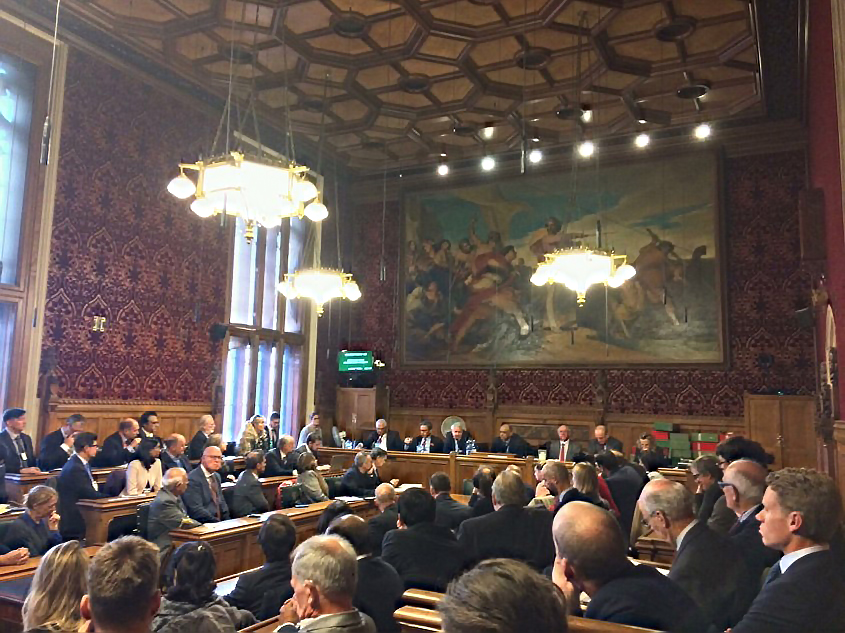
The recent international tourist forum “Ulytau-2019” in Nursultan City attracted participants from more than 30 countries, including the UK, USA, Italy, France and others. President Kasym-Jomart Tokayev of Kazakhstan announced that the government of the country would continue putting special attention and billions of dollars into promoting his country as a major tourist destination. Indeed, Kazakhstan has already invested billions over the past decade in developing the tourism sector and hospitality infrastructure by building the image of the country as a major destination on the Great Silk Road. In addition, the government has introduced major financial initiatives to attract the largest players in the global tourism business, from leading international hotel chains and restaurant outlets to major construction and transportation companies.

THE RISE OF “NEW” GREAT SILK ROAD

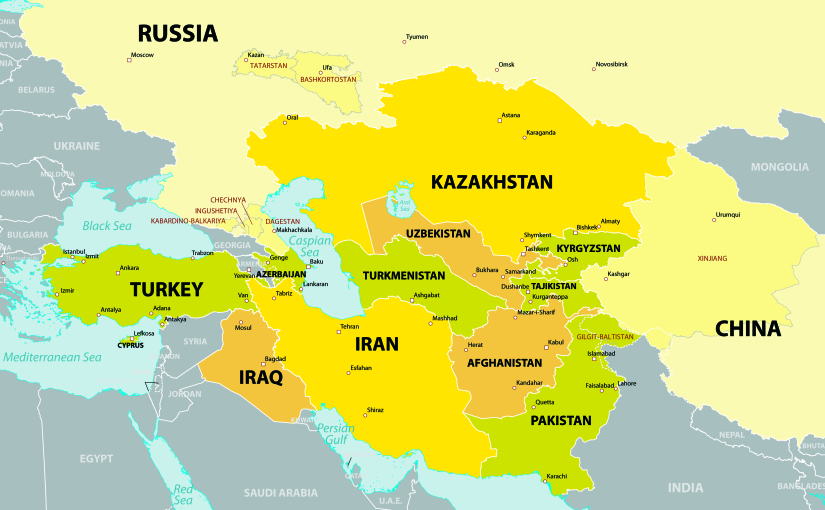
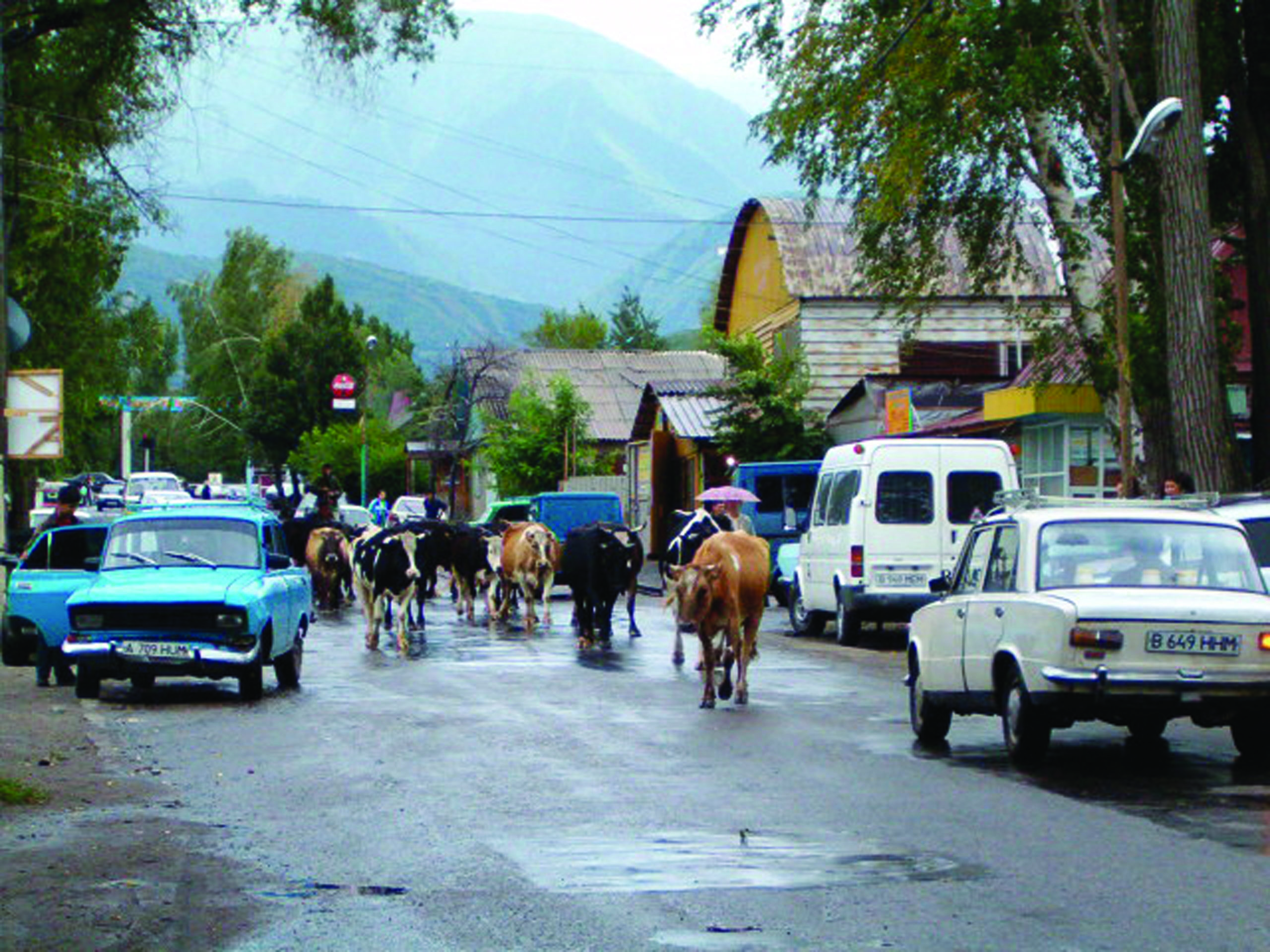
Kazakhstan continues to work hard on building its new Silk Road infrastructure and placing its modern and medieval cities and ancient caravan-sarays (hotels) onto global tourist maps. Kazakhstan is the 3rd largest country on the historical Great Silk Road, after China and Russia, and has been a destination attracting almost half a million tourists from the UK alone since 2008. During past decade between 2011 and 2019, the local and national governments have begun to realise that they need not only to preserve the major attractions and historical sites, but also to considerably upgrade the entire tourism infrastructure, from building new hotels to renovating all airports, highways and railways to serve between five and eight million visitors a year. The tourism boom has not only opened numerous ancient and medieval archeological excavations and well-preserved major architectural monuments for local and international tourists, but has also attracted intensive foreign direct investments (FDIs) at the rate of almost one billion USD.

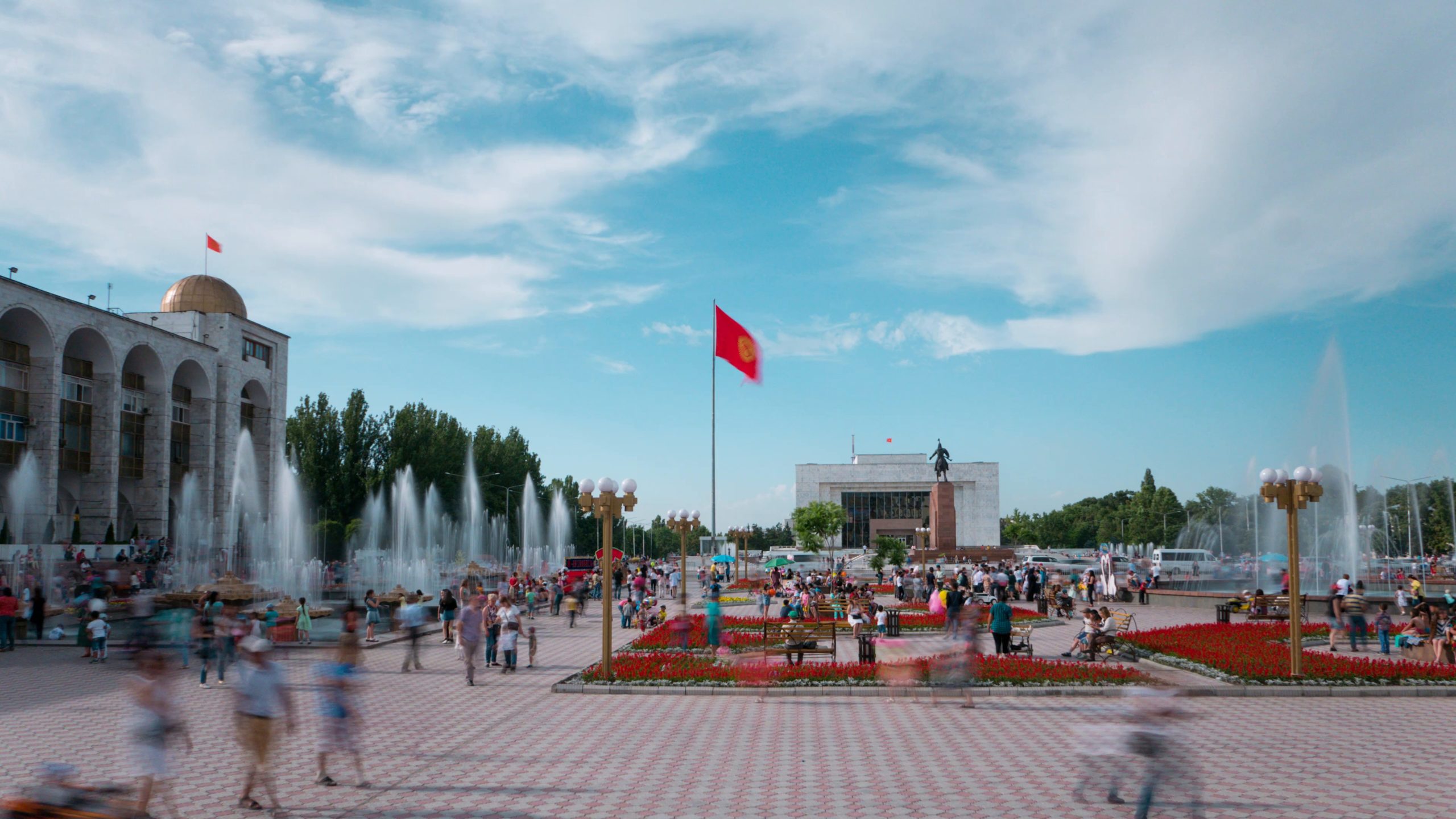
In promoting tourism, Kazakhstan has to compete with several large and well-known regional players in mass tourism, such as neighboring Uzbekistan and Kyrgyzstan. To move the country to the foreground, national tourism experts and major local players have focused their efforts on developing three major areas.

Traditional tourism on the historical sites of the Great Silk Road. As part of the Great Silk Road for almost 2,000 years, Kazakhstan is rich in historical sites, which are scattered mainly along its southern rim from the border with China all the way to the Caspian Sea. Various estimates suggest that the country is home to the remnants of more than 100 ancient and medieval cities and towns and more than 1,000 other historical sites from ancient Buddhist temples to Nestorian Christian churches. Some of these have survived through millennia of the turbulent history of Central Asia and represent interesting examples of cultural exchanges on the Great Silk Road.

Take for example the city of Turkistan with its medieval mosque and mausoleum of Khoja Ahmad Yasawi – a classic example of architecture from the time of medieval ruler Tamerlane (Timur). The ruins of a large medieval city – some scholars identify them with the medieval city of Kultube – are scattered over thousands of square meters, comparable in area to the remains of Italy’s ancient city of Pompei. Local experts ambitiously call it the “Pompei of Central Asia.”

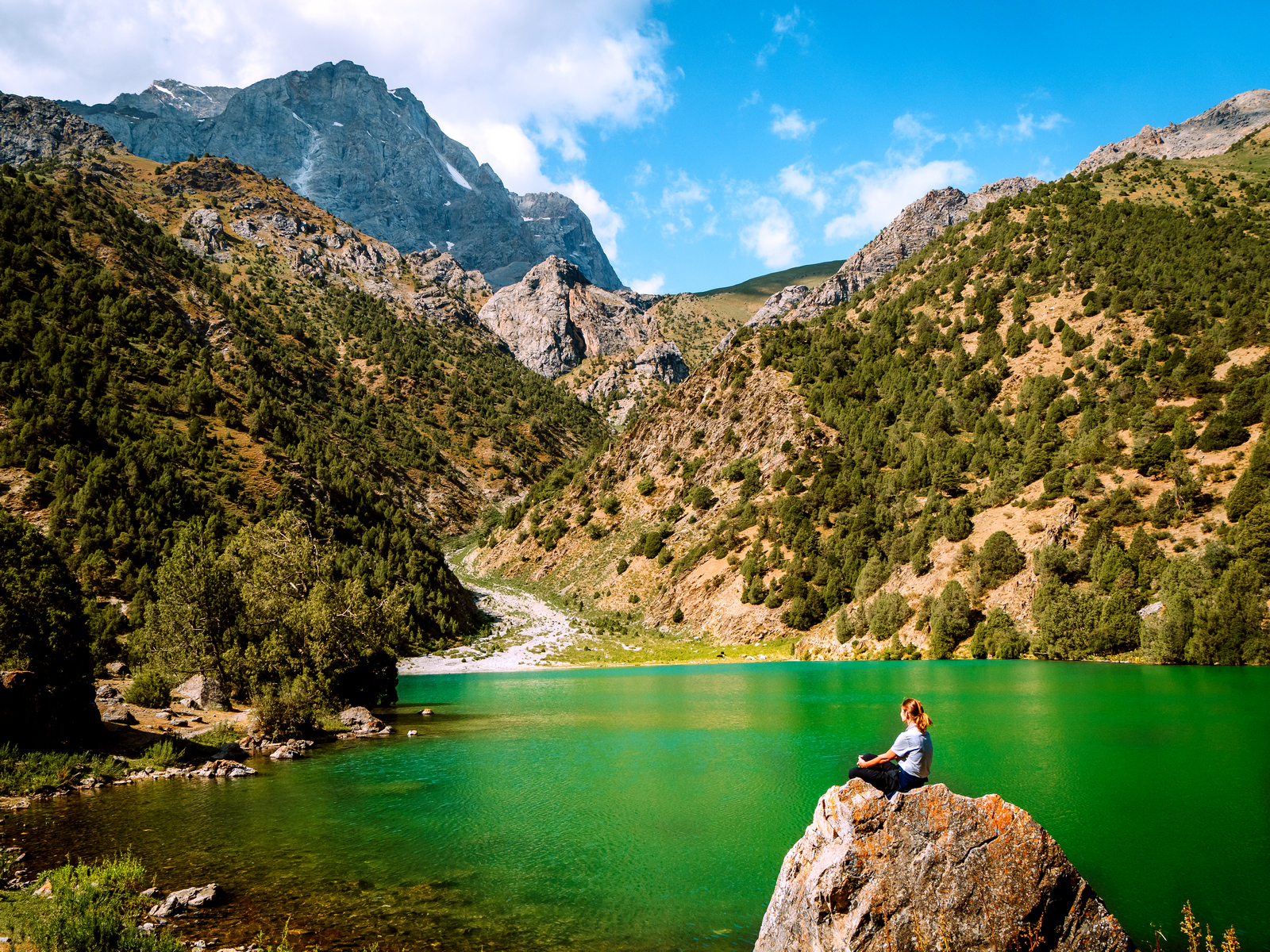
Adventure tourism. Another area for niche tourism in which local companies and government-funded operators are investing tens of millions of US dollars is adventure tourism. The mountains of southern and eastern Kazakhstan offer amazing landscapes and hundreds of destinations for adventure tourists. This includes safari tours from simple short tours along the great nomadic steppe to very complex multi-week safari expeditions over various terrains and climate zones. Several rivers offer good opportunities for river rafting combined with the exploration of local fishing and hunting opportunities. The mountains around Almaty City offer numerous year-around opportunities – from hiking in summer to skiing in winter and spring. In fact, in geographic terms, these mountains present the best skiing opportunities in the whole area between New Delhi and Moscow!

Eco (green) tourism. Over the past decade Kazakhstan has emerged as a new destination for eco-tourism with visits to exceptional locations from fragile and pristine Alpine mountain valleys and river basins in the south to the unique forest and steppe zones in central and eastern Kazakhstan. The country is home to hundreds of endemic species, and nature enthusiasts not only can observe unique birds and animals (such as the gorgeous snow leopard), but also participate in the numerous campaigns directed at preserving Kazakhstan’s wild animals, birds and insects.

THE NEW SILK ROAD PARADIGM

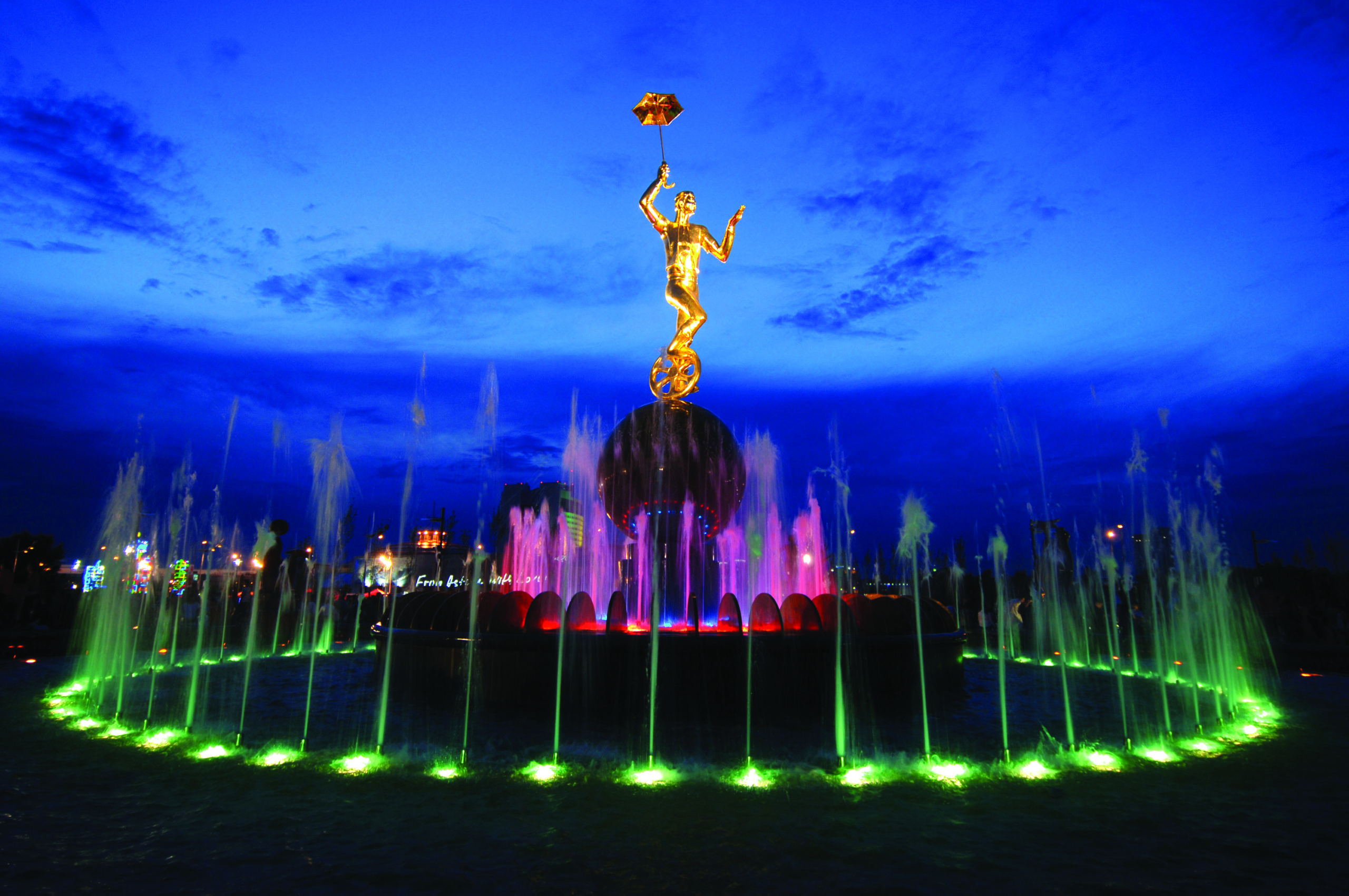
The tourism business in Kazakhstan – which is growing at an impressive rate of 6-9 percent per annum – has a considerable potential. To fulfil this potential, it needs to attract all sorts of international experts and investors. Kazakhstan has already attracted top architects like Norman Foster from the UK and Kisho Kurokawa from Japan to help develop architectural marvels in the rapidly growing new capital – the city of Nursultan (formerly Astana). The country has also made a number of other strong moves in the right direction. First, recent regulatory changes such as waiving visas for tourists from almost 50 countries around the world has eased travels opportunities for many travelers, including business people and ordinary tourists. Second, the country successfully hosted World Expo-2017 in Astana and the 28th Winter Universiade Games in Almaty and these and many other regional and global events contribute to the fact that Kazakhstan has become one of the fastest growing tourism destinations in the region. Third, Kazakhstan has spent almost US$40 billion since 1997 in building up Nursultan City as a prime regional business, financial and banking hub, hoping to make it one of the major tourist destinations between Beijing and Moscow.
PERSPECTIVES

During the past decade Kazakhstan has become one of the growing major tourist destinations on the Great Silk Road and an attractive destination for investors and major players in the tourism sector from European countries including the UK. In fact, according to official statistics the government-initiated strategy “Tourism Industry Development Plan 2020” channeled about US$3 billion into the development of five tourism clusters and the creation of 300,000 new jobs in the tourism sector alone and climbing to the 81st place in the in the global tourism ranking (2018, World Tourism Organization (WTO). If successful the country indeed might become one of the major tourism destinations on the great Silk Road offering diverse tourism activities and absorbing billions of dollars in FDIs.

AUTHOR BIOS:

Rafis Abazov, PhD, is a visiting professor at Al Farabi Kazakh National University and a director of Ban Ki-moon Institute for Sustainable Development. He is author of The Formation of Post-Soviet International Politics in Kazakhstan, Kyrgyzstan and Uzbekistan (1999), The Culture and Customs of the Central Asian Republics (2007), The Stories of the Great Steppe (2013) and some others.

Andrey Khazbulatov, PhD, is an associate professor and research advisor for the archeological research and excavation project “The Hillfort of Kultube” in Turkestan City, Kazakhstan. He is the author of three monographs and numerous articles on cultural development in Kazakhstan.

OCA#33  FALL 2019  WWW.OCAMAGAZINE.COM

BUSINESS IN CENTRAL ASIA: HOW TO COVER 20 YEARS’ GROUND IN TWO YEARS

SAIDMUROD DAVLATOV

Business mentor, owner and co-owner of 23 types of businesses, Davlatov has individually trained 292 entrepreneurs and coached 30 US dollar millionaires over the course of five years.

The premier of the movie, The Mentor is set to be held in Moscow in 2020. The plot is quite simple and is based on real-life events. It’s not just another success story; it’s a story about a boy who was sent to a mentor for instruction at the age of eight. In the mid-1990s, the civil war in Tajikistan forced him to become a migrant worker in Moscow. The events of the movie will be familiar to many our contemporaries from the CIS, especially those from Central Asia. It is the story of a man who, despite many obstacles, managed to fulfil his potential, to become a successful businessman and multimillionaire and then go on to teach others.

If 20 years ago I had been told there would be a film about me and what one can do with what I know today, I would never have believed it; but the simple truth is that the film really is about me.

I want to challenge the widespread belief that there are no opportunities for Western companies to do business in Central Asia. I will tell you about the peculiarities of doing business here using both examples of my own experiences and those of my students, 30 of whom have become US dollar millionaires over the course of just five years.

I believe that the path to progressive global change begins with the right system of education, one, for example, like the British system.

I see that the UK and countries in Central Asia have recently developed strong ties. For about a decade now, the Union Jack has appeared at the entrance of numerous educational centres in almost every city across the region. This means that the values of the British system of education resonate with local people.

Young people are interested in the British system of education and would like to understand the nuances of British culture. Because of its system of education, the UK has become a part of everyday life in Central Asia. English is already widely taught using British teaching methodologies. It is quite natural that over time students will want to continue their studies in the UK.

In this sphere, I see what is also lacking in many other areas, such as doing business and in production: a true partnership. Of course, there have been certain breakthroughs, but not as significantly as in the sphere of education.

I would advise business professionals from the UK and from other countries not to waste the opportunities that cooperation with the nations of Central Asia offers today. It is a very promising and rich region with large reserves of numerous raw materials. Unfortunately, the region produces very few finished products and in most cases the production process stops at the stage of working with raw materials; the ratio is 10% to 90%. At the same time, though, the prime cost of raw materials is low, there is little intensity to the competition and labour is relatively inexpensive.

There are free trade niches in almost every country, be it Kazakhstan, Kyrgyzstan, Uzbekistan, or Tajikistan. These economic zones have been established to make doing business easier, providing benefits and exemption from some taxes. It is highly profitable, therefore, to do business in these zones. Many agricultural enterprises manufacture natural products and can guarantee supplies in large volumes. High-quality food is needed by everyone everywhere, whilst textile production is also very promising.

If all of the advantages named above, plus low prices and the mentality and work ethic of local people are augmented with Western technologies, it will be possible to achieve a truly revolutionary breakthrough. With this in mind, I would recommend that all business professionals launch production facilities in Central Asia. Here you will find benefits, raw materials, a willing workforce and exceptionally favourable conditions. Later, the finished goods can be sold all over the world.

The financial tools available to local companies are inefficient as they do not yet employ the technologies and principles of modern European management. Many European banks have negative interest rates on loans and pay dividends to borrowers, but local banks only issue loans at high interest rates.

I think that the next 20 years will be hugely profitable for British businesses which choose to invest in Central Asia. Managers of British companies think quickly, efficiently, and on a grand scale. Thus, they have an undeniable competitive advantage.

Running a business in Central Asia today is akin to going back to the 1990s, but with state-of- art technologies at hand. What I managed to achieve in the course of 20 years, today I could have done in two. I have described this in detail in my two books: How to Become a Millionaire in Tajikistan and How to Become a Millionaire in the CIS States.

In my opinion, Central Asia is the best place in the world to do business today. I say this as a person who has been teaching and advising local entrepreneurs for over 20 years. I know the difficulties and struggles they encounter well. I instruct my students on how to set up business processes. They have already made significant progress, with one of them running a business with a turnover of 30 million US dollars.

I advise and help my students choose the right direction, and this is where I benefit from having long-standing relationships with a huge number of businessmen across the region. I have scrutinised all the pros and cons of various production areas and can help business professionals from the UK. I am extremely well-acquainted with the local opportunities and can help to establish strong, mutually beneficial ties in any city or state in the region.

Don’t hesitate; come to Tajikistan, Kyrgyzstan, Kazakhstan and Uzbekistan and see for yourself. In Central Asia today, people have first-hand knowledge about corporate management, and local businesses understand and accept the principles of transparent entrepreneurship; principles which are beneficial to everyone.

I will be glad to offer my advice.
Please feel free to email my agent, Karina Galoyan:
karina.galoyan@davlatov.tj

THE DEVELOPMENTAL JOURNEY OF THE FIVE STANS POST-SOVIET INDEPENDENCE

A brief analysis of overseas development assistance to the Central Asian Republics.


When the Soviet Union collapsed in 1991, abrupt national independence incited a sharp rise in poverty, inequality, and the disintegration of public services across Central Asia. A multitude of development challenges lay ahead for the five Stans: Kazakhstan, Kyrgyzstan, Tajikistan, Turkmenistan and Uzbekistan.

Yet, for their first decade of sovereignty the international community’s role in Central Asia’s development was largely neglectful. The focus was predominantly geopolitical than developmental due to the region’s strategic position between the natural resource giants of Russia, China and India.

Such neglect has meant the development assistance that was delivered to the Stans remains largely unexplored. Meanwhile, the effort on behalf of western actors to fill the vacuum that was left through the promotion of a shift from centralised models to more democratic socio-political models with a liberal market economy, has not bode well amongst the widely disjointed sovereign states.
A recent paper produced by Fabienne Bossuyt highlighted how although the EU was the region’s biggest donor in the first decade post-Soviet independence, providing €944 million in assistance until 2002, it was largely an invisible actor comparative to the US, UN and Asian and Muslim development agencies. Despite being absent in Central Asia in the nineties, the last fifteen years has seen China on the other hand become the leading actor in the region with high receptiveness to their assistance.

Bossuyt attributes this changing development landscape to one comprising of a mix of traditional western donors with emerging ones. The report states that where the west, ‘envisions the achievement of stability through inclusive development methods, China equates development with economic growth instigated through improved infrastructure.’ Symbolic of this is the focus on the Silk Road Economic Belt initiative and of China’s development cooperation.

In terms of impact, the EU’s approach has been generally criticised as relatively ineffective, with Bossuyt going as far as to say it has failed to make any significant difference on the ground. Contrarily, China’s assistance has been extensive, with local regimes seeing the development of infrastructure as more attractive. Cooperation is also easier for the nations when there are fewer conditions attached to aid delivery, such as human rights performance.

Although the EU can be criticised for its lack of priority in terms of overseas aid to Central Asian countries, the relative ineffectiveness of implementing western model ideals has been a result of unstable governance. The combination of natural resources with scarce accountability engendered pervasive corruption throughout the region. Tajikstan, Uzbekistan and Turkmenistan all scored highest for corruption in the Eastern Europe and Central Asia region in Transparency International’s Corruption Perceptions Index 2018 (CPI). Meanwhile, Kazakhstan has declined in terms of their CPI score. The report states:
“In many post-Soviet countries, checks and balances do not exist that would ordinarily keep powerful private individuals and groups from exerting exceptional influence over government decisions. In these settings, illicit lobbying practices take place and conflicts of interest go undisclosed.”

Western donors’ hopes for the region to achieve good governance across the board is impeded by antagonism between the states, which has for a long time dictated the narrative that regional cooperation between these hybrid regimes is required for true progress.

In May 2019 the EU set out a ‘fresh strategic vision’ for its partnership with Central Asia with the allocation of €1.1 billion for development cooperation between 2014 and 2020. However, for as long as the EU insists on a determination to help the region promote dialogue and cooperation at their own pace, China’s assertive economic development, non-interference in domestic affairs strategy will continue to lead the development journey of the five Stans.

And yet, there is the inexorable question of whether such an economic investment heavy approach will resolve the institutional weaknesses of the individual countries that is needed for them to achieve sustainable growth, good governance and a strong social sector.

Will China’s assistance strategy exacerbate inequalities and create new problems, or will it be the emerging trend for the international community to follow suit? Only if the West starts paying more attention to the Stans, can we find out what might work best.

Anastasia Kyriacou is the PR Manager for AidEx, the leading global event for the humanitarian aid and development community.

OCA#33  FALL 2019  WWW.OCAMAGAZINE.COM 

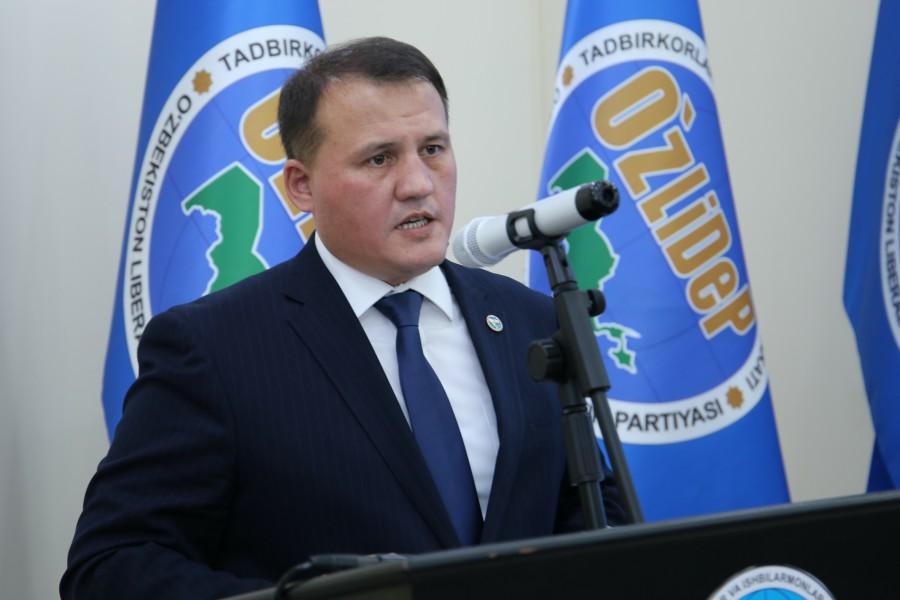
PUSHING THROUGH UZBEKISTAN’S NEW REFORMS INTERVIEW: AKTAM KHAITOV

Aktam Khaitov has held many roles in Uzbek politics. Currently the Leader of the Uzbekistan Liberal Democrat Party, he cut his teeth in several previous government roles as Minister of Employment and Labour Relations and General Director of the Uzbek Agency of Standardisation, Metrology and Certification (Uzstandard). Uzbekistan has changed significantly since the death of former autocrat, Islam Karimov, and OCA had the opportunity to interview Khaitov and find out more…

OCA: The label “Liberal Democrat” has been adopted by a wide range of parties across the world from the centre left minority Opposition in Britain through Japan’s ruling conservative government to Vladimir Zhirinovsky’s national grouping in Russia. Where would you place Uzbekistan’s Liberal Democrats in that spectrum?

Aktam Khaitov: First, let me briefly familiarise you with the history of our party in order to answer this question in a better way. The movement of entrepreneurs and business people, the Liberal Democratic Party of Uzbekistan (hereinafter – UzLiDeP) was created in 2003 as a nationwide political organisation that voices and defends the interests of the middle class, representatives of small business, entrepreneurs and farmers – the class of owners who are business people.

Having united on behalf of entrepreneurs and business people into a powerful political force, we need to strengthen the tools that make people’s power not theoretical, but real and ensure the effectiveness of parliamentary and public management. Summarising all of this, it can be said that UzLiDeP is a centrist liberal party, oriented toward liberal economic reforms.

OCA: Do you consider yourself to be a social liberal or an economic liberal or both?

AK: Most likely both. Our party stands for a social policy that promotes the development and self-realisation of people. The party believes that the main goal and driving force of democratic transformation is the person themself. Our targets are to halve the share of low-income groups of the population, achieve full coverage of all those in need of social protection measures, ensure that vulnerable sectors of the population have access to basic resources (land, bank lending and etc.), new technologies and financial services, including micro-financing. Our priority is further liberalisation of economic reforms. To summarise the above, and speaking briefly, there is a need for more freedom of enterprise and less bureaucracy.”

OCA: How easy is it for a multi-party democracy to establish itself and function effectively in a country, where this is a relatively new phenomenon?

AK: Currently, Uzbekistan is at a new stage of its development. There are five political parties in Uzbekistan, including the Movement of Entrepreneurs and Business People (Uzbekistan Liberal Democratic Party) such as Uzbekistan National Revival Democratic Party “Milliy Tiklanish”, “People’s Democratic Party”, “Justice Social Democratic Party “Adolat” and the Ecological Party of Uzbekistan.

Indeed, multi-party democracy policy began when our country obtained its Independence. But much has been done in this short historical period. Our party predicts a fierce struggle in the upcoming elections. Therefore, the openness and transparency of their conduct becomes one of the key factors in the implementation of the principle of democracy and determining the country’s authority on the world stage.

OCA: How many members does the Party have, and how many Members of Parliament or local councillors?

AK: To be specific, the total number of party members as of July 1, 2019 is 733 989 people, of which 383 166 people (52.2%) are under the age of 34, and 297 561 people (40.5%) are women.

The number of deputy seats in the Legislative Chamber of the Oliy Majlis is 39, the members of the Senate of the Oliy Majlis have 35 seats, the deputies of the Zhokarga Kenes of the Republic of Karakalpakstan, the region and Tashkent city Kengashes have 291 seats, while the district and city Kengashes seats make up 1976. As of July 1, 2019, the number of primary party organizations is 12,616.
OCA: In your view, what are the most important reforms that would benefit Uzbekistan at its current stage of development?

AK: I see four key areas we need to reform:
1. Free currency conversion
Previously, a simple financial currency exchange operation was a big problem in Uzbekistan. The President of our country Sh. Mirziyoyev allowed banks to buy currency from the population and convert money for legal persons to pay for import contracts at the market rate. This was the first and key economic reform carried out at the initiative of the President.
2. Reform of the financial system
The Central Bank began to regularly publish important financial indicators and actively collaborate with leading global financial institutions, among them: theInternational Monetary Fund and the World Bank. The result of this work was an increase in the confidence of foreign investors and the issuance of the first Eurobonds, most of which were acquired by investors from the UK and the USA.
3. True statistics
Several years ago, no one believed the statistics of Uzbekistan. In 2017, Mirziyoyev approved a program to improve the efficiency of statistical activities and improve the quality of statistical information. In 2018, the republic introduced a system for disseminating statistics according to the methods and standards of the International Monetary Fund. Today we know with certainty the real level of citizens’ incomes, unemployment, the level and main causes of mortality, and much more.
4. Freedom of journalism
Uzbekistan has risen four positions in the freedom of speech rankings. Previously, journalists were afraid to criticise officials, who held “senior positions” and did not cover a number of socially important topics. Now media representatives, not fearing for their own lives and health, can condemn the work of any public servant or state-owned company.

OCA: Are there women and youth sections in your party and, if so, what are the issues that most concern them?

AK: UzLiDeP pays close attention to issues of work with youth and women. In the structure of UzLiDeP, the Youth wing of the party operates and unites about 425,000 youth. The party is addressing the challenges of increasing the political culture and legal awareness of young people, forming their active civic position and a conscious attitude to political processes. It also provides lasting ideological immunity against various external and internal threats in the spiritual and moral sphere, and ensures the information security of children. The projects have already provided practical assistance to over 150 young entrepreneurs.

The “Women’s Wing” is also successfully functioning in the party, which helps to increase the political activity of women and enhancing their role and social status.For example, last year, over 200,000 women and girls were involved in UzLiDeP’sactivities of the “Women’s Wing”. One of the main tools of the “Women’s Wing” of UzLiDeP is the implementation in practice of various kinds of party projects aimed at the comprehensive support of women who intend to do business, create new jobs by broadly attracting girls to entrepreneurship by identifying active and initiative women.

In the UzLiDeP faction in the Legislative Chamber of the Oliy Majlis, 8 deputies are women. At present, UzLiDeP has a well-formed basis of which 8.103 are women or 30.9% of staff capacity from the party.

OCA: How has your past professional and personal experience in many different roles affected you?

AK: Of course, it is not right to praise oneself; one must prove one’s professional success by deeds. But, as can be seen from my biography, my professional activity is connected on the one hand, with the solution of a wide range of economic problems. But, on the other hand, in carrying out these activities, it was important to take into account the opinions and wishes of ordinary people and to feel their aspirations and hopes, the desire for well-being and high quality of life for families.
For myself, I think this is the most important professional baggage, which is to focus on solving specific problems of people and the importance of work by taking into account the needs of the population, as reforms should be carried out for the people.
I see in every workplace that the Motherland, society, our voters, trust me, so my goal is to try to justify this high trust by working for the benefit of our people. Years of work taught me that it is important that in each of us such values as readiness for change, responsibility, professionalism, justice and humanism prevail.

OCA: What are your perspectives on relations between the UK and Uzbekistan?

AK: Uzbekistan attaches great importance to the development of mutually beneficial cooperation with European countries. At the same time, special attention is paid to promoting a higher level of bilateral relations with such a leading European power as Great Britain.

In our opinion, the trade and economic interaction of our countries requires its further development. Although bilateral trade between Uzbekistan and the UK in 2018 grew by almost 40% and exceeded $235 million, we are confident that the parties have significant potential for the growth of mutual trade.

UzLiDeP also considers the possible development of inter-party cooperation as a step towards expanding interstate contacts between Uzbekistan and the UK. This may require the organisation of international conferences and round tables aimed at further developing interstate relations, disclosing Uzbekistan to the general public in Great Britain as a reliable and responsible partner. UzLiDeP expresses its readiness to support the business circles of the two countries in their intentions to develop cooperation.


OCA#33  WWW.OCAMAGAZINE.COM  Interview prepared by Saniya Seilkhanova

FIRST ECG FILM FESTIVAL HIGHLIGHTS NEW TALENT

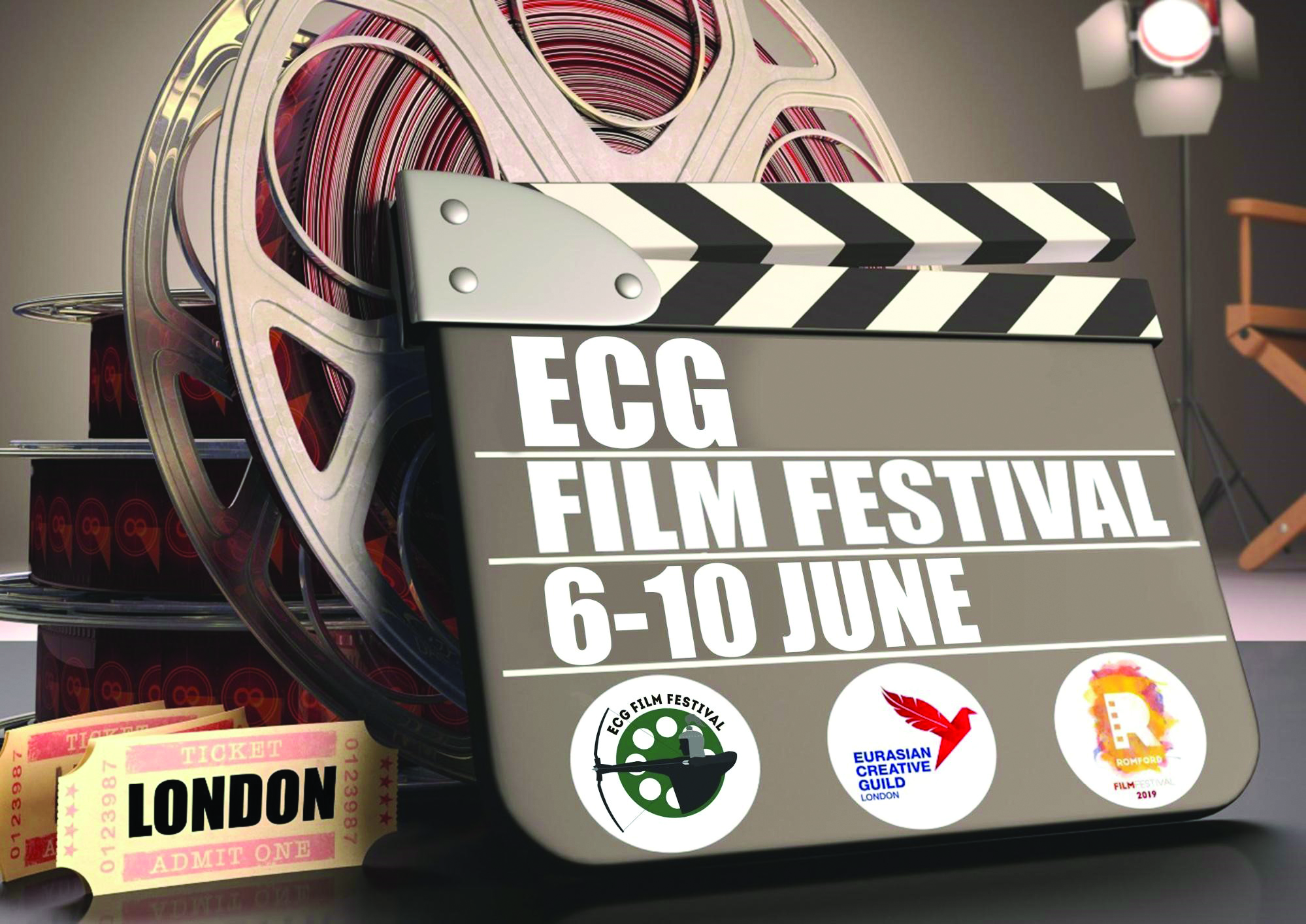
From 6th to 10th June 2019, Premiere Cinemas in Romford, London became the centre of attention for directors, producers, actors and designers from Eurasian countries. As part of the third ‘Romford Film Festival’, for the first time, the ‘ECG Eurasian Film Festival’ (London) featured alongside it as a contributing partner.

Founded in 2017 by British film makers and enthusiasts, The Romford Film Festival this year teamed up with the Eurasian Creative Guild (London) under the leadership of Laura Hamilton and Marat Akhmedjanov, to bring a unique platform for communication between British filmmakers and their post-Soviet counterparts. Aligned with the Eurasian Creative Guild (ECG) ambitions to promote all creative people, including filmmakers of the Eurasian region in Great Britain and the whole world, the festival was a culmination of over a year’s hard work to find, promote and develop film making talent.

Despite its infancy, The ECG Eurasian Film Festival gathered over 60 films from 24 different countries. The film program of the festival kicked off with the British premiere of the film “My Name is Kozha” by an outstanding classic of Kazakhstan cinema, Abdulla Karsakbayev. During the five days of the film festival more than 1,500 people visited and were shown films from diverse locations including Kazakhstan, Russia, Italy, Finland, USA, Belarus, Sweden, Germany, Iran, Georgia, Armenia, Ukraine, Uzbekistan, Canada and the UK.

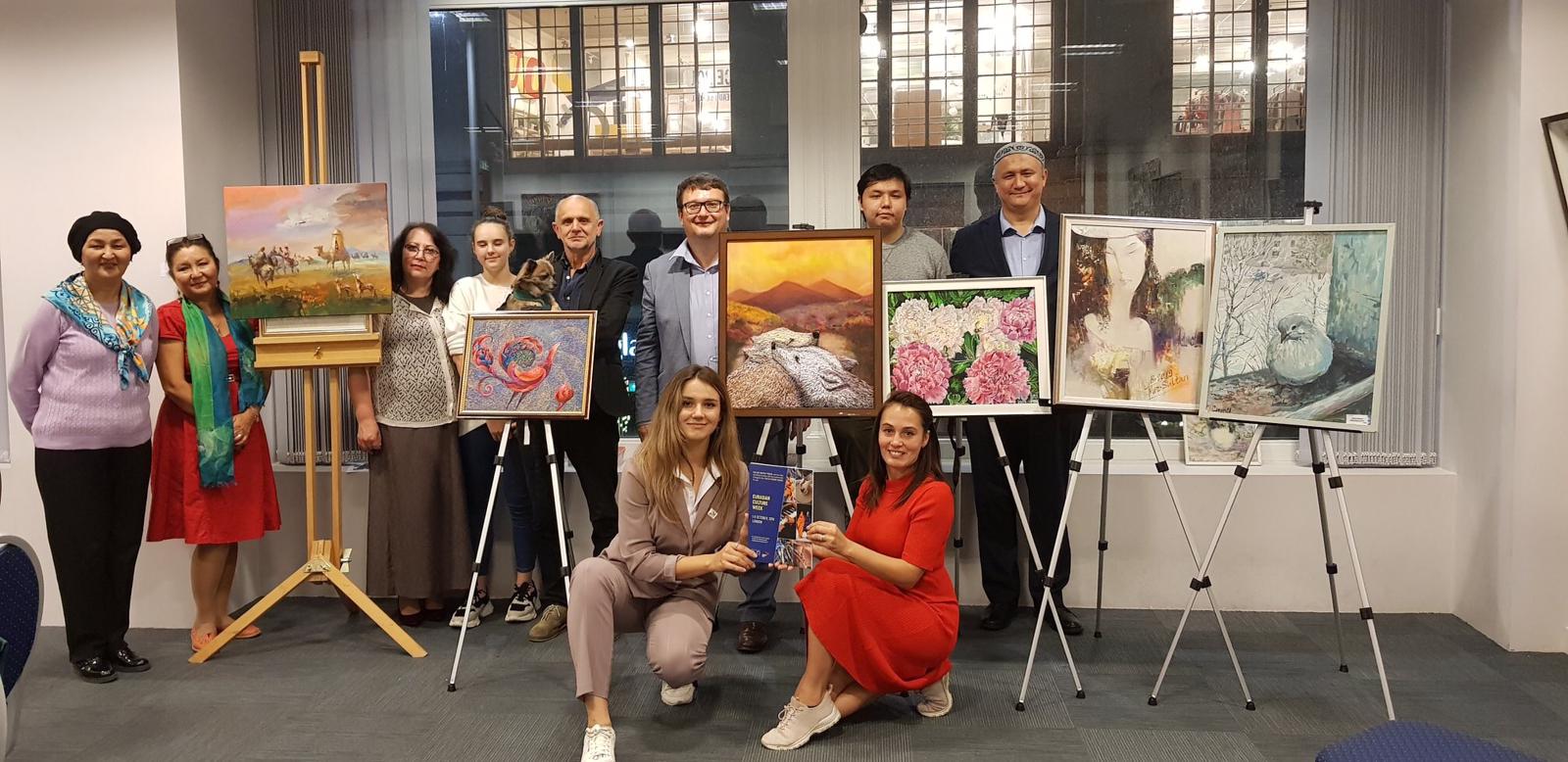
Guests of the festival also had a unique opportunity to learn about the Eurasian region, not only through cinema, but also through exhibitions of paintings, handicrafts and books created by members of the Eurasian Creative Guild. Two Silk Road Fashion shows, networking round table events and creative meetings were also held within the framework of the ECG Eurasian Film Festival.

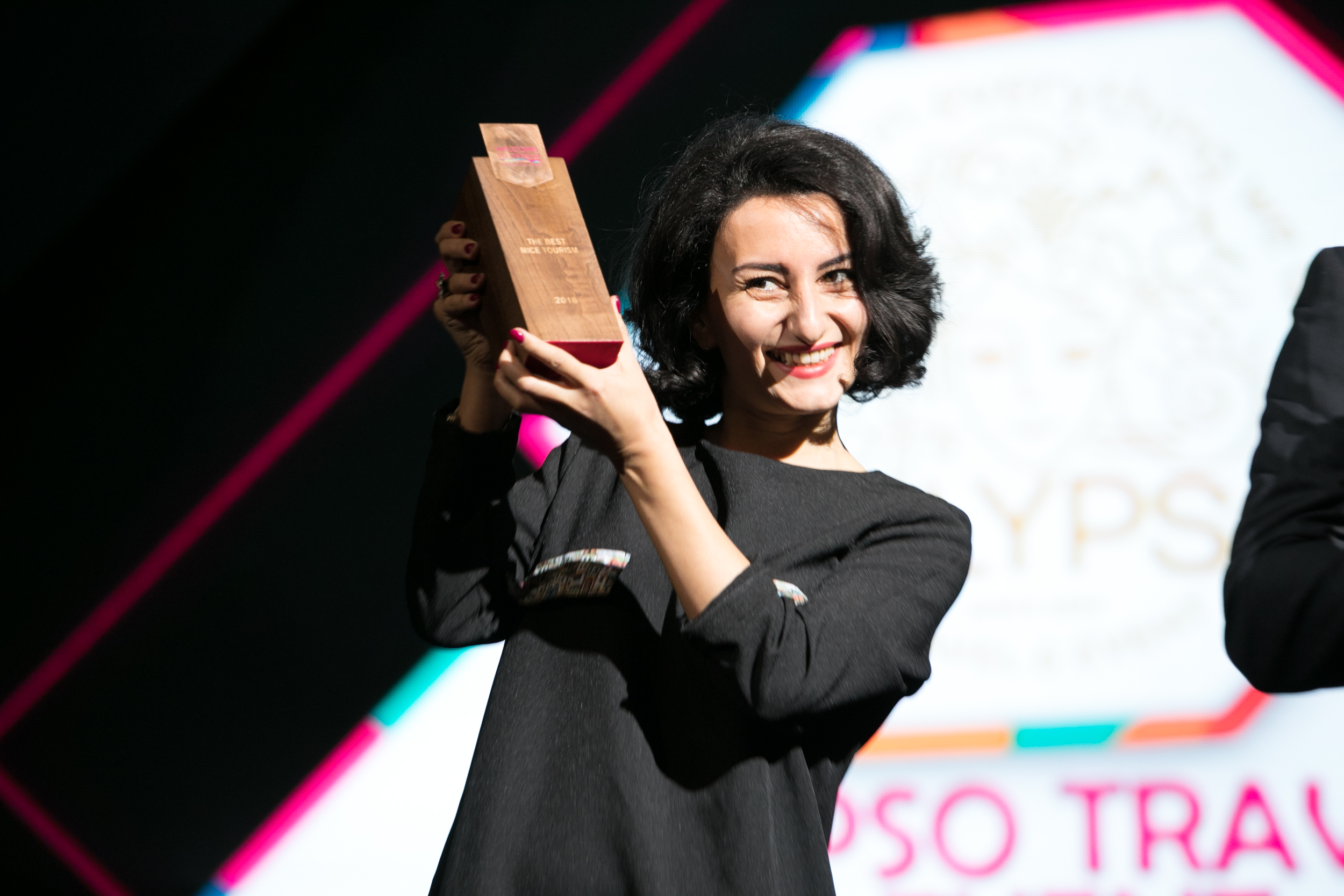
On the final day of the festival, and on the largest cinema screen, the award ceremony was orchestrated to recognise the most talented filmmakers for their efforts. This was stylishly conducted in the presence of the Mayor of Havering, Cllr Michael Deon Burton, among representatives of various embassies, a wide array of press and esteemed international guests.

The overall winner of the Grand Prix was to the Russian-Belarus entry film, “Kaddish”, while Best Director went to Mahmoud Shoolizadeh for the film, “Susan”, a UK entry. There were 15 awards handed out, as well as a number of diplomas. The event marks what is hopefully the inauguration of a new branch of exciting ECG projects and events.

FULL AWARD LIST:

1. Grand Prix: film ”KADDISH’ (Russia-Belarus)
2. Best Screenplay: the film “MIDNIGHT OF THE SHAH” (Azerbaijan)
3. Best Director: Mahmoud Shoolizadeh, the film “Susan” (United Kingdom)
4. Best Male Role: Wojtek Urbanski, the film “KHARMS” (Russia)
5. Best female role: Dinara Sharipova, “SEA AND THE GIRL” (Kazakhstan)
6. Best non-Eurasian director Hernan Findling, film “IMPOSSIBLE CRIMES” (Argentina)
7. Best trailer for the book Three Distichus – Elena Aslanyan (Armenia)
8. Best Documentary: “DONETSK” (UK)
9. Best director of documentary “ORGANIC SAGE OF INDIA” (India)
10. Best film based on real events “IT’S NOT FOREVER” (Russia)
11. Best Short Film “HEAVEN OF CHILDREN” (Iran)
12. Best script of the short film “MALIBU ALTERNATIVE” (Ukraine)
13. Best male role of a short film; Zura Pirveli, film “BEHIND THE DOORS” (Georgia-France)
14. Best female role of the short film: Irina Egorova, the film “BLOOD” (Russia)
15. Best Short Film Director: Boris Hayrapetyan “YES! TODAY” (Armenia)
ECG Eurasian Film Festival 2019 was made possible thanks to the active participation of the large internationally located Guild-member team, including: Alexandra Rey, Anna Lari, Angelina Krasnogir, Ainura Berdikul, Bolot Shamsiev, Dale Lessoway, Nadi Fadina, Natalie Bays, Maira Karsakbayeva, Solvi Fannar, to name but a few.

OCA#32  SUMMER 2019  WWW.OCAMAGAZINE.COM 

“VIKING EXTRAORDINAIRE” – Sölvi Fannar

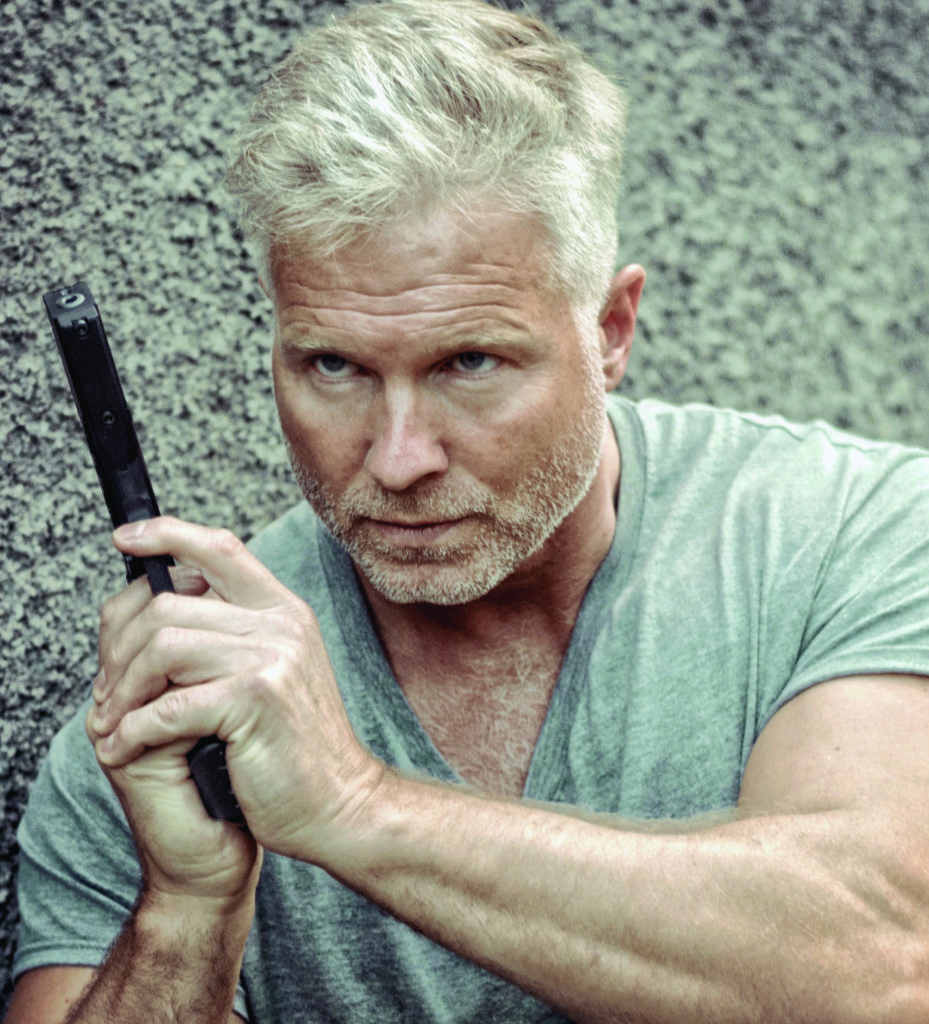
“Viking Extraordinaire”, Sölvi Fannar, doesn’t believe in following just one career path, in fact he has actively pursued several. He has acted in films, played music professionally, modelled, been a sports athlete, dabbled in poetry, and even spent time as a health professional. Recently, he is better known for his work in films, especially working as the agent for actor and strongman Thor / Hafþór Júlíus Björnson (The Mountain, from Game of Thrones).

Fannar’s talents stem from his upbringing in Iceland, where his parents, themselves talented, nurtured a multi-faceted childhood. Singing in a prestigious Icelandic children’s choir at the age of 12, he got his first taste of acting in a feature film. After that there was no turning back, later studying at the Icelandic Film School. A big supporter of ECG events, his presence always visible, OCA decided to catch up with the big man himself.

OCA: You’ve been described as the “poet, trapped in a caveman’s body”. How did that come about?
Sölvi Fannar: I’ve been called many things actually. “Renaissance Man”, “Iceland’s Bruce Lee” and more, but “the poet, trapped in a caveman’s body” is actually a poetry book that I’m writing. It contains very personal poems that in essence map a big part of my life, mirroring what I was going through and experiencing at the time and putting into words the state of mind I was in then – as well reflecting with hindsight. But in the way that we so often persuade ourselves to believe that we are alone in what we are going through, the opposite is actually closer to the truth as we collectively share experiences, even though each one of us does so in their own way as becomes evident when we discover how others express themselves, be it through art, photography, writing or otherwise.

OCA: Talking about bodies of cavemen, you’ve done sports for a long time and have even competed in World Championships. That is quite an unusual activity for poet, surely?
SF: I’ve been training since I was nine years old, beginning in karate and judo but then also competing successfully in breakdance, Tae Kwon Do, bodybuilding, strongman, gymnastics, discus and shot put. Internationally I also competed in the Scottish Highland Games and MAS wrestling. There have been many memorable moments. To name a few, I became a champion bodybuilder after only three months of training and achieved second in the stone throw by less than an inch behind the world champion in the Scottish Highland Games. Of course competing in breakdance is great fun although what they are doing in breakdance now is simply unbelievable.

As a board member of the Eurasian Creative Guild, I’ve not only gotten to travel to places I would never have otherwise seen, where I’ve held seminars on topics such as filmmaking while managing to intertwine that with competing in an ancient sport called MAS wrestling, first at the World Championship in Yakutia, and later in Kyrgyzstan. As it happens the Vikings also did a very similar sport a thousand or more years ago and called it ‘Keflisglíma’, so it was an incredible opportunity for me despite little time for preparations.

I ended up doing a lot of other things in Yakutia, for example a photo sessions for the ‘First Yakutian’. There is a beautiful legend that the first Yakut was a child born to a Viking warrior, who sailed up the Lena river, and a local woman of Turkic origin. I was also invited to be a judge in Miss Yakutia. And of course the MAS wrestling World Championships in Kyrgyzstan during the World Nomad Games was a once in a lifetime experience. Being a competitor as well as a guest of honour allowed for fantastic networking opportunities and seeing the region.

OCA: You have been working as a professional actor as well as a producer in the Eurasian area for some time but we have heard you’re starting to work in the US as well. What should we expect to see you involved with in that space?
SF: It’s actually very exciting. I’m involved in the development of an American project called The Dimension that intertwines the ancient world of Vikings & Norse mythology with futuristic SciFi action. Both being an associate producer and having a great part is invigorating. I’ll be working alongside Hafthor Julius Bjornson (The Mountain in Game of Thrones), producer Skip Williamson (The Underworld Franchise, Crank 1 & 2, and Gamer) and the fantastic team at DreamState Entertainment to create a multi-media franchise, which will include future films, podcasts, and a graphic novel series.

OCA: On top of your passion for acting, you also do many other things, including being a health professional, how is that compatible with what must be an already very busy schedule?
SF: Even though I got involved with acting and performing early on and had parts in several films throughout my life, my main focus was on sports and fitness and health counselling. It started out with me helping my dad get into great shape in 1988 and soon after that a lot of people asked me to counsel them for health. Later I studied to become a trainer as well as a functional medicine practitioner. I started my own firm, wrote books on health related matters, did lectures and seminars, had my own spot on national TV and wrote a column in a major newspaper. It was actually not until a few years ago that my youngest daughter pushed me to audition for a place that became available studying to be an actor at the Icelandic Film School. I applied and got in. It was during these studies that I was invited to work on Game of Thrones. It was a great opportunity to get to work on one of the most amazing TV shows ever created and of course I learned a lot as well. You cannot but learn when you get to work with such a dedicated group of seasoned professionals.

Since then I’ve done several feature films where I’ve had good parts. One of the more memorable one is called Operation Ragnarök, where I am also an executive producer, and the distributor is in Iceland as well as China. My character is Egill Sturlaugsson who is the Team Leader of the Icelandic Viking Squad along with five other characters of the Squad who also happen to be in my novel called Quis Custodiet Ipsos Custodes (Who Guards the Guardians) that will, if everything works out, come out at the same time as the film which is coming out in the next few months.

Another one is Three Dots and a Dash where I play a ‘brutal’ Russian mafia boss which was great fun since it’s a comedy and the director wanted me to go all out, that one should be coming out later this year but judging from what I’ve seen from it, it’s going to be hilarious. There are several films I’ll be working in later this year and in 2020 – and in two of them both as an actor as well as an executive producer. I also compose and produce music and am currently working on a soundtrack for my upcoming sitcom, Knightime. In the Viking spirit, I’m always looking for new challenges.

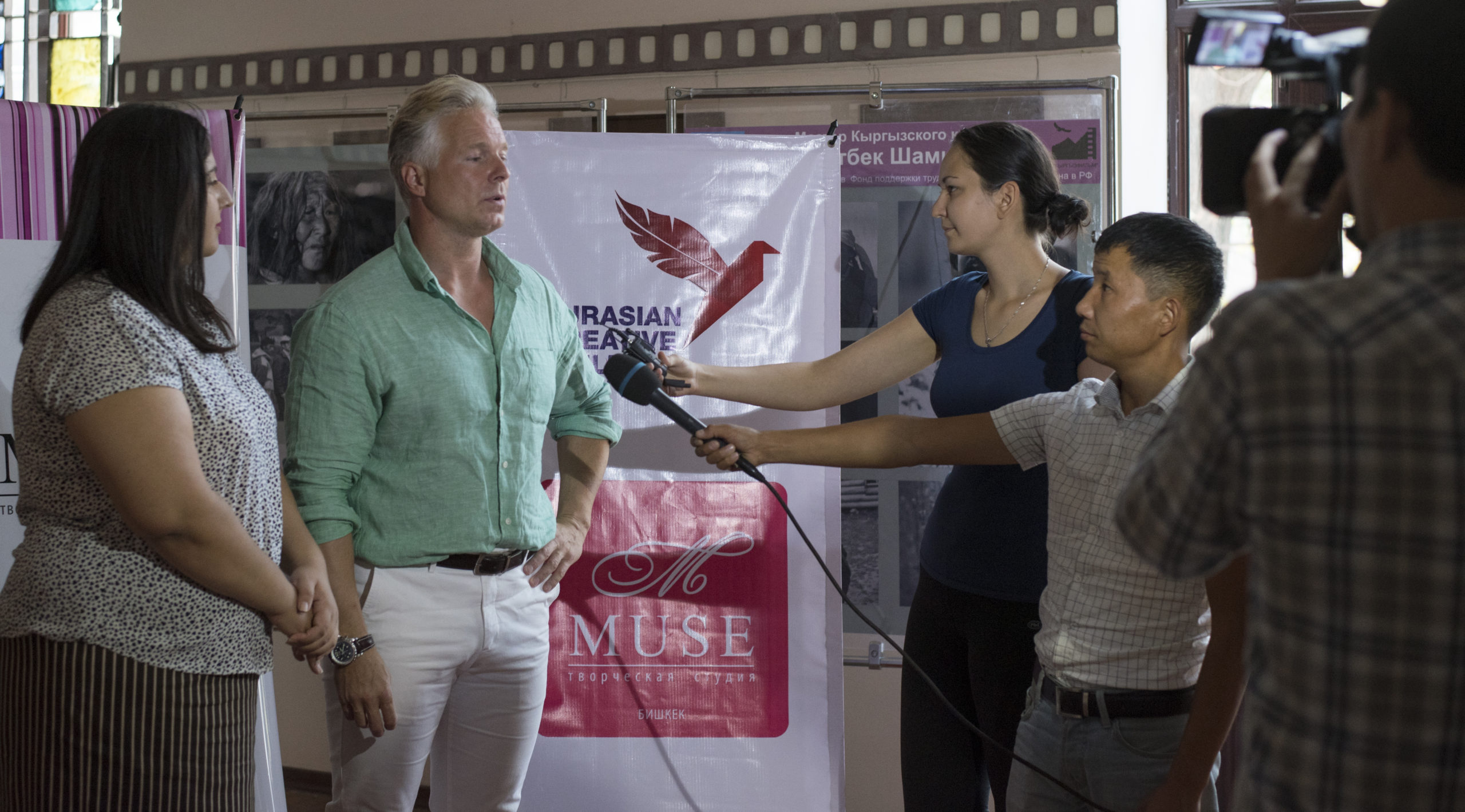
OCA: Recently you were interviewed by the BBC attending the Eurasian Creative Guild Film Festival in London. What were your impressions?
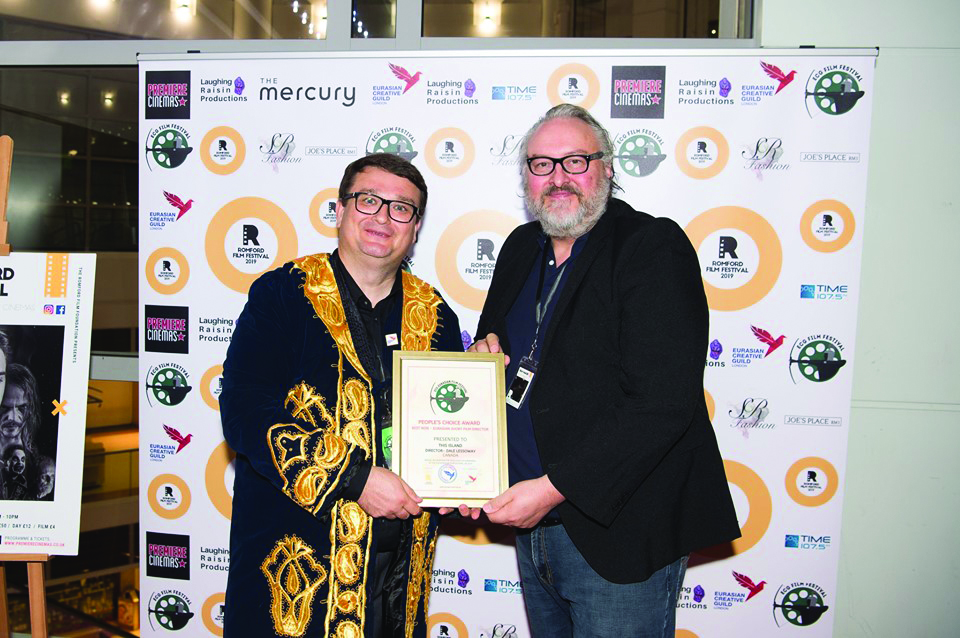
SF: Indeed, the interview was regarding the Eurasian Creative Guild Film Festival in London which was held very successfully right alongside the Romford Film Festival. In the interview I discussed the great efforts of a film called Kaddish that won the Grand Prix. I was lucky enough to get to hand the award to the producer, writer and director, Costa Fam (Konstantin Fam), since I had the honour of being a member of the jury.

Sölvi Fannar can be found on his Youtube channel:
youtube.com/solvifannar;
and on his website: solvifannar.com.

LOST ENLIGHTENMENT: THE GOLDEN AGE OF CENTRAL ASIA

The problem of distorting general history, a departure from the principle of objectivity in compiling history textbooks, and the lack of holistic basic research on the history of culture and science of Central Asia has long been troubling many historians, scholars, scientists and other representatives of the intellectuals. Scientists and historians of the Central Asian countries, after the acquisition independence, conduct research and publish books that often have a fragmentary or one-sided character. In this regard, there was a need for a new, broad and panoramic view of the general history of science and culture of Central Asia, which during different periods of its long history was part of different empires and large state entities. We needed our own Needham to reveal the history of science and culture of Central Asia to the world.

It is known that the outstanding Cambridge-historian, Joseph Needham (1900-1995), is the author of the stunning seven-volume monograph “Science and Civilisation in China”. The founder of studying of Chinese science in Europe, Needham proceeded from a thesis about universality of science and its continuous progress. The American Professor, Stephen Frederick Starr, came to a similar conclusion about the level and importance of Central Asian science for the world science in the age of Enlightenment.

Oddly enough, this long-awaited book was written not by a historian from the east, but by a U.S. overseas scholar, the President of the Central Asia – Caucasus Research Institute, Stephen Frederick Starr. The monograph by famous orientalist, researcher, and lecturer at the School of Advanced International Studies at Johns Hopkins University, Frederick Starr, titled “Lost Enlightenment: The Golden Age of Central Asia from Arab Conquest till Tamerlane’s Times” has become an event of recent years. This book makes not only Europeans, but also eastern people take a fresh look at our region.

It is remarkable, that the founder and Chairman of the Central Asia-Caucasus Institute was an expert on Russian and Eurasian affairs under the three presidents of the United States. Unfortunately, Central Asia in the eyes of a certain part of western inhabitants to this day is represented as a region of several little-known, poor States at the edge of the world, whose culture is absolutely unremarkable for them. But Stephen Frederick Starr thinks this is notion is wrong, and skilfully dispels the myth of backwardness and marginality of Central Asia. On the basis of extensive research, he colourfully and lovingly describes the Renaissance – the Age of Enlightenment in Central Asia.

This surprisingly rich book tells the story about the rise and crisis of the brightest intellectual and cultural traditions in the Islamic world. Starr proves that the “Muslim Renaissance” – the flowering of philosophy, exact sciences and poetry in the IX-XII centuries, was connected with thousands threads with the territories, which are now called Central Asia: from eastern Iran to western China. But Starr does not simply reveal a broad panorama of political, economic, and cultural processes: he shows how the story is created by personalities like Ibn Siné, Al-Biruni, Al-Ghazali, and many others.
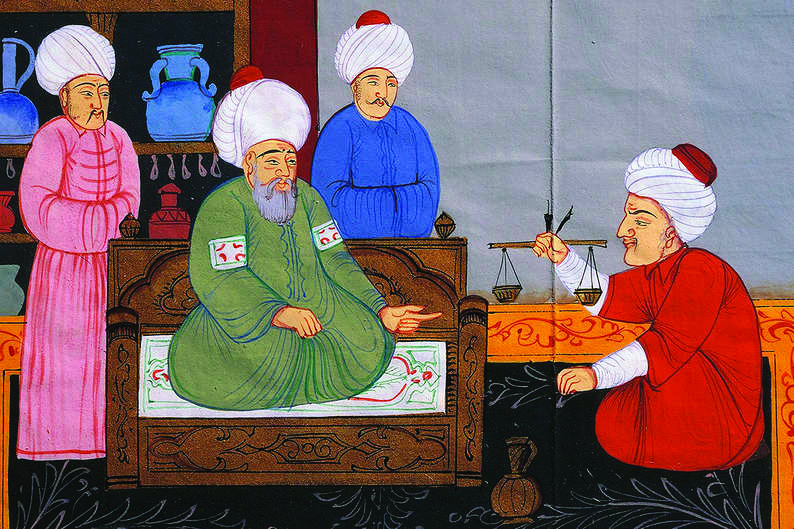
The reader learns from the book, for example, that the scholar and polymath, al-Biruni, discovered America three centuries before Columbus; that Abu Ali ibn Sina’s “Canon of Medicine”, written at the turn of the IX and X centuries, for 600 years was the main textbook on medicine in all educational institutions of the world, including the most famous universities in Europe; that the famous lancet arches entered the European Gothic from Central Asian architecture.

When one 11th-century Arab scholar made a list of all the “praiseworthy people of the epoch” who spoke Arabic, one third of the total number listed – 415 – appeared to be natives of Central Asia. The superiority of Central Asia is most noticeable in the field of natural sciences, philosophy and mathematics – scientists from this region accounted for up to 90% of the total.

Even a cursory glance at the wonderful work of Steve Frederick Starr on the main persons of science, literature and art testifies to the high level of the Epoch of Prosperity – the Era of Enlightenment.
The well-known great scientist Ibn Sina wrote over 400 works, 240 of them came to us in different forms. Ibn Sina’s “Canon of Medical Science” contains compelling arguments about the environmental impact on health, as well as the need for what we today call preventive medicine. He researched methods of treatment of hundreds of diseases, including psychosomatic ones.

The brilliant scholar, Al-Biruni, wrote 180 works. Biruni was one of several Central Asian scholars who spoke out for borrowing the concept of zero and negative numbers from India and paving new avenues for their use.

Several Central Asian scholars fought for primacy in the development of trigonometry and its adoption as an independent field of knowledge. It was rediscovered in Italy only in the 17th century.

In astronomy, the light of science Wasal-Khwarizmi. He and several other astronomers of Central Asia were engaged in measuring the length of the Earth’s degree of Meridian and the development of tables for the construction of horizontal solar clocks, which were precisely adjusted by geographical latitude. He also designed a tool that uses the sine quadrants to obtain numerical solutions to the problems of spherical astronomy. Biruni’s astronomical research has led him to conclude that planetary orbits can be elliptical rather than circular, and the apogee of the Sun changes predictably. Recently, among the planets orbiting other stars in our galaxy, planets with elliptical orbits were discovered, which drastically reduced the number of supposedly inhabited extrasolar planets.

Biruni’s tutor and close friend – Abu Nasr Mansur, is known as the “second after Ptolemy”. Al-Khuzhandi built a large sextant and made some very accurate measurements of the tilt of the ecliptic. Al-Ferghani wrote a treatise on the main medieval astronomical instrument – the astrolabe, which was later widely studied among European readers. He also wrote a study on astronomy, which became the most famous Arab work in Europe in this field. Among his many readers was Christopher Columbus, who lived 600 years after Ferghani.

Some Central Asian scientists have compiled astronomical tables of stunning accuracy. Ulugbek, the ruler of Samarkand, who passionately engaged in astronomy throughout his life, determined the length of the star year better than Copernicus, and measured the inclination of the Earth’s axis so precisely that his calculations are used today.

Al-Khorezmi was the first person who developed the theory of linear and quadratic equations in mathematics. It allowed him to find a key to various arithmetic and geometrical problems. As a result, a book called “Algebra” was published, which defined the name of this field of knowledge, and the term “algorithm” – a distorted form of the name of the scientist. Al-Khorezmi significantly deepened the field of spherical astronomy and did more than anyone else to popularise the decimal system invented in India.

In the sphere of optics a notable contribution was made by Ibn Sahl. He wrote an important treatise on the use of curved mirrors to focus light. Previously, scientists could not solve this problem. In the process, he discovered the law of refraction. Besides Ibn Sina, several other Central Asian scientists created volume works on applied and theoretical medicine. One of them, who studied in Central Asia, Abu Bakr Muhammad ar-Razi, was the most courageous diagnostician and surgeon of the Middle Ages. He was the first to use catgut sutures during operations.

Geography prospered too. Mahmud al-Kashgari created the first map on which Japan was marked. Many astronomers and experts in trigonometry used their skills to determine the latitude and longitude of hundreds of places – from India to the Mediterranean. Without doubt, the greatest geographical achievement of the era was Biruni’s work, where he used astronomical data to prove the existence of an inhabited array of land somewhere between the Atlantic and Pacific oceans.

Rashid ad-Din wrote the world’s first universal history. It would not be an exaggeration to say that Biruni turned out to be the greatest sociologist in the period between Thucydides and present time. For comparison: Hugo Grotius (1583–1645), Thomas Gobbs (1588–1679), Samuel von Pufendorf (1632–1694) and John Locke (1632–1704) preferred to theorise about society rather than study it.Mahmud Kashgari was a turkologist and ethnographer who created comparative linguistics as a field of knowledge.

The pride of Central Asian intellectual life is philosophy. Natives of the region plunged into this area with such passion and eagerness that they considerably bypassed all other scientists of this era. Their writings had a decisive influence both on Muslims all over the world and on the Christian West. The great German scientist, Adam Metz, said that the humanism of the European Renaissance would not have been possible without the early flowering of philosophical research in Central Asia.

The age of Enlightenment is rich with unsurpassed achievements in art and literature. Sufism, a mystical and ecstatic form of Islam that seeks to dispel all worldly problems so that the believer can enter into direct contact with God, was one of the striking examples of popular values that were the driving force of intellectual transformation. The Sufi poets Jalaladdin Rumi and Omar Hayyama have many admirers all over the world today. The early poets Rudaki and Asjadi are at the origin of the great Persian literary tradition. The colossal panorama of Iranian civilisation, the poem “Shahnameh”, set the world standard for other national epics. The author, Ferdowsi, was born in Khorasan, and a large part of his epic describes Central Asia, not the land, which is currently located on the territory of Iran. Almost all scholars, including Ibn Sina, wrote at least part of their works in verse.

Even a superficial and incomplete list of names and accomplishments confirm that the medieval scholars of Central Asia were not mere “transmitters” of ancient Greek achievements, they themselves were pioneers in various fields. Before the Islamic era, Central Asians invented the bow. Due to this invention, which quickly spread throughout China, India and the West, Central Asia can be considered the true birthplace of the violin.


A simple annotation of the contents “The Lost Enlightenment: the Golden Age of Central Asia from the Arab Conquest to the Time of Tamerlane”, even briefly, takes a long time. The monograph of Professor Frederick Starr reveals to readers an amazing Age of Enlightenment, which gave a powerful impetus to the development of world science and culture. And such work with colossal texture could be written only by the person, who was sincerely in love with Central Asia and fascinated by its history.

text by Akhmedov Begizhan Makhmudovich

Akhmedov Begizhan Makhmudovich is a writer, historian, member of the National Writers Union of Kyrgyzstan and Prize Laureate of International Funds (Kyrgyzstan) and Babur (Uzbekistan) named after Kurmanjan Datka.

KAZAKH ALASKA

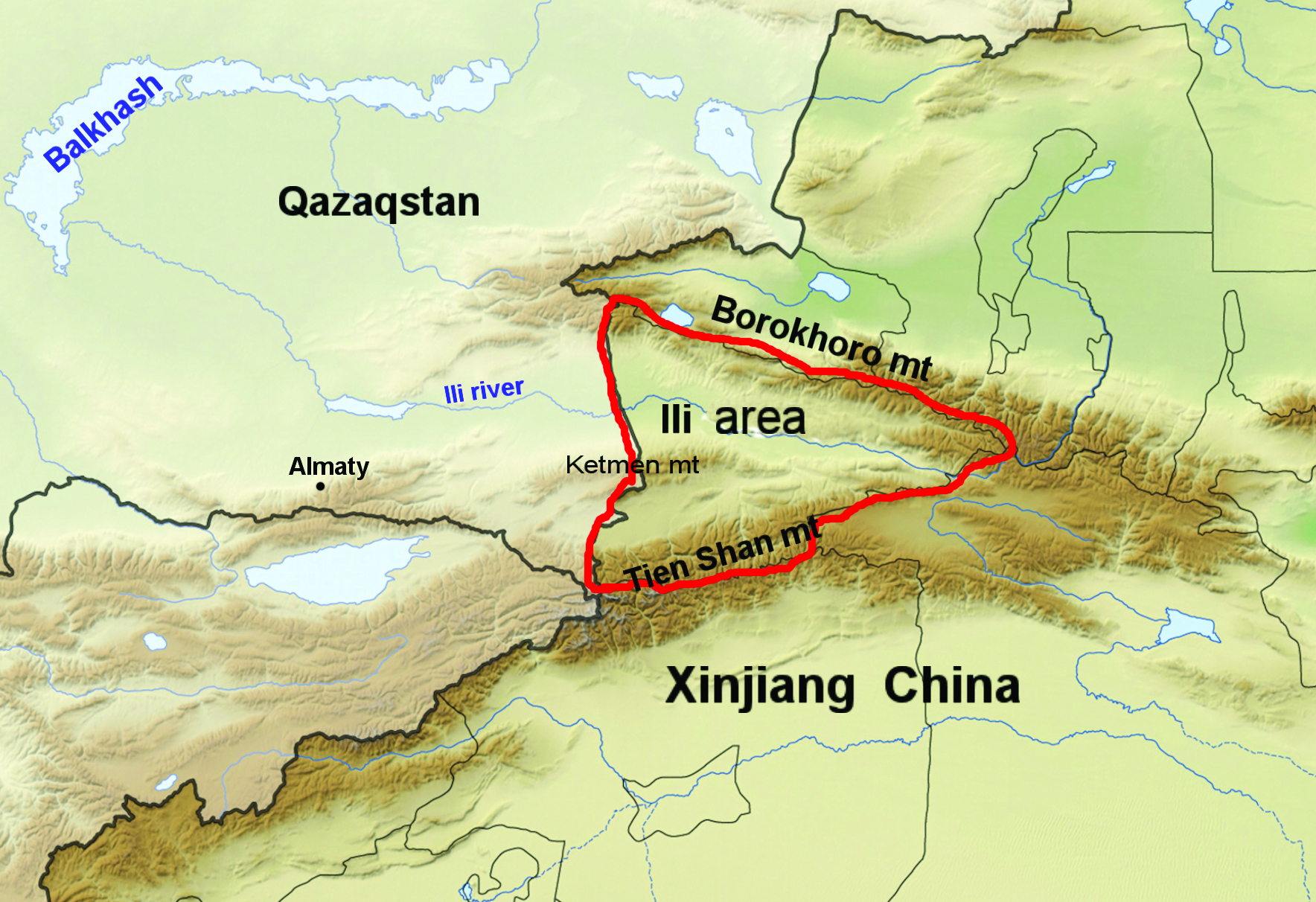
The territory of Ile in Xinjiang was occupied by Russian troops in 1871.

After ten years, in the year 1881-82, the Ile area was returned to China.

For the second time (after Alaska) the Russian Empire refused the

almost-conquered territory that was lying at its feet like a ripe melon …

Ile area
Numerous rivers, the most significant of which are the Tekes and Kunges, run down the Tien Shan ranges and, merging into one, make the Ile River. The main flow of the river crosses the territory of Kazakhstan, but its headwaters arise in the area then called Ile, which formed and still forms the Chinese region of Xinjiang today. China gets the majority of the river water for its needs. The Ile River becomes shallow and Lake Balkhash becomes shallow too. But back in the 19th century it could have been that the entire Ile valley became part of Kazakhstan. Why didn’t that happen?

In the 1760’s, after the seizure of Dzungaria by China coupled with the driving out of the Dzungarians to the deserted upper valley of Ile, Chinese Hans resettled there alongside Dungans from Gansu, Taranchi from Kashgaria, Sibo and Soloni from Manchuria and Mongol-Chahars from Mongolia. The Kalmyks also migrated there from Kalmykia in 1771. Separate nomadic tribes of Kazakhs and Kyrgyz travelled through the mountain gorges. Thus, the population of the Ile area comprised an explosive mixture of various ethnic groups, different economic patterns and various confessions. At this time, the western border of the area was the border between Qing China and Tsarist Russia.

Dissolution of Xinjiang
In the 1860s China, weakened by the “Opium Wars”, was seized by the fires of national riots and rebellions. This started with the peasant war of Tai-pings in the eastern part of the Empire. Then the rebel’ fervor spread to the west. In 1862 the Dungans’ rebellion blazed throughout Shanxi province. Then the fire of riot leaped over to Gansu. In summer of 1864 the riots came to Urumqi. The city was partially destroyed and burned away. The huge warehouses of tea that was designated to be exported to Russia were burned down. In March 1866 Muslim rebels, mostly Dungans, occupied the capital of Xinjiang – Ghulja. The Dungans were supported by their fellow believers, the Taranchi (Uighurs), and also by Kazakhs and Kyrgyz. The riot obviously took on the religious tint of a Muslim fight with infidels. The representatives of Chinese-Manchuria administration, Mongols and Kalmyks that fell into the rebels’ hands were viciously slaughtered. The infidel survivors of the massacre from the eastern parts of the province escaped to China, and those from the western precincts fled to the borders of Russian Altay.

After the final victory of the rebels in 1867 there appeared three independent Muslim states on the territory abandoned by the Chinese Xinjiang: The Taranchi sultanate on the Ile lands, headed by sultan Alakhan Abilogly; the Dungan Khanate in place of the Tarbagatay precinct, headed by Lotay Khan and the Yetyshaar state in Kashgaria, headed by the field commander from neighboring Kokand – Yakubbek. Neither China nor Russia recognized the newly created countries. However, Great Britain and Turkey recognized Yetyshaar. The so-called “Great Game” between Great Britain and Russia was at its peak and the politicians were guided by the “The enemy of my enemy is my friend” principle.

Russian Turkestan vs Chinese Turkestan
Also in 1867, as a counter to the Muslim countries, Russia created the Turkestan Governor-Generalship headed by General Kostantin von Kaufman.

In the Taranchi sultanate the power of Alakhan sultan was weak and he could not maintain order. During the feuds between Dungans and Taranchi, armed groups plundered from civilians, trespassed over the border with Russia and established connections with Kokand, Khiva and Bukhara while fighting with each other. However the tough and aggressive Yetyshaar ruler, Yakubbek, acted more decisively. He proclaimed himself to be the descendant of Tamerlane and suggested that every Middle Asian nation should unite for jihad against Russia. But besides the propagandist discourse he created a strong state, enabled taxation, summoned a regular army with various service arms, and with the help of the British and the Turkish re-equipped them with firearms. In 1870 his army occupied Urumqi, annexing the Dungan Khanate, and Yakubbek was ready to unite the entire former Xinjiang under his reign.

The Russian generals determined that a risk had developed of creating a huge and hostile neighbouring Muslim state in Chinese Turkestan under the custody of Great Britain and demanded decisive actions. Finally, after long hesitation, the Russian Government came to an agreement with the Generals to occupy the Ile area whilst it was not yet occupied by Yakubbek. That was when the occasion recurred. In May 1871 particularly violent clashes of Muslim troops with the Russian army occurred on the Russia-Taranchi border. This became the pretext for an invasion.

In June 1871, Russian troops under the command of General Kolpakovski crossed the river Borohudzir, which marked the border, and invaded the territory of the Taranchi sultanate. During several battles the disorganized and poorly armed troops of the Dungans and Taranchi suffered a defeat. The war ended with a victorious blitzkrieg. In eight days the Russian army occupied Ghulja and the sultanate was destroyed. The Ile area became the Ghulja region as part of Russian Turkestan. But Russia made a gesture to the international community, promising to China that as soon as the Chinese government found itself able to support its power in the region, the Ghulja region would be returned and the troops would be withdrawn. Sultan Alakhan Abilogly was honourably exiled to Verniy city (Almaty), where he spent the rest of his life, receiving his annual pension of five thousand rubles from the Russian government.

“Doves” vs “Hawks”
And what to do with the Ghulja region next? There were constant disputes about its future between the Turkestan regional administration and the Russian Central Government – between the Hawk-generals and Dove-diplomats. The Turkestan “hawks” – Kaufman and Kolpakovski and the majority of the Russian military were firmly set against the return of the region to China. The generals, having considered the strategic goal of defence, proposed that Russia replace the old, completely open, border that crossed the steppe with a new, almost impassable, natural border at the Tian Shan mountain ridge, retaining the rich and fertile valley of the Upper Ile. In this case, the frontier patrol duties would be reduced to control the strategically important passes of Talki (to Dzungaria) and Muzart (to Kashgaria). At this time the Semipalatinsk governor – General Vladimir Poltoratski – suggested solving the problem even more drastically, by taking advantage of the situation to occupy Urumqi and Kashgaria, thus expanding the Russian state to its “natural limits”.
However, people in the Ministry of Foreign Affairs (MFA) thought otherwise. The MFA’s head, Duke Gorchakov, who was counting money, well remembered his promises and regarded England’s opinion and Europe’s reaction with caution. In order to calm the combative generals, the diplomats assured them that ‘the refusal to return it would have been in complete contradiction to those undertakings that the Russian government repeatedly made to the Chinese government’. In this case, ‘the loss of the advantageous strategic position would be compensated by the recovery of mutually advantageous trade with The Heavenly Empire’. That was the main reason. It was not a secret that Russia was receiving huge profits from the export of their own produce to Ile region and from the import of Chinese tea with its further transit to Europe. As a result of the rebellion the trade routes via Chuguchak and Ghulja were cut off, trade was suffering losses and the treasury was not receiving taxes. Therefore, Russia was interested in the recovery of its former trade routes, the profit from which the Government considered was more important than expensive territorial purchases. Thus, the ‘doves’ won at the Russian court.

Whereas, there were disputes about the Ile region’s destiny at the Chinese court; they also considered costs and here also ‘hawks’ were disputing with ‘doves’. The head ‘hawk’ – General Zuo Zongtang, who had defeated the centres of the Dungan rebellions in Shanxi, set his heart on becoming the liberator of China. The General was keen to advertise the perceived ‘Russian threat’, persuading all that if China did not regain Xinjiang, the Russians would own it, and would move on to Mongolia and further on to Manchuria. His gang of ‘hawks’ appealed to the Empress Dowager Cixi’s patriotism, trying to persuade her that after the defeat in the ‘Opium wars’ China should demonstrate to the Europeans its power in suppressing the anti-Qin riots and that Xinjiang was to be returned at any cost. The ‘doves’ faction, headed by the Beijing governor Li Hongzhang, considered not only the Ile region, but the entire Xinjiang as a self-supporting area that did not belong to any other country. Li Hongzhang as a practical person argued that owning Xinjiang was detrimental, and suggested that they should forget about that ‘wild land’ and recollect that there was a ‘Japanese threat’ from the sea. ‘The hawks’ won at the Chinese court.

In 1875 General Zuo Zongtang headed ‘The Western campaign’ of the Chinese army to Xinjiang. At first he drowned the riot centres in Gansu and Urumqi in Dungan blood and then moved on to Yetishaar. The Muslim troops were heavily defeated. Yakubbek died in unclear circumstances: whether from poison, or from a heart attack. The state was destroyed and the Chinese General flooded Kashgaria with Uighur blood. Then the slaughterman of the Uighur and Dungan people claimed his right to the Ile region.

And thus, in September 1879 the Livadian Agreement was signed in Crimea, based on which Russian troops were withdrawn from the Ile region and then the latter was returned to China. However, according to the claim of the ‘hawks’ from the Military Ministry the agreement stipulated that more than 40% of the region’s territory with the valley of Tekes and the Muzart and Talki passes went to Russia.

‘There, where the Russian flag was once hoisted it must never be hoisted down’ – claimed Tsar Nicolay I. And so it was, though not always. But for the unprecedented cases with Alaska and the Ile region, the Russian tanks would have been standing by the threshold of North America, and the full-flowing Ile and maybe Irtysh would have been flowing fully within the territory of Kazakhstan. America was blessed with Alaska, while Kazakhstan failed with the Ile region three times: the ‘doves’ from the MFA won in Russia, Zuo Zongtang’s ‘hawks’ won in China and the Livadian agreement was not fulfilled.

The Ile crisis
The Chinese government considered the Livadian agreement as extortionate and did not ratify it. The Chinese ambassador Chung Hou, who had signed the agreement, was accused of acquiescence and lack of determination, and was “denounced as a Russian spy”. The Empress Dowager Cixi sentenced him to death, precipitating the so-called ‘The Ile crisis”.

The ‘hawks’ suddenly became more active in China. After Yakubbek’s death, Great Britain placed its bets on Zuo Zongtang. The Chinese delegates were purchasing fire arms, cannons and cruisers in Europe with the help of English loans. The aggressive General, while re-equipping his army, threatened to capture not only the Ile region, but all of Central Asia; and playing along with the English, he blustered to reach St. Petersburg. Demonstrating hard-line decisiveness, he moved his headquarters from Central China to Xinjiang, taking a luxurious coffin with him, thereby implying that he would return home ‘with a shield or in a coffin’.

The Russian government also started preparing for war, repositioning troops to the borders of Turkestan. Tsar Alexander sent Admiral Lesovsky’s fleet to the Far East to land troops in Manchuria. The Russian Attaché in London, General Gorlov received a proposal from Irish terrorists to create a volunteer brigade to fight with the British in Central Asia. The ‘hawks”-generals headed by Kaufman were rubbing their hands in anticipation of easy manoeuvres and were planning a ‘crusade to Beijing’.

In 1880 the Ile crisis reached its final phase. Qing China and Tsarist Russia, rattling the sabre were standing “wall-to-wall” against each other. The entire world was watching the confrontation of Russia and China with sinking hearts. Would the Chinese put the ambassador to death or not? Would war break out or not? Behind China one could perceive the shadow of the third empire – Great Britain. And there Queen Victoria made her move towards peace, sending a letter to her colleague – the Chinese Empress pleading with her to grant a pardon to Chung Hou.

While Zuo Zongtang was ‘warmongering’ in Xinjiang, the pragmatism of Cixi and Li Hongzhang was predominating in Beijing. They clearly understood that it was one thing to defeat the isolated and poorly armed rebel forces, but quite another to fight the regular army of the great northern Empire. Therefore, taking into consideration Europe’s opinion, Chung Hou was granted a pardon and Li’s supporter, Duke Zeng Jize then was sent to St. Petersburg to conduct negotiations.
In Russia they also considered that a bad peace was better than a good quarrel. The MFA’s position – to regulate the relations with China and to restore trade overweighed the geopolitical concerns of the Military Ministry. The Generals’ demands on the territory were reduced twice and the funding request in relation to occupational costs was increased.

Russian-Chinese agreement
The resolution of the “Ile crisis” became the new Russian-Chinese St. Petersburg agreement signed on February 12, 1881. Russia withdrew its claim for the Tekes valley and the strategic passes. Of the territory of the Ile region, with a total area of 50 thousand square kilometres, Russia (and later on Kazakhstan) achieved only a consolation prize of 10 thousand square kilometres. The old border along Borohudzir and Charyn was moved east to the river Horgos and these lands were settled by the Muslim-refugees from the Ile region, who assumed Russian citizenship. Today this territory is a part of the Almaty region. Besides this, the Chinese authorities were to pay Russia 9 million rubles to cover the expense of bringing order to the Ile region and to allow amnesty to the local population (remember that Alaska was sold for 11 million rubles).
In China the St. Petersburg agreement was received with delight as a significant success in Qing diplomacy. General Zuo Zongtang became the national hero who returned Xinjiang. Subsequently, an administrative reform was conducted in the province. The Ile region became the Ile-Kazakh Autonomous district and Urumqi became the capital of Xinjiang instead of the frontier Ghulja.

Text by Murat Uali
Translated from Russian by Dana Zheteyeva

OCA#32  SUMMER 2019  WWW.OCAMAGAZINE.COM  

THE LIFE AND ART OF MARC CHAGALL

Born in Belarus, Marc Chagall is a talented painter, a bright art practitioner of the avant-garde of the twentieth century who took over the world with his unique style and special outlook on life. Chagall is one of the few artists who formed a whole era in art. It is hard to name a person who has not heard of this great man with an incredible imagination and a unique vision of his creativity in painting.

At age 19 he entered the school of the famous Vitebsk painter Yudel Pen, who saw a bright talent and offered the young man to study for free. A few months later, the future artist went to study in St. Petersburg.

Chagall decided to continue his education in Paris: he attended classes at the academies of arts, examined various exhibitions and galleries, mastered new artistic movement – cubism, futurism, orphism and at the same time he was creating his own, exceptional style.

In June 1914 the first exhibition of Marc Chagall took place in Berlin, where were almost all his pictures and drawings painted in Paris. After his success, the name Marc Chagall became widely known.

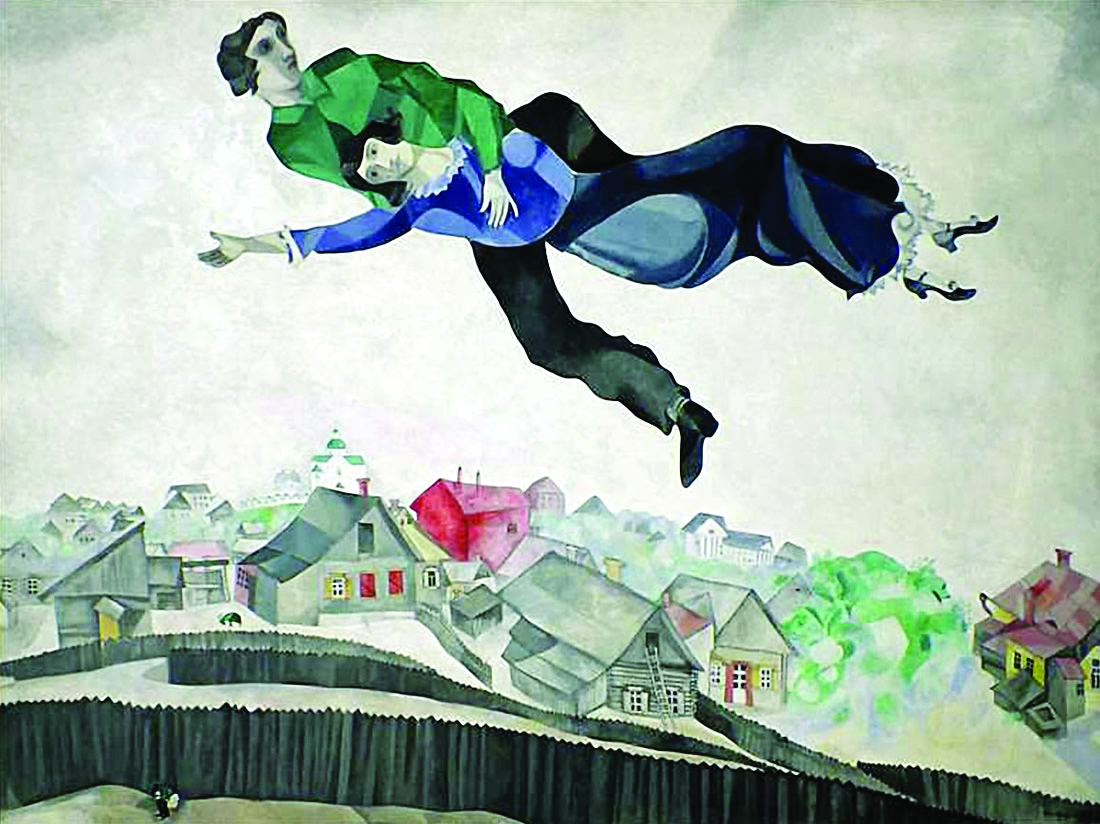
With the beginning of World War I, Marc Chagall returned to his homeland where he created famous paintings such as: “Over the Town”, “The Promenade”. Besides, in Vitebsk he got married to Bella Rosenfeld – a woman who became his greatest love and inspiration for the rest of his life. In 1934 Chagall’s paintings, which were kept in the museums in Berlin, were publicly burned on the orders of Hitler. Soon after that, Marc Chagall left France and went to the USA with his family.

Marc Chagall’s decision to move to the United States was promoted by the tense situation in Europe, when Germany declared war on the USSR. He lived in America with his family and during this time he created two picturesque panels for the Metropolitan Opera in the USA and many other famous works. In 1942, German Sevastyanov, manager of the New York Ballet Theater, persuades the artist to create the scenery and costumes for the ballet “Aleko”. For the four acts of “Aleko”, Chagall completed a series of sketches, costumes, scenery and four large panels.

Before leaving the USA, Chagall receives an order for illustrations for four tales from “A thousand and one nights”. As a result, Chagall creates the first series of color lithographs (thirteen illustrations), which were published in New York after the artist left the United States. In the US many new works were created, reflecting the American atmosphere as well as the anxiety of the war years. During his stay in the United States, Chagall continued to work in the field of book illustration. In particular, he created wonderful illustrations for the book of Itzik Fefer’s poems.

In the USA, the stained-glass masterpiece can be seen in the composition “Peace” for the UN building in New York dedicated to the memory of Dag Hammarskjold (UN General Secretary) and another 15 people who died in a plane crash. Chagall’s most significant stained-glass work in the United States is the ensemble for the “Union Church” located in the town of Pocantico hills, not far from New York. The mosaic composition established in 1974 in front of the Bank in Chicago is the last work of Chagall, created in the USA.

In 1944 he was going to return to Paris liberated from the Germans, but these days his wife Bella suddenly passed away. Chagall grieved for his loss. He did not paint nine months, but when he returned to it, he created two works dedicated to Bella “The Wedding Candles” and “Around Her”. Bella was not the last woman in the artist’s life but till his dying day she remained his love and eternal muse.

After the war Chagall returned to Europe, his artwork illustrated bible theme. Plenty of etchings for the French Bible edition: paintings, engravings, stained-glass windows expressed the message of the artist to the world. That is why in 1973 he decided to open a museum in Nice. The French government has announced this collection as the official national museum.

In honor of the 90th anniversary of the painter in the Louvre was held the largest lifetime exhibition of his works. Contrary to all the rules, pictures of the living artist were exhibited in the museum.

Marc Chagall passed away at Saint-Paul-de-Vence. He is buried in the local cemetery in Provence.

The art of Marc Chagall is striking in its diversity and defies strict classification. The artist’s style combines expression and unconventional style which was formed under the influence of cubism, fauvism, orphism. In the canvases he illustrated his special outlook and religious views.

Stick to his style, Marc Chagall continued to experiment in various techniques and genres all his life long. His creative heritage consist of book illustrations, graphics, scenic painting, mosaics, stained-glass windows, sculpture and ceramics.

One of the most fruitful movement for Chagall was a book illustration. For famous writers such as Andre Breton, Andre Malraux and many others Marc became the incarnation of a literary artist who expresses poetic lines in fantastic images.

Original works by Marc Chagall adorn the largest theaters in the world. At the request of Andre Malraux, Minister of Culture of France, the artist painted the plafond for the auditorium of the Paris Opera Garnier, created two murals for the New York Metropolitan Opera and decorated the building of the National Bank with mosaics in Chicago.

Chagall was one of the first who started to use easel painting in the design of theatrical scenery. In the early 60s the noted throughout the world painter became interested in monumental art and interior design. In Jerusalem he created mosaics for the parliament building, stained glass windows for the synagogue of the Medical Center and later he decorated many Catholic and Lutheran temples, synagogues throughout Europe, America and Israel.

The talented painter also made a contribution into literature: poetry, essays and memoirs in Yiddish were published during his lifetime and translated into Hebrew, Russian, Belarusian, English and French. The autobiographical book of Marc Chagall “My Life” gained world-wide prominence.

It is extremely difficult for a person barren of imagination to visually perceive the canvases of the artist because they do not fit into the concept of standard painting and are very different from classical works, where the accuracy of lines is extremely important. The artist has created his own reality, which is rich in colors and full of feelings, the one where people can fly and walk in the clouds. His paintings seem strange and at the same time they are extraordinary. That is the way the artist sees the reality surrounding him.

Today the work of Marc Chagall can be seen in galleries in France, USA, Germany, Russia, Belarus, Switzerland and Israel. The memory of the great artist is honored in his homeland: the house in Vitebsk where the graphic artist lived for a long time was turned into the house-museum of Chagall. Fans of the painter up to now can personally visit the place where the avant-garde artist created his masterpieces.

Text by Bozhena Krasnogir

FROM SAINT-LIGUORI TO NUR-SULTAN

After meeting eight young Kazakhs at the International Olympiads of Linguistics, I decided to fly from Canada to see my friends again and at the same time, discover the land of the Kazakhs…

My name is Nathan Samson, I am now 18 years old and I study Linguistics at the University of Ottawa. Last year, I competed in the International Olympiads of Linguistics (IOL). During the contest, which took place in Czech Republic, I became acquainted with the various Kazakh teams and quickly became friends with the members of the teams. At that time, I only had a little knowledge of Russian and absolutely no knowledge of the Kazakh language. I had a vague idea about Kazakh culture and history coming from my interest towards Turkish and Persian history, but I was far from having much of an idea of how Kazakhstan was today and what it meant to be Kazakh.
During my trip in the Czech Republic, I had been so interested and fascinated by the stories I heard about Kazakhstan that I had no choice but to visit this mysterious country and, with this end in view, I started preparing. I spent the last year studying Russian and Kazakh (though more Russian to be honest), I managed to earn enough money to afford my flight ticket and I stayed in touch with my friends. It was not an easy road that I followed until the day I sat on the plane, waiting to arrive at Nur-Sultan airport. A few times, I had thought it would never be possible to visit. Most of my friends and family probably never believed that I would really travel to Kazakhstan.
But I did it. At the age of 17 years old, I travelled alone, across Kazakhstan.

I arrived at the Nursultan Nazerbaev Airport of Nur-Sultan City at 4:55 AM on May 13th 2019. When I was finally able to exit the airport and find my friend, I already felt that this trip was going to be extraordinary. My first day in Kazakhstan was great: I had spent the last year thinking about this trip, about the country, the language, the culture and about the time when I would meet my friends again.

I thought about the different projects I could do during my trip: I was interested in making a documentary at first but finally opted for a book about my journey, so I started writing very quickly after my arrival.

The title of this article refers to the town where I come from: Saint-Liguori, a very small town in the francophone province of Québec, Canada. Big cities were always a bit scary for me, since I grew up surrounded by fields, so it was one of the things that scared me the most about my trip, to stay in a city like Nur-Sultan. That is the reason why I was happy to discover the Right Bank of Nur-Sultan, especially the Baiqonour district, where the way of living was closer to our provincial way of living, but at the same time, very Kazakh.

Before my trip, most of the people I had told about my plans were afraid for me. They thought it was a dangerous idea to travel alone across Kazakhstan being a minor and without a travel agency or any external organisation, but during my journey, I constantly proved to them that Kazakhstan is a place where, with good research and some knowledge of the culture and language, anyone can travel. One of the things that interested me during my preparation for the trip were the trains in Kazakhstan. I had read so many extraordinary stories about these long trips by train across the country, but I never expected what would happen in these trains…
I lived so many incredible adventures during my stay in Kazakhstan, but some of the most interesting moments happened in the trains that I took. I used to a carry a guitar with me when I would go to another city and I often ended up playing music during the night for the other passengers. It was something I really didn’t expect, because no one would think of playing guitar and singing in a train in Canada, but there, often other passengers would ask me to play. There was even one time, when we travelled from Nur-Sultan to Borovoe, when the whole wagon (we bought seats for that trip) listened to my music and sang with me the Russian songs I could play (some classics like Katiousha and some Viktor Tsoy music). They appreciated it so much that when I left the train, they all stood up to applaud me as I was leaving, shaking my hand and congratulating me in various languages.

Another big part of my journey that should be mentioned is my introduction into the muslim tradition. Travelling in Kazakhstan during the month of ramadan, I had no choice but to respect the people who welcomed me and to honour their faith by also holding the fast. They never asked me to do it, they told me several times that they wouldn’t be offended if I didn’t hold the fast, being a non-muslim traveller, but I felt that it would be disrespectful, after all what they were doing for me, to do such a thing. My goal was also to try to understand the Kazakh people and their reality. I couldn’t make another choice than doing as they were doing. Living as a muslim for a month helped me understand more about many things. First, a lot of my friends in Canada are muslim and I never had a chance to see their religion from that point of view. Also, I have been surprised to see how welcoming, helpful and respectful Kazakhs were during my entire trip. We would do well to remember that even if countries like Kazakhstan are not as touristically developed as France or Greece, for instance, it doesn’t mean that they are closed to foreigners. I would even say that the fact that it is not such a touristic place may make it a better place to explore if you are a bit of an adventurer. For those reasons I have plans to return next year.

OCA#32  SUMMER 2019  WWW.OCAMAGAZINE.COM  Text by Nathan Samson

ANIMATION IS KEY TO DEVELOPING EMOTIONAL INTELLIGENCE

As many parents believe that watching cartoons is either harmful or not of much use, nowadays, it has become fashionable not to show them to children. This opinion, however, does not hold true; good animation can contribute to the formation of a child’s personality, because high-quality cartoons, as with books and movies, help to develop emotional intelligence.

What do we mean by this phrase? Emotional intelligence is a person’s ability to perceive their own emotions and manage their feelings for effective problem-solving. A high level of emotional intelligence is one of the indicators of leaders and successful people. Emotional intelligence helps in many areas of life: from studying and building a career to friendship and good familial relations.
The process of learning through animation is often faster than through books, because the child can immediately see and hear what the hero feels and experiences. With the mood transmitted through music, sounds and images, the child can quickly empathise with the hero when watching quality animation. They can see the consequences of negative actions and reflect on what constitutes fitting behaviour. The child learns what is socially seen as good and bad from the examples before them.

A great example of how an animated series can help develop emotional intelligence is the British series, Peppa Pig, which is ideally suited to younger viewers. The main characters laugh, cry, become angry, offended and upset. When they’re happy, they jump in puddles gleefully, and when they’re sad, they cry. The voiceover and other characters give voice to the feelings and emotional state of the hero. For example, in the episode “George catches a cold,” George is afraid of the doctor and the viewer can see how scared he is as he hides under a blanket. The voiceover further emphasises the emotion of the character, and the doctor finds a way to cheer up George and reduce his fear. Watching this cartoon, a young viewer can easily become acquainted with basic feelings and emotions.

If we compare American and Russian animation, the biggest difference at the moment is that animation in America is a huge, profitable industry with well-established processes. Cartoons for both children and adults are shown in prime-time. In Russia, state regulation has led to a position where it is not profitable for channels to broadcast animated films. In Russia, there are almost no cartoons made for adult audiences, whilst in America, there are numerous examples, such as The Simpsons and Family Guy.

In other ways, Russian and American cartoons have become very similar in the last five years, with Russian animators adopting styles used by their American colleagues. This has made the characters in Russian animation more understandable and recognisable for viewers around the world. The differences between modern American and Russian animation are not so great. Both aim to tell expressive stories using both digital and traditional methods. Both use exaggeration, various tricks and modern music, whilst adhering to the basic principles of the art form. Most importantly, both Russian and American cartoons can serve as an excellent methodological tool for the development of emotional intelligence in children.

In the episode, ‘The Frying Pan” from the Russian animated series The Fixies – its script written by children’s author and member of the Eurasian Creative Guild, Arina Chunaeva – the main characters, Nolik and Simka argue as to who is better at skating. They decide to arrange a contest in which their friend Tom Thomas will act as the judge. He turns out to be a dishonest judge, however. Watching this cartoon, a younger viewer learns that you should never deceive your friends for the sake of victory, even if you really want to win. Thanks to this cartoon, the viewer begins to better recognise the causes of lies and boasting and the negative consequences of such actions.

In an episode entitled “Recipe for Disaster” from the world-famous Russian cartoon, Masha and The Bear – an episode which entered the Guinness Book of world records as the most-viewed animated video on social networks – the main character, Masha cooks all the oatmeal in the kitchen, and all the animals in the forest are forced to eat this porridge. The viewer can empathise with Masha, whose prank has gone too far, as well as with the forest dwellers and the Bear, who, as always, only wanted to rest. The situation is portrayed with humour and without any moralising overtones. The child can easily understand from the reactions and facial expressions of the characters what is good and what is not.

In the movie made by the Walt Disney Animation Studio, Moana, the main character teaches the viewer how to inspire others and understand their needs and the motivation behind their behaviour. The eponymous main character helps the demigod Maui to believe in himself again, and in the process teaches viewers how to cope with their fears and doubts and achieve their goals.

In order to facilitate the most rapid and effective development of emotional intelligence, parents should watch cartoons with their children, especially with those under the age of seven. Parents can then comment on events that occur and answer any questions the child may raise, such as why the hero cried, what upset them, and what should be done in this or that case. It is important to focus on the feelings and experiences of the hero, as well as on the motives of their actions.

By following this simple advice, cartoons can be elevated from a pleasurable pastime into great learning material. Sharing a good cartoon is not only an effective way to develop emotional intelligence, but a great opportunity to immerse oneself in the wonderful world of the child. This aids not only in understanding children, but in remembering how you looked at the world when you were young.

OCA#32  SUMMER 2019  WWW.OCAMAGAZINE.COM  text by Victoria Bukharova and Arina Chunaeva

DECONSTRUCTING TRADITION: THE ART OF FAIG AHMED

Faig Ahmed dismantles and reforms Azerbaijani traditions of carpet making, creating remarkable new works of contemporary art. Through his art practice he reconsiders these ancient crafts and their history by deconstructing both their physical form and their traditions, and questions the conventions associated with their craft by repositioning them in the contemporary art environment. From these ancient objects he creates new visual forms which challenge the role of iconic cultural objects in representing nations, traditions and history. The cultural significance of carpet weaving in Azerbaijan is reaffirmed by Ahmed’s practice who sees cultural history as a monolithic subject by which we establish our perspectives and visual vocabulary today but also something which is important to question and challenge.

Azerbaijani carpets are often extraordinary and intricate creations with examples dating back as far back as the 2nd millennium BC. They are made up of range of “schools” defined by their geographic origins and type of pattern. Their construction demands an exceptional level of skill. Ahmed has both manipulated original carpets – un-weaving them and using digital technology to redesign and reconstruct them – and also employed those equipped with the ancient skills to weave completely new carpets. Finding traditional weavers to craft his designs has proved difficult due to the sacred nature of the craft but eventually he found those who would be willing to work for him, although notably done in secret.


Through these methods Ahmed questions the role of truth in these carpets and whether in a deconstructed form they can they still carry the same significance and power as they did when objects of antiquity. His work shows how artworks can be contemporary but still retain a sense of an ancient aura. They are a unique collision of traditional crafts, steeped in history and digitally distorted and pixelated images. In his work ‘Oiling’ (2012) his hand-woven carpet gives the sensation that the coloured strands of the rug are melting, like the reflective pattern of oil in water. This sensation resonates with Ahmed’s home city, Azerbaijan’s capital Baku, and its own history of early oil drilling and the geopolitics around oil that would follow.

The elevation of these carpets into complex objects of art, hanging in a gallery environment, highlights their journey from their original function as a domestic feature – to be walked over – and how, through the role of antiquity and now as contemporary art objects, they have changed into cultural objects that are exhibited and capable of holding multiple meanings. This transformation from functional to iconic is highlighted by their manipulation into abstracted and digitally fluent forms with echoes of contemporary internet art. These digital manipulations express a three- dimensionality that re-activates and invigorates them. They draw the viewer in; as at first glance the skilful weaving of coloured strands appear as pixels seen at close range or a digital glitch.

There is a strange moral tension in this process of using an object, firstly of function, yet which has become renowned as a historic artefact and transforming it into a contemporary art object for exhibition. Ahmed seeks out carpets aged around 100 years old or more, using his own supplier to acquire theses cultural icons. He has reflected on the morality of this process – attempting to remain detached from their historic weight and tradition simply seeing it as another part of history – and another material or medium for an artist to manipulate. However, he has struggled to always maintain this distance; on one occasion he was using a carpet from the Karabakh school, developed in lowland and mountainous parts of the Karabakh region. Ahmed reflected on the issues of tradition and its intersection with nationality and sovereignty with this particular carpet. The Karabakh region is occupied by Armenia and the carpet came from a woman who cannot return there. This relationship between the icon and the displacement of its owner caused Ahmed to be unable to cut and appropriate the carpet, describing himself as ‘a hostage to tradition’. Unable to unravel the carpet himself he used an art production company to do so. This gave Ahmed the realisation that despite his best efforts it was not always possible to remain impersonal to tradition and its presence can be felt directly and personally. In turn this has given him a sense of responsibility and morality in how he makes his work. The reuse and negotiation of tradition through careful and considered manipulation can contribute a new truth to the works and retain or reaffirm the power present in the carpet.

In some of his most recent work Ahmed has begun to question the potential of the carpet as not just part of a singular culture but a wider transcendental visual experience. Travelling deep into the Amazon rainforest he has visited the Shipibo- Conibo people to study their carpet making. While carpets from cultures around the world may share some similar patterns, the Shipibo’s carpets are highly unusual as their designs are devised from shamanic visions produced by consuming the hallucinogenic herb ayahuasca. For Ahmed, this approach to carpet making offers a natural continuation of the abstracted reimagining of the Azerbaijani schools moving towards a more cosmic or universal language of pattern. The influence of this research can be seen in recent work such as In Liberation I (2018), which includes three psychedelic designs inspired by the Shipibo-Conibo where pieces disintegrate into a plume of red strands. In this work we have the sense that Ahmed carpets are becoming more alive than ever, almost organically growing these new forms out of the old carpets material. A constant rebirth from the old artefact.

OCA#32  SUMMER 2019  WWW.OCAMAGAZINE.COM  Text by Robert Mead, Photos by Natalie Bays

CHINGIZ AITMATOV EXHIBITION IN NUR-SULTAN

On May 15th 2019, the House of Friendship in Nur-Sultan hosted an exhibition dedicated to Chingiz Aitmatov entitled Tales of the Mountains and Steppes. The event was initiated by the Kyrgyzstan-Astana Ethnocultural Association and supported by The Eurasian Creative Guild (London). The main guest of the evening was Rosetta Aitmatova, the younger sister of Chingiz Aitmatov, who is a public figure and writer in her own right.

The event began with the announcement of the winners of the Chingiz Aitmatov international essay contest entitled “The Epoch Personality. Humanism” and the Manas Aalama Young Manaschi competition. Young writers were awarded certificates and books by the authors Kazat Akmatov and Shahsanem Murray, which were published as part of the ECG book series. Chairman of Kyrgyzstan-Astana and the Assembly of the People of Kazakhstan, Shavkat Ismailov personally thanked all the talented participants and presented awards together with members of the Eurasian Creative Guild. Saniya Seilkhanova – a representative of the Eurasian Creative Guild (London) – also thanked all of the participants and talked about the competitions and projects of ECG, such as the Open Eurasian Book and Literary Festival, a contest for publicists and the First Eurasian Film Festival held in London. Children then performed, reading poems and dedicating songs to Chingiz Aitmatov.

The programme continued with the inauguration of the Museum of Chingiz Aitmatov at school №79, Rosetta Aitmatova giving a speech to the students and teachers, telling anecdotes and interesting stories from Aitmatov’s life. The event then continued at the State Academic Kazakh Music and Drama Theatre with a performance of The Girl with the Red Scarf, based on the story by Aitmatov, which was extremely well-received by the audience.

The official opening ceremony of an art exhibition saw works by 37 artists from Kazakhstan, Kyrgyzstan, Russia, Ukraine, Armenia, Great Britain and France presented. Artists from the Eurasian Creative Guild took an active part in the exhibition. The traditional red ribbon was cut by Vice-President of the Assembly of Peoples of Kazakhstan – the head of the ANC Secretariat, Z. Tuimebayev and Rosetta Aitmatova. Books by the great Kyrgyz writer Chingiz Aitmatov continue to touch our hearts. His literature has inspired not only Kazakh and Kyrgyz writers, but artists from around the world. Paintings featured in the exhibition were based on his works by Aitmatov, such as The Day Lasts More Than a Hundred Years, The White Ship, Jamila, and The Girl with the Red Scarf.

The event continued with a roundtable which brought together public figures, ANC members, writers, scholars, representatives of embassies, ECG members, ethnocultural and youth associations. During the roundtable the honoured poet and writer, Bayangali Alimzhanov read from the cult epic Manas, and participants discussed the potential for further development of Kazakh-Kyrgyz cultural relations, emphasising the significant role of Aitmatov in Kazakh culture.

During the roundtable, Tuimebayev stated that ‘the idol of the legendary Aitmatov was the Kazakh writer, Mukhtar Auezov, and the contemporary writers Kaltay Mukhamedzhanov, Mukhtar Shakhanov, Olzhas Suleymenov, Zeynoll Kabdolov and Sherkhan Murtaza all had warm relations with Aitmatov. In Kazakhstan, Aitmatov’s works are highly appreciated, and thus he was awarded the title of ‘National Writer of Kazakhstan.’ In the capital of Kazakhstan, there is a street named after Aitmatov, and today’s event dedicated to Aitmatov is the best confirmation of our appreciation of his talents.’ Rosetta Aitmatova thanked the participants and organisers. All of the participants in the art exhibition were awarded honorary certificates.

OCA#32 WWW.OCAMAGAZINE.COM material prepared by Saniya Seilkhanova

MAKING AFGHAN CHILDREN SMILE

Warakai is the daughter of Kharakai, the talking rabbit on the BBC radio who, during the brutal war of the 1990s, stole the hearts of Afghans. If I can say so, I knew her very well. And in case you haven’t heard, Warakai and I will co-present the new BBC Pashto children’s bedtime stories TV programme, Lallo Lallo (Lullaby).

In the early 1990s, when civil war was raging in Afghanistan, I wrote and presented a children’s radio programme which the BBC broadcast from London. Knowing how little content was available for Afghan children, I was trying to give them some moments of sparkle and happiness so they could forget, even if temporarily, the bombs, the hunger, the fear, and perhaps lose themselves in a place where good prevailed over evil, where darkness always gave way to sunshine. This place was the children’s story slot on Wednesdays on BBC Pashto radio, transmitted on medium and short waves in Afghanistan as well as in the “Pashtun belt” in Pakistan’s northwest.

Most of the time, my daughter was my first listener. She would give me the most direct and honest feedback you can wish for as a writer. If she liked the story, I would see it in her eyes. I would be telling her about the ant beating the drum, and she would be give me a wide smile and do a drumming gesture. If my narrative confused or disappointed her, her face would immediately show it, she would frown and ask, “Why?” or “Is that it?” That’s when I would know that there was a need for a rewrite.

Watching my daughter’s response, I also could see how children’s imagination works as they picture characters in their heads. One evening I was telling her the story of a village where love had disappeared and people were angry with each other. No one was giving treats to the fairies in the trees, no one was visiting them, so the fairies decided to pack up and leave the loveless village. My daughter’s immediate reaction was: “Do the fairies have suitcases? What are their dresses made of?” As they tuned in to hear that tale, the audience were informed that the fairies’ dresses were made out of rose petals, their sandals – of green shiny leaves, and that they packed their garments in walnut shells.

To help me tell those tales, I soon summoned Kharakai, my grey rabbit co-presenter. Like me, Kharakai was safe from destruction yet tightly held onto the love for her mountainous native land. Kharakai was fun. She helped me explain some particularly tough and tricky parts of the story, asking questions exactly as a child would do. She often took over the narrative with her own interpretation.

Afghans fell in love with my co-presenter. The amount of letters, gifts, and toys we were receiving for her was unprecedented. And they were not all from children. During a duty trip to Afghanistan, at the end of a serious interview, an important interlocutor of my colleague, Kamal Behzadi, suddenly started to smile and asked who was behind the voice of the rabbit on the BBC radio show (to this day, the answer to this question hasn’t been revealed).

When, in 2017, I started writing and presenting the BBC News Pashto TV children’s bedtime programme, Lallo Lallo, I missed my old radio co-presenter’s questions, her funny interruptions. That’s how Kharakai’s daughter – Warakai, the Little One – joined us for the new series of Lallo Lallo.

Children can now watch our stories rather than just listen to them. But the Afghan child is still surrounded by war. Just like in the 1990s, many are familiar with the sound of attacking guns; they have seen, first hand, explosions in a market place or a school. For many, childhood ends at the age of four when they start to work. No matter how widely Afghanistan is reported around the world, it’s often hard to realise the extent of pain and suffering children there are facing.

I remember how the camerawoman at the BBC studio read aloud the titles of the stories we were about to record: “Landmine, the amputee, losing mother…” – she raised her eyebrows and asked: “Najiba, are you sure you brought the right script for bedtime stories?” Sadly, those were the stories for that day: “The landmine story is about the mice looking for a new playground – but the big field is full of mines,” I explained. “Will the mice see the signs? The second one is about a little fairy that lost her leg and yet is walking on crutches to look after the garden. The last one is about a little fox that lost her mother. She was extremely sad, but seeing her mother in her dream changes her mood, helping her to feel better.” The camerawoman’s eyes teared up. She cleared her throat and said quietly: “I am sorry, Afghan children have seen a lot in their young life… I’m really proud to be part of these stories.”

In the last 18 months, we have produced 78 bedtime stories – touching on health, safety, education and morality. I know Warakai will add a few fun moments of magic and colours, something every child deserves. Let’s see if her TV fan group can match that of her radio celebrity mother.

Najiba Laima Kasraee @najibalaima is the writer and presenter of the BBC News Pashto children’s weekly TV programme, Lallo Lallo, available via the service’s digital platforms as well as Shamshad TV in Afghanistan.

By Najiba Laima Kasraee

EXCLUSIVE INTERVIEW: ALMAZBEK ATAMBAYEV

Just hours before former President of Kyrgyzstan, Almazbek Atambayev, was arrested at his home in Bishkek on charges of corruption, Open Central Asia magazine completed an exclusive interview with the man once heralded as bringing a new dawn to the history of the country. In this frank and open interview, we get an insight into the deterioration of the political arena in Kyrgyzstan over the last decade and the events that led up to Atambayev’s public reversal of support for current President, Sooronbay Jeenbekov. These may very well be the last freely spoken words of a man whose love and ambition for Kyrgyzstan is now in ruins.

OCA: In 2011 you succeeded Rosa Otunbayeva as President of Kyrgyzstan. How did you feel at this dawn of a new era and what key aims of your presidency did you try and eschew?

Almazbek Atambayev: We had no time for euphoria. In October 2011, I was elected as President, just one and half years after the overthrow of the second family-clan regime and only one year after the tragic events in the south of the country.
During my premiership (since December 2010), we removed some of the acute problems in the country. However many people considered Kyrgyzstan to be a failed state. It was a difficult path to real stability, that took three years of my presidency. Only after this could we embark on the path of sustainable development of the country.

In 2014, we saw the first results of our work. It was the first spring without rallies and mass protests. According to the results of international financial institutions in 2013, Kyrgyzstan was removed from the humiliating list of “poor” countries. And, in the fall of 2014, we organised and held the first World Nomad Games in Kyrgyzstan. It was a grandiose sight for my compatriots who were not used to such events.

You can’t imagine how happy people were. Kyrgyz people, whom the media and politicians of neighbouring countries condescendingly called “Busoters” (brawlers), did not take part in rallies, but gradually turned to peaceful creative work. People rejoiced at the success of domestic athletes. We received guests from all over the world. Our youth increased their interest in the history and culture of their own nation. Accordingly, the economy started to grow. And all this was preceded by significant but painstaking work in each of these areas. It is well-known that nothing happens easily in this world.

OCA: What would you say specifically changed for the better during your presidency?

AA: At the national level, we adopted a 5-year development strategy. There were many goals and objectives. But, perhaps, it should be noted separately the five key strategic directions. The first of them devoted to Kyrgyzstan’s achievement of energy security.

All my predecessors talked about creating their own energy ring since even our own power plants in the capital of Kyrgyzstan used the power lines of Uzbekistan and Kazakhstan. The solution seemed very simple – develop your own power line! But there were always obstacles.

Despite serious obstacles, we managed to move from words to deeds. Over the years of my presidency, we not only built this energy ring, we also supplied two powerful power substations, increased capacity and thereby provided a reserve of the most important energy resource for the growth of the Kyrgyz economy. Contemporaneously, we embarked on the reconstruction our country’s largest hydroelectric station, Toktogul.

We concluded a profitable agreement with Gazprom and with this, we not only ensured an uninterrupted supply of natural gas, but also built good prospects for the development of the gas economy.

The second block of problems was related to transport independence. For 6 years, we built hundreds of kilometres of new roads, overhauled most of the existing roads of the national importance and came closer to improvement of local roads.

Before I left the presidency, we had almost completed the construction of our own transport ring. The new North-South highway will make the transport links between all regions of Kyrgyzstan easier and less vulnerable. It creates the basis for eliminating regional differences and contradictions. Significantly it enhances the tourism potential of Kyrgyzstan. The previously deadlocked Dzhumgalsky, Ak-Talinsky and Toguz-Toruzsky districts have therefore become more involved in economic activity.

For the third key achievement look at trade. I know that the West does not particularly trust the Eurasian Economic Union (the former Customs Union), but for Kyrgyzstan, joining the EAEU was the only chance to integrate into the global and regional economies. Moreover, we managed to create a Russian-Kyrgyz development fund with $500 million from Russia. This is the first large-scale development institution in the history of Kyrgyzstan. We are slowly starting to revive the country’s industrial enterprises, that we lost in the 90s. And most importantly, we change the development model from mediation in trade to the production of goods.

Our next strategic achievement, was the creation of a military security system. Unlike in previous years, Kyrgyzstan today has a combat-ready army. Kyrgyzstan is a peaceful country and our army is small, but today, the Kyrgyz army is sufficiently trained, armed and financially secured.
Finally, we improved the electoral system. International observers for the parliamentary (2015) and presidential (2017) elections described Kyrgyzstan as the undisputed leader in Central Asia in terms of ensuring transparency and democratic election processes.

OCA: Did you have any regrets from your time as President?

AA: First of all, we didn’t really complete work on the transition from our previous government to a classic parliamentary form of government that could work within our national characteristics. We stopped halfway. Secondly, I didn’t approach critically enough the study of the man who became my successor as President, Sooronbay Jeenbekov. It’s a pity…. As a result of this mistake, the country slowed down in its development.

There were other mistakes that I worry about. There are people whom I have offended voluntarily or involuntarily. It was not an easy time. That said, during 2011-2017, the team and I did a lot of work. We built a lot. The incomes of the population have increased. The country’s gross domestic product (GDP) almost doubled, the republican budget almost tripled in national currency and 1.6 times in US dollars.

Pessimism was replaced by optimism among the people. The people supported me. International partners also gave us support: Russia, China, Turkey, the European Union, the UN, and international financial institutions. Over the years, Kyrgyzstan received $ 1.8 billion in loans, but debts of $ 0.55 billion were also written off. We secured $ 3.5 billion of incoming grants and other free aid to Kyrgyzstan. Without the help of friends and partners it would be difficult to achieve what we did.

OCA: You are known for your approach to calling out and trying to deal with parliamentary and electoral fraud. How bad was the problem in Kyrgyzstan and how well do you think this has been addressed as things stand today?

AA: We sought “fundamentally” to solve the problem of free and transparent elections. Both national revolutions in Kyrgyzstan happened due to falsification of elections by the authorities. And we managed to completely reform the electoral system. Voters are now allowed to vote only with a biometric passport and fingerprints are identified with an electronic database that is reliably protected from hackers. By this, we excluded the practice of one person voting for several voters. We introduced automatic ballot boxes, which excluded another type of violation – the massive stuffing of ballots. Many countries of the world still do not have such innovations, even within Europe. Despite the return to authoritarianism seen globally, we are the only country in almost all of Eurasia according to the V-Dem Liberal Democracy Index, which has improved its position in the ranking of liberal democracy from 2012 to 2017.

However, the electoral system must continue to improve. Today main problem is the bribing of votes. There is a danger that in 2020 the parliament, unfortunately, may already be completely in the grip of the oligarchs.

OCA: You mentioned that you made a mistake in selecting your successor, however you actively lobbied for his election campaign. How do you reflect on that?

AA:The right to choose was ultimately up to the voters. The election system in Kyrgyzstan does not allow falsification of voting results. However, it should be recognised that in 2017 I really wanted Jeenbekov to be elected president. The fact is that since 2015, many people suggested I find a way to be re-elected for a second presidential term. But I had to set the example of a voluntary rejection of the idea of automatically extending the term of my rule in the country. Therefore, it was important to promise people that my course would be continued by new leaders of the country.

Sooronbay Jeenbekov, in all his campaign speeches, promised to continue my political course and transition to a parliamentary form of government, where the real leader of the country is not the president, but the prime minister. The two revolutions of 2005 and 2010 showed that the Kyrgyz people cannot tolerate sole power. That is why a Prime Minister reporting to the parliament is a more acceptable option for Kyrgyzstan than an unaccountable president.

Unfortunately, almost immediately after the election, my successor went the other way. With the help of populism and slogans of fighting against corruption, he managed to generate hope among the people. They believed him at first. But after a year and a half has passed, people have seen that reforms have been curtailed. Rule by one family clan has been reborn. Everything that is connected with me and my name is being blackened. And the political persecution of my supporters has made my opposition.

OCA: Do you intend to resist the regime of your successor?

AA: It is not easy for me and my supporters now. But this is my country! My children and I live here, work here. But I no longer intend to hold governmental positions. We are preparing leaders of a new generation. Today, the situation has fundamentally changed, there is belief again. Although the current president is doing everything to prevent my supporters from participating in the parliamentary elections in 2020, we are full of confidence in our victory. People see and judge everything, as you know, not by words, but by deeds.

OCA: Recently, many publications have written about the “Chinese threat” for Central Asia. Do you think China has plans to colonise the countries around it in Central Asia?

AA: Similarly, they write about the “sinister plans” of Russia in our region. But Kyrgyzstan must develop and we will certainly look for ways to cooperate with neighbouring countries. Moreover, with such huge international partners as Russia and China, cooperation with them brings many advantages to our country. The main thing is that the national interests of Kyrgyzstan should always be at the forefront.

As for the risk of colonization by China or the Chinese, today, just look at Canada. In Vancouver, for example, according to media reports, already 40% of the population are ethnic Chinese, and they constitute the backbone of the city’s economic power. Emigration from China, as far as I know, today goes primarily to the most developed countries in the world. In Kyrgyzstan, ethnic Chinese do not stay long, at least that is what the statistics show.

However, every country, including Kyrgyzstan, must monitor the situation in the economy and the demographic sphere, take appropriate measures, and also develop and implement development strategies.

OCA: The main message is that China is bringing countries to their knees through infrastructure projects. How do you respond to accusations made against you about the debt bondage of Kyrgyzstan to China?

AA: I want to remind you that in the 90s, when the World Bank was the country’s lender, we suddenly lost our industry in the country, having paid for the PESAK program and their “shock therapy”. I think that the real “economic killers” must be sought in the West – not in China. For example, without projects supported by China, there was no need to talk about any energy independence in Kyrgyzstan. China has helped us to solve our main strategic task. China’s loans to Kyrgyzstan were not classified. They are open and accessible.

As for the debt bondage into which Kyrgyzstan allegedly fell, – this is a lie. Judge yourself: Kyrgyzstan’s gross domestic product (GDP) grew from 2010 to 2017 by $ 3.4 billion. At the same time, the external debt of Kyrgyzstan increased by $ 1.3 billion. The total debt of our country to China is $ 1.7 billion.

If in 2010 the country’s external debt amounted to 58% of GDP, then in 2017 we were able to reduce this figure to 55% of GDP. The global average ratio of this indicator is even close to 80-90%. Over the years, we have significantly increased GDP and, in addition, have achieved the write-off of a significant part of external debt – $ 0.55 billion.
OCA: What are your feelings about the situation that evolved to ultimately remove your ex-presidential immunity?

AA: Firstly, the parliamentary decision to remove an ex-president’s status of immunity from me does not have legal force – the law establishing or aggravating responsibility has no retroactive effect. Secondly, the parliament removes from me only the status of ex-president, but the procedure for depriving political integrity is not spelled out in it. That is, from the legal side, all of this is not valid and unconstitutional.

Today I was summoned to come as a witness in the case of criminal authority by Batukaev. I have nothing to hide in this case, I have already told everything to the media and now I am preparing written evidence. But, I remember how they treated Sapar Isakov and Kuban Kulmatov, my supporters, who also went to the GKNB allegedly for a simple interrogation, and afterwards they were arrested. The Constitutional Court is now considering our interrogation complaint. It is the court, who will put an end to this and to how much further events will develop.

OCA: Since you stepped down as President, where do you see Kyrgyzstan’s path for the future leading?

AA: An image of the future of Kyrgyzstan is in the national strategy for sustainable development of Kyrgyzstan until 2040, the basis of which we managed to adopt before I left the presidency. As before, I would like to see Kyrgyzstan as an economically developed democratic country with a parliamentary form of government in the future. We have all the opportunities to become an integration platform for the Central Asian region.

OPEN EURASIA 2019 CONTEST ANNOUNCED!

Open Eurasia is an international creative competition, now in its eighth year, which brings together creative people from all over the world. Writers, poets, translators, illustrators, videographers and publicists will be competing for a number of awards with a total prixe fund of $31,000. The winners’ money will towards design and print costs for books to be published or to cover trip expenses to the annual Festival Open Eurasian Book Forum & Literature Festival in 2020.

In 2018, the festival was held in Thailand, and in previous years it took place in Bishkek, London, Almaty and Stockholm.

The aim itself of the competition is to gather creative people and give a platform to display their talent in such categories as “illustration”, “video” and “translation”. This means that contest creates new projects and opportunities as well as recognising and celebrating talent.

Winners will have their books published for free in one of greatest cities of writers and poets – London. Thanks to the 10 established awards, in 2019, the authors can publish their works which will be represented in the framework of the Open Book Forum Eurasian & Literature Festival and at other places across Eurasia!
The winners will be announced at the annual Festival Open Book Forum Eurasian & Literature Festival to be held during 14-17 November 2019 in the capital of the European Union – Brussels. During these 4 days, presentations, exhibitions, gala dinners and much more will be held. The winners’ works will be presented at the literary week in London in October and at the OEBF Festival in November of 2020.

TODAY, EVERYONE CAN TAKE PART IN THE FOLLOWING COMPETITION CATEGORIES:

1. ARTWORK (PROSE/SMALL PROSE/POETRY)
2. ILLUSTRATION
3. LITERARY TRANSLATION
4. VIDEO
5. PUBLICISM

For more information and terms of participation please contact us using the following email address: konkurs2019@ocamagazine.com

FESTIVAL OF EURASIAN FILMS WILL BE HELD IN LONDON

In June 2019, the Eurasian Creative Guild launches the first festival of Eurasian films in London, the ECG Film Festival, which will be held as part of the Romford Film Festival.

ECG Film Festival is a platform to promote Eurasian region cinema, bringing it to the English-speaking world!

The Festival will introduce those in the Eurasian film industry to film professionals from all over the world. Acquainting the world with films personifying Eurasian countries and their peoples. Thus opening the doors for collaboration opportunities, joint development and growth.

The western market of cinema is ready to accept the Eurasian market. Professionals from all regions of Eurasia are in great demand. Hundreds of talented directors, producers, actors, directors, animators and screenwriters are ready to enter the world market and show what they are capable of.

Film festival in London as a platform was not chosen by chance, as many world film studios choose the UK for filming and editing world-class blockbusters.

The Romford Film Festival is a stable, well-established festival attended by a large number of film professionals and residents of London. This association is the best solution for attracting the maximum amount of attention from the press, viewers and film professionals to Eurasian cinema.

The Romford Film Festival is a five-day international event held in the heart of Romford, the administrative center of London, a great location for independent filmmakers to showcase their work to film lovers.

Founded in 2017, the festival has already received brilliant reviews from critics, directors, local residents, spectators and even politicians.

We are grateful to Nathalie Bays, manager of the Romford Film Festival for such an initiative. Film festival to be held June 6-10, 2019.

More great news is the organizing committee includes such film experts as Dr. Nadi Fadina and Icelandic actor and film director Solvi Fanner. .

The festival will feature such works as: feature films, short films, animated films, documentaries, book trailers and best screenplay.

Applications have been filed from France, Azerbaijan, Georgia, Armenia, Germany, United Kingdom, Iran, Finland, Russian Federation, Kazakhstan and Kyrgyzstan.

AWARDS & PRIZES
GRAND PRIX
BEST EURASIAN SHORT FILM
BEST EURASIAN ANIMATED FILM
BEST EURASIAN DOCUMENTARY FILM
BEST EURASIAN BOOK TRAILER
BEST EURASIAN DIRECTOR
BEST EURASIAN SCREENPLAY
BEST EURASIAN ACTRESS
BEST EURASIAN ACTOR

Deadline: 30 April 2019

For many years, the Eurasian Creative Guild has supported and promoted filmmakers as part of Open Eurasia contest. Where the “videofilm” category has been awarded the Nemat Kelimbetov Prize for best film based on literary works. Now time has come for a standout film festival promoting the Eurasia film industry, exemplify their talents and their works throughout the world!

All enquiries on the above may be directed to
info@eurasianfilmfestival.uk.
Applications for screening out-of-competition on a commercial basis are also accepted.

¹Eurasian Creative Guild (London) — Eurasian Creative Guild (London) is a new forum for creative professionals. A virtual as well as an actual platform, whereon creatives from every sphere can unite. As much, dozens of globally significant creatives have already joined forces is an attempt to offer each other mutual support. Men and women from across the planet who believe establishing an association of writers, musicians, dancers, illustrators, graphic designers, sculptors and poets – along with anyone else who considers themselves truly creative – will benefit everyone involved in this partnership.

²“Open Eurasian Literature Festival & Book Forum – OEBF”– is an annual international literary festival and forum that unites poets, writers, artists, directors, creative people of any profession from the Eurasian region and from all over the world. The festival and forum is built on the principle of openness and interaction of all arts based on literature, providing an opportunity to establish a dialogue within the literary and cultural space and providing an opportunity for authors to express themselves.

ARTS IN DEFENCE OF BRANDS

For more than a quarter of a century, Belarus and the United Kingdom (UK) have successfully cooperated in the trade, economic, cultural, scientific, and humanitarian spheres. The promotion of Belarusian brands abroad is a strategic task for state bodies, enterprises, and non-profit organizations. Besides, the point is not in the products by Belarusian companies only. The “BelBrand” Association for the Protection of Intellectual Property is engaged in defending interests of national producers-owners of intellectual property on modern integration platforms, and in promoting Belarusian brands; it is involved in supporting and advancing youth initiatives, upbringing the responsible attitude towards intellectual property in young people, and rejection of unfair competition, counterfeiting and piracy; and the Association promotes young people’s ideas and projects in the spheres of sciences, technologies, culture and education.


Within its latest project, “Arts in Defence of Brands”, BelBrand is supporting talented young people by helping them in organising exhibitions, artistic plein airs, literary and theatrical festivals, publishing literary works, and in training them in technologies for promoting and commercialising projects and initiatives. The Association is rightly proud of such international projects as the Eurasian International Cultures’ Festival; the International Musical BELBRAND AWARD; “Arts in English” and others. On January 15, 2018, BelBrand officially became a member of the Eurasian Creative Guild. The bilateral fruitful cooperation has allowed us to realise several landmark projects in the spheres of culture, arts, literature and education both in Belarus and the UK. The Eurasian literary collection “Nits” (Thread) was published and presented the authors from the countries of the Eurasian Economic Union (EAEU); the Association’s activities were presented at Cambridge University; besides, literary saloons, creative meetings, arts exhibitions and plein airs of young painters were held. In September 2018, thanks to the educational project “Arts in English”, five Belarusian artists took part in a plein air event, held in the town of Hemel Hempstead and in London. The works created during the event, made a part of the exhibition of Belarusian arts in London held in October 2018. The Association’s successful projects are always a fruit of cooperation with its partner organisations. An important partner is the “Art Chaos” Art Gallery. The “Art Chaos” Artistic Gallery is a young Belarusian gallery, whose activities are aimed at the development and popularisation of Belarusian arts, as well as at supporting young painters. It was opened for visitors in 2017. Since inceptoin, “Art Chaos” has been a participant in a number of cultural events in the Republic of Belarus, held a number of personal exhibitions of young and famous contemporary Belarusian artists, and conducted charity projects. The gallery possesses its own collection of works of arts, as well as a collection of exhibition works, which are shown as part of a permanent sale exhibition in Minsk. BelBrand and Art Chaos have held and plan to organise, with the assistance of the Embassy of the Republic of Belarus in the United Kingdom of Great Britain and Northern Ireland and the Eurasian Creative Guild in London, a number of exhibitions: “Belarusian Arts – Life and Dreams” (October 2018), “Step BY Step” (January 2019), and a Week of Belarusian Arts (April 2019). A presentation of Belarusian arts is an infrequent phenomenon for London – the recognized centre of gallery activities. After knowing the works by Kazimir Malevich, Marc Chagall and Léon Bakst, the experienced London audience is still unaware of the contemporary Belarusian culture. Meanwhile, by relying on the national history, traditions of the Soviet period and by perceiving the new world trends, Belarusian painters and sculptors are depicting, in their own way, their country, their lives and dreams, by making use of the well-recognisable special author’s synthesis of surrealism and realism. A special feature of the recent exhibitions was the presentation of works by famous masters and by a new generation of painters and sculptors. The young authors: Maria Kosheleva, Anastasia Shilyagina, Alesya Issa, Maria Larionova, Pavel Grebennikov, Roman Sakovich, Varvara Vyborova, Olga Grouss, Alexander Yushkevich, are all laureates of the BelBrand Artistic Award, which gives them an opportunity, with the Association’s support, to take part in international plein airs, master classes and promote their works at various exhibitions.

The works of the recognized masters, Egor Batalyonok, Nikolai Buschik, Alexander Demidov, Vasily Kostyuchenko, Ivan Semiletov, Anna Silivonchik, Alexander Shibnev and Natalia Ivanova, were presented by the “Art Chaos” Gallery, a major promoter of Belarusian arts.

Anna Bizhik, and arts historian and the curator of exhibitions said, “It’s important for a creator to exhibit his/her works and acquaint people with them. Exhibitions in London, one of the world’s cultural centres, can rightly be treated for many talented Belarusian artists as the dream that has come true.”

In April, London welcomed, under the general theme “Belarusian Arts in London”, an exhibition of Belarusian artists’ paintings “Step BY Step”; a photo exposition “75”, dedicated to the 75th anniversary of Belarus’ liberation from Nazi invaders; a show and a presentation of the collection of the Belarusian costume designer Anastasia Falkovich; and an exhibition of Alla Gubarevich’s works “Artistic Thread”.

The photo exposition “75” presented photos by the Belarusian photographer Anastasia Andreichikova and project “Belarus Remembers” by the Belarusian Republic’s Youth Union.
These are not the only events planned by the BelBrand and its partners for holding in the UK in 2019. The deep conviction that culture is the most universal means for revealing new promising ways of interaction among peoples of different countries motivates the organisers to further actions.

Text by Nina Kalita photos by BELBRAND

KEEPING UP WITH THE TIMES!

The name, Rauza Yeraliyeva, has finally become a true discovery for the fine arts circles of Kazakhstan! It is surprising, perhaps, that the formation of her creative biography began only after an eighty-year threshold. All this time after receiving art education in her distant youth, she did not sit back, wholly devoting herself to her beloved work – painting.

By her own admission, Yeraliyeva painted for herself, believing this to be an inner task for her close associates and family. Meanwhile, the stacks of her works were accumulating, developing into ever greater artistic quality. Thanks to the efforts of the artist’s daughter, after consulting with experts, it was decided to organise the first solo exhibition of Rauza Yeraliyeva at the country’s leading art venue, the A. Kasteyev State Museum of Arts in Almaty. The exhibition, without exaggeration, created a real sensation: On the opening day, people did not leave for a very long time, returning again and again to the review of the works, and spending a long time discussing the most liked ones.


The exhibition occupied a fairly large area, which is rare even for already well-known artists. There were many offers to buy the works, which has also not been typical of late in such exhibitions as the art market has remained stagnant for some time. So, what is the secret of such excitement being generated around the paintings of this hitherto little-known artist? Perhaps the first and most important of them should be attributed to the ability to choose and utilize the space freely. Yeraliyeva has never been bothered by the throes of art known to many artists. She painted easily, completely without straining to search for topics, technology and style. Everything came from the inside and freely. The reason for painting could be anything that was “at hand”: a beloved family, a landscape outside the window, a luxurious service or everyday dishes of fruit and vegetables appealing in their appetizing forms. Sometimes her fantasy carried her away to eastern legends, Kazakh traditions or secular stories.
One of the paradoxes of her work is democracy in a completely non-political sense. As a rule, for the works of each artist there is a certain category of connoisseurs. The works of Yeraliyeva are admired by people outside of social status, level of education, professionals or amateurs and most importantly beyond any age limit. Young fans are attracted by their freshness and modernity and the creativity of the artist’s vision. The older generation, by subtle lyricism and romance of perception. Professionals by a variety and originality of artistic techniques and innovation of style. Yeraliyeva may have spent most of her life in the rigid ideological framework of the Soviet era. But it did not affect her.

Unlike most of her fellow tradesmen, she never painted for the social order, obeying only the needs of her soul. In her work there are no politicized motives, which is often what many of her contemporaries used. Yeraliyeva’s oeuvre is truly cosmopolitan. She manages to avoid another extreme, which has become especially active lately: manifestations of nationalism in a radical form, when the values of one culture are exalted over others. She is completely abstracted from concepts of this kind. In her works there is a genuinely harmonious combination of modern art trends with the certainty of the origins of the Kazakh and Eastern heritage. At the same time, her work cannot be entered into the historical or ethnographic framework, which could become an obstacle for the author’s full self-expression. Yeraliyeva’s paintings are a wonderful symbiosis of the achievements of Western and Eastern civilizations. Her favorite portraits are the images of her three daughters and they do not bore the audience with their repetition, as in each new work the artist’s fresh, innovative interpretations are quite obvious. They are distinguished by the stylization of the image, more decorative than visual approach; facial features are barely marked and fairly conditional, and at the same time a portrait resemblance is always achieved.

Made on a tree in an unusual vertical stretched vertical format – there is a rather decorative approach than using the usual easel painting. Numerous images of fairy trees are executed in the same style: a whimsical unique outline of a field and garden flowers; a magnificent still life of the author’s favorite, apples and peppers. The artist sculpts the form in a very peculiar way, which creates a luxurious mosaic effect, using stained glass, a precious inlay in her paintings. They unwittingly reveal a female hand, able to admire and reveal the natural beauty of everyday objects. “Amber Crystal”, “Bohemian Glass”, “Teapots” are aesthetically expressive on their own, and the iridescent polyphony of colour and the temperamental play of colorful strokes give a certain fleur of fabulousness and aristocratic nature to the objects painted.
A different impression is left by Yeraliyeva’s works depicting folk festivals, where through the list of dishes, serving, intriguing ethnic identity is seen. Almaty is the city of apples and it is quite logical that it is not possible to pass by this topic without comment. The simplicity of the plot does not make the paintings by the artist in any way ordinary. A riot of colors in the transfer of ripe fruit, striking in size (this is a uniqueness of local varieties), the sun’s glare on their liquid sides literally brings a salivating appetite to the audience. The artist is inventive in choosing a format – this is a kind of diptych of two components in an already elongated horizontal configuration.

Although she did not purposefully do so, almost all her paintings fit perfectly into the modern interior. Her artistic genre of “Nude” takes a special place in her work. The very approach to this topic of an oriental woman is evidence of the artist’s courage and even charisma. At the same time, she is not shy to be even somewhat sentimental, accompanying her paintings with lyrical opuses. It is surprising how many unexpected angles the artist finds in the interpretation of nude female nature. They are all completely different. In some there is a certain lack of clarity through the fragmentation of the solution, a barely outlined silhouette of the body, and the fragmentary strokes of the painting. This is the eternal secret of women. In others, we admire the storming energy that breaks through the picturesque layers of colors, and subtle sexuality, without which it is so difficult to take place in this world. Tenderness and touching, subtlety of perception, inherent only to a woman is manifested through a restrained, almost monochrome color gamut. Overall, the artist boldly appeals with a bright, almost defiant, pictorial flavor that she tames in order not to leave the rails of the laws of artistic harmony.

Living a long creative life, Yeraliyeva was not satisfied with what she had already been achieved. Her art is therefore attractive because at every stage of her journey she changes. An amazing paradox: she is always recognisable and at the same time something new is constantly being discovered that is radically different from the previous works. Her perception of the world is alien to all sorts of stagnation and conservatism. She is an addicting person and because of this, her recent experiments in the field of abstractionism and symbolism are quite in the spirit of modernity, with which she always keeps pace. And most importantly: her art is always relevant, because it is always and in all positive!

by Mariya Zhumagulova, Fine Art Expert

BRITS NAMED INTERNATIONAL RESIDENCY ARTISTS IN AZERBAIJAN

Two British contemporary artists, Nicholas Joubinaux and Tim Ridley have been chosen to travel to Azerbaijan from the UK in April 2019 to create new artworks. Taking inspiration from the similarities and differences between the UK and Azerbaijan’s cultural heritage, the artists creative investigations have already started to take shape.

Ridley’s ‘Parrots in the trees’ is symbolic of the types of animals found in Azerbaijani and Persian traditional painted ‘miniatures’ whilst as the same time reflective of his own societal interests as a vegan artist. Ridley’s art practice predominantly explores our human interaction with animals, and the ways we often personify nature as humans. Tim is very much looking forward to exploring Azerbaijan’s rich and diverse fauna and flora and it’s local residents within.
Nick Joubinaux will be exploring a very different Azerbaijan. One of rich prosperity and modernity. He will be expanding on his project Camera / Regarder, a series of images that Joubinaux, a photographer, has been creating since 2016. Working predominantly in central London, Nick creates works that capture the fleeting moments of a city through ‘camera obscure’, a processing technique that was used at the turn of the 20th Century. The quality and context of using this technique in a futuristic city such as Baku is that you can capture the juxtaposition of the traditional and modern. Nick is excited to think that this technique may have been used as standard photography process during the Oil Boom in Baku and as western Europe had its own connections with Baku during this time can feel a real connection between London and Baku society here.

Joubinaux and Ridley will be spending their residency week, and will be supported by, five other members of The NO Collective, a youth arts organisation from London. This cultural residency programme was initiated as a unique evaluation project for a web-information portal. InAzerbaijan.co.uk is a website dedicated to educating young people about Azerbaijan and its history and culture. It is supported by CSSN Azerbaijan, which funds innovative projects by international NGOS.

Natalie, the co-founder of THE NO COLLECTIVE and project manager says:
“As we came to the end of our project we were due to create an evaluation. It was overwhelmingly evident to us that throughout our working in Azerbaijan the thing that has been most poignant in research is the depth of culture and richness of society here. We had written enough quantitative facts on the website so for our website, we wanted to provide something unique to display that gave information about the intangible experiences that we have encountered in Azerbaijan. We felt that giving the opportunity to artists to make unique artworks that explore this experience would create such intangible information and in turn portrait the union and spirit between our two cultures’.

When the artworks are complete, they will be showcased on the InAzerbaijan website for years to come, and for young people to use as educational case studies. InAzerbaijan is the only website in the UK dedicated to sharing information to residents in the UK and has been written by young people for young people through first hand research in visits to the country.

The artist residency will begin in early April and will include a live exhibition of works that will be displayed in the historic area of Baku’s Icherisheher on Thursday 11th April. Named ‘Light Remnant to reflect both artists works – the show will welcome guests and members of the public in Baku to join the event. The exhibition will then travel to London and then Penzance in Cornwall to a variety of new UK audiences.

During the exhibition, Tim Ridley hopes to show a number of miniature works created from found materials and oil paint -depicting animals in a traditional style. He has been working with an array of materials, including oils paint, pencil and gold leaf. Joubinaux plans to turn a hotel room in Icherisheher into a living camera; inviting audiences into a space where they can physically watch how a photograph is made inside of a giant camera facing out into the cityscape of Baku. He will then display the photographs created in Baku to the London and Cornwall audience.

For more information about the artists and their works, please visit www.inazerbaijan.co.uk/light-remnant

Further information:

THE ARTISTS

Nick Joubinaux is an award winning photographer working in London for over 20 years. He plans to create a Camera Obscura installation in Baku – utilising old processing technology in a fabulously modern city. Displaying hand printed works of both London and Baku he hopes that audiences will be able to see the depth of materiality in the personally processed works and a timeless essence of the fleeting moments that he captures.

Based in Penzance in rural Cornwall, Tim Ridley is a mixed media artist who creates works on found materials, about a human response to animals and our links to nature. Fascinated by Azerbaijani and Persian miniatures, Ridley plans to make works exploring nature in similar styles to the historic pieces. He hopes to display drawings and paintings in miniature form during the exhibitions

IN AZERBAIJAN

A web project a collaboration between The NO Collective and CSSN Azerbaijan (Council on State Support to NGOs under the auspices of the President of the Republic of Azerbaijan). This information portal website project aims to improve contemporary communication between Azerbaijan and the UK and through doing so has used young people from both countries in the heart of its creation.

THE NO COLLECTIVE

A youth arts organisation which is the creation of Londoners Joe Easeman and Natalie Bays, who’s main priorities are to educate and expand horizons of young people through creative means and cultural connectivity. The Collective is made up of young professional members specialising in producing artwork, and teaching through creative means. Based in London, they work on a local, national, and international scale.

www.nocollective.co.uk

The CSSN Azerbaijan
The Council on State Support to NGO’s under the Auspices of the President of the Republic of Azerbaijan

The CSSN assists in the development of the independent Azerbaijani statehood and continued fostering of democracy. As Azerbaijan extends its path of democracy, transformation of society is a socio-political necessity. The public sector has been enriched and developed, and international experiences have been carefully studied. The CSSN was approved by a Decree signed by the President of the Republic of Azerbaijan Mr. Ilham Aliyev on 27 July 2007 and after key discussions were held in response to this, the Republic of Azerbaijan was established upon the Decree of the President (dated 13 December 2007) and the Regulations of the Council were approved.

www.cssn.gov.az/en/

text by Natalie Bays

WORLD MUSICAL HERITAGE IN THE HEART OF EURASIA

‘Don’t divide music into the serious and frivolous.
Music can only be good or bad.
You can compose a magnificent simple song and trashy opera.’

— Naum Shafer

There is a city located in the centre of Eurasia, on the territory of Kazakhstan. The city is named Pavlodar. It was founded in 1721 in the epoch of the Russian Empire as an outpost for the protection of salt-mining industries. The city became the centre of the region with highly developed industry and cultural life in the Soviet period. These days the world’s largest collection of gramophone records (not to be confused with vinyl ones) is situated in this city. The collection consists of more than 14,000 discs. Some of them exist as the only saved copy in the whole world. This collection was put together by a professor, musicologist, literary critic, writer, composer Naum Grigorievich Shafer.

This story began even before the birth of Naum Grigorievich, in 1930, when a gramophone and 30 records were presented to his parents as a gift for their wedding. That time the family have been living in Bessarabia occupied by Romania (today Chisinau, Moldova). Already since his earliest years, little Naum showed much more interest for the gramophone and the records than for the toys. In 1940, Soviet troops entered Bessarabia. In 1941, 8 days before the war against fascist Germany, the Shafers were deported to Kazakhstan together with many people of various nationalities. Representatives of the new government allowed each family to take no more than 100 kilograms of luggage.

The gramophone and the discs were included in the load of the Shafers. The NKVD employees (NKVD means Committee of internal affairs – the name of KGB in the early years of the Soviet Union) who came to evict the family tried to forbid them to take this property away with them. Apparently, they very much liked ‘miracle of technology’ (rare for that time). Little Naum who was in love with music, realised already in his childhood he could eventually find the same gramophone, but perhaps he would never find the same records. And he used the most powerful children’s weapon — crying and tearful requests to allow him to save his favourite things. Seeing this, one of the police officers urged his colleagues to follow the instructions and to allow the Shafers to take 100 kilograms of any luggage. Naum Grigorievich is still grateful to this man today. So, in June 1941, the Shafers family arrived in Kazakhstan with their gramophone and 30 records. They were settled in a village near Akmola (now Astana). Those 30 records became the basis of the collection of Naum Shafer. As it turned out, Shafers and other deportees were very lucky with this deportation, because when Bessarabia passed to the Germans, many local residents, mostly Jewish, were killed. Including the relatives of the Shafers who stayed in the place where they lived before the war.

Naum Shafer graduated from school in his new motherland and enrolled in the Faculty of Phylology of the Kazakh State University in Almaty. He continued to collect gramophone records. He also discovered the talent of the composer inside himself. He performed his work ‘Evening Waltz’ at an amateur art contest during his student years. The awards jury was attended by the famous Soviet Russian composer, Yevgeniy Brusilovskiy, who worked in Kazakhstan at that time and was very fond of Kazakh music. Brusilovskiy became the founder of Kazakh professional music, the Kazakh national opera, and he was the composer of its best examples. He appreciated the abilities of Naum Shafer and began to teach him music individually for free. Brusilovskiy even advised Shafer to quit philology and to enter the music conservatory. Mr. Shafer (at that time — comrade) didn’t want to enter the music conservatory, but he continued to create as a composer, taking the pseudonym Nami Gitin.

When Brusilovsky found out that Naum Shafer collected gramophone records, he was delighted, saying ‘You have no idea what you are doing!’. Brusilovskiy repeatedly appealed to the USSR Ministry of Culture with the request to create music libraries all over the state in addition to many book libraries already created. The answer always followed — ‘Well, we print musical notes’. Yevgeniy Brusilovskiy tried to explain to the officials only the sounds of the recording could convey the style of performance. These arguments had no effect. Therefore, having learned about the enthusiasm of his student, Brusilovskiy instructed him to continue to update his collection of the records, assuring him that this this was a very important thing for the entire human civilisation.

So, Naum Shafer continued. He collected more than 14,000 gramophone records during 50 years. He bought them in stores, corresponded with collectors from many foreign countries and exchanged discs with them. Naum Shafer’s wife Natalia Mikhailovna Kapustina always provided tremendous support to her spouse. Naum Grigorievich calls her a heroic woman. The couple had agreed between them to spend Naum Grigoryevich’s salary for records and books while spending Natalya Mikhailovna’s salary for everything else. Nowadays the collection contains records issued on all the continents of the Earth (except Antarctica, of course) during the period from the end of the 19th century to the middle of the 20th century. The music of almost all nations of the world is recorded on them — from folk music to classical symphonies.

The collection includes the archive of 1930’s Kazakh music recorded on gramophone discs, which is the largest in Kazakhstan. There are more than 10,000 vinyl records, more than 1,500 tape reels and compact cassettes in the collection. The owner of all this cultural treasure personally made more than half a million cards — each one for each song. It was made so as to be able to find a record easily. In 2002, with the help of local authorities, the Shafer house museum was opened in Pavlodar. The house-museum also has a library that consists of more than 17,000 books and more than 64,000 newspapers and magazines (since the 1930’s). Over 100 issues of Russian writers and poets, printed in the 19th century, are the most valuable among books. Naum Grigoryevich and Natalia Mikhailovna live literally behind the wall.

Naum Shafer has always been an admirer of Isaac Dunaevsky’s work (the famous Soviet composer). In 1988 he officially published a unique compilation named ‘Isaac Dunaevsky visiting Mikhail Bulgakov’. The compilation was issued on vinyl at the Soviet label ‘Melody’. It includes works that Dunaevskiy has been performing at his friend Mikhail Bulgakov’s home (another famous Russian Soviet writer, author of “The Master and Margarita’), and which were not published during the composer’s life. Naum Shafer has been collecting these records for 15 years. Dunaevsky’s son, Yevgeniy, was so shaken up by this act that he gave to Naum Grigorievich a few dozen gramophone records from his father’s personal collection. There are the rarest copies among them which were secretly brought to Isaac Dunaevskiy from abroad by his friends among diplomats (many kinds of foreign music were forbidden in the Soviet Union that time).
In 1995, Naum Shafer published a compilation named ‘Little bricks’ on vinyl too. This is an anthology of urban Russian songs over 100 years (between the 1850s – 1950s). The songs were performed by talented Pavlodar musicians working in Russia and the USA. It was the last vinyl record published under the label ‘Melody’.

In 2008, Paul Brummel, the British Ambassador to Kazakhstan, visited the Shafer House Museum. Mr. Brummel was pleasantly surprised by the presence of English records in the collection of Naum Grigorievich, which he had never seen in his life even in the United Kingdom. He listened with pleasure the songs on the gramophone that his grandmother sang him in his childhood. At the initiative of Paul Brummell, the British Council in Kazakhstan published a booklet about the Shafer House Museum in English.

In 2010 the museum was visited by the Greek ambassador Evangelos Denaksas. The wife of Mr. Denaksas is a musicologist. Mr. Denaksas was so impressed by the fact that any Greek song he called immediately materialized as a record on a gramophone disk. After that, the museum staff began to joke: they have everything – like in Greece (a popular Soviet joke at the times of commodity deficits).

In 2016, another citizen of the British Crown, a former DJ, and now an engineer, Nicholas Brigham, who has been working in Kazakhstan, was granted a visit to the Shafer House Museum. Nicholas, like his compatriot Mr. Brummell, also enjoyed listening to English gramophone records of the songs that were well-known to him from childhood. He presented a 1963 vinyl record of The Beatles to Naum Grigorievich. Naum Grigorievich presented his vinyl compilation ‘Little Bricks’ and a compilation of the songs by jazz singer Bing Crosby to Nicholas.

The Shafer House museum is very popular among guests from abroad. Naum Grigoryevich is always glad to receive every guest who is in love with music. He is ready to personally conduct a tour of his museum and play the records that his visitors have interest in. This is despite the fact that he is already 88 years old and has almost lost his eyesight. The gramophone stylus is designed to play only three records. After this the stylus must be changed. When the gramophone styluses in the Shafer’s house-museum were almost all used, Kazakhstan’s famous journalist and writer, Yury Pominov, with his son Dmitry, made a gift to Naum Grigorievich. According to their order, 700 styluses were made at a plant in Azerbaijan using preserved old patterns.

The museum also has a concert hall. Weekly, on Fridays, literary and musical evenings, presentations of museum projects, meetings with poets, composers, musicians, and artists take place in this concert hall. There is also a unique object that makes an appearance — a rare gramophone, which is more than 120 years old. The museum’s attendees listen to gramophone records on it. This is great opportunity to hear the echoes of the history.

Collectors from around the world have repeatedly appealed to Naum Shafer asking him to sell his collection, offering a lot of money for it. Each of them is ready to allocate a large building to moving the museum of records, and to make it the pearl of the cultural life of their city. But Naum Grigoryevich loves Pavlodar, and still wants to save his entire collection in this city for the next generations.

Sadly relations with the authorities are not always so good, however. Recently, Naum Shafer had to appeal to the Prime Minister of Kazakhstan, Bakhytzhan Sagintayev, with a request to save the museum from another so-called “optimization” (a word popular among Kazakhstani officials to explain the liquidation of an enterprise). Bakhytzhan Sagintayev, when he was governor of Pavlodar region, always appreciated the work of Naum Grigorievich, and now he has helped the museum to preserve its status. But, as mentioned above, professor Shafer almost completely lost his eyesight which he believes are due to the nervous experiences related to the protection of the house-museum from the attacks of local officials.

These days the heads of Pavlodar region have set themselves the task of developing tourism in the region and attracting foreign tourists in particular. Hopefully the officials will understand the significance of Naum Shafers’s unique collection and will do everything possible to help the museum, because this is the only collection of its kind in the world. Indeed, perhaps it can help make Pavlodar the centre of attraction for true connoisseurs of music from around the world.

Text by Vladislav Yermachenko
Photos: Vladislav Yermachenko, Nicholas Brigham and from the archive of the Shafer’s house-museum

CULTURAL CROSSROADS: TWO WOMEN’S JOURNEY ALONG THE PAMIR HIGHWAY.

In July & August 2018, two British women Catherine & Hannah, undertook the 2500km drive, unaided, along the Pamir Highway, famously the 2nd highest road on Earth, reaching altitudes of 4500m and coursing through the heart of Central Asia. Their mission: to reach, live with and film the women living along it. During their time on the road, they managed to interview more than 45 women from Uzbekistan, Kyrgyzstan and Tajikistan – hearing stories that have reached few Westerner’s ears. Their documentary, which will be released in Summer 2019, celebrates crossing cultural boundaries, encourages us to challenge stereotypes and emphasises that common bonds can be formed between people from diverse backgrounds if only we step up and create new dialogues.
Their trailer can be viewed here: https://vimeo.com/302153525

CROSSING CULTURES

Our endeavour to document and share the experiences of women living in Central Asia – an entirely unfamiliar continent – was, at its core, a cultural exchange. We wanted to draw attention to the myriad of cultures that have received minimal attention in Western media to date, specifically focusing in on the female communities. In England, where Hannah and I were born and raised, knowledge of the social culture in Uzbekistan, Tajikistan and Kyrgyzstan is largely based on generalisations that merge all countries ending in ‘stan’ under the same brush, forgetting or perhaps unwilling to accept that each may have a unique identity; not to mention the fear of terrorism and violence that mean relatively few Westerners are willing to cross these borders – assumptions we are determined to challenge in our documentary.

The three countries we drove through have been formed, and often divided, by complex histories producing richly diverse communities across the region. From the epic network of the Silk Road in the 1st century AD, through which ideas and goods were exchanged, to the divisive results of seven years Communist rule which proclaimed the nations of Kyrgyzstan, Uzbekistan and Tajikistan in the 1920s, this part of Central Asia concentrates a staggering variety of religious, cultural and political groups. The Pamir Highway runs through the heart of these often remote societies, transcending geographical, political and ethnic boundaries. The women we met along our route were representative of the region’s remarkable diversity. It was crucial to our documentary that we talked to individuals and organisations from all walks of life to capture the variety of cultures & micro-cultures at play: from urban and rural; the highly educated to those living in poverty; women from devoutly Islamic communities and those who are staunchly Atheist; from different tribes and with local languages; young and old; feminist and traditional; political and apolitical. High levels of female poverty, mass migration of men to Russia, and widespread domestic violence mean that women’s rights are still somewhat behind in these countries, particularly in rural Tajikistan. There are high rates of teenage pregnancy and maternity-related causes are the biggest killer of girls aged 15 to 19. Women face legal barriers to buying property, and are still poorly represented in parliament and government institutions.

But the history of women’s rights in the region is far from linear – when Bolshevik governments were set up in the 1920s Central Asian women were declared equal to their male counterparts, quotas were built into the social infrastructure, and gendered dress codes were significantly relaxed. Following the withdrawal of Soviet control in 1991, however, traditions and gender stereotypes have re-risen, many in conjunction with the re-growth of Islam – this dynamic was interesting to explore. Contrary to what we expected, in some of the cities, women reported increasingly oppressive Islamic mentalities and restricted freedom; while in some rural areas women often expressed enthusiasm at the new opportunities afforded to them. As a result of both Soviet & Islamic influences, there is huge variation in attitudes to women within and across the three countries and we were curious to see how more feminist organisations interacted with the traditional female values in parts of the countries. Few at home, and indeed in US or European audiences, will be aware of the subtle and stark differences in women’s experiences within and across these cultures. Without global awareness of these issues, the organisations campaigning for change in Central Asia lack the visibility and financial support they need to carry on their work.

Although we were always happy to share our experiences of British culture with ever-curious locals (and this often served as a conversation starting point), throughout the trip we intentionally abstained from imposing our own values or identities on any of those we encountered, our aim was simply to provide a platform for the wide cross-section of women whose voices are rarely represented on “western” screens. This is a region is all too frequently homogenised or misrepresented by audiences and media outlets, blurring the region under ‘The Stans’. By offering an intimate insight into the experiences of the women we meet, we aim to foster a more nuanced and personal understanding of the region and its plethora of peoples & cultures.

CHALLENGING STEREOTYPES

We feel our documentary is more relevant now than ever before. At a time when the media industry seems rife with misogyny (the growing evidence of gender pay-gaps and the horrifying prevalence of sexual misconduct within film and television is evidence enough of this), there’s a critical need for female-led filmmaking. It is still a frustrating rarity to have women both behind the wheel and behind the camera: only one woman has ever won a Best Director Oscar, and it was only last year when we had the first female nominee for a cinematography Oscar. Similarly, travel documentaries and car TV shows are almost unanimously presented by men, with the latter generally appealing to a male audience despite the fact that 50% of Britain’s drivers are women. These are all trends we set out to challenge. Stories from the press frequently remind us that in Britain, America and much of the Western world, xenophobia is on the rise. In the wake of Brexit, for instance, racialised hate crime spiked by 5% in Britain, and has remained at that higher level since. In stark contrast, Pamiri women, living in an extremely harsh environment, were overwhelmingly open, hospitable and generous to us, despite having little to offer.

In addition, we’ve come across few film or TV depictions of life in Central Asia, and those that do exist tend to take an orientalist attitude to the region, focusing on its Silk Road history. We wanted to take a more contemporary and nuanced approach, looking at the here-and-now of women’s lives across these countries. It is a particularly opportune time to be spotlighting women’s rights in Central Asia, which are at something of a transition point: In 2017 Kyrgyzstan’s youngest female MP, Aida Kasymalieva, headed a campaign to address domestic violence leading to the formation of new laws later that year; in 2016 the #НемолчиKZ (“Don’t Be Silent”) campaign was launched in Kazakhstan to highlight the issue of sexual violence in the country; in Tajikistan the 2014 UN Women’s project ‘Empowering Abandoned Women from Migrants’ Families’ has significantly improved women’s access to job and business skills. Yet today, communities surviving in the Pamiri ‘Bam-i-Dunya’ (‘roof of the world’) are some of the most isolated on our planet with 75% living below the poverty line, and women being disproportionately affected. It’s clear that we aren’t the only women challenging gender stereotypes: with 1.5 million Tajik citizens working abroad, many women are left as single mothers with little financial support, forced to occupy traditionally masculine roles in the community. Yet those who do have husbands in the country might not always be better off – domestic violence is prevalent in the region, with 20% of married women victim to abuse. Of course these women do need support and global attention, but they are by no means weak – they’re unflinching in the face of often immense oppression and unimaginably harsh living conditions. Our own efforts to defy gender stereotypes by undertaking this drive paled into insignificance in the face of the strength and resilience these women displayed – and we hope this comes across in the full film.

CREATING NEW DIALOGUES

Although the central narrative of our documentary is linear – following our route along the M41 from start to finish – it is populated with numerous, changing dialogues as we take detours (figuratively & literally) to converse with women and pursue their stories. It’s fair to say that our experiences along this spectacular road were sculpted almost entirely by our interactions with local women and what we learnt from them. The nature of our dialogues with local women changed thematically as we travelled along the road – themes which we hope to draw a passage through in our film and will outline in the following section. Tashkent, for instance, was one of our first stops – a sparklingly clean city of high-rise buildings and cosmopolitan society. It was here that we met the phenomenally impressive Aziza, a highly successful business woman who articulately discussed the pressures of young marriage that resulted in her having to bring up a baby whilst at university abroad, aged just 22. She also gave us an insight into the recent political history of the country, which was essentially a dictatorship until the death of prime minister Islam Karimov in 2016. Aziza herself was affected by the overbearing state when the government issued her with a crippling fine for hosting an unregistered women’s support group which prompted her to leave the country for some years. Aziza’s account provides a helpful overview of the country’s politics, and she represents one end of the spectrum of female empowerment we came across on our trip. The next stop (the historical city Samarkand) reveals the other end of that spectrum: the city’s ancient yet mesmerizingly beautiful mosaic-tiled mosques are reflective of the religious and social conservatism that still exists in the city. Here we stayed for several days with Sitora, a charismatic but traditional teenager who was the primary carer for her 7 year-old brother suffering from cerebral palsy. Her dreams of being a medic were put under significant strain as she missed classes to look after him, as she struggles under the enormous weight of her familial responsibility. Other girls emphasised their desires to be ‘modern’ and independent, yet told us about the pressure to marry young and the stigma associated with females learning to drive. From Samarkand the road and landscape became increasingly dry as we travelled south to the dusty town of Termez, where the Pamir Highway (M41) officially begins.

The themes of dialogue continue to change as the journey draws on with the middle section of our route, in the Pamir Mountain range, became emotionally and physically. A stretch in the early stages of the Pamir route – the Tavildara Pass – is notorious for its steep, rocky road that climbs crumbling cliff edges flanked by perilous drops. It took us a good 10 hours driving in one day to complete this section, including a wrong turn and a severely punctured tyre. Yet it was amongst these days that we met some of the most resilient women living at the foot of some of Central Asia’s highest peaks, and who have carved lives for themselves in this unforgiving environment. The Wakhan Valley, running alongside the Afghan border, offers yet more challenges – it’s incredibly remote, hard to find food, clean water and shelter, and the sandy tracks proved tricky terrain for the car wheels which continually skidded. From the Wakhan, the road climbed higher still, reaching its 4600m peak along the Ak-Baital pass, leaving our car choked of oxygen and struggling to make it up even small hills. At the road’s highest points, we’d drive a whole day without seeing a single person and the landscape felt almost extra-terrestrial, with open plains of red-sand stretched before a background of looming snowy peaks.

The road and landscape are key context to our dialogue with women in this region. This is an area where food is scarce and supplies expensive – the Pamir Highway is the only road. Jobs are few and far between, huge populations of men have migrated elsewhere in search of work and women are left with the near-impossible task of sustaining families and communities with the absence of males between teenage years and old age. As a result, women often operate machinery in the farms themselves. The interviews we carried out in the Pamir mountains were by no means the most emotional (perhaps a testament to the stoic nature of Pamiri women), but they were some of the most inspiring. Women seemed to be igniting their own micro-revolutions within the confines of their small rural communities. In Gharm, for instance, we met with Dilbar, who took us to a collection of bee houses which she had allocated to local women who use them as a source of income. Many of these women had husbands who had left for Russia but never returned, and the hives were their lifeline, enabling them to support the families their husbands had abandoned.

Women in Central Asia get little media attention at home and internationally, but it is the women living in the isolated villages of the Pamir mountain range that are by far the most poorly represented. Since they are physically so difficult to reach, their experiences have never before been documented and shared to the extent that we plan to do so. The access we had to women and their stories was frankly unprecedented, and we see this part of the narrative as the crux of the film. Encouragingly, the women were willing & supportive when we told them how their footage would be used. Further along the road, in Eastern Tajikistan, Murghab was home to one of our favourite interviews – the ever-charming Ahmedsharipova, a 76 year-old gynaecologist, her career had spanned from Soviet-occupied Tajikistan, through to the civil war and the chaos that ensued. With electricity only available for 5 hours a day in Murghab, she’d delivered countless numbers of babies with the most basic of facilities and nothing but a kerosene lamp to provide light.

The dialogues step-changed in the final leg of our journey, following a loose trajectory of growing female emancipation, culminating in our most “radical” interviews in our final destination – Bishkek. This reflects the trend we noticed from Osh as pockets of women started telling stories about social and sexual liberation. Osh provided a kind of turning point in this sense: in the space of just a few hours we went from chatting with women at an Islamic school for girls about their duties to their husbands, to a discussion of female sexual pleasure with a feminist group based just down the road. Bishkek was the first place the vocabulary of homosexuality was even recognised, and the stories in relation to LGBTQ+ rights were by no means wholly positive. We spoke with a lesbian woman (whose face we didn’t film in order to protect her identity), who had been the victim of sexual abuse as a child and had suffered domestic abuse in her former marriage. She told us we were among just three other people to whom she had disclosed her sexuality. Although she is now engaged to a Kyrgyz woman in the US, there is little legal chance she’ll have the right to migrate there, let alone gain the custody rights for her son to accompany her. To support women like her is Labrys, still the only recognised LGBTQ+ group in Central Asia. Aizhan and the rest of her team at the office do critical work in spearheading the movement for queer rights, despite the threats that work poses in their own lives – Aizhan was kicked out of her university when they found out she was a member of Labrys. Our conversations in Bishkek ranged from tattoos, to female travel, to women in government. It’s on this celebratory dialogue that we plan to conclude our documentary.

The creation of new dialogues with the women we met opened our eyes to new cultures and ways of thinking. More importantly, it enabled common bonds to form between individuals from remarkably different backgrounds: our interviewees ceased to be strangers, but became friends, many of whom we keep in contact with today and are eager to watch the documentary once it’s finished. Growing trust and building a rapport were paramount to ensuring they felt comfortable to open up to us and relaxed in front of the camera. Through chance encounters with local women, picking up local hitchhikers, fitness sessions with locals, cooking, drinking together and homestays, we explored how our experiences diverge but, crucially, we celebrated the shared values among female communities from vastly different cultures. In our documentary we want to combat attitudes of insularity growing within European countries. We want to stress how common bonds can overcome differences in both culture and language, rather than highlighting disparities, ultimately demonstrating that cultural exchange is as powerful as it is enjoyable.

We are currently raising funds for our post-production (primarily editing) costs. If you’re interested in financially sponsoring or sharing our project, please get in touch at catandhan@yahoo.com. We hope to raise the necessary amount to begin the final edit in June 2019.

Text & Photos by Catherine Haigh

SIBERIAN SPLENDOUR: A BRIEF TRIP TO LAKE BAIKAL

1
On the wild steppes of Transbaikalia,
Where people dig for gold in the mountains,
A vagrant, bemoaning his fate,
Is wandering with a bag on his back.

2
He walks through the thick taiga,
Where only a few birds sing,
He carries a tin can on his side,
His feet are strapped in dry skins.

3
He wears a worn-out shirt
And a lot of different patches.
The cap on his head is a convict’s cap
And he wears a grey convict’s uniform.

4
He escaped from prison during a dark night
Where he was imprisoned for defending the truth.
But he could not go any further
In front of him was Lake Baikal.

“По диким степям Забайкалья”
translated as “By the Wild Steppes of Transbaikalia”
Extract of the Russian folk song composed by convicts in Siberia in the 18th Century

For many the thought of Siberia sends shivers down the spine. Meaning “sleeping land” in the Tartar language, this vast area of land, which could itself swallow all fifty states of America with millions of square miles to spare, it is hard to imagine that it housed some of the most notoriously brutal labour camps that Russia had ever sought to construct. Coupled with this land mass’ renowned arctic temperatures, it is not a place most people would wish to find themselves in the middle of the Russian winter.

Before the dawn of mass tourism, you might have found yourself reading in a journal about the harsh, wild and insidious nature that engulfed the small cities in Siberia. It would not have been surprising since the region was mostly famed as a place good only for exiling criminals. So harsh and inhospitable was the terrain that many exiles were imprisoned only by nature – free to roam, but knowing that by leaving the relative safety of towns such as Irkutsk meant only one thing – death. This spiritual barrenland has challenged explorers and exiles alike, with its endless stretches defeating even the hardiest of humankind – except the very few who survived and even those still bore their scars long after.

But Siberia is a land of superlatives – forget that three of the world’s longest rivers flow through it – Lake Baikal tops them all. It is the greatest, deepest and purest of body of water on the planet. At 395 miles long, 49 miles long and just over a mile deep, formed from a natural geological rift, this unique lake has, in more recent times, captured many with its beauty and mysticism.

Home not only to many thousands of unique species of plants and animals, it is also home to the Buryat tribes who follow shamanistic practices that enable them to interact with the spiritual world under altered states of consciousness. This religion also spread across the Silk Roads into Central Asia and China mingling with and becoming adapted into parts of other religions over time. A trip to Baikal is not complete without contemplating the origin and impact it has had on the region.

So, as I landed in Irkutsk, after six hours of the delights of Aeroflot from Moscow, one cool March evening, I was intrigued to see this famed lake. The wonders of modern travel enabled me to make the trip to Lake Baikal just for the weekend. Putting aside the 5-hour time difference to Moscow, I sought to rest and relax before tackling a torturously long 16-hour daytrip the following day that would enable me to reach famed Olkhon island.

This dramatic looking island is the result of millions of years of tectonic movement and today boasts a population of just 1,500 Buryats within its 730 square kilometres of terrain. From the mainland it looked an ideally barren and unforgiving place to situate a Gulag. I waited for a cramped hivus hovercraft to take me over the 800 metres or so distance between the island shore and the mainland. It was here that I got my first glimpse of one of the main reasons I had come to visit at this time of year – the Baikal ice.

Only from the middle of winter in January until April does the whole lake freeze, but it is a phenomenon that bewitches all who visit and walk on her magical ice. Its transparency is striking – even at this “late” stage of the season, parts of the ice, are crystal clear. You walk as though on a mirror, but the clarity means that even though the ice is over a metre thick you tread gingerly. If I were concerned that I might just hit a weak patch and fall through, I needn’t have been. A two ton UAZ-452 Soviet van drove straight onto the ice to pick me up and take the ice road around the northern part of the island.

The wind, which whipped me ferociously as it swept around the cliffs, was calmer as I got out from the truck having driven at almost 90km/hr across the ice. We had arrived at a little rocky outcrop not far from the main village, Khuzir. A couple of other tours, also in their UAZ vans, had turned up to admire the ice and in particular the ice caves where large icicles compete for space and attention above you as you tread deeper inside. It is like an ice kingdom, but a silent, eerie one. Civilisation is almost non-existent and nature is as pure as it can get. You can drink the water that drips form the icicles as the warmer spring temperature causes them to melt. I partook in a small local tradition, that involved pepper vodka, of course, with my guide and then took an additional shot with a broken icicle to provide the “rocks” to my makeshift cocktail.

We continued driving on the ice road. Our driver thought the ice was not clear enough where we were as it has started to melt and go cloudy – apparently two days ago the official tourist season for ice driving came to an end. He seemed as confident as ever that there was at least another week or so that he could drive on the ice, but my guide related stories that had been heard about areas where the ice had thinned and vehicles had sunk.
Lunch was taken near the Three Brothers Rock (Sagaan-Kushun Cape), a natural monument that symbolises the main characters of an old Buryatian legend. Centering around three brothers who once lived on Olkhon Island, according to the legend, their father had supernatural powers and turned them into eagles providing they did not eat meat. The newfound freedom allowed the brothers to fly around the island and enjoy it as they had never before. However, they soon tired and became hungry, whereupon they came across a dead animal and, despite their promises to their father, ate the animal. When their father learned about this he was so angry that he turned them into the three rocks that can be seen today. The irony of this being an idyllic picnic places therefore was not lost on me.

Lunch turned out to be rice with boiled omul fish – a delicacy and local fish to lake Baikal, the fishing of which had recently been severely curtailed amid worries of extinction. “Contraband!” my driver delighted as he served up a prepared meal in a plastic box. It was still warm from the morning’s preparation. Its crumbly flakes were like butter as I made my way through this simple gastronomic delight.

The day ended at the tip of the island having travelled its entire length mostly by ice road. The Khoboy Cape sits at the most northern point of Olkhon island, deriving its name from an old Buryat word meaning “fang” because of its distinctive shape – an out-of-place vertically oriented marble rock, appearing fang-like from the cliffs. Here already, one of the long multi-kilometre cracks had appeared close to the rocks. Occasionally a cracking sound ricocheted across the rocks, reminding me that we really were at the end of the winter. Large slabs of crystal-clear ice, like waves frozen in time, had piled up making their own ice sculptures that I had to tread across and around. Without crampons each one was a slippery danger, but also a mesmerising beauty. Occasionally on the ice underfoot, small frozen bubbles of methane added dabs of white cloudiness amongst the thick ice – it was this that was most reassuring – the ice underfoot really was still solid and thick.

Irkutsk was still nearly 5 hours away, but out there in the wilderness it was hard to remember that a bustling life existed somewhere over the distant horizon. It must have been even harder still for those exiled inhabitants of the Gulags and other camps to remember or believe that such a distant life still existed.

P.S.
The author travelled to Irkutsk from Moscow with Aeroflot (four flights a day), staying in the four star Japanese-styled Hotel Sayen in Irkutsk and travelling to Olkhon with Russia EGuide tours (https://www.russiaeguide.com/one-day-tour-to-olkhon-island.html) – 1pax 28,000 RUB; 4 pax 9,300 RUB pp. Hovercraft 350RUB per person each way. It is recommended to spend at least 3 days for such a tour but if willing to spend a significant time in the car coupled with an early start then a one-day tour will get you to see most of the sights even if you won’t get to experience as much time of life on the island as would be ideal!

by Nick Rowan

A GLIMPSE OF 2050 KYRGYZSTAN

On March 20th, at 8 o, clock in the morning, the huge aircraft landed at Manas airport after the journey of 30 minutes. Kyrgyzstan’s Manas Airline has started its direct flights from Kabul to Bishkek over the last couple of years but this was my first time travelling in a Kyrgyz airline, and I pretty much liked the comfort as well as the hospitality of the staff. The heads of states of Nowruz celebrating countries had already arrived in the capital city of Bishkek. The purpose of my visit was to cover the Grand Nowruz celebrations 2050 along with the 30th anniversary of CASA-1000 (a power project that transfers electricity from Kyrgyzstan and Tajikistan to Afghanistan and Pakistan). Both of the events were taking place on two consecutive days at two different cities, Bishkek and Osh.

The double-deck aircraft had businessmen, diplomats, tourists, international students, journalists, and people from other professionals. The bilateral relations of Afghanistan with Kyrgyzstan had entered a new phase resulting in the exemption of visas between these two countries. I went straight to the counter where the charming lady immigration officer welcomed me with a smile and stamped my passport to get in. The vast terminal crowded with passengers entering and leaving the country was equipped with modern facilities. The temperature inside the terminal was warmer while Ala Too mountains around Bishkek were still white covered with snow. There were different computer machines and digital screens doing various tasks like updating the flight schedules, issuing receipts for choosing the mode of transportation to the center of the city, changing foreign currencies etc. One of the screens revealed that 1 US Doller was exchanged for 1.25 Kyrgyz Som, thanks to tourism and trade (energy, minerals and organic agricultural products) as the main factors behind this economic growth. Moreover, unlike West, despite technological advancement, Kyrgyzstan restrained itself from the robots; that was the reason that robots did not replace humans.

I checked my name on the screen that a flying car No.996 was waiting for me in the parking area. The flying car had been newly introduced in the country and its usage was not common with some exceptions, and I was enjoying that luxury.

Outside the airport, there was no push and pull of taxi drivers to get the passenger boarded in their taxis. Passengers had already chosen their mode of transportation having the receipts from the terminal. Besides taxis, metro train and electric buses were also taking passengers from the airport to the city center and its adjacent areas.

After sitting in the car, the driver welcomed me and flew the car.
“Sir, I hope you had a comfortable journey.”
“Yes, I had a good journey, thanks.”
After exchanging some words, I came to know that he was not only an informative person but he also spoke fluent English.
“You speak good English,” I asked surprisingly.
“Thank you Sir. Now many people like me in my country know foreign languages because of the tourists from all over the world visiting our country. Over the past couple of years, millions of tourists visited our country. This year it ranked 3rd most favorite destination among the tourists. Our country earns a lot of revenue from tourism.”
Meanwhile, he drew my attention to a 3-D book with moving photos. “I have read your book In the Land of the Tian Shan Mountains. This is one of the great books written on my country. It not only reflected our true image but also helped people from different parts of the world to know about Kyrgyzstan.” I was in the seventh heaven when he put forward the book for my signature. I made a digital signature for him, thanked him and entered into the hotel.

A room on the 50th floor was reserved for me at a seven stars hotel by the name of a famous Kyrgyz writer, Chingiz Aitmatov. This hotel was also equipped with modern technology. At the reception, my thumb prints and voice frequency were taken to work for different functions like opening and closing the room’s door, switching on the light, television, locker etc. After putting my luggage, I went to the mini-swimming pool attached to the room and besides relaxing in the water; I watched the tour of Issyk Kul Lake, world’s second largest alpine lake. The new information I got was that a fun city had opened for tourists inside the lake with restaurants, cafés, and amusement parks for children. After bathing, a briefing session together with lunch was arranged by the organizer about the events’ activities. I attended that session, and then went out to see the city.

The skyscrapers, double-storey roads and metro trains had completely changed the look of the city. Walking in the downtown, there were digital screens at different locations showing the achievements of their female President. Later I realized that she was very popular among the people because of her achievements in the spheres of human rights, economic development and rule of law. Located in the north of the country, the greenest city of Central Asia has been everybody’s favorite as it had opened its lap to everybody and that is the reason that it hosts different ethnicities, religions, and cultures giving it an international look. In the big shopping malls, one could buy branded along with the traditional Kyrgyz goods. Moreover, Macdonald, KFC, Starbucks, and King Burger were crowded with customers mostly students and office workers, and it reminded me the Kyrgyz version of KFC (Kyrgyz Fried Chicken) and King Burger (the two words were replaced giving it the look of real Burger King) where local burgers and food were served more than three decades ago. I went to the main Ala Too square where the legendry hero Manas was sitting proud on his horse with a sword in his hand and a big screen was showing an animated movie about the short history of Kyrgyzstan with tourists gathered to enrich their knowledge. I also visited my alma mater, the OSCE (Organization for Security and Cooperation in Europe) Academy which had become one of the top research and academic institution in the world producing top regional think tanks. After spending a busy day refreshing my youth days’ memories, l returned to the hotel and started preparing for the conference the next day.

The Grand Nowruz event 2050 was arranged at the national park of Ala Archa, located at a distance of about 40 km from Bishkek. Early in the morning, the delegates of the event were carried in metro train. There were diplomats, representatives of international organization, and members of Nowruz celebrating countries. The place for event was arranged in an open area surrounded by mountains, and the splashing sound of the river was energizing the soul. Presidents and Prime Ministers of Nowruz Celebrating Countries delivered their speeches highlighting the importance of regional cooperation, cultural relationships, religious tolerance and multiculturalism. Little Kyrgyz girls smoked the juniper plant around the heads of the states and removed the evil spirits for the coming year. Thereafter, performers of different countries entertained the participants with traditional dances. Every face was happy as they were somewhere inhaling the purest air while most parts of the world are facing extreme level of pollution. The clean air of the country is also one among the reasons that tourists visit to heal themselves from different diseases. For the lunch, various traditional foods from different countries were served on a long table with a moving train on it. After the lunch, the delegates enjoyed trekking in the nearby mountains as it was part of the program under the slogan “Grow Trees and Breathe Clean Air”. There was also a film crew from Hollywood shooting a movie. Because of the natural beauty, Kyrgyzstan has also attracted the attention of international movie makers. At the end of the day, the delegates left for the southern city Osh where the 30th anniversary of CASA-1000 had to begin the next day.

The bullet train took one hour to reach Osh. In the past, Osh city was one of the main cities of Ferghana valley and an important trade market along the Silk Road. Currently it is reviving its old geo-strategic position functioning as a significant energy trade hub between Central Asia and South Asia. On the way, I was seeing many huge solar and wind power plants which not only met the domestic needs but also exported electricity to Afghanistan and Pakistan. Kyrgyzstan also made its place among the top 10 environment friendly countries using entirely renewable energy. In agriculture sector, the country not only increased its production but had also maintained the originality of its agricultural products. That was the reason that the demand for its agricultural products was very high.

The event was arranged on top of Sulayman Mountain, one of the sacred mountains of Kyrgyzstan. CASA-1000 was the theme of the gathering. The project not only completed its 30 years of journey but there was also agreement on proposing the extension of the project to 30 more years with the inclusion of India. Furthermore, the energy experts also gave green signals of more electricity generation through solar and wind energy along with the hydro power to be exported to other South Asian countries.

Kyrgyzstan has progressed a lot over the past three decades. Sustained democracy, gender equality, religious tolerance, minimal crime rate, cultural diversity, tourism, and energy trade are some of the areas giving Kyrgyzstan the title of the most peaceful country.

WWW.OCAMAGAZINE.COM OCA#31 SPRING 2019 Text by Mohammad Idrees

DISCOVER MAGNIFICENT GEORGIA!

THE WELCOME TO GEORGIA – NATIONAL TOURISM AWARDS

Georgia is one of the most beautiful and ancient countries in the world, with its untouched nature, history, mountains and architecture. This small country is a real paradise for all kind of travellers throughout tthe whole year.

Let Tbilisi be the starting point of your unforgettable journey. Georgia’s ancient and vibrant capital, which despite its small size, has a lot to offer, from its historical buildings and monasteries to its quaint cafes and elite restaurants. Backpackers can navigate easily on a budget and one of the best hostels is Pushkini 10 while for more discerning travellers looking for comfort as well as culture, city offers many cozy and beautiful high-end options. There are three hotels we recommend: Ramada Encore Tbilisi – THE BEST VALUE–STANDARD ACCOMMODATION; Radisson Blu Iveria Tbilisi – THE BEST VALUE–PREMIUM ACCOMMODATION; Tbilisi Marriott Hotel – THE BEST HOTEL OF INTERNATIONAL CHAIN IN GEORGIA AWARD. Beside hotels, if you are looking for apartments in Georgia, then the first Airbnb management company THE BEST TOURISTIC START UP, Wehost, will guide you.

Georgian Cuisine and wine making is an integral part of Georgian cultural heritage. Archaeologists agree that cultivation of wine grapes dates back some 8,000 years, which makes Georgia the real cradle of wine! And here are places where you truly can feel the taste of worldwide famous Georgian cuisine and wine: Restaurant of ETHNO TSISKVILI – WINNER OF THE BEST TRADITIONAL GEORGIAN RESTAURANT AWARD; Barbarestan – CONCEPT CAFÉ/RESTAURANT AWARD; Chateau Mukhrani – BEST WINE TOURISM; Baia’s Wine- THE BEST YOUNG WINERY AWARD; Finally, THE BEST WOMAN ENTREPRENEUR IN THE TOURISM INDUSTRY winner, Tinatin Dugashvili, who is the founder of Family type tourist destination in the Kvareli region, Wine Yard N1.

One of the key reasons for tourism is the country’s location: from one side surrounded by Caucasus Mountains and from another side, the Black Sea. For mountain and ski lovers we highly recommend a visit to the beautiful ski resort, Gudauri, which is a prominent skiing destination, and where you can stay in the newly opened, unique design hotel Quadrum Ski & Yoga Resort – CONCEPT ACCOMMODATION AWARD.

Georgia is also well known for its artesian natural springs and its spa-resort – Borjomi, which is the home to the most extensive ecologically-themed amusement park in the Caucasus. In the best location the hotel Borjomi Likani hotel – BEST MOUNTAIN ACCOMMODATION and THE BEST WELLNESS & SPA RESORT – and Crowne Plaza Borjomi will be glad to host you.

If you are an adventure traveller the Altihut 3.014 – BEST ADVENTURE TOURISM -offers tracking, hiking and mountaineering tourism 3,014 meters above sea level. And for sea lovers in the pearl of black sea the first internationally branded hotel Sheraton Batumi – BEST SEA ACCOMMODATION – is waiting for you.

Except sea and magnificent mountains, Georgia has one of the newest tourist destinations, located 143km from Tbilisi – Nazy’s Guest House – BEST COMMUNITY BASED TOURISM. It is a special place to stay in the Pankisi Valley and allows you to engage with the Kist culture.

If you are seeking a peaceful place to rest then the Lopota Lake Resort & Spa (#ICREATE – THE MOST SUCCESSFUL GEORGIAN BRAND IN THE TOURISM INDUSTRY) located in the Kakheti region would be ideal for you.

Aside from all of the historical treasures, Georgia is a country of two incredible festivals. One is heaven for alternative and rock music lovers called Tbilisi Open Air – BEST FESTIVAL OR EVENT.

To make sure that Georgia is indeed the place to plan your next visit to, you can be guided there with the help of an essential travel guide application Travel Guide App – BEST E-TOURISM AWARD. With the help of the app, users can get information about Georgian and European cities, exceptional, tourist attractions or historical monuments.

If you are planning a group event with your colleagues winner of the BEST MICE TOURISM AWARD, Calypso Travel & Events, will provide you premium class service in the tourism and event industry.

And finally, if you are looking for leading incoming tour operator specialised in Cultural, adventurous and tailor-made tours for Groups and Independent Travelers to South Caucasus countries: Georgia, Armenia and Azerbaijan Caucasus Travel (THE BEST INCOMING TOUR OPERATOR).

Georgia is an utterly charming and highly recommended destination where beyond the mountains wonderfully welcoming and hospitable people will meet you.

Safe travels!

by Nuki Tetradze

INDEPENDENCE DAY OF THE REPUBLIC OF BELARUS

The spirit of Soviet times? Look no further than the main Belarusian national celebration – Independence Day of the Republic of Belarus.
The celebration falls on the 3rd of July due to the liberation of Minsk in 1944 from Fascist invaders. Why this date? In 1996 a referendum was conducted by the Belarusian president, Alexander Lukashenko, which was based on the conflict between the Parliament and Mr Lukashenka. In that referendum were raised questions such as the date change of Independence Day, some editions in the Constitution that were supposed to expand the President’s authority, the question of legalizing execution and so on. The majority voted in favour of those suggested questions, and that is why we now celebrate our Independence Day, on the 3d of July.

Originally, the date fell on the 27th of July and the cause for that was the adoption of the Declaration of Sovereignty of Belarus in 1991. But our people made their choice. Belarus became the only former Soviet country whose Independence Day doesn’t have anything to do with the dissolution of USSR.

But one must go back in time, to understand the most important historical events connected with this date. Due to one of the crucial Red Army’s operations called Bagration, the operation to liberate Minsk was carried out on 29th June of 1944 when the troops of the 1st and 3rd Belarusian fronts converged on the city to attack. Next, in cooperation with the 2nd front, the encirclement was completed. On the 3rd of July, the Soviet tankmen broke into the capital and soon the core forces of the 4th German army were captured, about 100 thousand people. There were also those who distinguished themselves during the operation. In the fights near Minsk, senior lieutenant Fedorov’s tank was hit. The tank driver sergeant Bessony’s legs were injured. The situation was such that they couldn’t receive help. Taking their chance, a group of Nazis tried to come up to the tank but Fedorov opened fire, and they all ran back. Then the Nazis dragged a large gun into place and with several shots wedged the turret. Fedorov let the German machine gunner come closer and threw grenades at him, the same way he prevented other attempts to capture the tank. With the onset of darkness, he took the wounded driver out of the machine and managed to escape unnoticed.

Winston Churchill sent his congratulations to do with this event, and others, to the Soviet army. This great event, the liberation of the Belarusian capital Minsk in 1944, is captured in the painting by Belarusian artist Volkov.

But what activities happen during the celebration? Traditionally, the government holds a big parade and an impressive air show is held in the capital. All usually starts in the morning with the President’s speech and with a minute of silence to pay tribute to heroes. Thousands of people, hundreds of machines, parade with the Belarusian army. The Russian army also takes part, which may be a surprise for foreigners.

All around you can see plenty of spectators and most of them are young. Thousands of children from schools are made to come out on that day to fill the streets. In 2017 the spectacle cost Belarus about 2.35 million dollars. Is it worth it? Breathing with the smoke of death machines and watching, you could have an overwhelming feeling inside. The atmosphere itself actually inspires your fear, especially if it is your first time It might look like North Korea or something of that kind but it must be understood that the last war caused severe damage to the Belarusian people; One in four people died in the war which was

a catastrophic disaster for the country and had a large influence on the people’s mindset, culture, literature and art. It gets you thinking of the past and what it brought to our lives. In Belarus this cannot be forgotten so we have been trying to show the world the price of peace and how it is important to stay in peace when it seems that the whole world goes insane. I assure you it costs too much.

After the great morning spectacle, some secular events are held. People of all kinds walk around the centre: families, youngsters, servicemen and drunks. Families usually go to the parks; some might go for a picnic. In every corner there is entertainment. Everything may appear strange to a foreigner because it has a specific atmosphere made by Belarusian culture. Music and singing, the food smell and laughter is everywhere: Minsk centre is full of people like never on any other day of the year.

In late evening there will be a place for another spectacle that is extremely popular as well: an impressive fireworks display. In Minsk they sometimes let them off from different points around the city. Many more Minsk citizens come running to the centre to see the beautiful display.

But for most Belarusians, it is no more than just a free day from work and celebration. Some who come out into the streets to celebrate couldn’t answer you what it is all about and what the story behind the celebration is. Everyone is divided on that day and has different thoughts of their own about it. It seems that Belarus desperately holds on to the past and the road further is unclear, but what unites us most is our silent hopes and prayers for our own young country.

Text by Anatoli Dzerhachou
Photos by Aleksei Gerasimenko

BELT AND ROAD INITIATIVE – CAN YOU PUT A PRICE ON INSURANCE?

With its cost estimated to run into trillions of dollars and main developments spread over 68 countries in three continents, it is quite natural for China’s belt and road initiative to be in the spotlight of all participating countries and business sectors. Asia Insurance Review spoke with ECIS-focused Bermudian Insurance-Linked Securities (ILS) specialist Phoenix CRetro Chief executive Kirill Savrassov about insurance linked securities as a risk transfer option for BRI.

China’s belt and road initiative (BRI) is probably one of the largest infrastructural development projects in modern human history. Phoenix CRetro Reinsurance chief executive Kirill Savrassov said, “Due to its size and geographical diversity, BRI-related projects definitely face numerous challenges and risks, both for the project’s initiator and for all other participants.”

Current estimates for turning this project into a reality vary from $900bn to several trillion, with most of the financial burden and the work being taken on by state-owned enterprises.

OPPORTUNITIES AND CHALLENGES FOR ILS

“As there are massive infrastructure investments in both China and many more nations including its neighbouring countries, the (re)insurance industry, including the insurance-linked securities (ILS) community will have its own multi-task opportunities and challenges with regards to the BRI projects,” said Mr. Savrassov.

“ILS, being a natural peak catastrophe protector for critical infrastructure with an effective track record on that in other parts of the world, it is not isolated from such a challenge or opportunity,” Mr. Savrassov said.

Having matured for peak protection for large catastrophe exposures (including infrastructure) in the US, Caribbean, Latin America and Africa, the ILS industry has a major opportunity in the Chinese market. The development and use of ILS solutions for BRI’s sub-projects can ‘rocket boost’ the entire alternative risk transfer area for Asia in general.

ILS CAN BRING IN SIGNIFICANT STABILITY
INTO INVESTMENTS OF BRI

Mr. Savrassov said, “In the case of BRI there is an added benefit of a good time scale and effective results can come to reality much faster than it took for the United States to achieve current level of ILS use. Especially with new domiciles like Singapore and Hong Kong consciously developing the required framework for those activities and Asian investors getting more and more interested in potentially good returns and uncorrelation of ILS to economic cycles.

“Another stimulus is existing investors’ appetite, when ongoing growth of insurance-linked securities as an asset class has unique intra-class diversification capability, any new peril or location opportunity naturally should gain a warm welcome by those, who already have allocations to ILS,” he said.
The belt and road initiative will have huge financing needs and the private sector will have a bigger role to play in this regard anyway.

As things stand today, insurers can participate in BRI projects via both equity and debt financing. Markets also predict that securitisation as a means of additional financing would also be made available soon for regional insurers and other institutional investors, so the current club of insurers, which uses the transfer of risks to the capital markets, will be widening.
Mr. Savrassov said, “Use of such instruments can allow a deeper understanding and therefore significant inflow of investments from Chinese and wider scope of Asian financiers or institutional investors into the BRI projects.

“It is also important to note that the burden of sovereign debt ratings below investable grade for the vast majority of China’s neighbouring countries in many cases makes other than ILS investment simply difficult for asset managers.”

MUCH OF BRI ROUTES PASS THROUGH CORRIDORS EXPOSED TO NATURAL PERILS

China and also several of the countries involved in the BRI projects do face a very obvious existence of real risk of natural perils.
Mr. Savrassov said, “Central Asia, where planned infrastructure projects are not just large investments but also are their tickets to join a global trade and geographic reorientation toward market economies in Western Europe, South and East Asia.”
He said, “Of the countries of the region, at least three of those ‘belt’ corridors are passing through one of the most earthquake-exposed areas of Eurasia, if not globally.

“So with plans like ‘Khorgoz’ on the China-Kazakhstan border near Almaty as the largest dry port in the world, massive road and railways development in Central and Western Asia with different infrastructure improvements, the element of resilience and proper catastrophe protection is critical and strategic for everybody.”

LOW INSURANCE PENETRATION IN THE REGION

A majority of the countries involved in the BRI projects do not have well-developed insurance markets and have low to very low penetration. Also, local issues like reinsurance protectionism in some of the countries and lack of experience in coverage for large-scale projects are also not of much help.

“In the case of devastating catastrophic events, help from international financial institutions/donor nations and ILS solutions (as uncorrelated mechanisms) appear to be some of the very few ways for peak exposure protection and therefore disaster financing,” said Mr. Savrassov.

He said, “Lack of investable grade ratings make other forms of private finance arrangements either expensive or difficult.
“Hence, for the sake of strategic resilience, the assessment of such scenarios and encouragement of ILS as a means of risk transfer represent important points for both China as project originator and participating country in term of overall BRI development.”
ECONOMIC DISPARITY BETWEEN EASTERN AND WESTERN PROVINCES OF CHINA

Mr. Savrassov said, “Another challenge is Chinese government’s plan to use BRI for solving the disparity between eastern and western provinces of the country, whereby Xinjiang, Tibet, Qinghai and Gansu are the four lowest-ranked on the China Economic Research Institute’s Free Market Index.”

He said, “These provinces are characterised by a high concentration of state-owned enterprises and so require heavy state subsidies from central government. Therefore integration of these into regional economies instead of showering with more central money sounds like a good logical solution.
“This could, however, raise some fundamental issues when it comes to natural catastrophes protection. With essential obligation for critical infrastructure the country so far may have limits of insurability for it. That is where the state can face a situation when there is no insurable interest for some key infrastructure elements.”

In 2012, Superstorm Sandy struck the North-Eastern US, which is one of the most economically developed (and hence most insured) areas of the world, only 50% of the overall economic losses there were insured.

Parametric reinsurance and ILS instruments are exact solutions for such issues at the sovereign or provincial government levels.

On the sovereign approach the example of Mexico, one of the oldest sponsors of ILS instruments, which received $50m and $100m in a matter of weeks as pay-outs from parametric CAT bonds following hurricane Patricia and Chiapo earthquake events.

ILS WILL ENHANCE BETTER UNDERSTANDING
OF RISKS AND THEIR MODELLING

Development of wider use of ILS products across the region will also have a positive side effect. Any ILS instrument will require a transparent, well-defined trigger with understanding of risks as well as their calculation.

Kirill Savrassov

Mr. Savrassov said, “There is an excellent quote for our industry, ‘If you can’t measure it, you can’t manage it, so you’re unlikely to finance it’, so whichever ILS instrument could be chosen, it will end up with one or the other form of modelling, which in turn will increase disaster resilience, risk management capabilities and will stimulate the use of the whole range of available products from parametric (re)insurance to catastrophe bonds issuance.”

He said there is another popular saying in China that ‘Third-tier companies make products, second-tier companies make technology and first-tier companies make standards’.

Mr. Savrassov said, “That quote, naturally, can be applied for BRI as the project which due to its size and importance can set standards for ILS use with regards to infrastructural projects across entire Asia and beyond, almost immediately putting it on the map as one of the largest new global ILS destinations.”

He said, “We really believe that by turning its attention to potential use of ILS either at central, provincial or partner country levels, China may not only obtain strategic disaster finance solutions but become a driver of the entire risk transfer industry.”

This article first appeared in the February 2019 issue of Asia Insurance Review.

A STRUGGLE FOR DEMOCRACY IN KYRGYZSTAN AND THE EURASIAN UNION

Over the past 27 years of independence, two colour revolutions have taken place in Kyrgyzstan, which as such can hardly be called, because a revolution is determined by a change in the political system but not by the overthrow of some political leaders in order to be replaced by others. Accumulated unsolved problems and mistakes have been passing from one authority to another, where they also continued to accumulate. The problem is that a certain group of people have always benefited from these “mistakes”, and the consequences were felt by ordinary people. So it was with Almazbek Atambayev despite all the expectations and confidence of the people. He tirelessly repeated that he had accomplished his main “mission” for a peaceful and democratic transfer of power. But was this supposed to be his main concern? His “main mission” was fulfilled by ex-President Roza Otunbayeva. Thus, the question arises about the prioritization of A. Atambayev, if there were any besides consolidation of his power after resignation.

However, even here he failed, as his main successor, whom he literally sat on the chair of the presidency started getting rid of all the levers of influence of Atambayev. Almost everyone predicted that S. Zheenbekov would either continue the work of his predecessor his entire term or at least for the first few years until he would really feel power. No one expected such an early manifestation of his own independence. This started by abrupt personnel changes with deliverance from the people of Atambayev. At the moment, the political conflict between the two is obvious, but this is not so much a conflict as there are only one sided attempts to return at least some degree of power whereas even his own party is now de facto controlled by the brother of the current president

Now what can we expect from the “unpredictable” Zheenbekov? In fact, he is not as unpredictable as it turned out with Atambayev, it was more a personal conflict with him, and as rumours circulate, provoked by Atambayev because of his emotionality. Fundamental changes and reforms within the country, as well as in foreign policy should not be expected. However, compared with Atambayev, Zheenbekov has already established better relations with Kazakhstan, Uzbekistan and Turkey.

It is necessary to highlight Russia’s position in relation to the new president, and how relations between countries will develop. Russia, although unofficially, supported Zheenbekov during the elections, since he still acted as a guarantor of the policies proposed by Atambayev, and Russia could have no doubts about Atambayev since he proved his loyalty. But after all the events, at this stage they are only analysing Zheenbekov and his actions. Their vector will still be aimed at strengthening ties with him, and Atambayev himself is no longer of their interest.

Zheenbekov, in turn, in addition to pointing to Russia and China during his inauguration as important strategic partners, allowed himself to be frank with his attitude towards Russia and V. Putin. For example, in an interview to “Russia 24”, to the question about EAEU, he said that “Russia is always at the head, it unites and resolves many issues,” and, “When we get together, we sometimes quarrel with each other, everyone roots for its own country, but we always find a common language. Of course, here is the arbitrator Vladimir Vladimirovich Putin.”. This is the personification of respect and attitude as to the “elder brother”.

In general, relations with Russia, as well as with Kazakhstan, are developing at the multilateral level within the framework of the Eurasian Economic Community (EAEU). But what is the EAEU for Kyrgyzstan?

Three years have passed since the accession of Kyrgyzstan to the EAEU, sufficient time for an objective analysis of the positive and negative changes that brought us an accession to the regional economic bloc. The accession was originally due to the political motives prevailing in 2015 for Russia and Kazakhstan, when there was a “parade of devaluations” and the starting point of the Western sanctions against Russia. Strengthening the integration process was dictated by the demand of that time in the vector of development of relations with strategic partners. For Kyrgyzstan, the next step could only be joining the EAEU.

After the collapse of the USSR, this was not the first attempt to strengthen integration within the framework of regional organisations. Many of them were not as successful as expected. The CIS, as an organization, has carried out its main mission of the “civilised divorce” of the post-Soviet space, and is now to a certain degree amorphous, because no large-scale projects have been implemented for a long time due to the difficulty of reaching consensus and a high level of bureaucracy.

The EAEU is another attempt to integrate the region, but here the situation has been a little different. Since 1995, the moment of initiation of plans for a single economic union by N. Nazarbayev, the history of integration has been taking place mainly in the unification of Kazakhstan, Russia and Belarus, which indicates sufficient time to prepare for such a level of union. For Kyrgyzstan, the EAEU is not yet fully operational. Those positive changes, which manifest themselves with the entry into the EAEU, go in parallel with other negative indicators due to the same reason. What are the pros and cons from the EAEU for Kyrgyzstan?

The main advantage is the simplification of the location of our citizens in Russia; within the framework of the EAEU, our citizens have the same rights as citizens of the state of employment. This was one of the main reasons for entry, as there was a possibility that Moscow would ban visa-free entry for labour migrants, which would have had catastrophic damage for a country where 30% of GDP is derived from migrant remittances. In addition, was the creation of the Kyrgyz-Russian Fund, which has already implemented and is implementing 1,630 projects.

Among the disadvantages, one is its own isolation and distancing from the Euro-Atlantic unions. For Kyrgyzstan, it is important to be able to vary between geopolitical vectors and adapt to all changes. And there is a very twofold approach, on the one hand, we live in an era of a new stage of globalisation, where regional and trans-regional blocs are beginning to play an increasing role, and it is important for developing countries to integrate themselves into such kind of alliances as best they can. On the other hand, choosing only one side, we immerse ourselves in an even greater dependence, from which it may well be very difficult to get out of in the future.

Secondly, the main problem that the country will need to solve is the increase in duties in relation to third countries. Kyrgyzstan, in accordance with its obligations to the WTO, had very low customs duties – about 5.1%. Increasing duties may have a bad effect on our economy because of our dependence on re-exporting goods from China to Russia and Kazakhstan. It is true that we need to get rid of this kind of dependency, since for the most part it is speculative in nature and, moreover, quite a lot of corrupt ways are associated with this sector. For example, official statistics that expose China and Kyrgyzstan always differ significantly. The amount of China’s exports to Kyrgyzstan has a difference of almost $3 billion compared to the amount of Kyrgyzstan’s imports from China. This clearly indicates the scale of unregistered trade. However, the problem is that there are too many people involved in this sector (the markets “Dordoi” and “Kara-Suu”) and the profit from unregistered trade, according to various sources, is more than 10% of GDP. Kyrgyzstan has a transition period for adapting to single customs tariffs until 2020, with the possibility to apply its own tariffs. Until that time, while no steps were taken to solve this problem and what will happen after 2020 is still unknown.

Mutual trade between Member States is actively increasing, but this is only to a small extent related to Kyrgyzstan. For example, the country’s foreign trade with the countries of the EAEU from 2014 to 2017 decreased by more than 1.5 times, which for the most part applies to Kazakhstan where trade turnover decreased by exactly 2 times from 1.3 billion to $ 700 million, while with Russia there was a slight increase in exports, but the decline in imports. With other countries participating in the EAEU trade turnover is a tiny share, with Belarus 2.1% and with Armenia there are almost no trade relations, which, in addition, states dependence on trade with Kazakhstan and the Russian Federation.

The question that worried Kyrgyzstan before joining is whether the EAEU will be able to keep the framework of economic integration without excessively politicizing the union. Evidence of the opposite was the conflict that occurred between the presidents of Kyrgyzstan and Kazakhstan, which directly turned out into economic protectionism from Kazakhstan, when the borders for the importation of goods from our country were closed. As an excuse, there were references to non-observance of sanitary and veterinary norms, in the solution of which there were promises to help from their own side and still in force was the 2015 Council Decision on the abolition of sanitary and phytosanitary control at the Kyrgyz-Kazakh section of the state border. There was no other way than to apply to the WTO as the Eurasian Court was unable to solve this dispute. Only this multilateral platform has solved the issue and the President of Kazakhstan N.A. Nazarabayev said recently, that Kyrgyzstan complained to all international instances. Nevertheless, for some reasons, Kyrgyzstan did not continue to demand compensation for the damage caused to the Kyrgyz Republic, which was voiced by the IMF. Moreover, we should not forget that under our commitments before WTO we have to pay compensation of almost 250 mln.$ because of the accession to the regional bloc which common custom tariff has exceeded the allowed rate.

In general, it can be seen that joining the EAEU would be the right solution in the long term and would take time to prepare the domestic market and solve existing problems. The EAEU in its essence can be an effective driver for our economy, with its correct application and developed market environment of our country. In many ways, we are to blame for all the problems that are a barrier to an attractive investment climate, export of our products and increase of our competitiveness. Let’s say what kind of investment climate can we talk about when there is political instability, what could be a plan or strategy for the development of a country when the composition of the government changes once a year, and the leaders are more busy with political intrigues inside the country.

It is true that it would still be difficult for us to avoid joining the EAEU in the future. And to talk about the use of the principle of procrastination, as Tajikistan effectively has been doing, is too late. The past cannot be turned back, and the existing problems, if they are not timely solved, can lead to even greater consequences. In the current conditions – it is necessary to achieve equal conditions within the EAEU, taking into account economic interests, while not forgetting that the Kyrgyz Republic is primarily a sovereign state which is a full member of not only the EAEU, but also of the WTO

Consequently, the current president, Sooronbay Zheenbekov, has a huge burden in dealing with the problems that his predecessor left him. First of all, this concerns the position of Kyrgyzstan in the EAEU. With effective government control, the problems that the EAEU brought us can lead our market to adapt, and this can shake up our industries in improving quality and bringing it to conformity to international standards, which can also affect our exports to the EU in the framework of the GSP + from which we are not really getting benefits due to inconsistency of qualities.

BEHIND THE DEVIL’S DANCE

Interview with award-winning author Hamid Ismailov


Hamid Ismailov, is not an unknown figure in UK literary and broadcasting circles. Having worked with the BBC for many years to help bring Uzbek and Central Asian news to the fore, he is known for being a reflective and passionate supporter of bringing Central Asian authors to the fore. However, as Uzbekistan opens up as a country under new leadership, this formerly exiled writer is now making new advances as his novel, The Devil’s Dance, has gained EBRD Literature Prize recognition for its English translation. Described as an “Uzbek Game of Thrones” it won a EUR 20,000 prize in March, to be split between Ismailov and the books’ translators, Donald Rayfield and John Farndon. Set in the 19th century, The Devils’ Dance, published by indie Tilted Axis Press, is a novel in two parts. The story of an unwitting courtesan, who navigates the intrigues of the courts and harems of the Uzbek emirates and khanates at a time when Britain and Russia are competing for influence in the region, is told alongside the trials of a well-known Uzbek writer and literary dissident who is imprisoned and executed at the hands of the Soviet state in the late 1930s.

Open Central Asia Magazine had the fortune of putting its questions about the novel, the writer and his future projects directly to Hamid Ismailov.

OCA: Please tell us a little bit about yourself, your background and how you came to be a writer?

Hamid Ismailov (HI): I was born in a very religious family and since Islam is based on words (the Koran is considered to be a Word of Allah, Hadithes – are sayings of the Prophet) therefore from the early childhood I was surrounded by stories of different kind – lives of the prophets, fairy-tales, poems, stories about my ancestors. From the very childhood my paternal granny taught me Koran and even wanted to send me to study Islam to Bukhara, like my late granddad did. He studied in Bukhara for 23 years and being mullah was shot dead during the Stalinian repressions. My mother, who was a professional woman, stood against it, but when she died quite early (I was only 12 years old) my maternal grandmother took me to her house near Tashkent. She was quite a frail person and loved listening to ‘1001 night’ tales, which I used to read her along with other Uzbek classics. My grannies, as well as my late granddads were writing some poetry, so literature was around me, and inside of me, in my genes.

OCA: Who or what would you say influences your writing?

HI: As you have seen, I was surrounded by stories from my very childhood. Apart from that I used to live initially in a village, later in a station with lots of different nationalities in them. Rural life is full of stories, as well as the life in a Tashkent suburbia. Every evening was about the stories of these people who came from different corners of the Soviet Union to gather in a small station next to Tashkent. However, if you are asking about the writers and books which influenced me, they are too many to mention. Then I wouldn’t say that they influenced me, they rather invited me into their conversations, involved me in their discussions and thoughts, so they were sharing their own and their literary heroes’ experiences with me.

OCA: As an Uzbek writer, how did your country’s approach to freedom of speech in the past affect your writing and your own life?

HI: Writing for me is a very private issue. Therefore, I never took into consideration what was happening around me on and state-level. Though I must say that during the Soviet times I used to have strong headaches, reading literary magazines or newspapers, because I wanted, but couldn’t write in that manner at all. So what I used to do and then publish – were translations. I used to translate our Uzbek or Persian classics into Russian, or European poetry into Uzbek. I translated Yugnaki, Jami, Navoi, Mashrab, Nishoti, as well as Verlaine, Lorca, Edgar Allan Poe and many others. After the independence I was forced to leave Uzbekistan either because of my writing or because of my social activity. I don’t know the reasons, I can just guess. It’s the government who decides why it’s forcing their citizens, but being in exile I was writing whatever I wanted to write, I was free to now pursue my aesthetical, cultural and literary aims, rather than thinking about the censorship, or freedom of speech. As I said in the beginning, writing for me is about my own liberty, my own freedom.

OCA: Congratulations on your EBRD Literature prize. This is not your first book, however, how would you describe your style and approach to writing in general?

HI: I’ll be short in answering this question: first of all, I don’t want to repeat anyone in my writing, and secondly, I don’t want to repeat myself in my writing too. So every new novel, every new poem is a look inside of yourself and at outside world afresh, anew.

OCA: Your winning novel, The Devil’s Dance, approaches many themes from the era of the Great Game between Russia and Britain in the 19th and 20th centuries. Why did you choose the title?

HI: This title ‘The Devils’ Dance’ was pre-chosen for me by Abdulla Qodiriy. He wrote a short story under the same title. In that story he tells how his father was seduced by the devils, who invited him to dance at their feast along the most beautiful woman. But then when he woke up from this seduction or obsession, he found himself in a muddy ditch. So that is a metaphor which shows us that every time there are seducing devils around us. They might exist in many forms: in ideological, cultural, financial – you name it – but waking up from that hallucination is a painful experience. My novel is named after this short story, because for me the life of Abdulla Qodiriy was also marred with these devils’ dances of the Stalinian time. Abdulla, like his friend Cholpon, accepted the revolution, which was promising an angelic future, paradise on earth, but turned out to be the devils’ dance of hellish repressions, purges and murders for them.
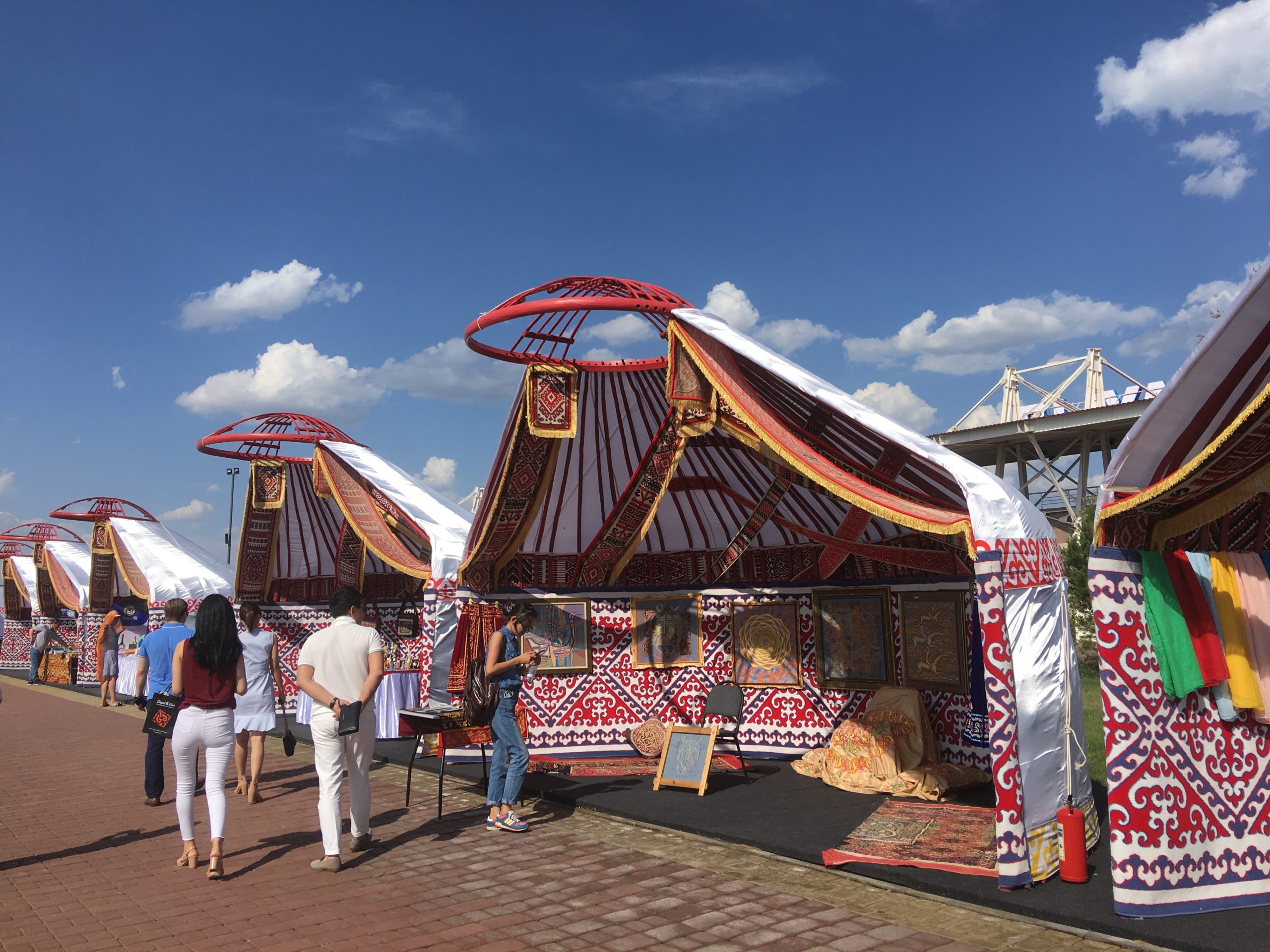
OCA: How did you ensure that nothing was lost in translation as it is notoriously difficult to capture the same essence as the original when works are translated?
HI: My books are written primarily for my audiences: if it’s in Uzbek – then for Uzbek readers, if in Russian, or English, then respectively for the Russian or English readership. I never write books for the sake of translation and therefore I regard any translation to any language as a bonus for me. Ultimately the responsibility fully lies with the translators, it’s their work, rather than mine. It’s them who are bringing this work from my culture into their own, they make it sound as a part of their language and tradition, therefore I am usually playing a tennis wall: if they ask, I’m answering, if not, I’m not interfering more than that.
OCA: How does the novel’s story reflect and/or attempt to reconcile tensions that exist between Russia and Britain today?

HI: Obviously, fiction books are not political manifestos, or social manuals, hence one shouldn’t expect them to amend the relationship or to improve them between countries or even people. A good novel is like if not a sea or ocean, at least like a lake, full of life. One can be drawn in it, another one might enjoy and have fun, the third one could quench his or her thirst. I think politicians and other people who deal with the international relationship should deal with the relationship you are asking about. What I’m describing in my novel is not geopolitics, but life of people, be it a Bukharian, or a British, an Iranian, or an Afghan, a Russian or a Jew. What interests me is the interplay between ordinary people and their stories, rather than the geopolitics of it.

OCA: The book has been described as being like “Game of Thrones”, to what extent do you agree with this comparison and would you see the story as being adaptable for film?

HI: I must admit that I haven’t read that book, neither I watched the film, therefore I can’t compare. As I said I’m trying not to repeat anyone, including myself. But if you ask me for the filming prospects, then for me the best literature is always the literature which can’t be filmed. Could you imagine, for example, a film based on ‘Finnegan’s Wake’ by James Joyce or let’s say on ‘Tristram Shandy’ by Lawrence Stern? So the best of the literature is always literature as an art, rather than a raw material for a screen script. Yet, if the filmmakers would be inspired by the story of ‘The Devils’ Dance’ – let it be so, I have no objections.

OCA: You have supported many ECG literary festivals. What word of wisdom do you have for aspiring Central Asian authors struggling to get their works published?

HI: Writing and especially writing novels is a very solitary work. Though on the one hand it seems that you are privileged to surround yourself with your literary characters, be in the circle of Qodiriy, Cholpon, Nodira, Uvaysiy, like in my novel, nonetheless it’s a very difficult work, which requires lots of discipline, lots of devotion, lots of give ups. You have to give up with nearly all your social life, with entertainment, with having fun for the sake of concentrating on your writing. If the young, aspiring writers are ready for that – all I wish them is good luck! Purely on writing I often say – wear your size of clothes, don’t try to seem bigger than you are, wearing two size bigger clothes. Equally don’t underestimate your own size trying to put yourself in two size narrower trousers. Both extremes are not only comic, but also dangerous…

OCA: What can we expect to come next from your pipeline of literary ideas?

HI: If you’re interested in what I am writing now, I am in the middle of a big Russian novel in five parts. If you are asking about my publishing prospects, with the translated books you’re always two steps behind. Now, for example, this September a novel, which I wrote in 2002, will appear in English. It’s called ‘The Language of Bees or Hayy ibn Yakzan’, translated by Shelley Fairweather-Vega. It’s a Sufi parable about the life of Avicenna. My other books that have been translated’ Gaia or Queen of the Ants’ in her translation too, is coming out in United States.

VII Open Eurasian Literature Festival & Book Forum – 2018

The 7th Open Eurasian Literature Festival & Book Forum, dedicated to the 150th anniversary of the outstanding portrait painter and revolutionary theatrical decorator Leon Bakst, took place in Thailand from 23-27 November.

Organized by the Eurasian Creative Guild (London) and the British publishing house Hertfordshire Press, the Open Eurasian Literature Festival & Book Forum (OEBF) is the only annual literary festival in the world to promote Eurasian literature internationally. As a cultural bridge between East and West, this unique event provides an opportunity for authors to talk about their work, share experiences and find like-minded people from different countries with whom to implement joint projects.

This year’s OEBF festival was attended by numerous honoured guests and included: representatives of the Russian Embassy, Attache for Culture of the Russian Federation Irina Vorobyova, Counselor of Kazakhstan Embassy in Thailand, Yerlan Danabekov and Bruno Lemercier, representative of the Jim Thompson Foundation.

Held for the first time in Southeast Asia, the festival comprised book presentations, art exhibitions, a tour of the most famous museum in Thailand, an official dinner, a cruise around the Gulf of Thailand on which “Eurasia Voices” were heard. Guests also gave presentations of their work at the international school Diplomat (Pattaya), and at the University of Chulalongkorn (Bangkok).

The conference at the oldest university in Thailand, Chulalongkorn, which was hosted by the Embassy of the Republic of Kazakhstan, included presentations by: the Ambassador of the Republic of Kazakhstan to Thailand Raushan Yesbolatova, Vice-Rector of the University Dr. Pirongrong Ramasoota, Vice-Chairman of the Guild Marat Akhmedjanov, Elena Bezrukova (Kazakhstan), Murat Ualee (Kazakhstan), Oksana Zhukova (Crimea), Nurgulya Osmonkulova (Kyrgyzstan), Temirbek Dzholdobaev (Kyrgyzstan), Alina Yurchenko (Thailand), and Aynura Berdikul (Kazakhstan).

The splendid opening ceremony and dinner took place in the Jim Thompson House Museum, Bangkok supported by a wonderful exhibition of paintings by Eurasian artists Alesya Issa (Belarus), Olim Kamalov (Tajikistan), Elena Bezrukova (Kazakhstan) and Lekim Ibrahimov (Uzbekistan).

In addition to Bangkok, the festival programme extended to Pattaya, where a meeting of the creative Russian-speaking intelligentsia was hosted by the SunDay Studio art gallery.


This year, no fewer than 13 new books published in London under the ECG Book Series 2018 were presented under the following categories:
FICTION SERIES : 8 BOOKS
Yuri Bashmanov “Vertical Racing”
(Kyrgyzstan)
Shamshiya Zhubatova “Oh Men Tus”
(Kazakhstan)
Lara Prodan “Why are we so Similar?” (USA)
Shahsanem Murray “Cold Shadows” (Scotland)
Dildora Tulyaganova “Imitating the Sufis”
(Turkey)
Literary collection “Thread” 1,2
Aldona Grupas “Nurse, Give Me a Pill for Death” (Latvia)

NON-FICTION SERIES
(POPULAR SCIENCE) – 5 BOOKS:
Bakhyt Rustemov “The Earth is our Common Home” (Kazakhstan)
G. Kapanova “Professional Competence of a Ballet Dancer” (Kazakhstan)
Nadezhda Kolyshkina “Feast instead of War” (Russia)
Nurym Taybek “Love for all, Hatred for No One! – the meaning of the life of Ahmadi Muslims (UK)
Orazaly Sabden “Abai. Future of Kazakhstan and World Civilization ”(Kazakhstan)

The festival also included the following presentations of other books:

OEBF CONTEST WINNERS 2017:
Kamran Salayev “Elish and The Wicker Tales” (Azerbaijan)
Wind: Short Stories – 2017 (A compilation of short stories by winners of the 2017 competition: Jacqueline De Ge (USA), Lenar Shaeh (Russia, Tatarstan), Isajon Sulton (Uzbekistan), Muhamed-Ali Sulaymanov (Crimea)
Anna Komar “Recycled” (Belarus)

PUBLICATIONS
BY HERTFORDSHIRE PRESS 2018:
Gulsifat Shahidi “Tales of Grandma Gulsifat” (Tajikistan)
Soyungul Chanisef “The Land Drenched in Tears” (Australia)
Leyla Aliyeva “The World Dissolves, like a Dream” (Azerbaijan)
Short Stories from Azerbaijan (Azerbaijan)
Saule Doszhan “The Tragedy of a Bastard”
(Kazakhstan)
One of the key attractions of the festival is the provision of a platform where creative people can share their ideas, and receive feedback from readers and experts about their work, and many authors and poets took the opportunity to discuss their recent work with fellow participants:
Svetlana Krivoshlykova presented her children’s book, “The Adventures of Mokhnatik and Venichkin”;
Timur Akhmedjanov presented Kamran Salayev’s books “Elish and The Wicker Tale” and Gulsifat Shahidi “Tales of Grandma Gulsifat”;
Ayder Muradosilov (Crimea) – winner in the video category 2016, made a speech about how the Guild connects the work of authors from different countries;
Husan Tursunov (USA) spoke on the topic “How to publish in the USA”.
Temirbek Dzholdobayev (Kyrgyzstan) gave a speech during the cruise on the “Voice of Eurasia”, and at the international school Diplomat, spoke about the work of the outstanding Eurasian writer Chingiz Aitmatov and his upcoming 90th anniversary.

Presentations on the famous author’s work, during the cruise, were also made by :
Nadezhda Serebrennikova (USA)
Alla Kretchmer (Israel)
Nurgul Osmonkulova (Kyrgyzstan)
Anastasia Kuzmicheva (Belarus)
Natalya Polyushkina (Russia)
Murat Ualee (Kazakhstan)
Elena Bezrukova (Kazakhstan)
Husan Tursunov (USA)
Hosiyat Rustamova (Uzbekistan)
Elena Zyulkova (Thailand)
Alina Yurchenko (Thailand)
Ainura Berdikul (Kazakhstan)

As part of the Open Eurasian Literature Festival & Book Forum, the 4th Annual General Meeting of the Eurasian Creative Guild members was held in the Caravan restaurant in Pattaya, at which a new Guild Charter was approved and Laura Hamilton (Scotland) was re-elected Chairman of the Guild for 2018-2019.

The approved Guild Advisory Council comprises: Marat Akhmedjanov, Anna Lari, David Parry, John Fardon, Azim Akmatov, Elena Bezrukova, Gulsifat Shahidi, Isajon Sulton, Alexandra Vlasova, Elena Aslanian, Anastasia Kuzmicheva, David Pearce, Lev Altmark, , Oksana Zhukova and Victor Reylyan.

An important part of the Open Eurasian Literature Festival & Book Forum, is the annual Open Eurasia international Literary Contest in which the 2018 winners shared a total prize fund of $ 30,000. This year, a staggering 800 applications were submitted by authors from 33 countries and the winners announced at the Awards Ceremony on November 23.

POETRY CATEGORY:
1st place: Hosiyat Rustamova (Uzbekistan)
2nd place: Murat Ualee (Kazakhstan)
3rd place: Osmonkulova Nurgulya (Kyrgyzstan) and Bestvitskaya Tatiana (Ukraine)

PROSE CATEGORY:
1st place: Lina Di (Russia)
2nd place: Farhat Tamendarov (Kazakhstan)
3rd place: Alona Kita (Israel)

SHORT STORY CATEGORY:
1st place: Alla Velts (Czech Republic)
2nd place: Husan Tursunov (USA)
3rd place: Anna Gogoleva (Russia)

BEST FEMALE WORK:
1st place: Lyudmila Dubkovetskaya (Moldova)
2nd place: Stasya Mio (Ukraine)
3rd place: Eva Sever (Russia)

BEST CHILDREN’S WORK:
1st place: Arina Chunayeva (Russia)
2nd place: Kulubek Bokonbaev (Kyrgyzstan)
3rd place: Svetlana Krivoshlykova (Russia)
and Ioanna Reeves (Belarus)

VIDEO:
1st place: Gordiyko Oksana (Poland)
2nd place: Andrei Yesaulov (Russia)
3rd place: LMN (Kyrgyzstan) video clip for Sultan Raev’s book “The Flood”

ILLUSTRATION:
1st place: Agafon Boke (Russia)
2nd place: Elena Lobova (Russia)
3rd place: Maria Erokhina (France) illustration for Alexey Batusov’s work “The Love of Stones”

TRANSLATION:
1st place: Translation of a passage from Gulsifat Shahidi’s book “Tales of Grandma Gulsifat” (Tajikistan)
2nd place: Dana Zheteeva (Kazakhstan) translation of Yulia Sobolenko’s poem “The Freaks”
3rd place: George Butchard (UK) translation of the passage from Nadezhda Kolyshkina’s book “Feast instead of War”

THE LAUREATES A OF THE FESTIVAL AWARDS:
Marziya Zakiryanova Award for the best women’s work : $ 5000 awarded to Lyudmila Dubkovetskaya (Moldova)
Nemat Kelimbetov Award for Video: $ 5,000 awarded to Oksana Gordiyko (Poland)
Maria Shevel Award Children’s work:$ 5,000 awarded to Arina Chunayeva (Russia);
Generals for Peace Association Award (Diplomas): Kuchkar Norkobilov (Uzbekistan), Oksana Zhukova (Crimea), Firdausa Khazipova (Russia), Nadezhda Serebrennikova (USA), Alexander Chigolsky (Belarus), Aizat Rakysheva (Kazakhstan), Nina Belomestnova (Russia).
The Live Line Illustration Award, established by Adam Kapanov: $2,000 awarded to Agafon Boke (Russia)
The “Butterfly’s Song” Award, founded by the creative studio of Ermek Amanshayev for Poetry: $ 1,000: awarded to Hosiyat Rustamova (Uzbekistan)
Irina Drofa Award for Translation: $1,000 awarded for the book by Gulsifat Shahidi (Tajikistan)

The “OPEN EURASIA – 2018” competition, awarded 33 winners of whom 15 attended the event in Thailand to collect their prizes. Further winners, this time nominated by Hertfordshire Press, will be announced in Paris on 12 January, 2019. This prize of $ 10.000 to one of the winners in the literary category, will go towards the publication of the winner’s book followed by a presentation at the 2019 festival.

AUTHORS/ SPEAKERS LIST:
1.Yelena Bezrukova (Kazakhstan)
2.Anastasiya Kuzmicheva (Belarus)
3.Mark Akhmed (UK – Uzbekistan)
4.Anna Lari (UK – Russia)
5.Aynur Berdikul (Kazakhstan)
6.Muradosilov Aider (Crimea)
7.Khazipova Firdausa (Russia)
8.Karavayeva Ilona (Belarus)
9.Serebrennikova Nadezhda (Russia)
10.Lobova Yelena (Russia)
11.Tursunov Khusan (USA)
12.Krivoshlykova Svetlana (Russia)
13.Polyushkina Nataliya (Russia)
14.Bestvyckaya Tatiana (Ukraine)
15.Ualee Murat (Kazakhstan)
16.Rustamova Khosiyat (Uzbekistan)
17.Narkabilova Gulchiroi (Uzbekistan)
18.Kretchmer Alla (Israel)
19.Gogoleva Anna (Russia)
20.Osmonkulova Nurgulya (Kyrgyzstan)
21.Zheteeva Dana (Kazakhstan)
22.Zhukova Oksana (Crimea)
23.Temirbek Joldobayev (Kyrgyzstan)
24.Aleksey Klimov (Russia)
25.Oksana Gordiyko* (Poland)
26.Lyudmila Dubkoveckaya* (Moldova)
27.Nina Belomestnova* (Russia)
28.Timur Akhmedjanov (UK)
29.Yelena Zyulkova (Thailand)
30.Alina Yurchenko (Thailand)
*via representative

The Fourth Official Ceremony of the Welcome to Georgia!

National Tourism Awards


On December 17, 2018 Rustaveli Theatre will host the most remarkable event of the Tourism and Hospitality industry of Georgia – the Fourth Official Ceremony of the Welcome to Georgia! National Tourism Awards.

On the Awards Ceremony winners and finalists of 20 different nominations, out of more than 350 nominees will deservedly receive recognition of “The Best in Tourism and Hospitality”.

Welcome to Georgia! National Tourism Awards is the Annual Awards Ceremony, which is held in Georgia for the field of tourism and hospitality since 2015 and has successfully established itself as a unique platform to develop Tourism industry of the State.
Welcome to Georgia! National Tourism Awards is the Annual Awards Ceremony, which is held in Georgia for the field of tourism and hospitality since 2015. It is kind of “Oscar” to celebrate the achievements of Georgian tourism and hospitality industry!

Award Ceremony is closed and will host to 800 guests: General Managers and owners of the best hotels, restaurants, wineries of the country, the market leading developers, the main businesses of the country, Government officials, national and local authorities, representatives of the largest hotel operators, travel agencies and tour operators, mass media and industry press.

The venue of event is national and cultural monument of Georgia – Rustaveli Theatre. Exquisite culture, centuries old traditions and unique hospitality will come together in Rustaveli Theatre on the Fourth Official Ceremony of Welcome to Georgia! National Tourism Awards to celebrate success of Georgian Tourism and Hospitality!

After Party host is Republic – newly opened multifunctional venue which combines cool and contemporary interiors by the worldwide renowned Georgian architects and artists. Located in the very heart of the city with panoramic windows offering a spectacular view over the city center and the Caucasus Mountains, Republic with its slick design and gorgeous views is an elegant addition to the historical center of Tbilisi.

For the fourth year already Georgian National Tourism Administration on behalf of Ministry of Economy and Sustainable Development of Georgia is Co-organizer of the Award Project. Also Co-organizer of the project is Bank of Georgia. Official Supporters: Tbilisi City Hall and Partnership Found. General Sponsor – Alliance Group.

For more information visit the website:
www.awards-tourism.com

ECG Chair Visits Kyrgyzstan

Over the past 5 years, I have edited some 26 works for Hertfordshire Press and the Eurasian Creative Guild, as well as a series of small epics published by the International University of Kyrgyzstan. The latter is the initiative of the indefatigable Professor Zina Karaeva who generously hosted my recent visit to Kyrgyzstan and meetings with teachers and students, as well as authors, poets and translators.

Mentoring sessions and dialogue with groups and individuals at IUK, the Kyrgyzstan-Turkiye Manas University and ECG, in addition to interviews for Radio Manas and the national state newspaper, led to interesting discussions concerning the preservation and promotion of the nation’s culture, and differences, and similarities, between Kyrgyzstan and countries within the UK.

Seven years had passed since my last visit and thanks to the kind hospitality of everyone I met, I found myself truly immersed in the landscape, traditions and history, so inherent in much of the work published in translation. Such first-hand experience, coupled with invaluable time spent with translators passionately committed to preserving historic legends, and talented writers determined to promote their work in the West, has undoubtedly enriched and reinforced my appreciation and understanding of how a nation’s cultural heritage informs and is portrayed through its art and literature.

I look forward to seeing what the future holds for this extraordinary country and to supporting the ever-growing campaign to share its riches with the rest of the world.

by Laura Hamilton,
Chair, Eurasian Creative Guild

ECG Vice-Chairman Addresses Houses of Parliament Event

The panel discussion for the evening was “How British Democracy Inspired the World” and was organised by Vesna Petkovic in the Parliament’s Jubilee Hall.

British democracy, as we know it today, started in 1832 with the Reform Act of Parliament and was followed by The People’s Act in 1918 which enabled women to vote for the first time. During the meeting various topics were discussed, such as how British democracy came to be a model for other nation’s around the world, women’s influence in shaping early democratic thinking and modern concepts surrounding this popular system of government.

Mr Akhmedjanov also spoke about the work of the Guild and the publishing house, Hertfordshire Press.

The panel speakers included:
Charlotte Dobson – Women Vote 100 – Parliament Community Outreach and Engagement
Monika Garbačiauskaitė-Budrienė, Chief Executive Officer of Lithuanian National Radio and Television (LRT).
Jūratė Caspersen, The Chair of the Lithuanian World Community Culture Commission.

Mrs Ahlam Akram, BASIRA (British Arabs Supporting Universal Women’s Rights)

The meeting was attended by David Pierce, an ECG board member, as well as UK member Svetlana Chevalier.

The event was organized by Vesna Petkovich, a British ECG member from the organization ProArt, who has assisted us with arranging the Guild’s first-ever meeting in British Parliament in spring 2019.”

Dreams Come True!

Whether we want to strike globalisation or not, it will be a part of our everyday life, embracing our future generations. We cannot escape from it anywhere. It would not be wise to say that we do not accept it. This is our future destiny. Every one of us should strive to develop technological advances in society and in our family, by learning about the achievements of science and technology while maintaining our traditions and customs. Being in the midst of globalisation, we need to be able to absorb the roots of the heart, to glorify our treasures, and to absorb the blood through our descendants. The younger generation will try to avoid the mistakes of the previous one and, if we endeavour to prosper our noble qualities, we will never perish as a nation.

If today Kazakhstan is a happy nation, its main support is in its independence! Kazakhs have their own homeland, the blue flag and the capital, Astana! There are the nationalities more than ten times bigger by population than we are, without their Fatherland. The most dangerous thing is that the flag falls, the language is lost, and ultimately the loss of independence. God bless you! For each of us, we must fight inwardly. Part of that is propagation of the value of the tribe. Praise the Father by praising the Mother. Preserving the nation by breeding offspring. The Kazakhs are no longer starved, but if their descendants are hungry and have no consciousness, globalisation will swallow it.

By writing “The tragedy of a bastard”, I reminisced about our national family values, by disclosing the unclean character of our youth, by correcting the errors, by keeping traditions of the ancestors, who preserved their blood. Moreover, dreams come true!

“A Master of Linking Different Views”
Review by Laura Hamilton

The Tragedy of a Bastard’ and ‘My own Strange Heart’ is a duology in which award-winning author Saule Doszhan explores aspects of the radical changes which have taken place in her native Kazakhstan in the post-Soviet era.

For centuries, Kazakhs have placed great importance on tradition and adhered to rules and values set down by their ancestors in a bygone age. Since gaining independence, the country has seen a resurgence of interest in principles and practices, which are often perceived, as oppressive by the current generation, leading to conflict within families and communities striving for a harmonious balance between the old and the new. In the first story, a naïve, middle-aged and highly educated woman gives birth to a child out of wedlock; an act regarded as both scandalous and selfish and which thirty years on, has a devastating effect on her long-stigmatized, illegitimate son. Saule Doszhan sensitively portrays all sides of the situation, from the perspectives of die-hard nationalists to young, forward-looking professionals and in so doing, provides a poignant insight into both everyday life and the heritage of her country.

Her second story, inspired by Kazakhstan’s first heart transplant in 2012, marks the stellar advances in medical care recently enjoyed by the country. Part fiction and part fact, it includes astonishing excerpts on the psychological impact of organ transplants and cites examples of recipients taking on the traits and characteristics of their donors.

This inevitably leads to debate concerning the ethics of transplants and whilst the medics and scientists are concerned only with the health of the donors’ organs, it clearly raises issues regarding ‘mixed blood’ and the importance which Kazakhs have historically placed on maintaining pure lineage through generations.

The significance of the ‘seven fathers’ lineage’ and the ‘steppe passport’ lies at the core of the first tale and by alluding to it again in the second, Doszhan deftly links the two to encourage the reader to contemplate how dynamically different views of the world can co-exist in the present day.

“The Greatness of Morals”
by Zhusipbek Qorgasbek

Literature has had a transitional period. At this stage, skillful authors may be reset. Instead, many new names are being replaced. It is not surprising that those who have been recognised achieve great success. They write worthy compositions for today’s readers’ demands. The reader is confident that he or she is experiencing those problems today. The reader also wants to see himself. For example, the “carrier assigned woman” can be found in every person’s life. We have experienced the “big house threat” as the nation, we are still passing through. “The Tragedy of a Bastard” is deeper than we imagine. It’s not a mistake to say that the “bridegroom with two husbands “ opens up some secrets. Saule Doszhan writes about these themes, connected with the past, with the social status of the past, the greatness of morals, and the humour that is underneath the foot. These are not memorable memorabilia of the country, and a raincoat bare plot is not set there, but also a full-fledged work of art, which is rich in various colors.

Saule Doszhan, a talented poet and a popular writer, was born on 2 September 1959 in Almaty Region, Kazakhstan. Her poems and articles started to be published in the regional newspaper in 1974. Her University background includes the Kazakh State University studying “Journalism” (1987) and then “Law” the Central Asian University (2006). Being a student, she entered the collection of young poets “Audience”, “Nine Keys”, and “Karlygash”. She gained a experience as a reporter-journalist, editor, senior officer in the following fields: “Socialist Kazakhstan (Egemen Kazakhstan)” newspaper; the Kazakh radio;”Kazakh language and literature” newspaper; the “Ulagat” magazine; Mazhilis of the Parliament of the Republic of Kazakhstan. She is a member of the Writers’ Union of Kazakhstan and the Union of Journalists as well as a member of Eurasian Creative Guild (UK) and the International Women Writing Guild (USA)

Bukvar Slavic Primer Celebrates 400 Years Since First Edition

In late October London saw a series of events dedicated to the 400th anniversary of the first edition of the East Slavic Primer – Bukvar, with the participation of the Director of the National Libray of Belarus, Roman Motulskiy.

Book culture in Belarus has a long history. The first library known to us on the territory of Belarus – the library of the Polotsk St. Sophia Cathedral – was created almost 1000 years ago. Belarusian educators gathered rich collections of books known far beyond their homeland. In 1517 Francysk Skaryna from Polotsk published the first printed East Slavic book. Having rich traditions in the field of book printing and creation of book collections, which influenced the development of not only their country but also neighbouring countries, Belarusians have suffered irreparable losses over the past few centuries due to historical and political circumstances: endless wars, religious struggle, changes in statehood and territory, etc., and the efforts of librarians to create book collections have been nullified. It was the mission of the National Library of Belarus to restore the lost historical and cultural heritage.

The National Library of Belarus, established in 1922, for almost 100 years of its existence, has gathered the world’s best collection of Belarusian books, which includes ancient manuscripts, the first works of Francysk Skaryna, rare Belarusian editions of the 19th century, and numerous contemporary publications. In total, the Library’s fund has almost 10 million units of storage, of which more than 1 million are a collection of national documents.

The staff are working to restore the lost cultural values in the following main areas:
– creation of a national bibliography;
– return to Belarus of its book heritage;
– virtual reconstruction of lost book collections
– facsimile reproduction of valuable literary monuments.

Over the years, the Library has prepared a number of unique facsimile editions and accumulated rich experience in facsimile reconstruction of book monuments. So, in 2017, to the 500th anniversary of the Belarusian and East Slavic book printing, it completed the largest project on facsimile publishing of Francis Skaryna’s book heritage in 20 volumes.

This year Belarus celebrates another big anniversary – 400 years of the first Primer – Bukvar. For most of us, the first book was a primer. The real pride of the national book culture is the fact that the first book in the world, which was called “Primer” and marked the beginning of the centuries-old tradition of many peoples in the field of primary literacy training, was published by a Belarusian printing house.

Given the importance of this event, the National Library of Belarus decided to implement an international scientific publishing project on facsimile reconstruction of the first “Primer”. The successful implementation of the project was made possible with the support of the Library’s partners: the Library of the Honourable Society of the Middle Temple in London, Embassy of the Republic of Belarus in the United Kingdom, Ministry of Culture of the Republic of Belarus, the International Association of Belarusian Studies, Belarusian State University, Ministry of Education of the Republic of Belarus, the European Bank for Reconstruction and Development, as well as “Belinvestbank”.

The first book in the world, simply called “Primer”, was published in Church Slavonic on July 24, 1618 in the printing house of the Vilna Orthodox brotherhood of the Holy Spirit in the town of Evie near Vilna (today Vilnius). It is one of the oldest Belarusian publishing houses that published books in Church Slavonic, old Belarusian and Polish. Before that there were other educational publications, but this was the first “Primer”. This publication has had a significant impact on the development of the book tradition of educational activities not only in the Belarusian lands, but also in many countries of Europe and Asia.

As of today, only two copies of the first Primer have survived. One of them is incomplete, located in the Royal Library of Denmark, and the second (full) copy is kept in the library of the Honorary Society of the Middle Temple.

The exceptional rarity and great value of the first Primer made it almost unknown to both scientists and the general public. Almost none of the Belarusian researchers had the opportunity to see the unique publication firsthand. At home not a single copy has been preserved: they were just “read to tatters”, as was often the case with academic publications. Thanks to the assistance of British Belarusians and lecturers of the University of London, in 2015 Belarusian experts had the opportunity to get acquainted with the valuable document and study it in detail. Later on, with the assistance of the Middle Temple Library, a high-quality digital photography of the book was made, on the basis of which a facsimile reproduction was performed.

The facsimile includes full-colour high-quality reproduction of the “Primer” the size of the original and with all defects and marks preserved. The “Primer” of Evie is a small book, compact and ideal for training. On 52 pages, each letter of the Cyrillic alphabet is printed in half-uncial. The external decoration is reminiscent of Vilnya editions of Francysk Skaryna. In addition to educational tasks, the “Primer” was intended for the needs of upbringing and was based on the Christian system of values. To this end, prayers, religious hymns, the creed, the commandments of God, sermons, the list of virtues of man and his sins are included as important texts to read.

Together with partners from the Belarusian State University, the National Library conducted a scientific study on the first “Primer” and the translated it into the modern Belarusian language, which made it accessible and understandable to a wide audience. The study was published in Belarusian, Russian and English, so that the spiritual wealth of Belarus would be accessible to the international community.

In April this year, the National Library of Belarus held the 14th International Bibliology Reading, dedicated to the 400th anniversary of the first edition of the Bukvar. The scientific event brought together more than 400 bibliology experts, teachers, linguists, cultural experts, historians and philosophers from Azerbaijan, Belarus, Great Britain, Latvia, Lithuania, Poland, Russia and Ukraine.

The opening of the international exhibition “ABCs of the peoples of the world” was held within the framework of the Readings. For the first time in Belarus about 1400 primers in 587 languages of various peoples from five parts of the world – Europe, Asia, America, Africa, Australia and Oceania – were shown. The exhibits were very diverse. In the space of the exhibition “Belarusian primer: 400 years of history”, in addition to excursions, there were held master classes on the methodology of literacy training, museum classes for children and other events.

The publishing project of facsimile reconstruction of the first “Primer” was completed on the eve of the Day of Knowledge (September 1) and on August 28 the NBB held its solemn presentation which was attended by a wide range of the public.

A number of events are planned in Lithuania, Latvia, Russia, Ukraine, Switzerland and other countries in order to present the facsimile edition of Bukvar to the foreign audience. But the first one took place in London, in the Library of the Middle Temple, the library that has preserved this monument of Belarusian book culture. The fresh facsimile book is the best example of cooperation between the peoples of Belarus and the United Kingdom over the centuries and a symbol of faith in friendly relations in the future.

Bishkek Hosts Macbeth with a Twist

In March 2018 I was lucky enough to spend six extraordinary weeks in Kyrgyzstan directing the first ever Kyrgyz translation of Macbeth, translated from the Russian into Kyrgyz, at the state theatre in Bishkek. I was working with 30 Kyrgyz actors who spoke no English and I don’t speak Russian or Kyrgyz.

To add to the mix I took two British actors with me who performed in English indi-vidually with the rest of the cast playing in Kyrgyz.They played Lady Macbeth and Macbeth respectively. In addition there was also a fully Kyrgyz performance which was filmed and screened on State TV.

So I had to deliver three different versions of the production in just over three weeks, as we performed four premieres, with the cast variations. The challenge of that aside, their method of working is entirely different. The company comprises of people who have trained there and effectively are attached to the theatre through-out their working life, this has advantages and disadvantages.

The advantages are that they practice their craft every day, and are used to working as a company. They are vocally highly trained and can easily fill an 800 seat thea-tre. They are physically grounded and able to experiment with movement and voice. For example the witches and Hecate invented a unique style of delivery incorporat-ing song and dance into the text.

The disadvantages are that they are not hungry for work in the same way that Brit-ish actors are. We were, I think, mutually bemused by the casting process. In Brit-ain it is standard that even well known actors interview or audition for roles and it took some time and a little diplomacy to explain that as I wasn’t familiar with their work, I would need to meet and audition them. I am glad to say that even the great state artists came to meet me, and I consider myself very lucky to have had the op-portunity to work with them.

Because of the state system they lack, to some degree, the competitive edge, and this affects their attitude to punctuality, line learning and even taking direction. It was noticeable that the younger actors were markedly less disciplined than the old-er actors who had trained under the old Soviet system. In the UK you have to con-stantly audition for the next job, it’s rare to belong to a company for more than a year at most, and that insecurity means not only are you only as good as your last job, but if you are not disciplined or reliable you won’t be employed again.

As in the UK, there is some sense that they are more interested in television and film than in theatre, despite their long tradition of storytelling and theatrical perfor-mance.

The whole production took place on a virtually bare stage with the actors providing a live soundscape and, through movement, a form of living scenery. It was fascinat-ing navigating the huge cultural differences and finding, of course, a common lan-guage in theatre. We discovered that the challenge of acting opposite someone speaking a different language was surmountable when the intentions of the scene or particular line were clear.
The challenge for the actors in particular wasn’t so much in the language but in the differing approach to rehearsals and the text. It quickly became apparent that we adhere much more strictly to and are led by the verse, whereas for Kyrgyz actors that is just one element of the performance. They do not adhere as strictly to the text, for example, which sometimes proved problematical, as key cue lines were sometimes omitted.

I was greatly impressed by their passion, technical ability and their willingness to take risks and commit to their performances. It was some of the most exciting thea-tre I have participated in. I felt privileged to work with such experience and talent and we had a lot of laughter along the way. I feel we had a great deal to learn from one another and it has left me with a thirst to work further with artists from Central Asia.

Kyrgyszstan as a post soviet state has a huge love and respect for culture, though as in the UK, the interest in theatre is waning and needs to be reinvented. This cross cultural fusion was the brainchild of the distinguished writer and politician Sultan Raev, a great cultural figurehead for his country. He invited me to direct the production after we met at the international festival “Women and War” which I pro-duced in London in 2016.

I had intended to bring the cast back to London but owing to the fact that the fund-ing completely fell through, that is unlikely, though I think we have much to learn from one another. I would very much like to bring the company here and to continue our cultural exchange. The production itself worked remarkably well given its dis-parate elements and the lack of rehearsal time. I would recommend the experience of working in such a different arena as it informs our practice and the more we can develop international links and collaborations the better.

The people of Kyrgyzstan were so welcoming, their culture so ancient and rich and the landscape so beautiful that it has won a lasting place in my heart. I look forward hugely to visiting and collaborating more with the artists of Central Asia, as our two great cultures have much to share and art is a great way to open the door to not just cultural but social, political and economical exchange.

by Sarah Berger

KURASH – TASHKENT HOSTS INTERNATIONAL TOURNAMENT IN MEMORY OF ISLAM KARIMOV FOR THE PRIZE OF THE PRESIDENT OF UZBEKISTAN

Tashkent played host to a prestigious international Kurash tournament in September attracting athletes from across the globe to compete for $100 000 of prize money. Great Britain were represented by Neil Schofield and Paul Sawyer at this event which paid homage to the nation’s first President, the late Islam Karimov, whilst also celebrated the 20th anniversary of the International Kurash Association. It was under the direction of the fledgling nation’s first President that Kurash developed from an unstructured, localised activity confined within the borders of Uzbekistan and Central Asia to the modern international sport status it enjoys today.

A brief history

The Uzbek national sport of Kurash enjoys a history stretching back several millennia. The earliest records of this style of wrestling can be found on 3500 year-old cave paintings. However, it was only when Uzbekistan established independence from the Soviet Union in 1991 that, with the blessing of President Islam Karimov, former judo and sambo star Komil Yusupov took the first steps to restructure Kurash into an international sport.

Within a very short time Kurash transcended the boundaries of Central Asia. On September 6th 1998 Tashkent hosted the first international tournament coinciding with the formation of the International Kurash Association. This event, for the Prize of President Islam Karimov, was attended by some of the world’s top judo, sambo and wrestling athletes including Georgia’s former Olympic judo champion, David Khakaleishvili and the UK’s Tim Thomas, an accomplished Olympic-style Wrestling, Judo and Sambo practitioner.

Since then, Kurash continued to grow and now boasts federations on every continent with over 120 individual member countries, including the UK.

30 countries challenge top Uzbek stars

To mark the occasion of the IKAs 20th anniversary and in recognition of the late President Karimov’s immense influence on the current global position Kurash now enjoys, the Uzbekistan Kurash Federation hosted a memorial international tournament in his honour. The tournament was further endorsed being also for the Prize of the new President, Shavkat Mirzizoyev. On September 6th, thirty countries’ athletes arrived in Tashkent to challenge eight top ranked Uzbeks. The tournament format was a straight knockout “Wimbledon style” elimination with no weight limit restrictions on the competitors meaning most wrestlers weighed in excess of 100 kilos.

Great Britain were represented by Neil Schofield, a current member of the British national Judo squad and 2016 British Judo champion in the +100 kilos category. Neil had previously represented Great Britain in the 2017 World and European Kurash Championships and UK hopes were high that Neil would present a significant challenge in Tashkent.

Accompanying Neil in an official capacity was Paul Sawyer, a former Kurash, Judo and Sambo international and a founder member of the British Kurash Association in 1999 with Tim Thomas.

Capacity crowd and TV coverage

This televised tournament, held in the Uzbekistan National Sport Complex attracted a large, vociferous crowd united in their desire to see the local heroes repel the international threat. They were not disappointed!

With no seeding of athletes, there was something of an FA Cup feel to the tournament with some favourites drawn together in the early rounds which also meant some lesser-favoured competitors avoided the big guns early on.

Japan thwart British challenge

A 38-strong field ensured most drew a bye in the first round including Great Britain’s Neil Schofield. Neil’s second round opponent was Japan’s Kento Taira who had impressively defeated his Georgian opponent in round one in under two minutes. The pair looked evenly matched in the early stages with the shorter, squat Japanese wrestler proving extremely difficult to unbalance. The first positive score came in the second minute from a well-timed foot throw from the tank-like Japanese which landed Neil on his side. Although not a contest-ending throw (to win outright the opponent must be thrown onto their back), it edged Taira in front thereby forcing Neil to take a few risks to get back on terms. As a result, he was caught for a second minor score but came agonisingly close to a winning throw himself in the last minute, the surprisingly agile Japanese barely managing to extricate himself from landing on his back from Neil’s leg attack. The Japanese ran out a narrow winner at the end of the 4 minute bout.

The Japanese destroyed his next opponent from Kazakhstan in under one minute before losing to the very highly rated Russian, Aslan Kambiev, in the quarter-final. Kambiev himself was beaten in the semi-final by Oltiboev of Uzbekistan.

Tense Final

The final between the two Uzbeks, Sherali Juraev, who had booked his final place by defeating Tajikistan’s Temur Rakhimov, and Bekmurod Oltiboev, was a desperately close, tactical affair. These were two adversaries who clearly knew each other very well. With so much at stake both approached the opening minute with some caution. A passivity penalty to Oltiboev followed almost immediately by a minor score to Juraev when he threw Oltiboev onto his front, ensured Juraev held a slight advantage at the half-way point. With one minute to go Juraev was also penalised for passivity as Oltiboev applied intense pressure. However, Juraev rode the storm, just managing to cling on to victory and the $50 000 first prize much to the delight of his supporters.

Neil Schofield – onwards and upwards

No medal for Neil Schofield on this occasion but certainly valuable experience for the future. “This was my first time in Uzbekistan and I was amazed at the huge level of interest and enthusiasm for Kurash”, Neil said. “I was very disappointed to lose and it would have been nice to have had some more contests but that’s just the way it goes sometimes. All in all though it’s been a fantastic few days and I’ve learnt a great deal from watching the other competitors, in particular the Uzbeks. Their contest strategies, jacket gripping engagement and sheer throwing skills set them apart from the other countries and I am taking some great inspiration back home with me. I’ve had the good fortune to travel to many places through Judo but the hospitality and friendliness I’ve met in Uzbekistan is second to none. I’m really looking forward to returning as soon as possible!”

IKA Gold Medal of Honour for Great Britain

At the post tournament banquet, Paul Sawyer was presented with the IKA’s Gold Medal of Honour in recognition of nearly 20 years involvement with Kurash as an athlete, coach, BKA official and also organiser of the World Junior Championships in Bournemouth in 2012. “This was an unexpected surprise”, he said. “I’ve thoroughly enjoyed my involvement with Kurash over the years. It’s very satisfying to see athletes of the calibre of Neil Schofield representing Great Britain with honour at these big international tournaments. I am sure that it’s only a matter of time before Neil is on the rostrum at a major event.”

Paul added, “I’d like to take this opportunity to thank Komil Yusupov and the IKA, the Uzbekistan Embassy in London and the people of Uzbekistan as a whole for their enthusiasm and support for British Kurash over the last 20 years. We look forward to it continuing and developing further in the future!”

by Paul Sawyer

Original Family Owners to Finally Sell Unique 17-19th Century Turkic Collection

The tradition of private collecting has existed in Russia for centuries. Such donations and gifts helped to create the collections of many university cabinets and museums of the pre-Revolution Russian Empire. For example, the collection of the present-day National Library of the Republic of Tatarstan (Kazan) is based on the collection of Ivan Vtorov, a well-known Kazan bibliophile and regional ethnographer, while the collection of the National Museum of the Republic of Tatarstan is based on the collection of a well-known Kazan collector Andrey Likhachev. The traditions of private collections of items with museum importance, of national costume and household utensils, jewellery, coins, books, and so on have continued to d velocity even today.

Raphael Khalitov, a Kazan collector, owns a unique collection of articles of applied art and ethnography of the Turkic culture of the 17th–19th centuries, which have been inherited – for centuries – within his family on the side of his mother’s great-grandfather, Zarifoullah. As to Raphael-efendi himself, he comes from the Xo‘jayli District of Uzbekistan. His ancestors were from the village of Kushar of the Kazan District of the Kazan Province (currently in the Atninsky District of the Republic of Tatarstan). The family of his grandfather and grandmother moved to Central Asia in the 30s of the past century saving themselves from dekulakisation at the period of collectivisation.

Raphael Khalitov came to know about the ancient family treasures shortly before his father’s death in 2009: “Father told me in his dying hours that parents of my mother were from the village of Kushar and that the major portion of these ancient articles was from there. He left it all to me as to his eldest son…”

The family collection contains about one hundred works of art. They include jewellery articles, household and interior items from dwellings of the Turkic nomads, manuscripts in the Arabic and the Old-Tatar languages, coins, cloths with tambour embroidery united by cultural peculiarities that are typical for peoples of the Turkic origin, and much more. The rare headgear of a noble Tatar woman from the Nogai family of the 17th–18th centuries is a true gem and pride of the collection.

The headgear complex is decorated with jewellery pendants with turquoise and cornelian stones of different shapes. Attached to the lower rim of the hat (on its sides) is the chest ornament made of the red cloth with a deep cut for head. There are small irregular and horn-shaped ornaments on the chest ornament that were widespread at the period of the late Medieval Age with many nomadic Turkic peoples, including the Nogais. Attached to the back side of the hat is the cloth plait ornament that covered the plaits of a woman. It is made of a silk cloth on a semi-rigid base and is decorated, just like the chest ornament, with irregular and horn-shaped embroidered pattern, semi-precious stones and jewellery pendants. Surprising and fascinating is the fact that the headgear of a Turkic woman has preserved in one copy only in the territory of the Republic of Tatarstan. Historians and ethnographers assume that it belonged to the tsar’s family of the last ruler of the Kazan Khanate (15th–16th centuries), Tsarina Syuyumbike (Sumbecca) (circa 1516–1557). As is known, Syuyumbike was daughter to the Nogai Bey Yusuf and a great granddaughter of Edigey (Edigu), the founder of the dynasty of the Nogai Horde.

This headgear represents an early version of the framed festive (wedding) headdress of the Turkic peoples of Eurasia that was used by nobles of certain regions until the early 20th century. Svetlana Suslova, Senior Researcher of Department for Ethnology of the Shigabutdin Marjani Institute of History of the Academy of Sciences of the Republic of Tatarstan, Candidate of Historical Science, underlines in her expert opinion that the headgear belonged to the Yaushevs, the ancient princes of the Zakazanye (north-western part of the Kazan Khanate), who were known from documented sources as early as from the times of the Kazan Khanate. The Yaushevs carried out an active diplomatic and trade activity in the Kazakh steppes and in the states of Central Asia, as well as performed some administrative functions in the Kazan Territory.

The other peculiar features of the collection include the horse harness of the 16th century that consists of 28 fragments, the men’s kalyapush skullcap (18th–early 19th century), bracelets, ear-rings, signet-rings, rings, pendants (17th–early 20th century), and so on.

The value of the family collection of Raphael Khalitov is truly great. A considerable portion of the collection of items was gathered in the territory of the Republic of Tatarstan and in Central Asia. They introduce us to several centuries of life and to the habits of the Turkic nomads. Many items are unique and cannot be found in collections of museums of the Republic of Tatarstan and the Russian Federation.

The collection of Raphael Khalitov was displayed in Kazan two times. The first was in March of 2014, at the National Museum of the Republic of Tatarstan, titled “Return from the Past”. The second time was in February 2017, at the Museum of Statehood of the Republic of Tatarstan under the Kazan Kremlin State Historical, Architectural, and Art Museum Reserve, titled “Journey to the Past: Turkic Culture Items from the Family Collection of Raphael Khalitov”.

According to opinion of the leading experts, the treasures from the collection of Raphael Khalitov are of great scientific and historical value. Expert opinions are available. This unique collection of the Turkic culture of the Yaushev Princes, which survived by miracle in one copy only, is now on sale. The price of the collection is EUR500 000. Who will become their new owner?

Lenar Shaekh,
Candidate of Philological Sciences, member of Eurasian Creative Guild

A Celebration of Afghan Culture in London

On the 19th August, we saw a truly authentic reflection of vibrant Afghan culture. Singers and dancers brought the energy to Hounslow’s excitable residents whilst a range of international cuisines added to the festivities. A Taekwondo club, managed by two Afghan brothers, demonstrated the skill and discipline of their students, whilst fairground lights and Afghan singers invigorated the festival further. We were lucky enough to have hosted the Mayor of Hounslow, Councillor Samia Chaudhary, as well as the Deputy Mayor of Harrow, Councillor Nitin Parekh, and officials from the Afghan Embassy, all of whom had some very kind words to say of the ACAA’s noble altruism. Our director, Dr Nooralhaq Nasimi, made a powerful and moving speech about the wildly unstable situation in Afghanistan, and underpinned the gratitude of Afghan refugees who have settled in Britain. The ACAA Summer Festival gave West London residents a glimpse of exquisite Afghan culture – a day of great celebrations and nostalgia for London’s Afghans.

WWW.OCAMAGAZINE.COM OCA#30 WINTER 2018 

Kazakh Superstar Brings Sensational Show to London

The London DQ show is part of the Kazakh Culture Days in the UK, hosted by The Ministry of Culture and Sport of the Republic of Kazakhstan and supported by the Embassy of Kazakhstan in the United Kingdom of Great Britain and Northern Ireland.

Dimash Quadaibergen is an international, multiple award winning and world-famous Kazakh superstar. A unique singer with a world-wide fan base, predominantly in Asia, with over 1.5M Instagram followers, Dimash performed an exclusive solo concert, the ‘DQ’ show at London’s Indigo at O2 on 19th November.

‘DQ’ is an astonishing new concert program by Dimash, which features his greatest hits as well as brand new unique pieces that were performed exclusively in London. Dimash’s repertoire included a large amount of world popular vocal masterpieces as he sings in various languages and genres. His record-breaking vocal range covers 5 octaves, 4 notes and 1 semitone, he can sing in almost all known vocal registers, both male and female, from bass to soprano; he also sings in a rare whistle register.

Dimash’s talents have been recognized by several prestigious awards including: Best Overseas Singer Award at the MTV Global Chinese Music Awards; Most Popular Male Singer Award at the Golden Mango Stars Awards; Most Popular Singer of the Year at OK! Magazine Music Gala and many more…

Dimash was born 1994 in the city of Aktobe (Kazakhstan) in a musical family. The singer’s parents are Kanat Aitbaev and Svetlana Aitbaeva, professional popular music vocalists awarded with the state title of ‘honoured cultural figures of the Republic of Kazakhstan’. In accordance with Kazakh custom, Dimash was brought up by his grandparents. He calls them his mom and dad. Dimash’s grandfather, Kudaibergen, is an engineer, and his grandmother, Miua, is a schoolteacher. Dimash has a younger brother, Abilmansur, and a younger sister, Raushan.

Dimash came on stage at the age of two and by the age of six, he already won his first contest called the Ainalaiyn Republican Children Contest in the Piano category. From the age of ten Dimash sang and participated as a presenter in various children events, including on television. Since the age of eighteen he has participated and won various Kazakhstani and international competitions and festivals.

All funds raised from ticket sales were used to support young talents of Kazakhstan and will help them participate in international contests and concerts. The program of support was established by the Ministry of Culture and Sport of the Republic of Kazakhstan in 2008. Over 1000 young talents – artists, designers, singers and musicians have already been supported through the program.

Kazakhstan is becoming an active player on the world’s culture stage. Astana Opera built in 2013 has already hosted La Scala, Operalia Placido Domingo, San Carlo and Mariinsky Theaters. Kazakh movie Amre won Best Global Hollywood Film Award in October 2018, Kazakh Actress Samal Eslyamova has become Cannes Best Actress Award in 2018 for her role in the Ayka movie. 11-year-old talent Danelia Tuleshova is a Kazakhstan representative at Junior Eurovision Song Contest in Minks this November.

The Ruzhansky Legends: Women in Belarusian Art and History

Ruzhany Castle, located in Brest region of Belarus, is currently under reconstruction. Earlier it was the residence of the potent dynasty of Sapieha, a castle whose beauty was compared to the French Versailles. Historical information states that the duke Jan Sapieha received the king of the Polish-Lithuanian Commonwealth Sigismund 1 the Old in Ruzhany. There was a theatre in the castle where the performances were in French. Destructive wars, especially the Second World War, turned a beautiful castle into ruins, but legends about those places still inspire Belarusian artists.

In one of the legends telling about the origin of the name Ruzhany – a small cozy town in Brest region, located on the border of Belarus with Poland, the names of two sisters – Ruzha and Anna, who were the daughters of the owner of the town (but the owner’s name remained unknown) are mentioned. The contemporary Belarusian artist E. Los (born in 1957) decided to embody her ideas about the appearance of these young beauties in the triptych “Ruzhansky Legends”. It should be noted that her works are also in the collections of the Museum of Ethnography in St. Petersburg, the Museum of Ancient Belarusian Culture of the National Academy of Sciences of Belarus, in the holdings of the Belarusian Union of Architects and Moral Re-Arnament (Switzerland).

The artist turns to pages of Belarusian history in lithographs “Anna”, “Ruzha”, “Hunting” (they make the series “Ruzhansky Legends” (1990)). On the lithographs of E. Los we see the coat of arms of Ruzhany with the image of St. Casimir in a wreath of scarlet roses, and the spire of Holy Trinity Ruzhany Church, and the domes of the Church of the Holy Apostles Peter and Paul, and Ruzhany Palace.

The image of the girl, depicted by the artist on the lithography “Ruzha”, can be described as collective, idealised, especially since the rose is the flower of Venus – the goddess of beauty [1, p. 485]. That is why knights-troubadours (XI-XIII centuries), chanting female beauty, compare the Beautiful lady with the rose, the most exquisite and desired of all flowers. On the other hand, the wreath of scarlet roses depicted on the coat of arms of Ruzhany (which is “Allusive arms” – the speaking coat of arms), and the name of the flower are surprisingly in tune with the name of the city, and with the name of lithography. Thus, we can assume that on the engraving “Ruzha” E. Los recreated an idealised female image – in the form of a girl holding a rose and a book. And a book has always been an indisputable attribute of virtue [2, p. 299], which is emphasised by the artist and through the image of the dog [3, p. 522] next to the Ruzhany-Rose.

Pondering the riddle of the image of the girl depicted by E.Los on the lithography “Anna”, one can assume that this image in some way goes back to the real (and legendary) historical character – Anna Jagiellonka (1523-1596), the daughter of the Polish king Sigismund I the Old and Bona Sforza. An original “hint” of the artist, necessary for deciphering the mystery of lithography, is the image of the stork – this bird in Renaissance and Baroque traditions symbolized respect to parents [4, p. 55]. Indeed, Anna Jagiellonka became the queen of Poland and Grand Duchess of Lithuania only at a very mature age (in 1575), in other words, the young years of the future queen were influenced by the powerful mother – the Queen Bon Sforza, who actually ruled the country.

Note that the artist portrayed Anna as playing the lute (against the background of Catholic Church of Holy Trinity), and this instrument also served as an attribute of Music, whose heavenly patroness was St. Cecilia [5, p. 610]. Religious and secular ideas about the “ideal of a creative woman” were broadcast through the image of Saint Cecilia in Western European art culture. These representations reflected an unspoken set of rules for a woman’s behaviour in society; society’s judgments on the level of general and artistic education of a woman; socially approved forms of creative activity of women [6]. On the other hand, the lute (along with harpsichord) was the most popular instrument of Renaissance, sounded at the royal courts. The lute was an ideal home instrument with a soft, silvery sound, and the lute in Anna’s hands seemed to recall the rapid rise of culture in the 16th century on Belarusian lands, the intensive development of music exchange among Western European countries, the popularity of the works of F. da Milano, V. Galilei, G. Bakfak. At the same time, the image of the entrance gate (brama) of the Ruzhansky castle on the lithography “Anna” nevertheless “approximates” the image of the girl to the legend of two sisters whose names merged in the name of the town.

It is possible to identify the generality of the artistic and aesthetic ideas inherent in the lithographs “Anna” and “Ruzha” E.Los through the comprehension of the specific characteristics of the space of everyday life. During the XV – XIX centuries for women the most accessible way of knowing the surrounding world of all historical forms of comprehension of the phenomenon of being (religion, philosophy, science) was precisely artistic creativity Playing musical instruments, reading, painting, organising home theatrical productions, embroidering (and other forms of artistic creativity) were expression of a personal relationship to the world around them, a way of intellectual and creative self-development of women within the framework of private life.

The softness and lyricism of the female images of “Ruzhy” and “Anna” is strengthened by comparison with the lithography “Hunting” (also related to the series “Ruzhansky Legends”). Its vigour, dynamic saturation of the figurative system is emphasised by the figure of the horseman, who proudly flaunts on the galloping horse. The stage of hunting is, as it was “voiced” by the artist through the evocative sounds of hunting horns, and in the imagery-emotional terms “Hunting” directly echoes the once popular musical genre “caccia” (Italian caccia, literally – hunting, pursuit). Caccia – the two-part canon – was one of the favourite genres of Italian early Renaissance (more precisely, the Ars nova period), which arose “under the influence of the pictorial nature of the genre: the canon of the two upper voices conveys a kind of revival and dynamics of hunting, pursuit of the hunter for the beast, roll call, cheerful exclamations “[7, p. 119]. The display of the sound of the musical canon on the engraving “Hunting” is undoubtedly the roll of two instrumental voices – the hunting horns of the horseman and the hunter is clearly “traced” by the artist.

Another important accent of the Linocut “Hunting” by E.Los is quoting fragments of works by other authors – in particular, the drawing of the Belarusian artist, musician and diplomat Napoleon Orda (1863), which shows the entrance gate and the main building of the Ruzhany palace ensemble. (It should be noted that it was practically destroyed during the Second World War). The artist “borrows” the image of the main building of the palace from the image of N. Orda, as if reminding the viewer of the brilliant events of the past: the reception in honour of King Stanislaus August Poniatowski (1784), the magnificent theatrical productions, luxurious balls and numerous hunts. Such a bright historical and chronological contrast, which is the undoubted creative finding of E. Los, expresses the emotional and simultaneously anxious attitude of the artist to Belarusian history, and attention to the past and the present.

by Shkor Lydia Alexandrovna
Associate Professor of the Department of
Belarusian and World Artistic Culture
Belarusian State University of Culture and Arts

AFGHANISTAN LOOKING TO THE FUTURE

The South Asia and Middle East (SAME) Forum hosted a special session on the topic of ‘Afghanistan: Looking to the Future’ on the 25th October 2018 in the Houses of Commons. The discussion began with Mr Khalid Nadeem, the Chairman, highlighting the tragic death of Jamal Khashoggi, the Saudi Arabian journalist, a point which was commented on by both Ivan Lewis MP and Jim Shannon MP.

Ivan Lewis MP related the death to the breakdown in international law and norms that is becoming globally prevalent and the increasing number of ‘big players’ on the global stage who are tearing up the international rulebook. Mr Khalid Nadeem noted that it was imperative to maintain close defence and intelligence relations with Saudi Arabia, especially relating to counter terrorism whose help has proved invaluable to the UK. He also stated that it was critical the UK maintain a constant dialogue with the Kingdom of Saudi Arabia because of the aforementioned security issues.

The discussion soon focused on the recent Afghan elections that took place last Saturday, in which one-third of the polling stations did not open for security-related reasons and voter turnout was lower than its previous two elections. On a brighter note the BBC World Service journalist Mrs Sana Safi noted the introduction of biometric registration technology in the election and the fact that it was the first to occur without substantial international intervention.

Ivan Lewis MP conducted the first speech on the UK’s perspective on Afghanistan, bringing to light his concerns regarding the dysfunctional political process and the possible departure of the U.S. from Afghanistan under President Trump. He noted that such an eventuality would reverse more than decade-long progress whilst further extenuating an on-going cycle of young men being drawn into the Taliban lines as a result of economic exclusion. He also highlighted the importance for a regional solution if long term peace was going to be achieved. Further, he expressed hope regarding the new generation of candidates and youth that were becoming more politically engaged in Afghanistan. However, he did note the deteriorating security case, specifically in the elections which saw multiple attacks on election officials and security services.

US analyst Johnathan Paris also praised the impact of the U.S. in the Afghanistan war highlighting that many Afghans voted in the last elections. This commitment to democratic elections is partly due to the U.S. approach towards Afghanistan. He therefore emphasised the crucial role of current U.S generals in preventing any premature policy moves from the Trump administration towards Afghanistan. Jim Shannon MP began speaking about the impact of the Afghan conflict on religious toleration in the region following a Q&A session. He criticised the increasing levels of sexual and religious violence in the region, citing several examples of different faiths being marginalised and persecuted within Afghanistan. Mr Shannon expressed deep reservations about Saudi Arabia in terms of its failures in religious and civil liberties, particularly in the case of the Jamal Khashoggi affair, having been concerned for a long time about the Saudi Arabian government.

Dr Nasir Shansab, Afghan writer and businessman, followed up with a speech on the economic prospects of Afghanistan. He highlighted Afghanistan’s poor economic conditions and fragile economy. Dr Shansab saw little hope for the future of Afghanistan’s economy, pointing to its high infant mortality rate – which is one of the highest in the world – and to the average male life expectancy of only 45 years. Furthermore, he pointed to Afghanistan’s reliance on international aid and its illegal opium trade, and its widespread and systemic corruption.

Sir Barney White-Spunner, former Lieutenant General, commented on defence strategy within Afghanistan. He noted the relative success of military intervention in Afghanistan whilst putting its troubles down to a disunited economy and hostile tensions between ground actors. Furthermore, he mentioned the troubles facing those supporting intervention, mainly from men such as President Trump who are raising questions about whether intervention has been value for money and why the U.S. should continue to act as the world police. Sir White-Spunner highlighted the importance of recognising that the Taliban are not a perfectly united front and that the ability for potential peace talks involving the organisation’s representatives, to have an impact on areas such as drug-smuggling in some regions is likely to be low. Thus, suggesting that a solution to the conflict may lie in identifying fractions within the Taliban and exploiting its disunity. He argued that since narcotics was the main driver for the Taliban, greater focus should be put on this area. He also disagreed with the practicality of attempts to find an alternative cash-crop with which to replace opium production, citing these as often naive.

The Chairman, Mr Khalid Nadeem, closed with a final comment on the importance of these fora to keep close attention on Afghanistan and ensure that politicians, and the public alike, do not become complacent in what has now been a 17-year conflict.

WWW.OCAMAGAZINE.COM OCA#30 WINTER 2018 Contributors: Sarmed Hyder, Marketa Jerabek, Luke Oades, Johann Power

The Global Silk Road: Building the Financial Pillars

The revitalisation of the Silk Road has been envisioned as a scheme, which would stimulate the free movement of people, goods and services from East Asia to Western Europe via Central Asia. The Central Asian leaders believe that it could stimulate economic growth in the region, the rise of small-and-medium enterprises (SME) and the creation of new jobs. The New Silk Way also could give opportunities to millions of travellers to visit natural beauties still untouched by civilisation and unique cultural centres of the millennia-old Silk Road. According to the World Bank (World Bank, 2018 est.) estimates of economic prospects from the modernisation of infrastructure and easing of movement of goods and services in the region could double intra-regional trade by 2025-2018. Updating infrastructure can also add at least 1.2-1.5 percent of GDP growth within next decade, which would add at least 2-3 billion dollars to the combined GDPs of the five Central Asian States (CAS) and help to create at least 500,000 jobs in tourism sector alone within next 10 years (the World Travel & Tourism Council (WTTC), 2017 est.).

The business community in the Central Asian States came up with the idea of the International Financial Centre (IFC), which would serve the entire region in attracting investments and offering financial services, using the examples of IFCs in Dubai IFC, London and some others.

THE SILK ROAD COOPERATION:
BIG PROMISES AND FAILURES

After the fall of the “Iron Wall” about 30 years ago, the governments of Central Asia repeatedly declared the benefits of the development of what Newspaper AIF-Kazakhstan calls the “Global Silk Road” and announced a “Silk Road collaboration.” However, until now many ideas have remained only on paper. One of the key problems has been the underdevelopment of infrastructure and service sector in the region, and the need to finance thousands of small and large projects – from developing tourist clusters to rehabilitation of hundreds of small and medium airports, which were closed in the 1990s. Unfortunately, the government-led investment funds in the region could not attract enough capital to the CAS and foreign investment funds did not rush into the region. Indeed, the business community badly need an International Financial Centre (IFC). It would serve the entire region in attracting investments and offering financial services, using the examples of IFCs in Dubai IFC, Singapore, and Shanghai as national financial centres were too small to achieve the required economy of scale. Since the 1990s, the governments in the region have attempted several times to establish financial centres and stock exchanges, which were supposed to serve the entire region, but failed miserably. The last failed attempt was the establishment of the International Financial Centre in Almaty City, which after US$300 million of investment was quietly closed.

The China-led Silk Road Economic Belt (SREB) program could become a solution for the Central Asian region, providing financing for several large-scale infrastructure projects connecting China with Europe via Kazakhstan. For example, Beijing has offered several loans to the government of Kazakhstan during the difficult years of oil revenue decline and actively participated in the privatisation program between 2012 and 2018, investing about US$28 billion during the past five years. The “One Belt, One Road” (OBOR) program and the Asian International Infrastructure Bank (AIIB) have helped to create a foundation for financing some projects in the region. However, the OBOR program did not meet the expectations of Central Asian leaders as the program’s initiatives have more often focused on a series of infrastructure mega-projects and macro-economic indicators and has paid significantly less attention on working with local private sector institutions, such as the myriad of so-called “bazar capitalists” – small and medium enterprises (SMEs).

The Astana International Financial Centre (AIFC) was officially inaugurated in summer 2018 out of the necessity to revitalise regional and global economic cooperation and technological exchanges, expanding them from the Central Asian markets to the wider markets of the so-called Silk Road Belt region. Indeed, for almost two decades policy-makers in Kazakhstan and Central Asia have been talking about the need to stimulate intra-regional economic integration – especially in the area of regional and international infrastructures. Yet, the political will and joint declarations did not lead to concrete large-scale joint regional projects or joint ventures, despite the long history of effective collaboration in the 20th century and the obvious need to develop an “economy of scale” by enlarging national projects into joint regional schemes to become competitive in the international arena. The main obstacle often has been – among other things – a lack of adequate capital and financial resources for funding such projects. It is projected that the AIFC will provide financial services in the words of Kazakhstan’s government officials – “not only for Kazakhstan, but also for the whole world” creating a competitive financial hub and financial pillars for the development of the “Global Silk Road.”

The “One Belt, One Road” (OBOR) program and the Asian International Infrastructure Bank (AIIB) have helped to create a foundation for financing some projects in the region.

IMPLICATIONS:

The OBOR program and significant rise in Chinese investments into Kazakhstan’s economy, infrastructure and financial projects have boosted economic growth in the country and led to the completion of several long-delayed large infrastructure projects. At the same time, Astana has started thinking of avoiding dependency on a single investor and decided to take a number of steps toward diversifying its portfolio of international investors. While the government of Kazakhstan welcomes investments, infrastructure and business development with its Chinese counterparts, it has clearly highlighted its quest for diversifying investments, building its very own, internationally competitive financial system and raising capital directly in the international financial markets.

For almost three years, a team of Kazakh government officials and local and international experts have been working closely with several international and transnational financial institutions, such as the NASDAQ, Shanghai Stock Exchange, London Stock Exchange and many others to develop a unique project – the Astana International Financial Centre. They have developed an exclusive regulatory system introducing among other things changes in the national constitution, investing almost US$400 million in funding and in large business space transfers to the AIFC. The preparation work of the team has included three major aspects of additional legal regulatory changes. First is that the entire functioning and all activities of the Centre would be outside of the legal regulation of Kazakhstan, and would be conducted under British law. Second is the introduction of a special system of preferences and regulations in taxation, currency exchange and currency movements as well as a special visa immigration status for the AIFC. Third is the commitment of Astana to continue its national privatisation program using the AIFC platform. To this end, the government has committed itself to holding Initial Public Offerings (IPOs) of more than US$34 billion within the next few years, including privatisation of such national business jewels as Samruk-Energy and Kaz-Post, as well as privatisation of major enterprises currently under the control of the Ministry of Transportation and the Ministry of Energy. The managing team of the AIFC has created a series of extremely favourable concessions (some experts say – one of the most liberal in the region) to attract the attention of financial top-players from the USA, such as the NASDAQ and Goldman Sachs Group.

The government of Kazakhstan hopes that through collaboration with leading international partners the AIFC will gain access to the latest technologies and know-how in working with various financial instruments at the national, regional and global levels. This is especially important as Kazakhstan has launched a new round of ambitious multi-billion dollar reforms dubbed Industrialisation 4.0 betting on the benefits in moving towards a service-driven economy.

The government of Kazakhstan hopes that through collaboration with leading international partners the AIFC will gain access to the latest technologies and know-how in working with various financial instruments at the national, regional and global levels.

CONCLUSION:

The government bets that its new financial and other initiative can contribute to diversification of investments into Kazakhstan’s ambitious projects, making Kazakhstan’s and Central Asia’s section of the Silk Road more attractive for business and financial deals. For example, as recently as September 2018, during his visit to Kyrgyzstan to attend the Sixth Meeting of the Cooperation Council of Turkic-speaking States (CCTS), the president of Kazakhstan declared that he would like to improve collaboration with neighbouring countries in Central Asia in industrial, agricultural and financial sectors, inciting them to work with the AIFC. Indeed, the Centre needs to attract enough financial resources from regional players, especially from Uzbekistan, Turkey and Turkmenistan, to become a real financial hub for Kazakhstan and Central Asia.
In this regard, Astana plans to take several important steps towards creating sustainable and stable economic and financial systems. Firstly, this includes overcoming “economic nationalism” and embracing intra-regional “Silk Way” economic collaboration with neighbouring Kyrgyzstan, Turkmenistan and Uzbekistan as well as with Tajikistan and Afghanistan. Secondly, the government of Kazakhstan intends to reconceptualize the current model of economic development taking into consideration the new realities and trends emerging upon the need in moving away from the commodity-exports driven economic development. In collaboration with leading U.S. universities Kazakhstan proposes training a new class of financial talents and professionals capable of handling financial instruments, wealth and assets management not only for individual states, but also for regional projects. Last but not least, the government envisions developing closer working relationships with U.S. partners at all levels, not only with large companies but also with small and medium enterprises (SMEs) able to attract technologies and investments, create jobs, and move goods and services.

AUTHOR’S BIOS: Rafis Abazov, PhD, is a visiting professor at Al Farabi Kazakh National University and a director of Ban Ki-moon Institute for Sustainable Development. He is author of The Formation of Post-Soviet International Politics in Kazakhstan, Kyrgyzstan and Uzbekistan (1999), The Culture and Customs of the Central Asian Republics (2007), The Stories of the Great Steppe (2013) and some others. He has been awarded an IREX 2010–2011 EPS fellowship (Title VIII program) for research on public policy reforms in Kazakhstan.

WWW.OCAMAGAZINE.COM OCA#30 WINTER 2018 Text by Rafis Abazov,
photos are courtesy of the author

On the Rarity of Nuclear States

The proliferation of nuclear weapons is undoubtedly an acute problem in international politics today. Currently, there are nine states in possession of nuclear weapons: America, Russia, China, Britain, France, India, Pakistan, North Korea and Israel; while those capable of manufacturing at short notice are estimated to be around 30. This begs a significant question, indeed: Despite the security benefits associated with nuclear weapons, why are there still so few states that procure them in practice? Reflect, for instance, on each of the five Free-Zone regions around the globe, from Latin America and the Caribbean to Central Asia, in order to ask what precludes such states from proliferation? To answer this question in as brief a length as possible, it is perhaps best to examine only the most important factors that come to mind.

Assuredly, starting with the most obvious of all reasons, one’s initial response must be centred round the fact that many states lack the requisite capabilities, like material resources (highly enriched uranium as well as finances), specialised facilities, not to mention expertise and knowledge, to produce and maintain nuclear weapons. In this vein, a nation, obdurate in acquiring nuclear weapons (if it lacks the capabilities), will fail to even start the process at the very outset. One should bear in mind, however, exceptions to this rule would be the above mentioned 30 states, Japan and Sweden to name but two, which are sufficiently capable. Hence, they do not fall under the said category.

A further ground for nonproliferation is to do with possible external threats to security, which are probably best delineated from two different angles. On one level, many states that lack nuclear weapons do not face existential threats from other nations. Two cases that demonstrate this point well include Argentina and Brazil. Clearly, when these two states realised in the 1990s – immediately after the Cold War – that they did not pose a danger to each other’s safety, they openly began to reverse their nuclear weapons programmes. Yet, one must not omit, respecting the other level, alternative cases shew that states, in spite of continued hostility from others, might not commit to proliferation as an active means of self-defence. An instance in point comprises South Korea and North Korea. To be sure, while facing a threat for more than six decades and a probability of a nuclear attack, the former is still to manufacture atomic weapons of its own as a means of deterrence against the latter. One may explain this, of course, through no other reason than South Korea’s security alliance with the US overall. Certainly, the former is essentially guaranteed security with the latter’s assurance of retaliation against a belligerent in the potential event of an attack.

Proceeding on this track, a third factor conducive to nonproliferation involves inter-national agreements and the development of long-term norms. In this regard, the Non-Proliferation Treaty

(NPT), which was instigated by the US – currently signed by five nuclear states and 190 states in total – was intended to reverse the spread of nuclear states until none remained. Furthermore, by establishing the International Atomic Energy Agency (IAEA), the NPT equally has ensured nuclear facilities within signatory states could be investigated in person and, thusly, prevented (say, by sanctions) from conducting secret programmes. Meanwhile, one must not forget, all this is accompanied by the development of long-term norms, evidenced somewhat by the general aversion to violent images of nuclear explosions, entailing a global consensus that it is better if only a few states possessed nuclear weapons, as well as concern with reputation and prestige amongst ‘good international citizens’, such as Germany and Switzerland.

Lastly, bearing those in mind, the final reason concerns a leadership, or hegemony, enforcing and managing nonproliferation across the globe; securing resources and fissile material away from emerging black markets; at the same time as developing long-term norms by way of its soft power. In essence, the leadership must articulate short-term goals and guideposts for the ultimate achievement of nonproliferation. It goes without saying, this role is at present filled by the US as the most powerful nation in the world: not only did it inaugurate the NPT and the IAEA, it has engaged in bilateral as well as multilateral negotiations with states under its ‘security umbrella’, assuming in turn the responsibility of their safety and protection. During the Cold War, to recall, the Soviet Union offered an alternative leadership and ‘security umbrella’, which is why (when it collapsed), some nations that already possessed nuclear weapons, such as Ukraine, Belarus and Kazakhstan, became convinced of their dispensability when offered to join the US’s ‘security umbrella’ in addition to receiving package deals, like economic aid.

Summarily, all things considered, four factors may explain the rarity of nuclear states across the globe: capabilities; external threats and alliances; inter-national agreements and norms; and, finally, leadership. Here, one must be cautioned that no single factor is responsible for absolutely every case of nonproliferation. Rather, to conjecture, it is the dynamic combination of these factors under the specific context of a state that really determines their relative significance compared to another. In this way, all factors might be said to be probabilistic, but not deterministic. What seems to be important, therefore, is to treat the above reasons as ‘implements’ within a toolbox used circumspectly to form relevant and context-based policies towards the eventual objective of a nuclear-free world.

WWW.OCAMAGAZINE.COM OCA#30 WINTER 2018 Text by Daniele Hadi Irandoost

ECG members took part in events in Minsk, Belarus, on April 18th, 2018

Marat Akhmedjanov, the Vice Chairman of the ECG, and Elena Bezrukova, Founder and Director of the Elena Bezrukova Centre, a professional business-trainer, coach and practicing physiologist, along with other ECG members took part in a workshop entitled ‘Intellectual Product Commercialisation and Promotion.’ The participants of the workshop – the authors of many innovative projects, finalists and winners of the Belarusian Republican Competition for Innovative Projects and representatives of scientific institutions – got the opportunity to learn about new ways of promoting their scientific and creative activity through ECG membership and pathways proposed by the ECG. The event was organised with the support of the Belarusian Innovative Foundation as part of a platform of the Republican Confederation of Entrepreneurship.
Presentation of the latest project of the publishing house, Cambridge International Press, the ECG Book Academic Series, held in the Republican Institute of High Schools.

Marat Akhmedjanov presented details regarding the project and outlined opportunities available for authors in publishing their works through the academic book series. Authors from Tajikistan, Great Britain and Kazakhstan – all ECG members – presented their books published as part of the project:

Gulsifat Shakhidi, a novelist, journalist and expert in literary criticism presented her latest book, I am Looking Towards the East.

Stephen M. Bland, award-winning author and journalist shared the story behind the creation of his book, Does it Yurt? Travels in Central Asia or How I Came to Love the Stans.

Elena Bezrukova, professional business-trainer, coach and practicing physiologist presented her unique book, Projective graphics, a collection about a new movement in art.

Nurym Taibek, an expert in philosophy and religious studies, spoke about his new book, Love for All, Hatred for None – Ahmadi Muslims’ Raison d’Etre.

The audience at the institute were highly receptive and all of the authors were happy to answer questions from guests and to share plans about their future works.

The IVth meeting of the Eurasian Creative Guild in Minsk took place in the Loft Café. The creative atmosphere brought together more than 40 participants. Guests had the opportunity to get acquainted with the ECG, it’s members, and BelBrand Association projects, as well as to hear from creative works by writers from Great Britain, Tajikistan, Kazakhstan, Russia, Ukraine and their homeland. The winners of the BelBrand Literary Award from 2016 and 2017 also delighted those attending with snippets from their work. An open microphone section, allowing new talents to express their creativity, closed the event.

ECG and the BelBrand Association express their sincere gratitude to all the speakers and guests for creating such a wonderful atmosphere for this highly creative evening.

A summation of the results of the ECG members visit to Belarus were presented on April 19th at the BelBrand Association offices. Many perspectives, routes towards cooperation, new projects and initiatives were discussed. ECG members were awarded diplomas by the BelBrand Association for their active participation in events dedicated to the formation and promotion of Belarusian creative projects.

The Eurasian Creative Guild expresses its gratitude to the BelBrand Association for organising personal meetings on the development of cooperation with Belarusian organisations and institutions for Gulsifat Shahidi, Stephen M. Bland, Nurym Taibek and Elena Bezrukova. The ECG would also like to thank the Republican Confederation of Entrepreneurship, the Belarusian Innovative Foundation, the Republican Institute of High Schools and the Loft Café for providing platforms for the events and their assistance in promoting them.

All the events were organised by the BelBrand
Association for Intellectual Property – a corporate ECG member

A Journey to the End of the World 1 st ECG Meeting in Yakutsk

Strangely enough, it is not the cold that hits me as I step out of Yakutsk airport onto the frozen snow trodden path to my taxi. The whole area is shrouded in a thick misty fog and the waiting row of cars all sit patiently with their engines humming and billowing exhausts. It doesn’t feel to bad as i step out from the war safety of the terminal building having just landed that morning from Moscow.

Within seconds my coat starts to rustle like an empty crisp packet and it feels brittle. And then the stinging cold hits me. My nostrils freeze as I take a deep breath and I cough a little as it become difficult to inhale the frozen atmosphere. Then my cheeks begin to sting and my thin trousers feel like an icy blanket as they rigidly wrap themselves around my legs.

It is minus 42, but the locals seem almost unaware. My driver, Dmitry, meets me and takes my luggage so that I can put on my gloves and a hat. I start to shiver as I try to do so – my Moscow clothing is simply not up to the job. I can feel my cheeks burn and sting with cold and I am praying the car is not far but visibility is restricted to about 10 metres. I have been outside just 90 seconds and the cold is now very real. Its claws are wrapping themselves around me, constricting my movement and I am relieved that the car is cosily warm.

Moscow’s balmy minus ten had felt refreshing and pleasant. I am used to walking in the park at this temperature and barely feeling cold. Here the only place that feels warm is my head, thanks to my fur hat – here fur is a necessity, not a nice to have fashion statement.

“It’s colder today than in Omiyakon,” Dmitry chimes as we set off into town. Two weeks earlier temperatures in the coldest village on earth had plummeted to below minus 63.
“Welcome to the coldest city on earth!” he says with a chuckle.

But today’s temperature is nothing out of the ordinary. Only below minus 55 do schools and businesses start to stop. Today is warm in comparison to some winter days. Thank goodness for that, I think to myself.

My hotel is the hostel-like Hotel Bravo, up nine flights of stairs in an ageing and unkempt Soviet building built on stilts thanks to the permafrost making any other foundation unsafe. The welcome is also warm in every way and I am shown to my room.

I empty the contents of my suitcase onto my bed and start to don four days’ worth of clothes all at once. I plan to rotate the two thermal trousers, two pairs of jeans, two thermal tops, two T-shirts and two jumpers during my stay. The suitcase is empty and I am quickly wearing everything I own. I wrap my scarf around my face and, like a Michelin man, I walk out to meet my guide, Piotr, ready to face the cold.

Piotr has been arranged to accompany me on my four days in Yakutia. He is from Yakutsk but has such an incredible command of English that I wonder if he has studied abroad. But no, it is all learnt from his mother (and English teacher), university and watching English-speaking films. He looks Yakutian, hailing from a Turkic origin, but is of a more modern generation, fully integrated into Russian society.

We drive to the Permafrost Institute that has been studying the geological conditions in the region for decades, trying to understand and live within its harsh climate. It is not a museum or tourist sight as such – but a working laboratory, and our guide is, herself, one of the scientists. She takes us 8 metres below the earth where it is “only” minus 5 and I am relieved. Walking just a few metres from the car to the entrance, my face had once again begun to sting, glowing red within a minute.

It is no secret that Russia is abundant with large, sparsely populated regions. We are already six hours ahead of Moscow in Eastern SIberia and almost (but not quite) at the end of the earth. Less than one million people inhabit the Yakutian region, mainly in large towns, but some survive in small villages, seemingly cut off from time and modernity. The region is surprisingly rich in natural resources, gold, diamonds and an abundance of minerals, as attested to in the Treasury museum that opens up just for us to tour. The bored security guards look almost disappointed that a tourist has come to disturb their peace today as I hand in my phone for safe keeping.

There is no railway to Yakutsk, only a road built by Gulag inmates known as the Road of Bones that travels on to Magadan. In summer, the Lena river provides suitable passageway for mainly Russian tourists. In winter it doubles up as a vital ice road connecting villages on both sides more easily. Piotr thinks that fewer than 10,000 people visit each year, but he is acutely aware that this type of adventure tourism is rapidly growing and likely to be enough to service the new tour company he is setting up with his friend, Mikhail, who he met during his time as a graduate working a lowly job at the Ministry of Economics.

Earnings in Yakutia are officially around 35,000 rubles per month (about 500 GBP), but I hear that many earn much less. After housing costs, much of the winter salary goes on warm clothes and food – frozen of course, though fortunately the freezer is simply a hole in the ground where the temperature stays below zero all year round. I am surprised that the region can be so full of mineral resources (after all that was why the Soviet Union put so much investment into the region and its people) and yet appears to be struggling so much – but it doesn’t surprise me to learn that much of the wealth is carted off to Moscow.

Dmitry, who has been sitting outside, with his engine running for almost two hours, for fear that if he turns it off, it will never restart, collects us and takes us to the outdoor fish market. It is like no other market I have seen. The fog still oppressively clings to the ground, but through it I spy the first of bunches of frozen fish, their mouths open in the same expression as when they would have been caught. Row upon row of frozen fish and meat sits eerily still in the silent market. A few hardy, wrapped souls try to hawk produce to passers by but it is very hushed – conserving energy is important here.

I take some photographs on my phone but the battery lasts only a matter of minutes at this temperature and as I put it back in my pocket it is as though i have just put a lump of ice into my trouser pocket. I last ten minutes at the market before making a hasty retreat to my car. People don’t hang around long here, that is for sure.

Piotr points me towards a local restaurant where I try local stroganino (frozen sushi is the best description i can muster), fermented samagon (mare’s milk) and venison in a fruit-laden rich sauce. It was surprisingly nice and warming, before tackling the cold walk back to my hotel. I seemed able to now last thirty minutes in the cold – knowing what to expect and keeping moving helped.

The next day we drive to Sottinsay village – on the other side of the Lena river. Here, a museum to the ancient way of life in the Yakutian region remains neatly preserved in the snow. To get there we have to cross the frozen river on a makeshift ice road open about 5 months of the year only.
Yakutia has had Russian presence since the 17th century, though Yakutian people are a Turkic tribe with asiatic features speaking a throaty language more reminiscent of Central Asia.

“How has centuries of Russian rule influenced your culture?” I ask Piotr as a heavy truck passes us on the ice and I pray simultaneously that the ice holds.

“We didn’t resist the Russians, you know,” Piotr answers. “This is actually a very rich region of resources and so we welcomed their co-operation and they worked with us to exploit these.”

It seems a bit too simple an explanation but he is genuine in his belief. Less than half of population today though are ethnic Yakutians. The Russian influence, especially during the years post the Russian Revolution of 1917, is strongly felt and few retain the nomadic way of life of their ancestors. The impact of the Russian revolution is noted in museums throughout the region as political prisoners were sent to work in the Gulags alongside ordinary criminals. Even today, Siberia brings haunting chills of those days to many a family who lost ancestors or relatives in these brutal death camps. Without them, however, the region may not have modernised or held any status in the USSR. They provided the roads and infrastructure that allowed socialism to penetrate through the ice to all corners of Russia’s vast lands.
We are met in Sottinsay by the affectionate museum director, Elena. She takes one look at me and decides that I need more clothes and borrows a hardy duffel coat and felt valenki boots from her husband. I feel like I am in a space suit on the moon as I walk clumsily to visit the traditional houses and churches that once held residents of the villages. Summer in the open woodland with so much space for hunting must be marvellous for the residents who now live around the museum. In winter, nobody seems to venture outside and at, minus 45, the thought of an hour long visit is challenging.

We make it to lunch to defrost, where a special table has been set up with piles of food so high that for the four of us it seems like we will need a week to get through. Portions are generous and we speak in a mix of Russian and English with great humour and vigour. Foreigners are few and far between here – maybe a hundred or two a year and from the UK, only a handful each year. I am the first Brit since the winter snows arrived. We finish our meal with traditional songs – even I am asked to sing an English song. Flustered, and trying to find a song that she might have heard, I plump for the few lines of Vera Lynn’s “We’ll Meet Again”. I am not sure why, but its words felt genuine towards a lady who had been so charming in her reception. And she did at least recognise the tune.

Before leaving I ask Elena whether I can carry out a science experiment. I had heard about and seen videos of people being able to turn boiling water into snow instantaneously and so I ask if she could bring a saucepan of boiling water instead of the coffee to try it out. She obliges without batting an eyelid.

“What am I supposed to do?” I ask inquisitively. The reply didn’t start well.

“I don’t know’” Elena says. “I have never done it before.”

Piotr indicated I should throw the water up into the air and over myself. With trepidation I put my trust in science, knowing that if this failed, I would likely end up with some nasty burns. With as much force as I could muster I throw the liquid into the freezing air, draw as deep a breath as the freezing air allows, and watch as the liquid instantaneously transforms into tiny snow particles, catching the wind and showering down safely over us. Strange and surreal, but magical.
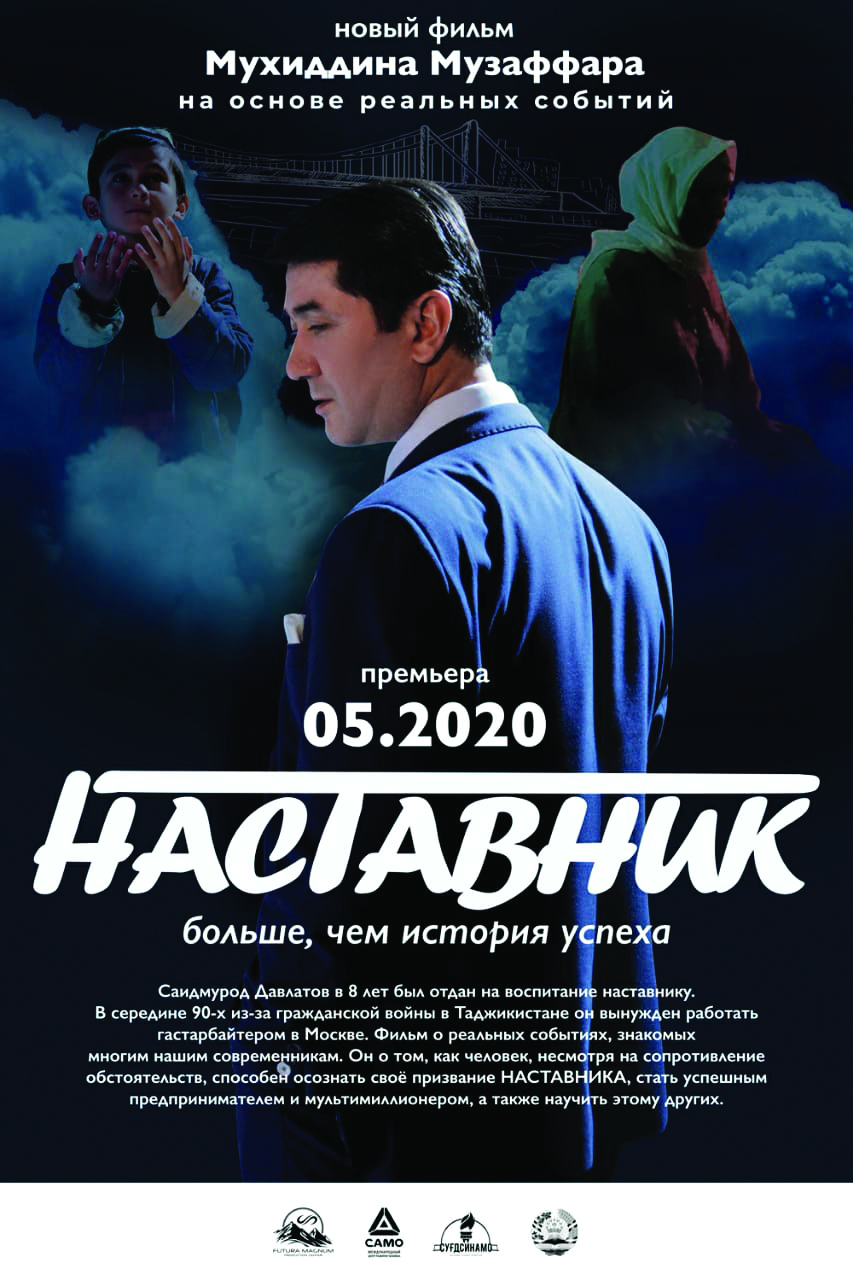
We head back to the village to have tea with a sporting family whose front entrance memorial has almost a thousand sporting medals dangling above it. Sadly, the lady who greets us, lost her husband five years previously and many of the medals are his in traditional Yakutian sports. Others are from her family’s fifty or so close members, many of whom have moved away from the village. Nonetheless she keeps the heritage and culture of Yakutia through her art and her dancing and singing group who are renowned throughout Russia. While the style of music may not suit a Western audience, it is captivating to see how the history of Yakutia is still represented today.
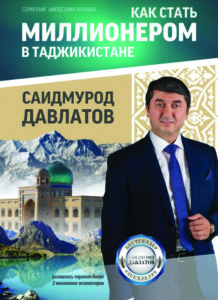
The next day starts early for we are to drive to the Lena river to go ice fishing. It is a balmy minus 38, but even that sounds like a recipe for frostbite to be sitting waiting for fish to bite. I needn’t have worried of course as ice fishing is is done in the comfort of a heated tent and a bottle of homemade vodka infused with herbs and spices to drown out the fact that this is probably well above the usual bottled strength available in the supermarket.

My teachers are Aleksandar (a seemingly part time police superintendent) and another Piotr (a part-time art film director). They have, of course, set everything up, so all that is required of me is to watch, learn and drink before then trying my hand at dropping a piece of thin nylon cord down a hole the size of a coke can that they have drilled through the two metre thick ice. It’s slow fishing but the stories and jokes flow. Aleksandar has more luck catching a fish about every twenty minutes and finally I too have one biting on my line which I quickly pull up in excitement and find a seven inch fish that fills me with some beginner’s pride. It is a very relaxing way to spend a morning, occasionally stepping outside the tent to cool down and admire the vast expanse of the snow-covered ice river. As I survey the scene it is clear that there is still great respect for nature here especially as its harshness in winter makes the locals appreciate more what it has to give during summer.

From the fishing we drive to the small town of Pokrovsk. In my desire to see life outside of the main city, i have asked to see how people live in a more rural setting. All the villages run close to the river but are dotted out in a long string. Space is most definitely not at a premium. Houses may not be that large but they are surrounded by large fenced-off gardens. Right in the centre there are a few high-ish rise flats, but nothing like Yakutsk. Gas pipes are above ground everywhere (they cant be buried in the permafrost). A solitary petrol station serves the whole town of about 8,000 people. Other heating fuels are heavily subsidised by the state in order to encourage people to stay.

By the time we arrive in Pokrovsk it is almost seven o’clock in the evening and the town is quiet. The only cafe is closing and I rush to a bare-looking shop to try and pick up supplies for the evening. It is dismal and grim – few people walk the streets and the shops are confined to a handful of shopping centres. For a Saturday night there is quite literally nothing open and nothing to do. Worse, alcohol sales in the whole town are banned in entirety for some reason – you can’t even drown your sorrows. I manage only to find some stale bread, plastic cheese and a bottle of water for the night in the town’s only hotel – the Sterkh.

I spend an hour walking outside along the streets, hunting for activity but, barring the odd car, I meet only two other people hurrying about their business. The fog has descended eerily again on the town and it is otherwise deadeningly still. My hat, eyelids and scarf that covers my face all have tiny frozen balls of moisture covering the.

The Sterkh provides no comfort. I am the only guest and the front desk is managed by a burly woman of little charm, totally disinterested in my stay. There is no internet, which provides a rare extraction from modern life for me and I settle for some reading in bed and an early night.

It turns out that there is life in Pokrovsk, but that life erupts underneath my floor boards at midnight as a large empty room under the hotel transforms itself into a night club for about two dozen youths. This appears to be their only chance to drink alcohol and mingle. As I try to find the hotel manager to complain, I come across a drunken couple making out on the stairs. Stillness has turned into a deafening racket of thudding Russian pop beats and shouting. Of all the places in Pokrovsk it so happens that the only hotel and nightclub are located right on top of each other. Sadly the hotel doesn’t appear in any online forums so no reviews of my unhappy stay will appear anywhere else but here!

The next day, bleary eyed and with less enthusiasm to face the cold, Piotr had organised a visit to School No. 1 where his uncle, the wonderfully named Spiridon, is headmaster. The school had heard that I was a writer of sorts who had written about travelling the road and wanted to put on a big welcome for me. No less than a hundred children pile into the Saturday morning assembly. School here is six days a week in winter. After a wonderful opening ceremony of music, dancing and poetry I try to relay my experiences so far in Yakutia and add some similarities to other countries I have visited and written about. Questions follow, with the children wanting to know every single country I had ever been to – I suspected many had not yet stepped outside of Russian as they hung on every word, even if some of the more remote countries they had never heard of.

Brunch was taken in the headmaster’s office where Spiridon serenades me with a rendition or two of local songs played on the oddly named (and even more strange sounding) “Jew’s Harp” a metal curved instrument that is played by humming into the instrument clenched in one’s teeth, the vibrations making the metal twang in high and low pitches. The origin of this instrument is somewhat debated and it also goes by the name Jaws Harp, so has little by way of Jewish origin per se, with Yakutians being especially keen to take credit for it.

We returned to Yakutsk later that afternoon. The Union of Book Writers was to hold the first Eurasian Creative Guild meeting in the office of famed poetess, Natalia Kharlampaeva. The meeting had moved from the National Library at the last minute, but in some ways, being inside the very office of this splendid organisation was more personable and memorable. I had mentioned Natalia’s name throughout my trip and people knew of her work and efforts to promote literature in a post-Soviet space that had otherwise been left void in the region.

Twenty writers and journalists cramped into the office, surrounded by books. Each had brought more local delicacies to try, including dried venison and horse meat and more frozen fish accompanied by a semolina-like porridge called Samagon. I was plied with food from every corner as I tried to relay a few words about just what I was doing visiting this remote part of the world. Piotr had kindly agreed to help translate simultaneously which worked a treat as the meeting went at a pace that didn’t allow me to stop to consider a translated phrase. The participants were passionate about bringing their ideas and thoughts to the fore. We discussed travel writing, local customs, how to bring Yakutian culture outside of Russia and the role of literature in modern society. This was exchange of ideas as I had envisioned them when I agreed to be on the ECG board, all done with the tradition of hospitality and openness I had already seen in Yakutia.

Returning to Moscow the next morning, after a jolly evening drinking with Piotr and his business partner, Mikhail, I felt it almost tropical as we landed into a temperature just below freezing. Yakutia had been an adventure and, although far too brief, had left me with memories more of warmth and friendship than the cold, at times eerie, landscape one might imagine (and indeed can all too easily experience).

Nick Rowan February 2018

Uzbekistan’s Zara King Gracefully Conquers MISS USSR UK 2018

MISS USSR UK is a fascinating show, with the contestants from all the different countries of the former Soviet Union, organised by Russian entrepreneur and founder, Julia Titova. The international beauty pageant MISS USSR UK, now in its sixth successive year, is gaining popularity more and more in London and beyond.

After ten finalists competed for the top prize, Zara King was crowned MISS USSR UK for 2018. Zara King (26, Uzbekistan) was awarded the coveted title of MISS USSR UK 2018, which took place on Sunday 29th April at Proud Embankment, London. The winner received many amazing prizes including a £40,000 yacht trip from Riana Group to discover Montenegro, training worth £4,500 with world-class coach Harry Singha, gift certificates for £4,500 from prestigious medical clinic Dr. Rita Rakus and much more. Five contestants received a luxurious ultra all inclusive holiday to Rixos Sungate Hotel Mayfest, where will be performing well-known Russian stars like VIAGRA, Egor Kreed, Timati and others. They will be filmed by Fashion TV and the show will be broadcast all over the world.

The popularity of MISS USSR UK has been growing every year. The project has received proposals for collaborations from all over the world. After the ambassador of the project and world-famous Irina Dedyuk, performed on the same stage in Monaco with the world stars, MISS USSR UK has signed the contract for a beauty contest MISS USSR in Monaco. It will be taking place for the first time on 8th of November 2018 at the venue in the south of France Grimaldi Forum, at the final evening of the largest event in the entertainment industry MICS Monaco. The audience choice Anastasia Abakumova (27, Russia) will be representing her country in Monaco already this fall as part of MICS Monaco and Miss USSR UK collaboration.
Thousands of hopeful girls applied to participate this year. After worldwide online voting and judges’ votes, MISS USSR UK selected ten stunning finalists, who represented Kazakhstan, Ukraine, Russia, Lithuania and Uzbekistan at the Grand Final. During the last two weeks, the finalists were actively preparing for the contest in London with world acclaimed professional model coach and the director of the prestigious International Academy of Femininity “CATWALK”, Olga Lebedinova. They have also developed their communication skills during personal growth masterclasses with renowned world-class speakers Rakish Rana and Harry Singha. All contestants were revealed to guests during National Costume catwalk showcasing spectacular outfits. The show also featured catwalks in stunning evening gowns by the talented designer Cholpon as well as swimwear created by Room 24.

The festive atmosphere and stylish guests, who were the spectators of a variety of entertainment made the evening absolutely unforgettable. The spectacular night was filled with live music from sensational global artists, elegant beauty contests and celebrity performances. The event also held a charity auction during the Grand Final in aid of Sebastian Papadopoulos – little boy, fighting rare form of brain cancer. Auction is run by “Coordinates of Kindness Foundation” in collaboration with “We Are Stronger Charity”, which had a massive success. The nominated charity has raised thousands of pounds, proving once again that beauty will save the world.

text by

An Artist Who Draws Light Amir Shayesteh Tabar

When it comes to Persian culture, it is impossible not to mention the immortal names of great poets such as Rumi, Rudaki, Firdausi, Khayyam, Nizami and Hafiz. Persian poetry is the key to understand the culture of Iran, as it permeates all aspects of the life of the Iranians. And even in Persian fine arts, you can feel the influence of poetry. In an interview with OCA, the artist Amir Shayesteh Tabar talks about his main occupation and how his Persian culture affected his work.

OCA: Amir, tell me a little about yourself. What influenced you, and what made you who you are today?

Amir: I was born and raised in Iran. In my life, I had to endure many sad and tragic events. First of all, this was the Islamic revolution in Iran, which occurred in 1979. it changed a lot in my life. Many people had to leave their native country,. It was a forced step, I looked for myself, I longed for creative self-realisation. I would not become who I am today if I had stayed with my relatives and beloved ones at home.

OCA: Was it difficult to be in foreign countries?

Amir: After leaving Iran, I wandered a lot between countries, from city to city. Many times, living in a foreign country, I experienced prolonged financial difficulties, but all this did not undermine my belief in a better future. I learnt a lot, it changed me a lot.

OCA: You create your paintings in a unique, previously unfamiliar technique. How did you get the idea of creating such works?
Amir: In my youth, I was attracted to computer technologies, and the more they enthralled me, the more I realised their capabilities. I spent a lot of time and effort to master digital technology. At the same time, I was interested in visual arts the same time developing painting skills. Over time, the idea came to me to combine these two spheres – digital technology and fine art – to implement the “Blue Symphony”, which at that time existed only in my mind and it had no similar at real world.

OCA: Tell us, what is the “Blue Symphony”?

Amir: “The Blue Symphony” is a new concept formed by letters more than anything else.

The whole image in Blue Symphony Artworks are a combination of words and letters only:
“In the name of God, The most Graceful, The Most Merciful”
Whatever you see in those pictures they are only about words. It took me 16 years. Only for the calibration of the colours I spent four years of my life. It’s not just pictures – it’s the intertwining of letters and words into one whole, the use of digital technology in art as well. In that time no one was taking Digital Art Seriously.

The title of each painting takes names from the suras of the Quran. Most important, what seems, at first sight, intricate and creating a sense of intricately intertwined patterns of the line are actually not lines, but words and letters that form the Arabic phrase, “In the name of the Lord, the Most Merciful and the Most Gracious.” All this is done with the Persian font Nastaligh. However, do not treat the “Blue Symphony” as calligraphy – I just used fonts as an element of work, but my main task was not just to appealingly form these words but to convey the essence of the concept through font, colour, and space.

OCA: What do your pictures contain, what do people talk about?

Amir: They create an atmosphere of calm and comfort. Contemplating them, you feel some connection with the universe, with God and all the composition merge together. Expressing Divinity, love, light and infinity, which is somehow the goal of my life,

And moreover since living in many countries, having overcome my adaption to the different cultures, I understood one of the main lessons of my life – to achieve mutual understanding between cultures there are a lot of barriers – language, traditions, mentality. But all these barriers exist only on the surface, and in order to achieve full mutual understanding it is necessary to go down to the very roots of your inner world where we are all one. And art is the one of the best tools that helps to achieve mutual understanding.

OCA: Why are you so attracted to the new direction of digital art?

Amir: Digital art offers many advantages, which were not available in the past centuries, as it was not achievable using other artistic tools.

One of the advantages of digital art is saving original art works, preservable for centuries
after creation, just by saving the files for the future and or re-printing, where the other tools
and mediums were not able to be saved by the passage of the time, like oil on canvas or watercolour.

Another advantage and potential of digital art is, for everybody and every place, not only for
art collectors or museums, actually pure digital art has the ability to satisfy the heart of its audience by giving the possibility for everybody to have original in his home or office or even museum. How many people have the chance now to see the originals of Leonardo da Vinci’s works, or Mona Lisa ? Most people have only witnessed these from the newspapers, TV, magazines or the internet!

OCA: Do you agree with your position in the art community?

Amir: Not all representatives of the art community accept my position. The possibility of an endless reproduction of work, in their opinion, depreciates the value of the work. However, I believe in the digital future of the world. However, to satisfy art collectors, requiring unique works, I have a unique solution: A digital print and signature of the artist supported by the Blockchain system. That is my new project that will surprise the Art world.

REFERENCE:

Amir Shayesteh Tabar a well-known contemporary of the fine arts, the winner of the Lorenzo il Magnifico president Award In 2009, in Florence Biennale – an international exhibition of contemporary art.

Timothy Verdon, an art historian, and teacher at Stanford University, praised the work “Blue Symphony”, calling Amir a true artist, able to eloquently and elegantly convey the beauty of the Eastern tradition to European audiences.

Way to Yourself

The artist, Zhurkabayeva Guldana, is on the threshold of her first mature personal exhibition “WAY TO YOURSELF” that will be held at the Museum of the First President of the Republic of Kazakhstan. This sums up the results of what has been done since her first personal exhibition of 2008. Since then the artist has created about 150 creative works.

During her training as an interior designer, Guldana began to take great interest in painting and graphics. At the same time she made a choice in favour of
free creativity in the field of easel painting.

The works of Zhurkabayeva Guldana reflect the signs of modern Kazakh art, where it is possible to see a mixture of techniques of Decorative and Applied Arts, a message to the symbolism of rock paintings, a historical past and comprehension of national symbols, both medieval and modern. At the same time, various works refer to the style trends of the 20th century. But most of all, her works also have a lot of their own, personal style.

The silhouettes, symbols, proportions and plots of ancient rock carvings are aligned with a texture of natural “wild” material. The use of animal skins, the unpolished fur gives the impression of ancient messages. The “animal style” of the Scythians is repeatedly seen in the works of this modern master and other from Kazakhstan. The themes of totemism and shamanism are close and exciting for many contemporaries. Here the artist rethinks ancient symbols, extensively using them in her work. The works on the skin “Scythian Motifs”, “ Deer Hunting”, “Cave Circulation”, “Petroglyphs of Tamgaly”, “Sounds from the Past” and many others were made by the author under the impression of the first drawings of mankind.

To bring your vision and to be understood by the viewer is not an easy task, especially if emotional feelings are added to it. The artist is given the gift to see the world in a different way. The world is bifurcated, divided and emotionally sharp in the works of Guldana.
Shortly before her first personal exhibition, Guldana underwent serious eye surgery, after which she saw the real world in a fragmented, divided state. Not only was her acuity of vision changed, but also the estimation of the size of objects and the distances between them. The artist does not just represent a divided world, she lives in it.
The fragmented vision of the world, which for an ordinary person would be a disaster, for a true artist, perhaps, is a starting point for artistic experiments. The multiple projection of forms, or separation of compositions into the right and left parts, occurs in many of Guldana’s works, for example in one of her earliest works “Cause and Effect”. Here, conditionally depicted is an eye shape, torn in the centre, which reflects an endlessly repeated series of figures, like a reflection in a room of mirrors. All the expression of an irreversible reality is perceptible in this work. In general, in the most of Guldana’s paintings, we can see images of human eyes, “Glance of Green Eyes”, “The Priests of the Eye”, “Where is a Saviour?”, “Displacements” and many others. The eyes are one of the main symbols, a window into a kind of unreal world and the centre of the universe and the reflection – the mirror of the soul.
Choosing a theme for her future works, Guldana tries to fully reveal and diversify the motives of her works, sometimes looking for answers in the works of old masters.

Inspired by the creativity of the surrealists Giorgio de Chirico and Salvador Dali, she experiments with the shape and space as exemplified by the painting “The Unconscious”. In a flaming timeless space, on conventionally designated architectural forms, a lonely, lifeless sculptural figure melts.

In other works of Guldana, we see the philosophy of Buddhism, “Meditation in the dimensions,” “The East is a subtle matter”. Guldana often discusses religion, self-knowledge, faith in yourself and God. The names of recent works “Order in Chaos”, “Do it Now”, “Living Energy”, “Mirror of the World”, “Dissolve in Motion”, presented at the exhibition, clearly demonstrate it.

The all these works were created in the technique of traditional easel painting. Guldana learns new material for herself and the themes of the works tell about many deep thoughts of the transience of life, death and love. The philosophy of the latest works reveals maturity and readiness for self-development, scrupulous work in the ratio of colour elements, the search for form and harmony of composition.
ZHURKABAYEVA GULDANA
(ALINA) TURSYNOVNA.
Kazakhstan, Astana

Member of the Eurasian Union of Designers
Member of the Union of Associations of Young Artists of Astana
Member of the International Organization of Expo & Women
Participant of international, republican, regional, city exhibitions
The laureate of the “Shabyt” award of the Kostanay Public Fund of the Club of Patrons in the nomination of “Fine Arts”, 2009
Laureate of the 2nd degree of the International Festival-Competition “Tanysu”, Republic of San Marino, 2016, Nomination of Applied and Decorative Arts
Laureate (1st place) of the International Festival-Competition Italy, 2016

Kazakhstani artist Guldana Zhurkabayeva, known to the creative world under a pseudonym “Alina”, expresses her inner world in her only artistic form. Her works are executed in a nomadic style of natural material with the use of skins and leather, filled with ancient symbols, sacred secrets and petroglyphs. Impregnated with a steppe smell of Artemisia, they attracted foreign experts’ interest and critics who awarded the first place at the International Festival of art “Tanysu” (San Marino, Italy).

Today the master gradually departs from Decorative and Applied Arts and tries herself in a new kind of fine art – painting. The first initiatives were highly appreciated at the exhibition “The Way to Yourself”, held at the beginning of the year at the Museum of the First President of the Republic of Kazakhstan.

But those, who are not closely acquainted with the artist are hardly aware of her special vision of the surrounding world and the diagnosis with which the master of paintings has been living for decades (constant double vision).

“This is a rare disease and cannot be cured. Only the philosophy of OSHO helped me to understand that it is my advantage, my UNIQUENESS, that gives me an opportunity to look at the world in a new way”.
The master always reflects an inner temperament in her works. Guldana Zhurkabayeva’s paintings are bright, colorful and the whole dance of singing colors is nothing more than a reflection of the artist’s soul. Absolute harmony.

But has it always been this way?

The task of art does not consist in the most accurate representation of reality, but in the depiction of the artist’s personality and their special view of the world, fantasies, memories, aspirations and visions from a special angle.

Guldana does not adhere to a certain style, but simply follows her impulse, transferring her energy and creating a living surface on the canvas, in some of her works, the avant-garde direction is clearly observed.

For what will a spiritual search lead the master? What will happen next: cubism, neoclassicism, surrealism, modern, nobody knows, even the artist herself.

As many talented people, Guldana is not afraid to try herself in different hypostases and besides paintings, she also creates designer accessories. Guldana is planning to realize and develop herself in this direction.

LITERATURE CHANGES THE WORLD FOR A BETTER LIFE!

A love of literature made me get involved with the challenging project of promoting Kazakh authors. The idea came to me 3 or 4 years ago and I started to be interested in different international literature contests in the world. I invested a lot of time and energy to reach my goal and find prospective fields for me to realise my ideas.

There is, however, one serious problem that does not allow literature to be available to world readers. This means that it must be translated into other foreign languages, mostly into English. My efforts presented me with a first lucky chance at the Open Eurasian Book Forum and Literature Contest that allowed any authors from Kazakhstan and other Central Asian countries to be the participants of this big event, presenting their books without translation into English with the hope to win recognition on an international level. Hard work with Kazakh authors’ promotion sometimes seemed to me useless, but I did not give up.

Fortunately, the 2016 OEBF literature contest results were very optimistic for my authors. The shortlist of winners contained the names of writers and illustrator presented by the first literary agency “Bestsellerkz”, from Kazakhstan, such as Serik Asylbekuly, Beknur Kisikov in the category of”Literature”, Aigul Kemelbayeva in the category of“ Translation” and Zhenis Nurlybayev – 2nd place in the category of “Illustration”. Following this appreciation, I decided to keep on working further with the same goal to open new names to world readers thanks to the organisers of this wonderful big event for creative people. Ten out of sixteen authors got into the shortlist of the 2017 OEBF that made me more certain with my directions. I am happy to name several Kazakh authors, whose works were selected as the best ones among others, such as Tynymbay Nurmaganbetov, Kuandyk Tumenbay, Alibek Askarov, Saule Doszhan, Kenges Duisen, Galym Zhaylybay, Serik Aksunkaruly, Naziken Alpamyskyzy in the category of “Literature”, Saule Doszhan in the category of “Translation” and Kuralay Umbetova in the category of “Illustration”.

As a surprise I found out one more recognition of my work in literary contest, in the list of 3d place winners were found Galym Zhaylybay – nomination for ”Poetry”, Saule Doszhan – nomination for “Prose”. Naziken Alpamyskyzy, the eldest participant of the contest, was awarded the nomination by the “Association of Generals of the World for Peace”, for the best work on the topic of strengthening peace, friendship and mutual understanding between people.

Last year, five Kazakh authors published their books within the book series “Eurasian Creative Guild (London)” by Hertfordshire Press publishing house. Presentations were held on 11-13 October in England, where the following writers and poets from Kazakhstan took part, such as: Kuanysh Zhiyenbay, Naziken Alpamyskyzy, and Gulzada Netkaliyeva.

Gulzhan Elesheva, a journalist from Atyrau, Kazakhstan, was in the list of participants of the literary week in London, too. The group of writers and poets paid a visit to the Ambassador of Kazakhstan, Mr. Erlan Idrissov, and had a very interesting discussion about issues of Kazakh literature promotion. Kuanysh Zhiyenbay, Naziken Alpamyskyzy, Gulzada Netkaliyeva, and Gulzhan Elesheva gave him their books and a young poet, Ardaktym Netkaliyeva was glad to read one of her poems during the meeting at the Embassy.

Bakhtygul Makhanbetova, literary agent, shared her thoughts about the translation work of Kazakh literature and suggested some ideas to co-operate in partnership with the Embassy. We, also enjoyed the film “Hamlet” by Aziz Zairov during the literary days in London and took photos with the main leading actor.

One more presentation of the authors’ books was held in Stockholm, Sweden, which was also full of interesting events during the annual international contest, festival and forum, OEBF2017. Three finalists, Naziken Aplamyskyzy, Saule Doszhan, Kenges Duisen, and Nazipa Shanai, with Bakhtygul Makhanbetova, as their literary agent were happy to spend wonderful time together as a group delegation from Kazakhstan, on 15-22 November, 2017, in Stockholm. The festival was a very good platform of exchanging ideas around literature, art, and culture. Saule Doszhan noted that, it helped her to prove herself. Naziken Alpamyskyzy presented her poems by commenting their history in Kazakh and Russian so enthusiastically. Kenges Duisen suggested some interesting ideas about an animation project based on his novels and tales for children to his colleagues from different countries. Nazipa Shanai is planning to publish a book in future.

Bakhtygul Makhanbetova took part in all events actively and even functioned as one of the moderators of the round table dedicated to translation issues of the world literature. She and other moderators focused on the success of translating texts from original languages but not translating Kazakh works into foreign languages. A few words about other creative and talented people from Kazakhstan, first, poets, Marina Mikhailovskaya and Dilyara Lindsay were brilliantly genius with their poetry world during the festival days. Antonina Shouster talked about Elena Bezrukova in her book and it helped us to learn more about a successful woman, who has overcome many difficulties in her life and achieved a lot. Adam Kapanov and his son, Anuar Kapanov invested their energy and knowledge, and finance to let festival ideas come true. Dauren Kasteev, the 2nd place winner in the category of “Illustration”, presented his masterpieces successfully at the exhibition during literary week in London and at the festival in Stockholm. A special guest of the festival, Nurym Taibek was also a very respectable speaker of the literary days in London and festival week in Stockholm. He lives in London these days. Thanks to the Embassy employers of Kazakhstan, we were happy to visit the group of Kazakh diaspora that live in Sweden for a long time. We visited museums, libraries and took photos at the Nobel museum and other places of interest.

In conclusion, I must note, that ECG started to function at the right time, co-ordinated by the right group of people, and at the right places where hundreds of creative and talented people from different parts of the world can communicate and become partners, friends and peacekeepers in the world!

by Bakhtygul MAKHANBETOVA,
Literary agent, Kazakhstan

Welcome to Belarus: A Glance at Educational Opportunities

Many years have passed since the Republic of Belarus was considered to be on the outskirts of Russia and needed a special introduction. Nowadays Belarus is a dynamic, fast-growing country with cities of European format and an open visa-free policy. Every year the number of tourists increases; in 2017 Belarus was visited by more than 283,000 foreign citizens. Guests are attracted by the unique Belarusian nature; a distinct and proud culture with its own language, customs, cuisine and art; and the warm and friendly attitude towards foreigners.

Of particular interest is acquaintance with the educational system of the Republic of Belarus. Belarusians have not destroyed the strong traditions of the Soviet school system and are moving confidently along the path of the Bologna process. About 15,000 foreign students from 126 countriesare enrolled today in higher education institutions. They opt for Belarus due to the high quality of education, qualified faculty members and the possibility of studying Russian and Belarusian languages in an authentic environment. The relatively low cost of training also serves as a good opportunity to participate in the educational programs of the Republic of Belarus.

The Belarusian system of higher education comprises 42 states and 15 non-state higher educational institutions (VNU) with a total of 243,700 students. Universities and academies offer graduate and post-graduate programs and are engaged in fundamental research. Higher educational institutions offer full-time (day) and part-time (night and correspondence) programs in Russian, Belarusian and English languages. The degree that has been traditionally conferred by Belarusian higher educational institutions is called a Certified Specialist. It usually requires five years of training, success in the final state examinations and the defense of a thesis. The study at medical institutions lasts longer and has a different set of requirements. The need to integrate into the world educational community has stimulated the introduction of two other degrees: Bachelor’s, after four years of training, and Master’s, after six years of instruction. The advanced scholarly degrees include Kandydatnavuk (literally “Candidate of Sciences”) and Doktarnavuk (Doctor of Sciences). The degree of Kandydat is approximately equivalent to a Ph.D. and requires at least three years of post-graduate study, success in qualification examinations, and the defence of a dissertation. The Doktar’s degree is highly prestigious and can be obtained after many years of teaching and independent research. A three-year sabbatical called daktarantura leads to the defence of a second dissertation of high theoretical and practical value. The defence is preceded by the publication of several dozen articles and at least one monograph.[1]

Belarusian education never stops in its development. Recently, the National Institute for Higher Education (NIHE) has entered the world ranking, Round University Rankings (RUR). RUR is a world university ranking, which measures the performance of the world’s 930 leading universities by 20 indicators across 4 key missions: teaching, research, international diversity and financial sustainability.

The National Institute for Higher Education has the official status of the leading educational institution in the sphere of professional development and normative-methodological support of the higher school of the Republic of Belarus. In implementing its educational and cultural programs, the Institute makes wide use of the human and intellectual potential of education and science of the Republic of Belarus, close partnerships with the institutes of the CIS, the UN, UNESCO, the Council of Europe, foreign universities, educational, scientific and information centers.[2]

Today, the Republic of Belarus sets ambitious goals in the sphere of exporting educational services and attracting foreign students. The Study Centre for International Cooperation in Education is engaged in the scientific, methodological and organizational support of this activity. Here an examination of international treaties in the field of education is carried out, continuous professional training of employees of institutions of higher education engaged in international cooperation is organized, various trainings and conferences on the development of export activities of the Republic of Belarus are held. On the basis of the centre there is an information-consulting centre on foreign citizens training in the Republic of Belarus, remote consultation of representatives of higher education institutions, recruiting companies on international cooperation issues. This centre is the right choice for obtaining comprehensive informationabout educational programs and any forms of cooperation. [3]

It is the NIHE where the foreign educational documents are examined for their recognition in Belarus. Annually, the centre issues about 2,000 responses on academic and professional recognition of foreign documents on education, training periods. The National Institute for Higher Education performs the function of the National Information Centre on Academic Recognition and Mobility (Belarus ENIC).

For the last three years the Institute has organised and conducted an “International Summer School of the Belarusian Language”. During a two-week period the participants of the project have a unique opportunity to acquire the skills of Belarusian oral and written communication in a short time and to join the linguistic, historical and cultural heritage of Belarus. The lecturers, who are well-known Belarusian researchers, introduce students to the current issues and problems of Belarusian linguistics, literature, history and culture. Visiting museums, exhibitions, libraries and other cultural centers of the country, meetings with figures of Belarusian culture, art and science and themed parties allow listeners to plunge deeper into the linguistic cultural environment. The “International Summer School of the Belarusian Language” is already a fairly well-known project, which every year attracts up to 80 people from about 45 countries, who are interested in the Belarusian language.

The Russian school, teaching the language as a foreign language, and internship programs for foreign students are of no less interest. The lecturers have extensive experience in teaching Russian as a foreign language, using special teaching methods and individual approach to each student, making the learning process more comfortable and efficient including distance learning. Programs are designed for all levels and ages, at the end of the course a student receives a state certificate. On behalf of the Ministry of Education, the National Institute for Higher Education works on creating a regulatory and methodological framework for the establishment of the National Certification Centre of the Belarusian and Russian languages.

The NIHE has prepared a new format of training programs for university staff and has enabled internship abroad as part of professional mobility on such subjects as: “The strategy of an educational institution for the development of export of educational services”, “Innovative strategies for the career guidance of centres for planning and career development in the institutions of higher education”, “Scientific, methodological and organisational support of pedagogical activity with foreign students in English”, “Cognitive Science and Education in the European Higher Education Area and the Republic of Belarus” and others. During these programs specialists, teaching staff and heads of educational institutions will be able to visit educational institutions, to get acquainted with the peculiarities of the organisation and implementation of activities of educational institutions abroad.

A special role is played by the NIHE in the formation and implementation of the state youth policy, the organisation of educational work in the institutions of higher education. The qualification “A Youth worker” can be obtained only at the Department of Youth Policy and Social and Cultural Communication (it should be noted that far-sighted business leaders and organisations have recently introduced this position into the staff list). The NIHE prepares and publishes an annual national report titled, “On the situation of young people in the Republic of Belarus”, and holds a computer database of talented young people among students and working youth.

The NIHE has some experience in the implementation of international projects and programs. For example, this period serves as the national coordinator of the project ERASMUS + “Promotion of development of competencies in Belarusian higher education (FOSTERC)”. 8 Belarusian universities are developing projects of experimental educational programs in the field of higher education stage II (training starts on September 1st 2018), providingthe implementation of the Bologna tools in the educational process of the organization and orientation of training content on the formation of competencies demanded by the labour market.

Employees of the NIHE represent our country in the Council of CIS; the Council of Europe’s Steering Committee for Youth Affairs; the Pool of European Youth Researchers (PEYR), and the Group of national correspondents of the European Knowledge Centre on Youth Policy (EKCYP).

WELCOME TO BELARUS!

Welcome to the National Institute for Higher Education!

http://education.stateuniversity.com/pages/144/Belarus-HIGHER-EDUCATION.html#ixzz5EbFYwoUy

http://www.nihe.bsu.by/index.php/ru/

http://studyin.edu.by/en

text by Ludmila Kozhuhovskaya
Vice-Rector for International and Scientific-Methodical Work
Of the National Institute for Higher Education (Minsk)

THE ENCHANTED WANDERER AVICENNA

There are only few people from the East who are unconditionally recognised by Europe. Avicenna takes the first place among these glorious people. Suffice to say that after the invention of a printing press, Avicenna’s Canon of Medicine became the first printed book after the Bible.

APPRECIATED GENIUS

We mostly know him as an outstanding physician, who in those days was compared to Hippocrates and Galen. If everything is more or less clear with Hippocrates and his oath, then Galen is rightfully considered the father of European medicine. Greatest Michelangelo used to say, “It is better to make mistake eulogising Galen and Avicenna than to be right, eulogising others”. We will talk a lot about the medical heritage, but now let’s highlight Avicenna’s main works, in addition to his most famous “The Canon of Medicine”. There are “The Book of Knowledge”, “The Book of Instructions and Notes”, “The Book of Fair Trial”, “The Book of Salvation” and even mystical works such as “The Book of Love”, “Liberation from Death Fear”, or “Books about Predestination”.

Researchers still cannot say exactly how many works he has written. According to some data, the number of scientific works by Avicenna exceeds 456! Many works were misattributed to Avicenna, which is also a sign of success. Other works may be forged. There is one thing beyond doubt, though, the personality of Avicenna is comparable perhaps only with Leonardo da Vinci. He was interested in absolutely everything: mathematics, physics, chemistry, animal physiology, music theory, military strategy, linguistics, law and astronomy. Avicenna has been mentioned in European culture since the XII century. Since then people and books can’t stop talking about him. A lot of books are written about this famous man, many of his thoughts are relevant to this day. Avicenna is one of the few people in the history of human civilisation, whose fame has not faded for a thousand years, but even became more vivid.

Till now, many countries have argued about who owns exclusive rights to this genius. Turkey, Uzbekistan, Tajikistan, Iran – each of these countries treat him as their own national treasure and they all have a reason to believe so. After all, Avicenna was born in Turkestan and buried in Persia, although he spent most of his life wandering around Iran and Turan. Several monographs, such as “Ibn Sina the Great Turkish Scholar”, have been published in Turkey, while a majestic monument was erected in Dushanbe. The Turks and Persians consider him to be a diamond of their history. For more than a thousand years the Muslims, in their turn, have been visiting the Mausoleum of Avicenna as a holy place in sign of respect and in the hope of being healed.

Avicenna, or more precisely, Abu Ali Al-Hussein Ibn Abdallah Ibn Sina, was born into a wealthy family. His father, Abdillah Ibn Hasan, served as a tax collector. However, unlike present times perhaps, this service required education, life experience, intelligence and decency. After all, “only pure thoughts and responsibility can prevent abuse, because bribery cannot be concealed.” Anyway, Avicenna’s father spent a lot of money on the education of his children and was not found to be involved in anything suspicious. Avicenna’s mother, Sitara, was from Afshan, a small village near Bukhara, where Avicenna was born in 980AD.

THE MAIN THING IS TO UNDERSTAND
IS THE ESSENCE…

In those days, children were trained from the age of five until “fully being educated”. In school they studied Farsi and Arabic, grammar, stylistics, poetics, the Koran and much more. As a school boy, Avicenna made great progress for five years of training. Finally, it turned out that he had nothing to do at this school by the time when he turned ten. He brilliantly mastered Arabic, Farsi-Dari was his native language, therefore the boy’s quatrains in both languages were always the best. Being a ten-year-old boy, Avicenna knew the Koran by heart. He was yet to get acquainted with his favourite topics of mathematics and medicine, but even then his mind was ready for the hardest work. One of these days, Bukhara was visited by Abu Abdillah Nathili, a well-known scientist of that time. The tax collector immediately went to the scientist and literally begged him to stay at his home. Avicenna’s father even promised to provide the scientist with food and water and pay a salary only for training his son and giving him an example of “comprehension of knowledge.”

Continuous communication with the scientist immediately delivered its benefits. Avicenna wrote, “I was the best among many students asking questions.” A little later, he became the best of those who tried to answer these questions.

At that time, Aristotle was the greatest figure of authority in the scientific and philosophical world, and at the age of fifteen young Avicenna began to study Aristotle’s Metaphysics. Surprisingly, this philosophical treatise was translated at that time into all major Eastern languages and repeatedly commented. The fifteen-year-old teenager read this fundamental work several times and, as he recollected, could not comprehend it until a bookseller advised him to read Al-Farabi’s Comments to Aristotle’s Metaphysics. Later Avicenna called Al Farabi’s work a “treasure and key to the understanding of everything.” After this breakthrough, Avicenna called Aristotle his teacher, while his theory about the unity of material, physical and spiritual things became a determining point for the young man.
Perhaps, after comprehending this treatise, he extraordinarily easily learned medicine. “Medicine is not as difficult as it is commonly believed. The main thing is to understand the essence, but not the outward appearances,” said Aviccena, being a daring boy of sixteen, not a grey-haired wise man. No, young Ibn Sina was not an arrogant braggart… When the Emir of Bukhara, Nuh Ibn Mansur was sick, the best healers could do nothing about his illness, and seventeen-year-old Avicenna was invited to the palace. Avicenna cured the emir and was appointed as the emir’s resident physician and granted an access to the emir’s personal library. Avicenna triumphed as he could read “books that no one else could see.” The fact is that Bukhara experienced the last quiet years in its history, a little later the city was conquered by sultan Mahmud Gaznevi. The city was ruined, the emir’s palace and library burned down.

By that time, the twenty-year-old young man already became a well-formed scientist, who wrote several large books and held correspondence with all the bright minds of his time. But life in Bukhara became more and more alarming and the young genius went to Urgench at the personal invitation of Khorezm Shah Mamun II.

Khorezm Shah Mamun was an amazing figure of his time. He was a well-educated, witty man, who always tried to come to the core of the matter. At the same time, he was rich and powerful. He brought together all outstanding representatives of science and culture at his court. The most outstanding minds could discuss the most pressing problems and exchange views in his palace. Most importantly, the scientists were given an opportunity to work, in particular to verify scientific hypotheses and conduct the most courageous experiments. Often there were serious disputes between researchers and philosophers, in which Avicenna was a winner more often than others. The arguments of Avicenna baffled even Biruni, the most famous wise man of that time.

ENDLESS WAY

However, this idyll could not last long. Mahmud Gaznevi, a new formidable ruler, appeared on the horizon. The cruel despot wished to see the most famous scientists, musicians and poets at his court so that they “could enjoy the honour of presence” in the sultan’s palace. Disobedience was equated to a treason felony. The ruler of Khorezm could not disobey and only advised his friends to flee before it was too late. Finally, Avicenna and his friend went to sandy Kara-Kum in order to prove that scientists serve for science, not for authorities, no matter how terrible they are.
Losing his strength and friends, Avicenna crossed the terrible desert and came to western Iran. There he was met by emir Kudus, a poet and philosopher, who surrounded himself with scientists (people of that time called them “the light of truth”). Ibn Sina became a star of the first magnitude among these scientists. The emir presented Avicenna with a house and gave him all he needed, including an opportunity to communicate with others and work. It was the place where Avicenna started writing the first volume of the Canon of Medicine. However, a quiet life is not for the eternal wanderer. Whether for safety reasons, or in search of new knowledge, Avicenna left everything and set foot on the path of adventure once more. He slept in inns, paid visits to rich people, communicated with the poor. And everywhere he healed and cured people, sometimes saving hopeless patients. Everything he saw and felt he entered into his travel books. But sinister Sultan Mahmud Ghaznevi didn’t stop searching for him. The scientist was put on the wanted list, a reward was promised for his head. Forty drawings describing the fugitive were issued.

In 1023 Avicenna stayed in Hamadan and cured another emir from gastric disease. As a reward, Avicenna was appointed a vizier in the rank of advising minister. The new vizier worked hard and developed a number of projects to manage the country and even a reform of armed forces. But the Ministry of Defence had its own views on this matter and military generals asked the emir to execute Avicenna. The pressure from military officials was so great that the emir was forced to expel the reformer from the country. Forty days after Avicenna’s deportation, the emir suffered another attack, and the physician was returned back with honour. However, Avicenna didn’t want to stay at the court and tried to leave. But the ruler was changed and military officials imprisoned Avicenna for four months. The physician was treated with extreme caution as everyone could fall ill. This fact enabled him to escape.

ALLAH HAS MORE IMPORTANT THINGS TO DO…

While wandering, Avicenna still made his research and practiced medicine. Sometimes Avicenna healed his patients in the open air from his saddle. Finally, the scientist came to the heart of Persia – the city of Isfahan, the largest city of that time. This bright and noisy city with a population of a hundred-thousand people became the place where Avicenna completed the fifth volume of his Canon of Medicine, a work that took ten years. This unique work collected all the medical knowledge accumulated by that time. The Canon covers anatomy, physiology, surgery, acute, chronic and even hereditary diseases. It describes 800 simple medicines and even complex ones: some of them contain up to 37 components. Almost on every page the Canon offers new information, previously unknown to medical science. In gratitude for such a thorough work, naturalist Carl Linnaeus called a whole family of tropical plants as Avicennia.

Avicenna was the first scientist who described plague, cholera, jaundice, distinguished smallpox from measles, described diabetes, named symptoms and treatment for such diseases as meningitis and stomach ulcers and many others. The scientist believed that “febrile states” are caused by invisible carriers of disease. Louis Pasteur confirmed this theory more than 800 years later. Avicenna had a lot of similar hypotheses. It was Avicenna who first explained how the eye worked. Earlier people believed that the human eye emitted special rays like a flashlight. Being reflected from objects, these rays returned back and give images. This is not so much medicine as physics of course.
Even a simple enumeration of what he did is amazing. There are more than 450 works covering 29 areas, of which 274 have survived. Moreover, Avicenna composed poems and wrote many philosophical works. Unlike many other people, Avicenna understood God in his own way. Allah is the all-knowing father, who created this world. This is his main mission. Avicenna believed that God supervised only such issues as creation of the universe and maintenance of the general order. In his opinion, it is wrong to believe that God keeps watch over the daily bustle of people and participates in their affairs.

Meanwhile, Massoud Gaznevi, the successor of Sultan Mahmud, together with his huge army broke into Isfahan in 1030. Violence, fires and outrages came about with a bang. Avicenna also was faced with difficult times: his house was destroyed, many of his manuscripts and works disappeared without a trace. “The Book of Justice” consisting of 20 parts was irrevocably lost. Who knows, maybe this book unveiled the deepest thoughts of our genius.

Avicenna died at the age of 57 during a military campaign in 1037, accompanying the emir. When Avicenna realised that his body was exhausted, he advised physicians, “Do not waste medicines. It’s in vain. I’m not suitable for treatment”. Before his death, the genius donated his property to the poor and rewarded and dismissed his servants. Avicenna was buried in Hamadan, where his tomb is located now. His mausoleum was rebuilt in 1954, when the World Peace Council celebrated the millennium anniversary of the scientist. In general, little is known about Avicenna and his personal life. You may ask, “What about women?” There are only beautiful poems glorifying their beauty. There are no names, no specific references. But in his edification for descendants he said, “We die in full consciousness and take only one thing: the understanding of the fact that we have learned nothing.”

text by Adam Kapanov

image AVICENNA, Fathy Zin

Tajikistan: Female Faces of Violent Extremism

Participation of women in jihadism is an intriguing subject. Here, ideology and emotions, rejection and expectation are intertwined, and personal circumstances and spiritual motives are often mingled together. Yet, a recent upward trend has been noticeable. In Tajikistan, women constitute some 20 percent of those who travelled to the Middle East to join Salafi jihadi groups there, a slightly higher proportion than the EU average.

Three types of women’s involvement with jihadi movements can be observed: passive, active and confused. The passive type prevails. This is a wife taken to the Middle East through pressure or a lack of awareness, or a woman married to a domestic jihadi who has been unable to resist indoctrination in family. Their problem is often the marriage they are in, over which they have little control, especially if they have children. Many young women are taught since childhood that loyalty to one’s husband is a woman’s greatest virtue and that the ability to bear come what may is a secret of a good married life. Thus, they fall victims of ignorance, are motivated by a desire to keep the family together, or by excitement of going abroad. Some women are materially driven and are susceptible to the promises of flats, cars, money, allowances, an opportunity to have domestic help and avoid living with one’s mother-in-law under the same roof. Some believed that they were going with their husbands to Turkey for work, and realised that they were in Syria when it was too late.

The active type is a local recruiter and a propagandist, a transnational activist facilitating the movement of recruits into foreign fighting zones. She could have moved to Iraq or Syria to become a nurse, a doctor or a teacher, to be in a profession where interaction is confined to females only. She is an activist by nature, holds ideological convictions, wants to be a part of ‘something big’ and is internet-savvy. Such women embrace Salafi jihadism on their own free will and in different circumstances might have joined another type of social movement. Exodus to Syria is a conscious choice and sign of empowerment, with men often uninvolved in their decisions. They tend to be educated and conscious about the world around them. Such women are active on internet sites and mobile applications, as they have sufficient education to master prolific social networking and enough time to engage in it. Those with active minds and ambitions do not find it easy to fulfil behavioural expectations that the community places on them, and the socially conscious types despair of the problems their country is experiencing. These are the women that are likely to be attracted by the false notions of moral certainty, purity, overcoming ethnic boundaries, social equality and justice that IS claims. They started to come out. The first six trials of women accused of recruitment into Salafi jihadism took place in Tajikistan in 2016 showing that women began to play greater and more pro-active roles, because there were no such convictions reported before. Around that time, they started to feature on the wanted list of photos of foreign fighters in Syria and Iraq, – one posing with a machine gun, which previously only included men.
The ‘confused’ face is often driven by reaction to circumstances and strong emotions. Some women find themselves in problematic life situations and become targets for recruiters who offer a way out of family tensions or financial difficulties. Redemption can be a motivational drive. Repentant sex workers and women in entertainment industry can regard involvement into Salafi-jihadism as redemption for their past ‘sins’ and a ‘born again’ experience. For example, in Sughd, which has a holiday resort with various facilities, a 28-year old former night club dancer R.M. was sentenced to a 12-year in prison for intending to participate in the armed conflict in Syria with her common-law husband. Reportedly, the couple were recruited by her brother who was fighting in Syria.

Pursuit of love and marriage is also a powerful driver. The notion of ‘jihadi love’ gained traction as some women fall to the appeal of warrior masculinity of jihadi fighters. For them, they are ‘real men’ – heroes in contrast to banality and what they perceive as a deficit of masculinity around them. They also think that the sex power equation is in their favour, as there are many more men than women available for marriage in the conflict zones. There is a distinct group of jihadi brides – single women who are considered to be past marriageable age in their home communities. They leave for Syria for romantic reasons, with engagements made on WhatsApp prior to departure, and marry as soon as they get to their destinations. It has been alleged that women who are educated, but have been unable to find any husbands, are particularly vulnerable to recruiters.

Often all ends rather badly. Many became widows in Iraq and Syria, sometimes more than once, and they and their children face great difficulties in leaving the conflict zones. So-called ‘ISIS families’ got displaced after the fall of Mosul and Raqqa, and have been dispersed throughout the region, including Turkey and Jordan. In Tajik law, women who were taken as family members into fighting zones and were stay-at-home wives and daughters, are not prosecuted on return, but such cases hardly happen. They have no documents and are too scared to declare where they come from when they arrive into refugee camps, and repatriation help is hardly available.

To be fair, the state authorities, including the Committee on Women and Family Affairs, make efforts to prevent and counter violent extremism. However, the phenomenon of radicalisation is elusive, and far more developed countries than Tajikistan struggle with the same problem. Different cultural influences pull Tajikistan in different directions, and radicalised teachings and jihadi propaganda increasingly are one of them. As long as these ideas are not defeated, there will be women drawn into them.

Research in Tajikistan was supported by the UN Women. Anna Matveeva is the author of Through Times of Trouble (Lexington Books, 2018)

Cashing in on Kyrgyz Tourism. Room for Further Development?

Take it how you like but having been based in Kyrgyzstan for two years now as a freelance consultant completing evaluations of developmental projects I’ve seen tourists to the country come and go and have reflected on my own experiences in the process too. I originally herald from the historic city of York in the North of England, whose main source of revenue comes from the large number of tourists who visit the city each year, largely attracted by it’s spectacular architectural and cultural heritage. As such, I am well aware of the benefits that tourism, when managed well can bring to a city, a region and a country.

I have frequently noticed people discussing how to develop tourism into a viable and sustainable sector of Kyrgyzstan’s economy whilst I have been here. A two day international forum held in Bishkek in November 2017 was in fact dedicated to the development of Kyrgyzstan as a ‘brand’ that could help to attract foreign visitors. At that forum, the consensus seemed to be that the Kyrgyzstan has great tourist potential, but to date this remains relatively untapped.

What can Kyrgyzstan actually offer foreign tourists? Due to the fact that the Kyrgyz were a nomadic people, and so did not construct buildings, Kyrgyzstan does not possess an abundance of historic sites such as those in Uzbekistan or Georgia. It can however offer a range of largely outdoor activities, all of which have the potential to play a role in attracting those in search of adventure and something ‘a bit different’ from the average ‘package’ holiday.

The impressive beauty of Kyrgyzstan’s mountainous wilderness offers huge possibilities for hiking, trekking, horse riding and skiing for the intrepid. Since 2014, Kyrgyzstan has hosted a biannual Nomadic Games, which are open to national teams from anywhere in the World who wish to compete in it. During the ‘Games’, over ten categories of traditional national sports associated with nomadism are conducted, including horseback archery, wrestling on horseback eagle hunting and ‘Kok Boru’, a sport similar to Polo in which two teams of hose riders battle over the carcass of a dead goat which serves as the ball. The Games start with a lavish opening ceremony, which includes national music and dancing provided by skilled performers in national costume, and is introduced by the country’s President.

For those who prefer less strenuous pursuits, Kyrgyzstan can also offer spectacular Issyk Kul, one of the world’s largest fresh water lakes, which was a popular holiday location during the Soviet period. Issyk Kul can offer can offer swimming, sunbathing, fishing and water skiing amongst other attractions. Winter also can offer excellent downhill and overland skiing at cheaper prices than in many locations.

Kyrgyzstan’s current immigration regulations are very favourable to attracting tourists, as no visa is required before arrival for the nationals of many countries. There is accommodation available all over the country to meet all kinds of travel budgets from a few dollars to several hundred dollars a night. Return flights to Kyrgyzstan from Western Europe can cost less than $500, and internal prices are some of the lowest in the Central Asia region. As such, holiday prices are reasonably price competitive internationally.

It seems to me to be possible to divide foreigners who come, or may come in the future, to Kyrgyzstan into four distinct categories, each of which has it’s own particular characteristics, which need to be taken into account by those working in tourism. The four distinct categories I would identify are English and Russian language backpackers, short-term Russian language holiday-makers, short-term English language students and short-term holiday-makers and tourists of all nationalities who attend the biannual Nomadic Games. Let’s take a look at the dynamics of each.

Backpackers visit Kyrgyzstan as part of their long-term world tours, often arriving overland from Kazakhstan or Tajikistan. They travel independently on a ‘shoestring’ budget, staying in cheap hostels and planning their own activities largely by consulting travel guides, other backpackers and social media. Although they are not always popular with mainstream travel agencies, they do provide income to hostel owners and other operators in the service sector. A future increase in their numbers would only bring more money into Kyrgyzstan

Short-term holidaymakers whether they are from post-Soviet countries or elsewhere have very different needs from backpackers, and have the potential to create a sustainable source of income to a variety of operators in Kyrgyzstan. To date, the overwhelming majority of foreign short-term tourists are from post-Soviet countries, for the most part from neighbouring Kazakhstan and Russia. Unlike potential tourists from elsewhere, post-Soviet tourists know about Kyrgyzstan’s attractions and in this sense Kyrgyzstan can be said to already have something of a ‘brand’ among this section of the potential tourist market. They also view the country as in some way being part of ‘their world’ with a shared joint historical experience, similar psychological makeup and do not experience any language barriers.

To date, the number of non-Russian speaking short-term holiday-makers in Kyrgyzstan has been relatively modest. According to Government statistics, they have largely been from Western Europe, China, India and the Arab World. Non-Russian speaking short-term holiday makers would no doubt enjoy the same types of activities as Russian speakers, but would require an English, Chinese, Arabic or other language guide.

Having given the subject much thought, It has occurred to me and no doubt to others that there is great potential in Kyrgyzstan for incredible organised adventure holidays for groups of foreign tourists both from former Soviet countries and elsewhere. An action packed holiday of two to three weeks of could for instance consist of:
Hiking and trekking in the mountains, including camping in scenic locations such as beautiful lakes.
Horse riding either for experienced or lessons for beginners.
Coaching in how to play Kok Boru.
Coaching in archery.
An overnight stay in a yurt stay with a semi-nomadic family.
Learning Central Asian cooking from a master chef.
Souvenir hunting in the bazaar.
Sunbathing, swimming, water-skiing for the experienced and learners, or yoga at Issyk Kul.
Skiing in winter and spring, which could of course make up an entire holiday itself with some of the above-mentioned activities thrown in.
A historical tour of Bishkek.

In early February 2018, I spoke with Azamat Zhamankulov, the Deputy Minister at the Ministry of Culture, information and tourism of the Kyrgyz Republic in order to get an idea of the Government of Kyrgyzstan’s plans for developing the tourist sector. I learned that the Government views tourisms as being one of the most important economic sectors to develop and aims to in crease revenue from tourism to over 10% of GDP by 2023 from less than 5% at present. Government strategies to create ‘sustainable’ tourism include support to private sector operators, support to infrastructure, support to the biannual Nomadic Games and continuing and expanding the most liberal visa regulations in the Central Asia region. I have been impressed by the Government’s positive support for tourism in Kyrgyzstan whilst I have been in the country, and consider that their intentions to develop tourism potential in cooperation with the private sector are fully realisable.

I spoke with another person who can potentially play a key role in making Kyrgyzstan a major tourist destination also in February 2018, Nursultan Adenov, Head of the Secretariat of the World Nomad Games. He explained something of the cultural significance of the Games. The Games are not political and have international significance. They can be viewed as a celebration of the world’s largely lost nomadic lifestyle, which was/is totally un-polluting, lived in harmony with nature and has it’s own history, legends, form of leadership, art forms, games and laws. There is insufficient space to explore these kind of issues here, but anyone interested in finding out more, may like to attend the next Games themselves in September 2018.

One of the main things that has become clear to me is that the next International Nomad Games in September 2018 has the potential to be a catalyst for the development in Kyrgyzstan into a sustainable industry in the future.

For the 2018 Nomadic Games, I would suggest that it is desirable to maximize both international television and social media coverage of the games. Searches on the internet show that there was some international coverage of the previous Nomad Games. Reputable international newspapers, such as The Guardian, wrote about the 2016 Games, whilst international TV channels, Al Jazeera and an Indian channel DD News, produced informative reportages on it. On Youtube, as of early January 2016, the short clip of Al Jazeera had just under 20,000 views, whilst the DD News coverage had less than 2,000.
I would suggest that government and private sector planners in Kyrgyzstan’s tourism business might like to aim to increase the coverage of the Nomad Games on international TV channels, newspapers and social media through implementation of a carefully planned strategy. They might like to have in mind the ‘brand’ of Kyrgyzstan they wish to create. I would suggest that this ‘brand’ could be, for instance, a fascinating, beautiful, largely undiscovered destination for the adventurous and a relatively new, modern, developing nation, rediscovering its lost traditional nomadic heritage.

A quality documentary about the Games, which gives a flavour of Kyrgyzstan’s potential tourist attractions shown on international channels that could be very welcome. If such a film were to be made, those with an interest in tourism development in Kyrgyzstan should do as much as they can to make the film go viral as far as is possible. After this, individual travel agents in Kyrgyzstan could then take the opportunity to publicise their services online to potential new clients. With this kind of exposure to what tourists are likely to come Kyrgyzstan, and with the money they bring, tourist services can be improved and expanded.

In some cases international aid projects from private sector development have provided support to the tourism sector, for example by training hotel staff and tourist guides. I would suggest that future projects could continue to help tourism in Kyrgyzstan by teaching basic English phrases with the necessary interpersonal skills to border guards and those who work with tourists, such as guides and accommodation receptionists. Border guards smiling and saying ‘Welcome to Kyrgyzstan. Enjoy your stay’, and friendly hotel and hostel with whom foreign tourists can communicate would no doubt make a good impression on foreign visitors, who would then write about it on social media. This could only boost the budding tourist business and delivery the country a potentially even bigger future.

TEXT BY

BRITAIN AND TURKMENISTAN

I write this looking out over the foothills of the Kopet Dag, which are lightly frosted with snow, a week after the Turkmenistan UK Trade and Industry Council (TUKTIC) in London: a good time to reflect on the relationship between our two countries.

TUKTIC alternates between Ashgabat and London. It takes place at approximately 18 month intervals. It signals the clear desire on the part of the UK and Turkmenistan to expand and strengthen our commercial ties. We are both trading nations, though Sir Simon McDonald, Permanent Under Secretary of State at the Foreign and Commonwealth Office, conceded last week that Turkmenistan has the longer track record in international trade. The city state of Merv was a regional centre and major transit point on the Silk Road in the 12th century. It was among the largest cities in the world at the time, second only to Kaifeng in China. And although it is technically still a young country, the territory which Turkmenistan now covers also had a capital city some time before we did. The fortress and settlement at Nisa, on the outskirts of present day Ashgabat, was the capital of the Parthian empire in the middle of the third century BC. As Sir Simon pointed out, that makes London, which was founded by the Romans only in 50 AD, look a comparative latecomer. Nor can we compete with Ashgabat’s marble buildings. London looked very brown by comparison. And of course it rained. Our welcome was warm, however.

Turning to business, British companies have wide-ranging expertise to offer in areas where Turkmenistan has expressed an interest or a need. These include the oil and gas sector, financial services, engineering, agriculture, utilities and education. We are pleased and proud that it was a British company, Trivandi Chanzo, which helped organise the Asian Indoor and Martial Arts Games in Ashgabat last September. We are also delighted that Cambridge University has now signed a Memorandum of Understanding with the Turkmen Ministry of Education which will enable them to work together to develop the English language curriculum for schools in Turkmenistan. We look forward to reproducing these successes in other fields, in particular with those companies which were represented at TUKTIC, and which all have a serious interest in doing business in Turkmenistan. We also had representatives from the Department for International Trade (DIT) there, including Arslan Garryyev, the International Trade Officer in our Embassy in Ashgabat. DIT promotes British trade and investment globally, and can link foreign companies to companies in the United Kingdom in their sector. Conversely it can, through Arslan, provide reporting for British companies on opportunities in Turkmenistan in their field. In some cases export finance is available to British companies trading with Turkmenistan through UK Export Finance.

We can tell you about that, too.

Beyond trade, 2017 marked the 25th anniversary of diplomatic relations between the United Kingdom and Turkmenistan. The year saw visits to Ashgabat by the Prime Minister’s Trade Envoy, Baroness Nicholson, and also by Sir Simon McDonald himself, the first visit to independent Turkmenistan by a Foreign Office Permanent Under Secretary of State. This underlined our common interest, not just in trade, but more widely, in both the prosperity and wellbeing of the Turkmen people and the peace and security of the Central Asian region. We have noted, and value, Turkmenistan’s engagement in helping Afghanistan work towards a stable and prosperous future. We commend plans to expand transport links to its Central Asian neighbours and the country’s contribution to the equitable sharing of regional water resources through its chairmanship of the International Fund for Saving the Aral Sea. We look forward to continuing our dialogue with the Turkmen government on these. We have much to learn from Turkmenistan’s understanding of the dynamics of Central Asia from its geographical position at the heart of the region.

And there is a broader message to take away. It is that Britain is, and will remain, a reliable partner and an honest friend to Turkmenistan. We are a European country, proud of our European heritage and values. That will not change when we leave the European Union next year. But we have always looked out beyond Europe to the wider world. We see our global role as a country which promotes good governance, democracy, the rule of law and human rights, and which seeks to prevent and resolve conflict and to build stability, peace and prosperity. We will, in the words of the Prime Minister last year, now become even more “a country that goes out into the world to build relationships with old friends and new allies.” Turkmenistan is among those old friends, and last week’s meeting marked a further stage in that friendship.
President Berdimuhamedov has designated 2018 the year that Turkmenistan commemorates its place at the heart of the Great Silk Road. With the development of a 21st century Silk Road from China across the world, Turkmenistan will once more be at the heart of the continent, a link in the chain, a connecting road. We hope that Turkmenistan will let us walk that road with them.

Thorda Abbott-Watt
British Ambassador to Turkmenistan
29 January 2018

Užupis Republic? And where on earth is that?

A Look at the Unique Creative Environment of the Old Town of Vilnius

Tomas Čepaitis has been an ECG member since 2017. He is an essayist, English translator, and speaker of Lithuanian, Polish and French languages. He is also the publisher of the “Glashatay Zarechiya” newspaper and the “Zarzecze” Publishing house in Vilnius, and has been a European Culture Parliament member since 2013. Tomas translates verse, prose, dramatical works (from the likes of W.Saroyan, Y.Erlickas, S.T.Kondrotas and Laurence Stern) as well as scientific texts. He is the author of libretto, songs, musicals and rock operas and the winner of the “Haiku to Vilnius” award (2009).

Besides, Tomas is one of the founders of a unique art project – Užupis Republic – a bohemian neighborhood-turned-independent-Republic based in Vilnius, the capital of Lithuania. Currently Tomas is the Minister of Foreign Affairs of this “Republic”. It is not the first of such small micro-republics to sprout up across the world, but as with all such places it has an interesting story to tell.

Initially Užupis was a district largely located in Vilnius’ old town; today it is a UNESCO World Heritage Site. Užupis means “the other side of the river” in the Lithuanian language and refers to the Vilnia River; the name Vilnius was derived from the river Vilnia.

The district contains the Bernardine Cemetery, one of the oldest cemeteries in the city. Most of the district’s Jewish population were killed during the Holocaust, and later the old Jewish Cemetery further uphill would be destroyed during Soviet times. The houses left abandoned were later occupied by marginal elements of society, mainly the homeless and prostitutes. Until Lithuania’s declaration of independence in 1990, it was one of the most neglected areas in the city, containing many run-down houses, largely without utilities. The district has been a common haunt of artists and bohemians since Soviet times, and even today many young artists are squatting in abandoned buildings near the Vilnia River. 2013 saw the inauguration of two big art centres by the river and by the gymnasium.

The “Art Republic Užupis” was founded on April 1, 1997 (April Fools’ Day) when the district declared itself an independent republic (The Republic of Užupis).

This community started life as a squat. In 1997 the residents of the area declared that Republic of Užupis, put up their own independent flag, issued currency, postage stamps, and elected a president, and a cabinet of ministers. Of course, today artists are no longer squatting…but many art students still rent flats here.

Meanwhile Tomas is the author of the famous Užupis constitution, which was co-written in a couple of hours with his friend Romas Lileikis, who later became the President of Užupis. Romas Lileikis is himself a poet, a musician, and a film director. This whimsical text, which also doubles as a Bill of Rights, would come to embody the philosophy and character of the newly-formed nation.

Copies of the 39 articles of the Republic’s constitution and 3 mottos – “Don’t Fight”, “Don’t Win”, “Don’t Surrender” – in 23 languages, can be found affixed to a wall in Paupio street in the area. Sanskrit and Hindi versions of the constitution were added on 25th May 2017, and the latest board opening was a Kazakh version (on 15th June 2018) – the first official text in Latin alphabet for over a hundred years. The next language will be Armenian and the launch is planned for July 5th. Some of these articles would be unremarkable in a constitution; for instance, Article 5 simply reads “Man has the right to individuality.” Others are more idiosyncratic; a typical example can be found in Article 1 (“People have the right to live by the River Vilnelė, while the River Vilnelė has the right to flow past people.”), Article 12 (“A dog has the right to be a dog.”) and Article 37 (“People have the right to have no rights.”), each of which makes an unusual apportionment of rights. There are a number of paired articles, such as Articles 16 (“People have the right to be happy.”) and 17 (“People have the right to be unhappy.”) which declare people’s right to either do or not do something, according to their desire.

Today the population of Užupis is about 7,000 inhabitants including approximately 1,000 artists. The Republic even has its own national anthem, money, passport stamp, and an army (numbering something like 11 men)! Each year they celebrate their independence on Užupis Day, April 1.

Artistic endeavors are the main preoccupation of the Republic.

The symbol of Užupis is an Angel – a statue of an angel blowing a trumpet – which was unveiled in the main square on April 1, 2002. It became a symbol of the revival Užupis. Previously, a temporary sculpture of an egg stood in its place. The egg itself became the subject of various anecdotes. After being replaced by the larger statue of Gabriel, the egg was sold at an auction and now stands on Pylimo street.
Even Artūras Zuokas, a former mayor of Vilnius, lives in Užupis and frequently takes part in the Republic’s events. Užupis does not house Internet-cafes, kiosks, big malls, or governmental institutions (except Užupian ones), and there is no embassy to Lithuania.

It is not a new idea – to organize free spaces, and it is popular around the world – squats, art spaces, intentional communities, alternative festivals, parties and dance events, eco-villages, etc. are rather popular. And, meanwhile, Užupis is not the only autonomous micro-nation in Europe. The most famous self-proclaimed autonomous village in Europe is Freetown Christiania in Copenhagen, Denmark. There are, of course, quite a few differences. The number of people living in Christiania seems to be considerably smaller, officially below 1000.

But the project started by Tomas Čepaitis remains unique. Where Užupis seems to be not only condoned, but even celebrated by members of the Lithuanian Parliament, Freetown Christiania’s relationship with Denmark would appear to have been considerably rockier. Some long-term residents of Christiania even had the idea to buy (or rent) all of the land occupied by Christiania from the Danish State.

In Užupis artists, local people and visionaries have joined forces to creatively turn the area into a place of the ‘beyond’. Beyond, in the sense of being ‘wished for’, a collection of mindscapes and spaces for possibilities to become realities. Juhani Ihanus, Užupis Ambassador to Helsinki and Beyond, calls it a place that is not ‘owned’. He says, “Užupis is not ‘ours’, not belonging to ‘us’, to ‘our’ group or pals. If owned, it would become an institution systematically depriving its members of their individual rights. Perhaps it is for nomadic seekers of changing truths, for the wise and the ship of fools.”

So, Tomas, his friends and colleagues have found their own understanding of freedom in their free cultural creative space.

As Tomas says, “I was always a defender of small ways in politics, which do not harm other people. It is possible for humanity to survive, if it turns to restoring the stories of your generations, personal family sagas, and harmonize them with the times. There is no progress in the world, it is an illusion. Only installing new districts, while destroying old ones to build a “future oasis” is in fact a runaway from reality, cutting the roots and natural Godgiven rhythm. And every place, district of the world has its own sense and possibilities, not less richer than Uzhupis had. Every place deserves the same reverence, as was given by us to Užupis, and is waiting for its genius loci to return, as English poet Alexander Pope stated even in the 18th century.”


WELCOME TO THE EURASIAN NATIONAL UNIVERSITY!

You may not have heard of it, but the L.N. Gumilyov Eurasian National University has made significant advances for the years of educational activity. This national University of Kazakhstan puts its success down to fundamentally classical principles together with innovative footsteps.

The reason for establishing this national university in Astana, the capital of Kazakhstan, was borne from the idea of Eurasian Union, and was first raised by President Nursultan Nazarbayev by a decree issued on 23 May 1996. The ENU leapfrogged into the modern era of sovereign Kazakhstan where “the Eurasian heartland became Astana”. And a phase of maturity started with the first step of the university.
At present, more than 20000 students (among them people of more than 35 states) are studying Architecture and Construction, Transport and Energy, Mechanics and Mathematics, Physics and Technical Sciences, Economics, Philology, Law, History, IT, International Relations and Political Science.

There are 1600 teachers, among them and scientists from 72 countries lead the three-cycle system of Bachelor, Master and Doctorate with English as the language of instruction. International cooperation has been implemented with 280 of the world’s higher education institutions. Scientific and technical cooperation regularly occurs with more than 47 countries, including France, USA, Poland, Finland, Russian Federation, Belarus, Turkey, Great Britain, Italy, Korea, China, Japan and Germany.

The ENU is not only the national leader, it is also has international recognition. The ENU is the one Kazakh university among the international ranking QS Top 50 Under 50, including in QS World University Ranking; QS Emerging Europe and Central Asia.
A number of students and teachers share their thoughts on the ENU’s success along its journey here…
Maelys Van DER CLISSEN, the student of the Faculty of International Relations (France)

Before I came to Kazakhstan, there was a lot about this country I did not know. It seemed so far away. However, I wanted to learn foreign languages and to see a new culture in the first instance.
When I was choosing universities, I found that the L.N. Gumilyov Eurasian National University was the best for my needs. Because it is located in the heart of Eurasia it is one of the best universities of the country. I study Russian and international trade in English. The schedule of courses are flexible and there is plenty of help available for foreign students. Many people gave me their phone numbers, and it was so helpful to know that if I had any problems or questions I could call up and they would help me. The university offered me a place in a hostel, but I preferred to live with a very accommodating family because I had the opportunity to learn about the culture of the Kazakh people. Furthermore, they taught me how to speak in Kazakh.

Punit GAUR, PhD (India), invited scholar, ENU.

It is well understood, for any university the science, innovation and research are three main values that must be developed. In this context, the Eurasian National University has provided professional research establishments to all its students and departments. The University supports researchers leading improved research strategies with the emphasis squarely on multidisciplinary approach. With regard to innovation and teaching at the ENU, these processes have integrated instead of assimilated teachers and students. That is what I see as a major reason why the Eurasian National University progresses in the world ratings each year.
I should note that ENU plays a role in the international statehood to a very high level. Kazakhstan was the first among the CIS countries, which accepted EXPO-2017. And the largest number of volunteers, from the ENU, where action is. Kazakhstan has reached 36th place among 190 countries in the world business-index. These facts reflect the efficiency of execution of scheduled plans.
Dana MUKHIYAT (China), the student of the Faculty of International Relations.

I am the first-year student specializing in International Relations at the Eurasian National University. In the future, I dream to become a diplomat who could help states resolve the conflict situations and help them to communicate.
The ENU interested me given the knowledge from strong specialists from different countries. They have a lot of experiences and wide knowledge.
“International Relations” today is a universal modern specialty. I am sure that after completing my education it will open me up to new opportunities. That is why I think that I made the right decision by choosing the ENU.

Shahabuddin SAFARI (Afghanistan), the student of Faculty of the Architecture and Construction.

On admission to the university it was a chance to go to one of the Asian countries: Pakistan, India, Malaysia and Kazakhstan. I chose Kazakhstan – we have the same culture. In fact I wanted to study an engineering construction specialty at the ENU. Besides students from the whole Kazakhstan, we live in one hostel with the children of other countries and became friends. Here I studied Russian and Kazakh languages. Now I have my own vision on various questions existing in the world. I am sure of the future of friendly Kazakhstan.

Andrey SHENIN, associate professor (Russian Federation), invited scholar ENU.

The university exists for students. It always will be. As the world changes, students change, and they do request to be more involved in the educational process these days. Lectures where the information flow is one way is no longer satisfactory. They want more details and more interactivity. In my opinion, the most interesting lectures or seminars are those with the aid of modern technologies and which demonstrate the practical skills of research work.
We need a dialogue. Students must to feel the interest in them and that the teacher is on the same page with them. Then the process will evolve, and education continue to improve.
The Eurasian National University in this regard affords opportunities for students if they are to develop their full potential: there are audiences, qualified teachers, high technology and progress. Mainly there is atmosphere of knowledge.

Talal AWWAD, director of the Centre for Entrepreneurshipand Innovation Development of L.N. Gumilyov, PhD, professor, professor of the Department of Geotechnical Engineering of the Faculty of Civil Engineering,
University of Damascus (Syria)

For almost two years now the Eurasian National University, and the kindly and friendly multinational country Kazakhstan, have become a kind house for my family and me. Tremendous progress has been demonstrated in the development of Kazakhstan and its people.
It has become policy to transition from standardized to customer and practice-based units, developing entrepreneurship education and business itself as a whole. Every day, the business initiatives of teaching staff are supported, interests are at the boundary between science and production with the commercialization of scientific research results.
It is a great honour for me to work in the L.N. Gumilyov Eurasian National University. International recognition of the Eurasian National University is confirmed by participation in international programs of academic exchange. The University is a pioneer in its country in its PhD program development with support from international consultants.
The ENU was awarded the prestigious international medal “United Europe”, the International Socrates award and the golden star for “CIS Best Company”.
The successful development of the ENU is related to the transformation of the university to an independent educational organisation where knowledge is acquired and imparted, but also new ideas are generated based on the achievements of modern science.

The Strategic Importance of Central Asia for the U.S.A.

For the U.S., Central Asia is a place where challenges and opportunities meet. On the one hand, the region is prone to many of the problems the U.S. faces around the world: a resurgent Russia, an emboldened China, and the rise of Islamist extremism. On the other hand, there are many economic opportunities between the U.S. and the region—oil and gas from the region can help reduce Europe’s dependency on Russia, and close cooperation with regional countries can help solve larger problems like the situation in Afghanistan and the fight against extremism.

Although the region has been an important crossroads for economic and security matters for centuries, the U.S. is a relative newcomer to the region, unlike many of the other actors in the region. Today, the U.S.’ interests in Central Asia derive primarily from energy and economic opportunities, the war against transnational terrorism, and the desire to balance Chinese, Russian, and Iranian influence in the region.

U.S. engagement in Central Asia has waxed and waned over the years since Kazakhstan, Uzbekistan, Turkmenistan, Tajikistan, and Kyrgyzstan gained independence. In the early 1990s after the collapse of the Soviet Union, the U.S. began to pursue relations with these newly independent republics with vigor. After a few years, that initial enthusiasm for engagement in the region petered out. This quickly changed, though, after the tragic events of 9/11. In the aftermath of the terrorist attacks, the U.S. had to scramble to rebuild relations with the region because the region was needed for U.S. anti-terrorism operations in Afghanistan. But when President Barack Obama ended U.S.-led combat operations in Afghanistan, U.S. engagement in Central Asia waned yet again.

Today, it is time for the U.S. to reengage with the region with the same level of enthusiasm it had in the early 1990s. America’s primary goals in Central Asia can be summed up with four “S”: secure, sovereign, secular, and security in Afghanistan:

• A secure Central Asia. The U.S. should promote policies in the region that help with regional security. A secure Central Asia region brings many economic, trade, and energy opportunities. A secure Central Asia will encourage much needed foreign investment. Assisting the countries in the region in becoming a stable and secure transit and production zone for energy resources will greatly benefit America’s interests and those of its allies. Helping the countries in the region combat extremism and terrorism are needed, too—especially in light of foreign fighters coming forth from the region.

• A sovereign Central Asia. It is in America’s interests that the Central Asian countries remain fully sovereign with little or no influence from outside or regional powers. This is particularly true given Russia’s maligned influence in the region. In addition, China’s Belt and Road Initiative must be watched closely. The U.S. should caution the region from agreeing too easily to Chinese investment and BRI initiatives that could undermine its national sovereignty. Strong and stable governments resilient to outside influence are in America’s interests in the region.

• A secular Central Asia. For the most part, radical Islamist movements have not established deep roots in the region the same way they have in the Middle East and North Africa. This is mainly due to the secular nature of the governments. It is in America’s interests the situation remains this way. However, there is a cause for concern. Approximately 2,000 foreign fighters from Central Asia have joined the ranks of ISIS. As ISIS is defeated in Syria, it is reasonable to suspect that some of these fighters will try to return home.

• Security in Afghanistan. Many fail to see Afghanistan for what it really is: a Central Asian country. Referring to Afghanistan as part of the so-called “broader Middle East” is misleading. Culturally, historically, economically, and geographically, Afghanistan is part of Central Asia. The countries in Central Asia, especially those that border Afghanistan, have to be part of the larger solution to the problems faced in Afghanistan. Also, a key plank of the Trump administration’s new Afghan strategy is pressuring Pakistan to end its support for the Taliban and associated groups. A consequence of this approach with Islamabad might be that the ground and air resupplies transiting Pakistani territory could be cut or stopped all together. If this happens, the Central Asia region could become very important for the military effort in Afghanistan once again.

Any discussion about U.S. relations with Central Asia is not complete without highlighting the legitimate human rights concerns in the region. However, this cannot be the overriding issue that trumps all others for the U.S.
Instead, U.S. strategy for Central Asia must be seen as a chair with four legs, focusing on security, economic cooperation, energy, and human rights. If one leg is longer than the other, the whole chair is unbalanced at best, or unworkable at worst. For too long, the U.S. has focused too much on just one of these four issues, and usually at the expense of the others. This is not a healthy or sustainable way to advance U.S. interests in the region.

So how is the U.S. doing in the region today?
Outside the context of Afghanistan, the Obama administration had little meaningful engagement with the Central Asia region other than setting up the “C5+1” dialogue. In November 2015, Secretary of State John Kerry visited all five countries in Central Asia. However, nothing from this visit marked a major change in U.S. policy towards the region.

Secretary of State Rex Tillerson held a C5+1 meeting in New York City during this past year’s United Nations General Assembly meeting. At a minimum, this shows that the U.S. will continue with this Obama era initiative, which is generally viewed as positive. U.S. Energy Secretary Rick Perry was meant to travel to Kazakhstan last summer but his trip was canceled due to a major hurricane hitting Texas. Unfortunately, it has not been rescheduled.

In January, the White House welcomed Nursultan Nazarbayev, President of Kazakhstan, for a meeting with U.S. President Donald Trump. This was the first working visit by the head of state from a Central Asian republic to the White House since Trump’s inauguration almost one year ago.

The Trump administration, distracted by domestic issues, has not formulated an apparent strategy for the region and U.S. engagement remains minimal. Central Asia’s mention in the recently published National Security Strategy was minimal and mainly focused in the context of Afghanistan. While this alone is not bad, a more comprehensive view of U.S. goals and interests in the region is long overdue.

It is time for the U.S. to show a more enduring and strategic engagement with the region before it is too late.

WWW.OCAMAGAZINE.COM OCA#28 SPRING 2018 USA EDITION Text by Luke Coffey


FROM KABUL TO QUEENS, NY

As a women photographer, exploring the paths of the ancient Silk Road, I was far from home, feeling like a stranger. In May 2005, many foreigners were in Kabul, mostly NGO types, none of us were on vacation. With the lull in fighting, the occupied forces were nearly invisible, yet the tension on the street was high. I was about to start an education program in Waras District for boys and girls as Executive Director of the nonprofit I had co-founded. On this particular Friday afternoon, I sought out a way, as a Jew to pray in Afghanistan.

Just before sunset, Zablon Simintov, Afghanistan’s last remaining Jew welcomed me to the Synagogue on Flower Street. A concrete low-lying building, unidentifiable except for its turquoise blue door. The once 40,000 plus Jews who had lived in Afghanistan in the late 60’s frequented this place of worship. Now it is under the watchful eye, of its solitary care-taker; Simintov.
Inside the Synagogue, I noticed the Jewish iconography -the Mogen David motif of the brickwork and iron rails -a tin wall placard in Hebrew read: “Light in memory of SHLOMO SON OF NISSAN, 9th of Tevet 1968”

There were remnants of a Bima and the tattered wood doors of the Ark. Simintov, in his Pashtun style Salwar Kameez stood alone in the barren Sanctuary. We left down a dark hallway away from the Sanctuary to a small anteroom that served as Zablon Simintov’s parlor and bedroom. A tiny mattress stuffed up against one wall, a simple table and 2 chairs against another. I caught a fast glimpse of his hand dipping a shiny razor into the dark watery opening of a Royal Dalton china teapot, it’s flower pattern and gold rim looked gaudy against the sweat stained walls. Suddenly, Simintov picked up his towel and the foamy teapot shouting; “I’ll be back in a moment.” as he disappeared. He returned minutes later with the same Royal Dalton teapot and four china cups dangling from his stubby fingers. Temperature aside, it was difficult to swallow the hot tea for fear that one of Simintov whiskers would get stuck in my teeth. My driver and guide both waved their hands and refused to take any tea which was unusual as Afghanis drink ten cups of tea before noon.

Lighting the Shabbat Candles Anshei Shalom Synagogue Kabul, Afghanistan © Marla Mossman 2017

My politeness prevailed and an hour later I was standing before four candles nesting on the grimy windowsill. Simintov and I, shoulder to shoulder breathed in the sweltering Kabul heat. I did not speak Farci and he did not speak English but together we chanted in unison the Hebrew prayer for Lighting the Shabbat Lights:
“Baruch atah Adonai …….”

Built in 1965, Kabul’s Anshei Shalom Synagogue is now a reminder of what a multi-cultural, cosmopolitan city Kabul used to be. Later in the 1980’s the synagogue was desecrated when the Torah was stolen by the Taliban and never returned.
According to numerous publications during its apex in the 7th Century, the wayfaring travelers on the Silk Road wanted to be buried in accordance with their religion. The holy men and families from distant homelands helped usher the dead into the afterworld. The ruins of Synagogues stretching from the Levant on the Mediterranean to Kaifeng in China were an offshoot of this phenomenon. The Hebrew language, prayers and traditions all connected the merchants of the ancient Silk Road in an eddying exchange of cultures.

I thought of this in retrospect as we drove the straight road that led to the former Khawaja Rawash Airport now known as Hamid Karzai International Airport. I felt a sense of relief that at 4:30 in the morning there was less chance that a roadside IED would detonate. I was more than happy to leave Afghanistan

Back in Manhattan, my mind raced with ideas, and stories. I wanted to find a link between the Silk Road and the immigrant communities living in the Five Boroughs of New York -to document how they maintained their culture while adapting to the American ways of life. Simintov and the Kabul Synagogue came to mind. I remembered he told me it was funded by contributions from former members living in America.

After months of research and phone calls I was sitting across the desk of one of Manhattans premiere colored gem stone dealers and Kabul’s Anshei Shalom Synagogue’s primary donor; Jack Abraham.

Eager to learn more facts about the Afghan Jewish community, I blurted out; “Tell me about your magnificent journey as a Jew, from Afghanistan to Israel and finally New York?”

He leaned back, laughed and began to unwind the labyrinthine history of his connection to the synagogue in Kabul, his people their relocation to New York in the late 1950’s to become the largest Afghan Jewish community outside of Isreal. He explained the nature of trade on the Silk Road, how money transfers were based on an honorary system (known as “Hawala,” or interest-free banking in Arabic).

In its prime, the Silk Road was a bustling network of camel, horse and donkey trails between Persia, Afghanistan, Central Asia, and China all engaged in trade. A paper or financial promise in Kabul, Afghanistan could be made good, in Kaifeng, China. Based on a family’s honor, a piece of paper instructed the loan, from one powerful merchant family to another. Thus, the first international trade agreements and peace treaties.

With the modern times, there was a mass exodus of Jews from Central Asia specially Uzbekistan and Afghanistan to Israel. With little property, the Jews took gemstones and diamonds with them. Eventually in the 1950’s many of them immigrated to Queens, New York to become the experts and dealers in rubies, emeralds and sapphires. Their shops were reestablished on Manhattan’s 47th Street and grew into New York’s famous Diamond District.

Yossi Abramov & Jack Abraham on 47th Street New York’s Diamond District © Marla Mossman 2017
As our conversation continued, I introduced Jack to my Peace Caravan Project – a nonprofit art project which documents the origins of the great religions along the Silk Road. He was intrigued and invited me to see the sister Anshei Shalom Synagogue in Queens.

The Bride Anshei Shalom Shalom Synagogue, Kent Street Queens, NY © Marla Mossman 2017

Simchas Torah is an important Jewish holiday marking the end of the annual public reading of the Torah and the beginning of a new cycle. Jack’s orthodox community often reads from Sundown to Sun up. I went to see the Synagogue for myself and to celebrate with Jack.

Scarves and Prayer Books Anshei Shalom Shalom Synagogue © Marla Mossman 2017
I was surprised to see in the center of the Sanctuary the Bima, shrouded in beautifully patterned, silken scarves that reached the ceiling. The dressed Bima represents the “Bride”, the Torah the “Groom” and at the end of the prayer service the scarfs are auctioned off as gifts to the wives, daughters and mothers. This is a unique custom carried over from these Mizrachi Jew’s Bukharin traditions.

Women’s Section Anshai Shalom Synagogue
© Marla Mossman 2017

Immediately, upon entering, I was escorted to the women’s section. I could hear the Rabbi reading from the Torah – his words common to all Jews around the world – even though the chants, the rhythms may change depending on the country’s musical traditions.

Purim Costumes Anshai Shalom Synagogue
© Marla Mossman 2017
It’s been my pleasure to return to the Anshan Shalom Synagogue to celebrate the unique rituals during the holidays with this Afghan Jewish community. To share with them their intimate connection of heart and soul that keeps their traditions alive. I am grateful they welcomed me in to photograph and hear their stories.

Through The Peace Caravan Project’s mission, I continue to document and bear witness to the world’s disappearing cultures.

I understand what it means to travel to distant lands, enveloped in diverse traditions and the need to preserve the customs that are familiar. It’s important to honor and respect those that are different from our own while we all share in our one humanity.

Photography & Text by ©Marla Mossman 2017

Batya Raizel Bagully 16 years old, forward, California, USA.

Batya has been living in California since 10 months. At this age she was adopted by the wife of Raisel, so she turned out to be in the USA. Can you tell about your family?

My family is very supportive of my decisions to play football in Kazakhstan. I have an older sister who attends university in Edinburgh Scotland and I get to see her a few times a year. My parents (my father James Whittington and my Mother Stephanie Bagully), love watching me play football and cheering for my teammates.

Why did you choose soccer, most people think that it isn’t a womans game?

Soccer (football) is very much a women’s sport in the United States and there is a lot of support for young girls to learn how to play. I love the sport because anyone can play and the whole world plays soccer.
We know that from the age of 8 you started playing football at the Los Angeles Galaxy Academy in California and played for the midfield and forward position in Los Angeles Galaxy San Diego. At the age of14, you got the opportunity to return to Kazakhstan, for the first time since adoption. Has received a call to the national women’s national team of Kazakhstan on football U-16 to participate in the training camp, which was held in Shymkent. Then in late April 2016 she participated in the UEFA tournament in Skopje, in Macedonia, as part of the Kazakhstan national team, playing with the teams of Ukraine, Lithuania, Macedonia. In mid-August 2017 in Minsk, she played in the UEFA Development Cup among women’s youth teams under 17 years as an attacker with Montenegro and Belarus. In late September, participated in the junior national team of Kazakhstan U-17 in Denmark in the qualifying tournament of the European Championship-2018. Why did you choose Kazakhstan?

Kazakhstan is my country of birth and my parents have raised me with a strong pride in Kazakhstan. I wanted to know more to about Kazakhstan, and my playing soccer for Kazakhstan was a perfect way to do that. I have made many friends with the girls from the Kazakhstan teams and I am very lucky to have the opportunity to get to play on the field with these amazing girls. We have become close and I am very proud to be representing Kazakhstan.

Have you ever seen Kazakhstan’s soccer before? Whom of football player of Kazakhstan can you choose?

I watch the Biik Kazygurt team and they are my favorite. They play good football and they are a strong team. I would like to play for them someday. I have met a few of the players and I follow a few of them on Instagram.

Who is your favorite Soccer player?

My favorite player of all time is Abby Wambach. I have a picture of her on my wall in my bedroom. She was a strong player who could lead her team to championships.

What is your favourite Football club?

For men’s clubs I like Barcelona because of Messi. He is a smart player that has never let his size stop him from being the best. For women’s team I like Biik Kazygurt because they have been very strong in the champions league in UEFA and I hope they can someday win a championship. It was. As luck that they drew Leon in the final 16, because Biik was stronger than other teams in the 16, but Leon was just a bad draw for them to have.

If compare between California and Kazakhstan training of soccer players what kind of advantages and disadvantages do you see?

In California girls start training in soccer at age of 5. There are many coaches from England and some played at high levels in England. Also in California girls train all year and take very few breaks. We have training 4 days a week every week. In Kazakhstan there should be more support for girls soccer and I think that is changing and there seems to be more people who are excited about girls soccer. I read the web site for Kazakhstan football and I see more events for girls and young girls to get them excited about soccer.

Do you think who brings profit to country, people, uno stayed in country, or who is abroad?

I think the best players and best teams are the ones that bring the most money and fans. All professional teams try to get exciting players and it makes the fans come to the games. I think the money the men’s teams pay for players in the premier league is too much, but some of that money is payed to UEFA so that money gets used for youth teams, so that is good.

Is Kazakhstan football famous abroad?

Because of men’s Astana team and women’s Biik team Europe is now starting to learn more about Kazakhstan football. But in the U.S., unfortunately they do not know much about Kazakhstan football. Maybe soon.

How do you think the success of player depends on talent or luck?
Training, and hard work are very important. Talent has to be identified by coaches and those players have to be trained to be the best. Luck is not how soccer is developed.

Tell me please about your team and coach in California?

My current team is the San Diego Surf Academy team. My team is part of the US team development academy. We train and play by UEFA rules and we train with the best players. My head coach is from England and he is very good. I also have two other coaches I work with that are for one on one training and they are from Trinidad and England as well. My team is very competitive and most of my teammates are going to play soccer at the highest levels for teams at top universities.
Can you give advice for beginners football players?

I would tell young players to make sure they have fun. Soccer is a game, we should not forget that. But the most competitive players will work hard and try and be the best. Those players will always succeed.

Do you have any hobbies except soccer?

I like to play basketball. Soccer takes most of my time, but I like to be with my friends when I am not traveling for soccer. My family likes to travel and we like to see new countries.

What profession would you like to do in the future?
I want to play professional soccer when I am finished with university and then I would like to work for UEFA. I would like to help young players to get a chance to play soccer and have a love for the game.

Do you have a dream?

i have many dreams, but I want to play at the top level and win a championship. To play in the Olympics or to play for in the World Cup would be my biggest dream. I also want to work for UEFA and help developing countries build their youth programs.

What’s your favorite book? On which book hero would you like to be similar and why?

My favorite book is “Foward” by Abby Wambach because it describes how hard Abby worked to achieve her dreams. I found it inspirational.

by Dina Oraz

Cultural Differences

Just when her life felt right: new career, new home, new grandchildren, Janet Givens leaves it all behind and follows her new husband into the Peace Corps. Assigned to Kazakhstan, a Central Asian country finding its own way after generations under Soviet rule, Givens must also find a way to be in a world different from what she knew. And what she expected. Stresses of a difficult new language, surprising cultural differences, and unexpected changes in her husband lead her to question the loss of all she’s given up. Will it be worth it?

Four days after Hadija’s mother died, Woody’s credit cards arrived at the Peace Corps office. We boarded the local bus into Almaty to pick them up and book our return flight to Zhezkazgan.

It had been a long summer, a tiring vacation in many ways, and getting back to our apartment in our little town held great appeal. We said a sad farewell to Hadija and her family, not knowing when or even if we’d see them again, and moved to a hotel in Almaty for our final evening, closer to the airport.

Woody doesn’t feel calm when we’re traveling unless he gets to whatever gate he’s going through hours before he needs to. So, after checking our bags with the airline, we settled in at a Nescafe red café where we could keep an eye on our departure gate.
With hours to kill, I dug out my journal as Woody opened the book he was currently reading. American pop music blared disconcertingly in the background.
As I opened my frayed notebook, I saw my list that Gulzhahan and I had been working on over the past six months or so, a list we called “Cultural Differences in the Classroom.” It reminded me that, as I moved into my second year, I knew more of what to expect.

While I’d been so quick to notice the oddities and strange practices among my Kazakh colleagues that first year, Gulzhahan had been equally diligent to let me know that the identification of odd “cultural differences” went both ways. I smiled as I looked over our list, remembering the question I’d posed to her one afternoon in the school’s café.

“What do I do that seems strange to you?”

It turned out that my “flipping them the bird” every time I pointed to a word on the blackboard had been only the beginning. It was not enough to chalk the differences up to the individualistic culture (mine) versus communal culture (hers). We wanted concrete examples of these differences. So, we started our list.
My water bottle was a case in point. For years, I’d taken for granted that sipping water throughout the day, especially in hot weather, was a good thing. Unfortunately, the sips I’d taken in Kazakhstan during my lectures weren’t viewed as healthy. Rather it signaled I was “undisciplined and self-indulgent.” Kazakh teachers never drink during a lesson—water on a hot day, coffee on a cold day, even the ever-present chai—in front of their students.

When I sat on the classroom desk, or, to be more accurate, leaned against it to give my weak back a little respite, I might well have been perceived as sacrilegious.

“Table tops are holy,” Gulzhahan had told me early on. “It’s where we may eat. We would never sit on one.” It had taken me months to absorb the idea that this taboo included any surface that might ever be used as a dastarkhan (a table top), a teacher’s desk included.

Kazakh teachers never count their students. During one of my early team-teaching classes with Gulzhahan, I began counting the students by twos, needing to know how many chocolate bars to hand out. Gulzhahan stopped me.
“Counting is only for animals,” she had explained.
“How do you know how many there are?” I’d asked, baffled.

“We take attendance.”

I was proud of my collaboration with Gulzhahan. Neither of us was trying to convert the other. Indeed, the idea never occurred to us that either of us was wrong. We were simply curious about our differences, often laughing at the absurdity of some of them. Our intent was to learn, to understand, to grow as human beings, and, hopefully, to try to find a way to expand our process to include other cultures, other classrooms, other teachers.

We both loved our own culture and understood the larger role that culture plays. It shows us where we belong and binds us to those who are like us. But sharing a culture can also set us apart from those who are different, creating outsiders, aliens, the ominous “other.”
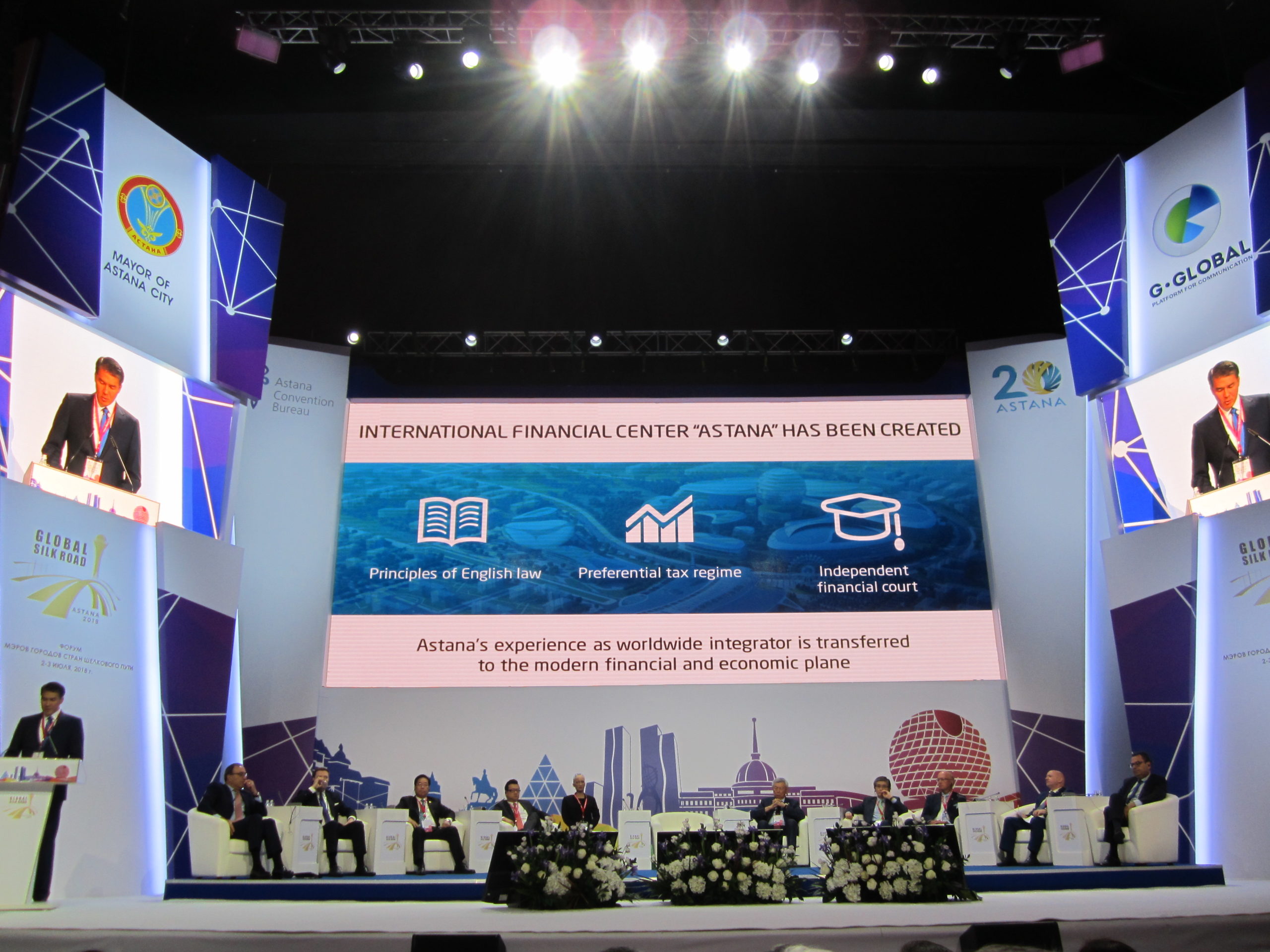
We were a well-suited duo to tackle this challenge. Gulzhahan and I trusted each other, talked to each other, and were eager to answer each other’s questions without judgment.

At the same time, I had never felt judged by anyone there. Through naiveté and ignorance, I’d made multiple faux pas, and each one had been met with understanding, patience, and not a little resignation. I remembered a student in one of the classes that first semester after I’d learned about pointing. I’d had much trouble remembering to not point. Something I’d done so habitually, so unconsciously for so many years was hard to stop. I’d turned to my students and let them know.

“It’s hard for me to remember,” I had told them. “I’m hoping you are not too offended when I forget.”
A student along the far wall, one of the stronger students, responded.

“It’s okay. You’re an American. We’re used to it.”

Sitting in the airport’s bright red café, I chuckled as I remembered how I’d felt when I finally used my pen as a pointer: as though I were putting on airs. I’d ignored my internal affectation-alert and just kept on. How would I fare with the pointer this second year? Would it still feel like an affectation? I was eager to find out.

Our boarding call pulled me out of my reverie, and I realized how eager I was to get on board, to get back to our town, our work, and to my friend Gulzhahan and our shared vision. I was going home, home to my life in Zhezkazgan. Home to the Kazakh steppe.
by Janet Givens

Belarus – US: Forging New Partnerships

The 25 years of diplomatic relations between Belarus and the United States have seen ups and downs. But we have always been mindful of the importance of maintaining good and fruitful relations with Washington. The United States became the second country in the world to establish diplomatic ties with Belarus, and back then it was a big occasion for the new independent country of Belarus.
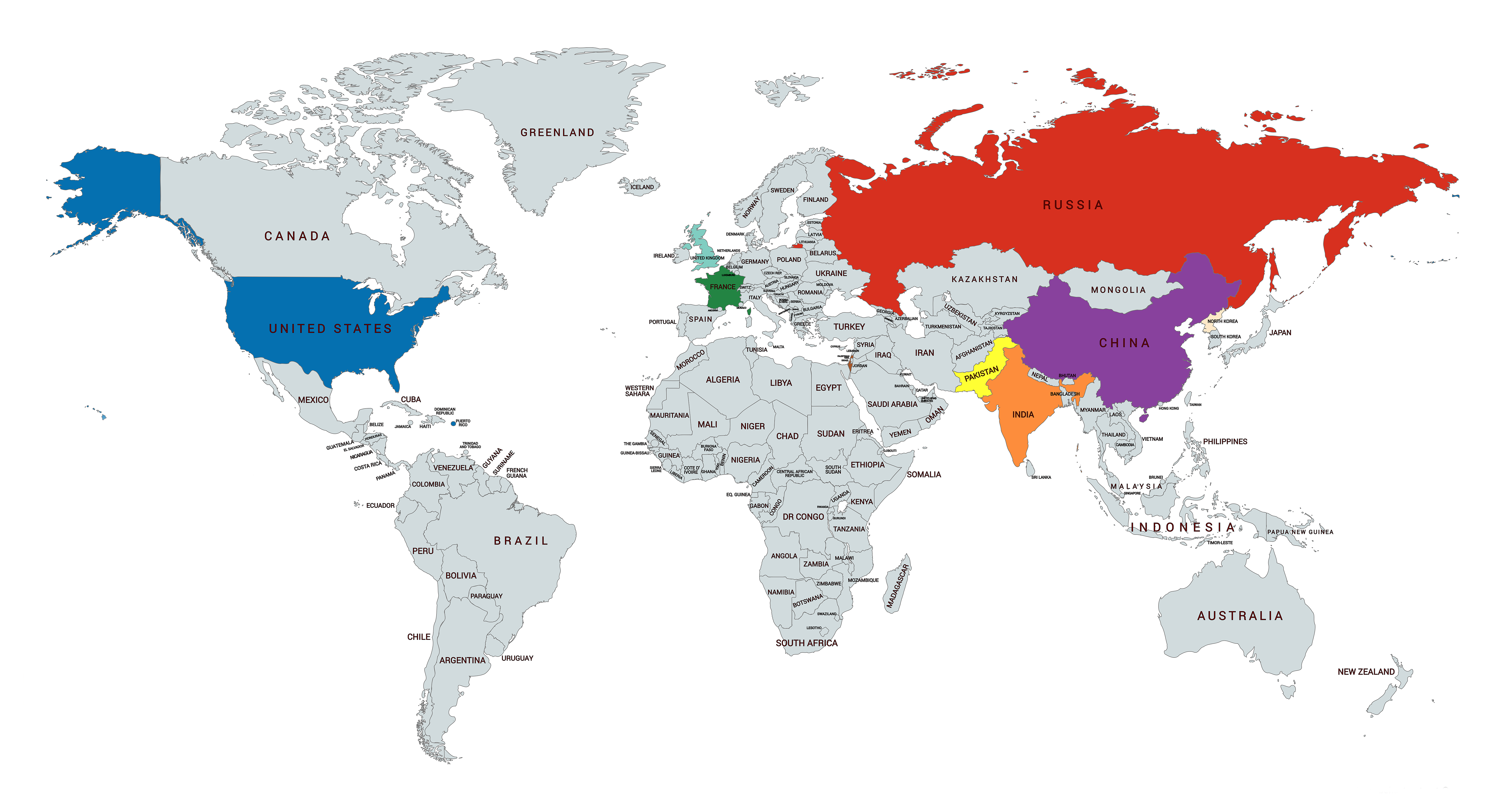
I believe that our Western partners, the United States, understand that Belarus has always been a net donor of European and international security. 20 years ago Belarus, unilaterally and unconditionally, relinquished possession of nuclear weapons and removed them all from its territory. With our U.S. and European partners, we seek to deliver input to managing global and regional problems, to countering modern challenges and threats. In 2011, Belarus offered its rail network to transport cargo to U.S. forces in Afghanistan. Belarus and U.S. joined forces in combating illicit trafficking in nuclear material. In 2014, Belarus proposed to conduct on its territory negotiations on resolving situation in Eastern Ukraine, and the Minsk agreements have been universally recognized as the only instrument that can lead to sustainable peace in Ukraine.
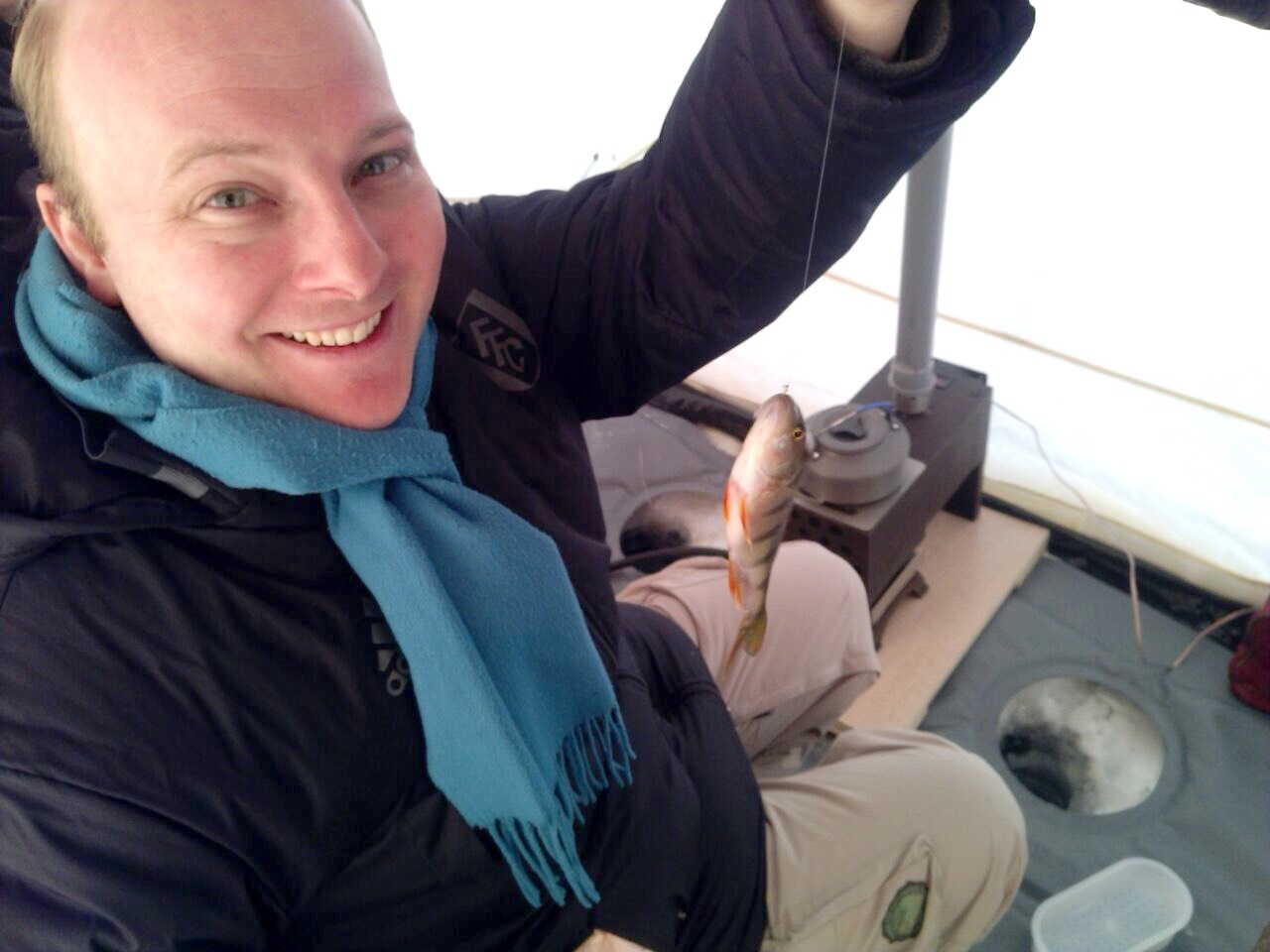
Full normalization of Belarus – U.S. relations has been one of the priorities of Belarus’s foreign policy. It is rewarding that over the last four years there has been a positive momentum in the development of our bilateral relations. We have enjoyed limited but steady and consistent progress, and we have avoided pitfalls and mistakes as contacts between the two countries become more intensive and new opportunities were explored.

On a vast majority of international issues, our values and viewpoints are shared with the United States. In the United Nations, our Government has recently supported the global outreach of the U.S. to curb production of fentanyl, an extremely dangerous and lethal drug. A few days ago, at the U.N. General Assembly the U.S. co-sponsored a Belarus’s resolution to combat trafficking in persons.

With the Trump Administration, we are engaged in political and sectoral dialogues on a number of issues of mutual interest and concern. It is through honest and respectful dialog that we forge understanding and common ground on matters where we may have some disagreements, like the pace of human rights reforms in Belarus.

The areas of Belarus – U.S. engagement which possess significant potential is trade and investment. This potential has yet to be fully explored, but there are factors where progress is already observed and where we can demonstrate how serious and promising a partner Belarus is.

Belarus is an export-oriented state with a well-developed production sector, services sector and agriculture. Belarus is a global leader in the export of freight vehicles, tractors, road construction and municipal equipment, potash fertilizers, flax fibers, dairy products, butter. Our open pit dump trucks have 30 percent of the global market. In 2013, Belarusian Automobile Plant produced the world’s biggest dump truck, its load capacity is 450 tons and the monster is listed in the Guinness Book of Records.

Belarus is 38th in the World Bank’s Doing Business out of 190 economies covered in the study. Belarus Government is following the path of macroeconomic stabilization and structural reforms using the expertise of international financial institutions, particularly the IMF and World Bank.

Belarus trade with the U.S. is not insignificant: over 1 billion dollars annually both ways counting both goods and services. Trade is balanced – we import more goods from the U.S. but we sell more services. The U.S. is a significant investor in Belarusian economy. There are about 400 enterprises with U.S. capital active in Belarus. There is a growing interest on the part of U.S. corporations in Belarus, it being part of the Eurasian Economic Union.

The last two years saw increased contacts between business communities, especially at a regional level: in 2016-2017 Belarusian business delegations visited Texas, Florida, California, New York, New Jersey, North Dakota, Minnesota, Wisconsin, Indiana, Illinois, Arkansas, Pennsylvania.
In June 2017 the Belarusian National Exposition featuring tech and IT sectors was organized at eMerge Americas high-tech exhibition in Miami Beach, Florida. That was the first ever Belarus National Exposition in the U.S.

Belarus is particularly proud of the export of its computer services to the U.S. and worldwide. In the past several years Belarus has earned the reputation of the leading “IT country” in the Eastern European region. This is naturally becoming a new brand for Belarus. According to the Global Services 100 rating, the Republic of Belarus placed 13th among the 20 leading countries in the sphere of IT outsourcing and high-tech services. Moreover, three companies with Belarusian roots entered the top-100 of the largest world companies in this sphere: EPAM Systems, IBA Group and Intetics Co.

EPAM Systems (NYSE: EPAM) became the first IT services provider in the history of the Central and Eastern Europe region which floated its shares on the New York Stock Exchange. The company’s market cap has increased more than fivefold since the IPO.

Providing special business environment for IT business, Belarus Hi-Tech Park (HTP) is one of the largest and fast-growing IT clusters in Central and Eastern Europe. Currently, 187 IT companies with over 31,000 software engineers are registered as HTP residents. More than 60 percent of them are foreign companies and joint ventures. About 3,000 new jobs are created in HTP companies annually.

In 2016, the HTP exports equaled USD 820 million, with the export share in the total revenue reaching 90 percent. Since 2006, HTP has grown at a rate of 25-30 percent annually. 92 percent of the software produced in the Park account for exports. 49 percent account for the European countries, 44 percent – for the U.S. and Canada.
Five out of 10 world’s largest companies, according to Forbes Lists, are among HTP customers. About 1 billion people in over 150 countries use mobile apps developed by HTP residents.

Belarus is famous for its strong computer programming school. There are 51 universities in Belarus and 16 thousand graduates with ICT and related technical skills annually.

If the current growth trend continues, the volume of Belarus computer services sold to the U.S. will exceed half a billion dollars in 2017. We take pride in the fact that we sell such volumes of products of the human brain to the most technologically advanced country in the world.

Web resources to further explore opportunities of economic and investment cooperation with Belarus: www.belarus.by, www.investinbelarus.by, www.export.by.

text and photo courtesy of Embassy of Belarus in the U.S.

Mr. Pavel Shidlovsky
Charge d’Affaires, a.i. of Belarus in the U.S.

Mr. Shidlovsky has been Chief of Mission of Belarus in the United States since April 2014. Before coming to the U.S., Mr. Shidlovsky served as Director of U.S. and Canada Office of the Ministry of Foreign Affairs of Belarus, overseeing political and economic cooperation of Belarus with the United States and Canada.

Between 2004 and 2008, Mr. Shidlovsky served in the Embassy of Belarus in the U.S. as Counselor covering economic, political, science and technology, humanitarian, educational issues. Prior to that, since 2001, he was Assistant to the Minister of Foreign Affairs of Belarus managing the private office of the Foreign Minister. His first foreign posting was in Canada where he served as Second Secretary and Vice Consul for three years.

Mr. Shidlovsky joined diplomatic service in 1993, after having graduated with honors from the Minsk Linguistic University as linguist and interpreter from English and French. Mr. Shidlovsky also graduated with honors from the Academy of Administration under the aegis of the President of Belarus in 2011 as specialist in international relations. In 2011, he received an award of the Presidential Administration of Belarus for outstanding performance in foreign service.

Gulsifat Shakhidi

“As Columbus once discovered America, today America opens the modern literature of Central Asia”

In November 2017, at the 6th OEBF Festival in Stockholm, Tajik writer Gulsifat Shahidi received an honorary award. “For her personal contribution to the unification of the peoples of Eurasia through literature.” The attention of the guests of the festival was attracted by her new book “My Eye Directs to the East”. In her work, the writer emphasized the development of inter-cultural, inter-ethnic space, the establishment of humanitarian “bridges” connecting Russia and Tajikistan. For her creativity, Gulsifat Shahidi repeatedly received international recognition: in 2015 she was awarded the medal “Dove of Peace” from the international association “Generals of the World – for Peace”; in 2016, she received an award as “Author of the Year” from the British publishing house Hertfordshire Press. In an interview with OCA, Gulsifat Shahidi talked about her work, why she wrote her works in Russian and English, as well as the forthcoming presentation of her book in the US and what awaits her from the American public.

OCA: Gulsifat, your books were presented in Tajikistan, Russia, Britain, Israel and Sweden, where they were highly appreciated and resonated. Tell me what country do you intend to conquer now?
Gulsifat Shakhidi: I plan to present the book in the New World, I will be there for the first time. I want to present my work to the American reader. This became possible today due to my active participation in the projects of the Eurasian Creative Guild – participation in the Open Eurasian Literature Festival, translating my books into English and, of course, publishing books in London at the Hertfordshire Press. My creative career changed greatly after my books were translated into English. I realized that the translation of works into English expands the circle of readers who can get acquainted with my work.

OCA: Your native language is Tajik, why most of your works are written in Russian? In what language is it easier for you to write?
G.Sh: Of course, it’s easier for me to write in my native language. As a bilingual writer, I am equally able to create in both languages. However, the Russian language, like the English language, expands the circle of readers of my work. Books are written to be read, not to be collected on shelves. In this sense, the Eurasian Creative Guild does a very important thing – it acquaints the readers of the whole world with the literature of Central Asia, presenting the writings of writers of this region through the translation of their works.

But, I think in Tajik. Therefore, I have an art editor, Vera Deinichenko, with whom I have been friends for more than 40 years.

OCA: In August of this year, you were awarded the prize in the nomination “For the Development of Literary Traditions and the Creation of New Acutely-Actual Forms.” For two years of active creativity, you have released six books and received four prestigious awards. Which of the awards is most valuable to you?
G.Sh: For the writer, the greatest reward is when he takes in his hands the new smell of printing ink only, that the published work, when he has regular readers, and then – new ones, which gradually become the category of permanent ones. I want to note that only on the website of Proza.ru, I already have seven thousand people. All these rewards are important to me. This is a kind of stimulus and, as it were, an advance on the creation of new works.

The award “For the development of literary traditions and the creation of new acute-topical forms” was not in vain handed in at the Diplomatic Academy. Writers through their works should be diplomats and open new opportunities for strengthening and mutual cooperation among peoples, becoming kind of messengers of peace. I very much hope that in America they will also find their readers, not just me. So many books of my colleagues were published by the Hertfordshire Press publishing house – they are all an opening for American readers. As Columbus once discovered America, today America is discovering the modern literature of Central Asia.

OCA: Gulsifat, can I briefly tell you about your books?
G.Sh: Two of them took a long time to write and kept me at my writing-desk – these are my scientific essays “Sentimental Journey, or all of my time” and “My eyes are fixed on the East”. This comparative literary criticism is directed not only to learned men, but also to the simple reader. Written in the genre of popular science essay. But the other four – art books – are the story “The City Where Dreams Come True” and “The Neighbors”, a collection of humorous stories “Farhod of Nawgilem” and a biographical story “Share Love”. This all was not stored in the writing-desk, but in my subconscious. Somewhere in my life I saw someone interesting stories told and of course artistic thinking works and it all falls on paper.

OCA: Did you start writing at the age of sixty-is it too late?
G.Sh: Firstly, I always wrote. I am a journalist. I do not think that there is such a concept in creativity – late or early. Everything has its time! No one can know in advance what, when and how much it is given to fate. To me now it is comfortable, as I consider my main mission fulfilled – I am a happy mother, wife and grandmother. Now you can spend more time on yourself. The main thing is that my close people support me in this. I thank them in every possible way for this.

OCA: In any field, there are those who rejoice at your success and those who are cold about it. You feel that you have opponents.
G.Sh: I felt this much earlier before I began to write prose. My husband, Tolib Shahidi, is a creative person and very successful. He is a composer whose works are performed in many countries. Throughout our life, we have seen different people and different attitudes towards achievements. In due course, I have got used, without it does not happen. I have no painful vanity. We had one employee during my work at the research institute, which said – if you do not have an enemy, then you die as a person. Now I remember these words with humor, but there is probably some truth in this. I’m glad that I write that my books are published in four languages, it’s better to think about it.

OCA: Are you still writing? What new surprises await us?
G.Sh: I continue. Of course, I do not want to disclose all plans yet, but I took up a big form – a female novel. What happens, we’ll see. And yet, I want to write funny tales to my grandchildren. The main thing, I want to write. I also want to publish a collection of my articles, reviews, reviews. I want to justify my rewards. After all, many are interested in being noticed, reading, writing positive responses to my works. And, so as not to have a lot of unnecessary conversations, I first expose my works to the readers’ court in the form of publications, I get feedback, then I’m already going to print.

OCA: Who helps you with the release of books?
G.Sh: I want to express my gratitude to my beloved friend Vera Deichenko – this is my permanent art editor. When they offered me their editor in the editorial office, I refused. Who, if not Vera, who has traveled along and across our republic, can understand the Tajik reality, the specifics of people’s life.

I express my respect to the creator and inspirer of the Eurasian Literary Forum in London, Marat Akhmedjanov, who gave me the opportunity to believe in my creative powers, supported me, and introduced me to eminent writers and translators. The spiritual and positive support of Marat Akhmedjanov gives me the opportunity to go further, not stopping at what has been achieved.

And, of course, the closest are my family, my main support. Without them, I probably could not release a single book. I love you, my family!

OCA: What do you wish your new readers from America?
G.Sh: This is a new mentality for me. I would like the American reader to accept my work. I know that now in America there lives a large number of people – people from Central Asia and the former Soviet Union. They will, in my opinion, be the first American readers of the books published by Hertfordshire Press.

As a writer I would like people to read books more. The book is a faithful and reliable friend who will never betray you. Read our books – this is the greatest joy for the authors.

OCA: Good luck and success. We are waiting for new books and new readers among American book lovers.

WWW.OCAMAGAZINE.COM OCA#28 SPRING 2018 USA EDITION  Text by Maria Indina

Uyghurs: between China and Central Asia

It was March, and a whole neighbourhood on the outskirts of Almaty, Kazakhstan’s biggest city and former capital, was once again preparing for the spring festival of New Year. Men were handling outdoor tasks while women were chopping carrots for pilaf, the main dish of their Zoroastrian New Year celebration – Nowruz.

The men and women I came to meet with were Uyghurs – one of the biggest Turkic-speaking people of Central Asia. Here, in Kazakhstan, they are a minority.

It was a vibrant scene. Women in brightly coloured clothes and small headscarves, worn across most of the Muslim regions of the former Soviet Union, singing traditional songs while chopping the carrots. The older women playing folk instruments, the kashgar rubab and the dutar. The dutar is a two stringed lute and the kashgar rubab traces its origins to the ancient Silk Road city of Kashgar in Xinjiang, China.
Xinjiang is home to at least 11 million Uyghurs – a Turkic, Muslim people. It is a vast region of China about the size of Western Europe, culturally and linguistically close to Central Asian nations. The events of the 19th and 20th centuries led to the wider region’s division between China and Russia. As a result, Xinjiang came under full Chinese rule, becoming part of modern China – the Xinjiang Uighur Autonomous Region.

Twice in the last century there were attempts to establish an independent Uighur state in parts of Xinjiang but they were crushed by the Chinese. In the mid-20th century tens of thousands of Uyghurs fled China, crossing the borders into the then Soviet Central Asian republics of Kazakhstan, Uzbekistan and Kyrgyzstan. There are now about 350,000 ethnic Uyghurs in this region, the majority of them living in Kazakhstan.

Their language and traditions make Uyghurs similar to all Central Asians – but they are closest to Uzbeks in their dialect, culture, food and general lifestyle.

“Until recently the biggest Uighur community was in Uzbekistan,” – says Kakharman Khozhamberdy, an activist I met in an Uighur neighbourhood of Almaty. “But due to this closeness they have assimilated into the Uzbek society.”

In Kazakhstan they may feel close to their historical homeland, but the 250,000- strong Uighur community fears losing their culture and traditions. And even though Nowruz is widely celebrated across Central Asia, today Uyghurs are trying to make their festival a little different.

“Everyone celebrates Nowruz. Kazakhs cook gojee and Uzbeks make sumalak. So we Uyghurs prepare pilaf – this makes us a little different from them,” says Halima, a dutar player and actress. “We are trying to keep our traditions alive, speak our language and teach our children to respect our culture, but it is very difficult.” She says all her children speak Uighur but the grandchildren prefer speaking Kazakh and Russian.

In recent years Central Asian Uyghurs have made a point of displaying their culture to the younger generation during Novruz: all women wear their colourful national outfits and hats with golden embroidery. The stalls are groaning with all kinds of Uighur food, the musicians play Uighur melodies.

Rooted in Zoroastrianism, ancient Nowruz somehow survived in the region throughout the centuries of Islamic worship, coexisting alongside a strong Muslim identity. In fact, Uyghurs “tried” many other religions before becoming Muslim, also including Shamanism, Buddhism and Christianity. Since they became Muslim, Uyghurs have been known for a history of practicing a moderate form of Islam.

Uyghurs’ dances and songs are mixed-gender – there is no separation between men and women as Uyghurs perform their folk dances and songs. Something non-existent in this predominantly Muslim region, physical contact during the dances – holding hands, putting an arm around a female partner – is part of tradition.

As many Uyghurs made modern Central Asia their home, many have lived with a dream of having an independent homeland in Xinjiang. This is an aspiration China fears.

In the early 1990s, when the republics of Central Asia gained independence following the collapse of the Soviet Union, many Uyghurs both in Xinjiang and in the wider region were inspired, too. They started organising themselves into political groups, talking about Uighur independence and reviving their cultural traditions. However, independence is rejected, not only in China, but also by other Central Asian states.

China’s economic and political presence is expanding in the neighbouring post-Soviet Central Asia. All the nations here are now members of the China-led Shanghai Cooperation Organisation which promotes Beijing’s political ambitions as well its economic interests.

The Chinese have invested billions of dollars into the Kazakh oil industry. They have built new pipelines to import gas from Turkmenistan and Uzbekistan. The region’s two smallest and poorest countries, Kyrgyzstan and Tajikistan, rely on Chinese investment, goods and services, too. New railways and roads are already bringing this region even closer to China.

Just as for all Central Asians, this is a good opportunity for the Uyghurs, too. “We built a big house in Almaty after starting our small business selling Chinese-made industrial and surgical gloves,” says Jahan, a local Uighur woman.

She and her husband travel to China to buy the gloves. With the recent construction boom in Kazakhstan, trade is flourishing. “Everything we have earned so far is due to new trade relations with China, and our family is grateful for this,” says Jahan. “We travelled to China, saw their beautiful cities, and people there are very hospitable and welcoming.”
She doesn’t want to talk about politics. Right now many Uyghurs on both sides are enjoying new business opportunities. But most of all – the Uyghurs outside China are happy to be able to visit their long lost relatives in their historical homeland of Xinjiang.

“Thousands of Uyghurs fled China in the 1950s and almost all of them had relatives left back in Xinjiang,” says Shaymardan Nurumov, an Uighur representative in the Assembly of People of Kazakhstan, the country’s national political body. “Parents were separated from their children, siblings couldn’t even write to each other let alone talk on the phone or meet face to face,” Mr Nurumov says in his office in central Almaty.
“Now Uyghurs on both sides of the border have re-established their family ties: we visit each other when there is a wedding or a funeral. People are doing business, interacting with each other. This was not possible until recently.”

But not all Uyghurs are happy that what they regards as their homeland is part of China. Violent attacks committed by radicalised Uyghurs across China over the last few years have killed hundreds of people. Some say that these attacks are used as an excuse for the Chinese to crack down on Uighur nationalism.

“We haven’t been to Xinjiang and don’t know what these people went through. Maybe their family members were killed and the anger made them violent,” says Sadriddin Ayupov. The young imam whom I met in his mosque in Almaty’s Uighur quarter is dressed in modern clothes and an embroidered Uighur hat. “So these people forgot that Islam is all about patience and peace,” he adds. “They have clearly got the religion by the wrong end.”

Imam Sadriddin is worried that Kazakhstan’s Uighur youth may be radicalised. He is using his mosque to deter them from that path. “We have just finished this volleyball pitch and are now building a basketball pitch,” he told me as he showed me around his mosque which looks more like a sports centre. “With these facilities we can attract young people to our mosque and keep an eye on them so they don’t get distracted from the right path.”

A majority of Uyghurs in Xinjiang as well as in Central Asia have a secular lifestyle. But in the age of the internet and global jihadist ideas, Sadriddin Ayupov finds it challenging to make young people listen to moderate clerics rather than the firebrand preachers on the net.

“It is tricky to be an imam,” admits Imam Sadriddin. “We need to deliver the true meaning of religion. But as we preach moderate vision, some brainwashed young people don’t think this is genuine Islam.”

For the Uyghurs in Kazakhstan, it is very important to have relations and open borders with their homeland in Xinjiang. In fact, China, too, wants these Uighur people to act as a bridge with its Central Asian neighbours. However, the main question for China as well as Central Asian governments is: Will these trade and cultural relations lead to a new Uighur political and religious activism on either side?

In the meantime, many Uyghurs don’t want to talk about it.

by Rustam Qobil, journalist,
BBC Central Asian service

WWW.OCAMAGAZINE.COM OCA#28 SPRING 2018 USA EDITION

To become a good friend – visit my home and try some of my bread!

Many people all over the world, including Turkmens, consider bread an essential and irreplaceable part of the diet. Bread contains numerous nutrients and useful bioactive substances, and many will regard a meal, whether ordinary, everyday fare or a festive dinner with sophisticated dishes and delicacies, as incomplete without bread. No wonder the proverbs state “no bread, no meal” or “no salt – no taste, no bread – no nourishment”…

Archeological evidence suggests that Turkmen people baked chorek – a flat, round loaf, stamped with decorative patterns of dots – in conical clay ovens called in Turkmen tamdyr (or tandyr, tannur, tenir and tandur in neighboring countries) for many centuries.

For Turkmens, bread is not just a simple and essential food, it is something sacred, a building block of life and requires a special reverence, almost worship, similar to that shown to parents and guests. It forms a very important part of the non-religious spiritual tradition of Turkmens. If you are invited to a meal with a Turkmen family, the first food offered is chorek, carefully unwrapped from the camel-wool cloth called sachak in which it has been kept warm. The guest is expected to break off a piece as a sign of acceptance of hospitality and hand it on to his neighbor on the right.

Migrating for centuries across the boundless expanses of one of the harshest and most hostile environments on earth, Turkmens stuck together and helped one another to survive. With their understanding of the challenges and dangers of desert travel gained from their own experience, they would help other travellers, especially those from distant countries, greeting them as honored guests and offering the best, or often all, they had. Bread has always been the most important part of this ritual because it was highly regarded as a sacred symbol of one’s land, of goodness and well-being, of home and a happy family life.

A famous Hungarian researcher and explorer of Central Asia, Arminius Wambery, who visited Turkmenistan in 1885, described in his travel notes how one Turkmen slaughtered the only goat he had for his guests and put on the table the loaf of bread that the family had stored for weeks, which he did not even touch during the meal.

“My guest is more important than my father”, says one Turkmen proverb, and Turkmen people still believe the road to paradise will be open to them if they welcome a stranger, who must have been sent by god, with bread.

Many superstitions surround bread: it should not be turned upside down, should not be stepped on or over, should not be put on the ground and no one is allowed to walk behind a person baking bread. Bread is often used as a protective amulet. Turkmens put a bit of chorek under the pillow of a sick person or a pregnant woman, and into the cradle of a baby. A bit of chorek is given for good luck to a person setting off on a long journey. Many parents still give a small piece of chorek that was baked in the family tamdyr to the son leaving home for his military service. The son must eat this piece and the remaining loaf is cherished until the son’s return.

Bread is a symbol of the warmth of the family hearth, and the family hearth for a Turkmen is the tamdyr, which, because of its shape and significance, was often associated with the heavenly sphere. The tamdyr is as respected as an owliya (holy place) and would never be destroyed, even if old and shabby, or the last lonely reminder of an abandoned settlement, in the same way that a mosque would never be destroyed. Walking past a tamdyr old people always say a prayer.

Built as an oven for baking bread, the tamdyr has always been a symbol of friendliness and unity. In the old days several families would erect one good tamdyr to be looked after between them, and they would decide who would bake bread on which day. When a new sack of flour was opened, the women would give away the first batch of the fresh warm chorek to the neighbors and only after that baked for themselves. If there are many tamdyr in a village it is believed to be a bad sign, an indication of unacceptable individualistic relations among neighbors. Old men say that enemies used to count the number of tamdyr in a settlement to ascertain how united the population was and to decide whether to attack or to stay away.

“The tamdyr and chorek are the masters of the house”, Turkmen people say. On moving to a new house for the first time people carry chorek in their hands and build a tamdyr in the courtyard. Although numerous types of bread can now be bought at a shop or market, from time to time Turkmen mothers still bake chorek in their tamdyr to preserve the warmth and unity of the family for many years to come.

So, if you happen to visit someone in Turkmenistan, be confident that you will be invited to visit their home and share bread with them, because this is the best way for them to show their hospitality…it is there that you will see reflected the true soul of the Turkmen.

text and photo courtesy of Ayan Travel

WWW.OCAMAGAZINE.COM OCA#28 SPRING 2018 USA EDITION 

Tajikistan and the United States of America: Gardening a Tree of Friendship

A message from H.E. Mr. Farhod SALIM, Ambassador of Tajikistan to the United States of America

The Republic of Tajikistan and the United States of America celebrated the 25th anniversary of their bilateral relationship in 2016. The United States was among the first countries to recognize the independence of Tajikistan in 1991. Since the establishment of diplomatic relations, our countries continue to strengthen important, valuable and mutually beneficial cooperation and partnership in a wide range of areas, including countering drug trafficking, border security, agriculture, health, education and economic connectivity.

The Founder of Peace and National Unity – Leader of the Nation, President of the Republic of Tajikistan H.E. Mr. Emomali Rahmon in his Address to our Parliament noted, that “The essence and objectives of the open door foreign policy, implementation of which contributes to the constant increase of the numbers of our friends, will remain the same, and will serve to strengthen the cooperation of Tajikistan with all the countries of the world”. This foreign policy enables and encourages us to continue to improve further our ties and collaboration with our international partners to overcome modern challenges and threats and strengthen further our mutually beneficial relationships.

Since 2010, both sides introduced new forms of bilateral engagement – Annual Bilateral Cooperation, where issues of common interest are discussed openly and constructively. We believe this format is important, since it provides a unique opportunity to exchange views and improve relations based on mutual understanding and respect.
Recently, the new multilateral format of engagement was established – the C5+1 Ministerial Format, where our ministers of foreign affairs, following the outcomes of relevant working group’s meetings on important subjects, meet and set new guidance for further cooperation. Minister of Foreign Affairs of Tajikistan H.E. Mr.Sirojidin Aslov participated in all the Ministerial meetings of this format, and he is actively engaged in promoting regional security and economic connectivity for the sake of future prosperity.

To ensure further economic development and improve wellbeing of people, the Government of the Republic of Tajikistan set three strategic goals; energy independence, food security and releasing the country from communication deadlock.

Tajikistan possesses rich natural resources and hydro energy potential is among the largest of them that provide opportunity for economic prosperity. By utilizing these resources, Tajikistan can easily provide Central and South Asia with environmentally clean and economically sufficient energy. We are grateful to our American partners for their engagement and support for the CASA-1000 regional project, which is aimed at the export of energy from Central Asia to South Asia.

Food security is among the priority strategic goals of the government of the Republic of Tajikistan. Agriculture production has been defined as an important factor of food security of the country. In this regard, sufficient use of a land, land improvement and its productivity, increased exports of fruits and vegetables are priority tasks. The President of Tajikistan in his Address to the Parliament noted, that “we could ensure food security only when we will more and more increase domestic agricultural production and be less reliant on imported products”. Obviously, ensuring food security depends on productivity and sustainability of agricultural development, therefore this sector is an important section of Tajikistan’s economy that provides 20-21% of GDP.
To overcome the challenges of the country’s remoteness, the government is implementing several projects with our partners and international financial institutions to construct and modernize roads, highways, railroads, bridges, tunnels, airports and other transport infrastructure in accordance with the international standards. The implementation of these important projects is allowing us gradually to break the communication deadlock. Some of these projects have regional and international importance that will ensure access of the country to the sea ports of South Asia and transit highways of other countries. In this regard, the Trade and Investment Framework Agreement between the United States and Central Asian countries can further assist regional connectivity. We are thankful to the government of the United States for their support of constructing the biggest bridge in Panji Poyon, connecting Tajikistan with its southern neighbor and opening trade opportunities with South Asia.

As Tajikistan’s hydro energy resources, our bilateral relations with the United States of America have enormous potential for further development and improvement, for the benefit of our people, our nations, our regions and our world. I am confident that with the approach of partnership and mutual respect, we can utilize these potentials gradually.

I would like to thank your publication for providing this opportunity to introduce the rich and ancient culture and region of Central Asia to our North American partners.

WWW.OCAMAGAZINE.COM OCA#28 SPRING 2018 USA EDITION 

I see a light for my native cinema at the end of this dark period

INTERVIEW WITH Bolot Shamshiev

Few will know much about the cinema in Kyrgyzstan. What currently hampers its development is never aired and never makes the top priority list of state and international organizations. But there is a cinema to note and so Open Central Asia decided to meet one of its prominent players, the People’s Artist of the USSR, the Soviet Kyrgyz actor, film director and screenwriter, Bolot Tolenovich Shamshiyev.

OCA: Bolot Tolenovich, tell us a little bit about your childhood and upbringing?
Bolot Shamshiev: I was born in the city of Frunze, now Bishkek. My father was a well-known Kyrgyz poet and journalist, Tolen Shamshiev. My mother was a doctor. My father went to the front six months after my birth, to fight the Nazis. Therefore, from infancy I was brought up by my maternal grandmother in the village. My father I saw only in 1946, when he returned from Berlin. After his return, our family again began to live in the city. Frunze – the city of my childhood was a quiet and cozy town on the north side of the great Tien-Shan mountains. Although I was a city man, I was always attracted by mountains. I very early began to travel through the grassy hills of Bospoeldek – the foothills near Frunze – to investigate shady mysterious gorges. In high school with my comrades, I began to master steeper mountains in the gorges of Alamedin and Ala-archa. But the main attraction of my youth was cinema. I did not miss a single film from the post-war repertoire of the Frunze cinemas. Gradually the dream was born to become a film director, to make films myself. After graduation, I decided to enter the Institute of Cinematography in Moscow. I did not act immediately. I was considered too young and was only accepted for the second year. At the institute, I got a real education, thanks to the outstanding masters of Soviet cinema – A. Zguridi, V. Belokurov, S. Gerasimov, T. Makarova and other well-known authorities of Soviet cinema. As a second-year student, I began starring in the main role of the film “Heat”. I quickly learned the basics of film art and by the end of my studies at the institute I managed to make a short film “Manaschi”, which won the main prize at the International Film Festival of Short Films in Oberhausen (Germany, 1966).

OCA: How did your creative destiny go on? What do you like more – to be an artist, to play someone’s role or to lead the process of filming?
BS: I was drawn to art cinema. After two successful undertakings in documentary cinema films (“Manaschi” and “Chaban”), I began work on a complex project – the adaptation of the story of the Kazakh classic M. Auezov’s “Shot at the Karash Pass”. This film was given to me with great challenges, not in terms of creativity, but because of production dislocations at the young film studio Kyrgyzfilm. Due to my inexperience and youth (just 26 years!), I took on a historical film with expensive scenery and great extras. And in the absence of a qualified film crew at the film studio. But I showed a fighting spirit, coped with the task, and the film went to the world screen. I was noticed not only by the cinematographic authorities of the USSR, but also by my enemies. Each subsequent film that was given I overcame the artificial barriers created not only by party curators from the official ideology, but also by ill-wishers within the state.

After the collapse of the Soviet Union and the attainment of independence in my Kyrgyzstan, patriarchal-clan relations forgotten in the Soviet era have sharply increased. The authorities, not having a clear social base, turned to the experience of the past and the clan structures began to be formed in the country. As a result, we experienced political instability, frequent changes of governments, which had a very negative impact on the cultural level of the population. The country forgot about representatives from the creative professions and the film studio stopped producing films. All creative workers were withdrawn from the state and were essentially thrown out onto the street, left without pay. The filmmakers were forced to independently seek sources of funding for the embodiment of their artistic designs. But it was not just about art, money was needed for the elementary survival of the families of filmmakers. But there were no longer any sponsors inside the republic. And to this day, for 25 years, not a single professional producer has appeared with money nor a skilled entrepreneur in the production of feature films.
In 2010, the interim government, led by Rosa Otunbayeva (a representative of the Saruu tribe from Talas), allocated money to produce a feature film for the first time. But due to clan attachments and the tribalism that prevailed in the country, such a serious project was given to a representative of the tribe of Saruu. This tribesman of Otunbayeva was not a professional filmmaker, who spent his budget profligately. The film was shot over four years and ended in complete failure. It became clear that the clan relations would lead the country into a final impasse, as once in 1916 northern Kyrgyzstan suffered a national catastrophe after the uprising of the Kyrgyz against the colonial policy of the tsarist government. In the hundreds of thousands of people killed, the Kyrgyz tribalism was primarily to blame. The tribes, who were rival to each other, could not organize a united front against the criminal tsarist regime. And if it were not for the October Revolution of 1917 that eliminated tsarism, all my Kyrgyz people would have been destroyed at the beginning of the 20th century, as once the white colonists destroyed the indigenous Indians when they conquered the American continent. So, professional cinematography is only a dream. At least today in the field of culture, sadly I do not see the light at the end of the tunnel.

OCA: You paint a bleak picture.” Soviet cinema was adored in the past in the West. But in Kyrgyzstan in recent years many films of young directors have appeared on the screens. How do you explain this phenomenon given all the challenges?
BS: An example of what is called “in spite of”. Yes, the state has forgotten about the culture. There is no well-thought-out state policy in the field of professional art. But if in the republic there were problems, these were not only with culture. Problems are everywhere. Social, economic, legal. Each for himself. The slogan “Enrich yourself, how you can!” gave rise to guerrilla warfare. Corruption struck all strata of society. But there are good things still. No wonder the Chinese say: “in order – a mess, in disorder – order!” From the very bottom began to appear a sort of youth cinema. Thanks to the fact that today it is possible to make a video cheaply and broadcast to the world, it’s not difficult or costly to get a picture on the screen. So, a lot of amateur film studios have appeared. The youth began expressing themselves on the screen about a government that had forgotten them. The trouble is that for the sake of surviving the young film studios engaged in commerce, which brought other problems. Money, alas, without it there is no life. It would be desirable for our youth not only to gain public recognition, but also to earn a living.

But to win recognition, one must learn. Cinematography has its own iron laws. They need to know, and it is natural to observe. But to learn, you need to have money. And where will it be found by a young talented person from a low-income family? The question is rhetorical, because the overwhelming number of families in Kyrgyzstan are poor and not able to pay expensive training abroad.

OCA: Why does your government not provide talented youth with assistance in obtaining a fully-fledged education?
BS: The government, these are officials who came to power through clan ties. They are therefore interested in their own family, close relatives, clan obligations. If there is a selection, some tiny help from the government in the field of education, then only to its own. And “their own” is not necessarily talented. Maybe a talented engineer would turn out from this or that child, and yet he was sent to study as a film director!

OCA: What is the main mission of cinema in your opinion?
BS: The whole world is cinema! Modern life is inconceivable without cinematography. Thanks to the invention of the Lumiere brothers, we learn not only about ourselves, but also other worlds. If there is a miracle in the world, then this is a movie! The magic world, the gift of God sent to mankind, that Man should become a Man! In all the works of our great writer Chingiz Aitmatov, the words “How to be a human being, a man” are a refrain. I will say that I believe that the main mission of the cinema is to ennoble the human being! With the help of mass propaganda on the screen, thanks to the democracy of motion picture art: making the world a better place! My Kyrgyzstan is no exception. The consensus of the peoples on the earth is important. And this consensus can provide all forms of all arts, especially cinema!

Maria Batz

KAZAKHSTAN: The quest for international recognition drives many emerging markets

WWW.OCAMAGAZINE.COM OCA#28 SPRING 2018 Text by Nick Kochan

The quest for international recognition drives many emerging markets. Kazakhstan has undoubtedly been better at it than many. The country has spent great effort and money building up an image as a modern state whose leaders can sit at the top table with world leaders. This effort at branding has been driven by the President. To some extent those around him have cooperated in bringing the country to international attention.
Building the international image has been nothing less than a national project, to which the resources of the state have been harnessed. Why has Kazakhstan made such an effort to build its image and how has it done so. Can this activity have any form of down side, or is all publicity, good publicity?
The country’s reasons for this national campaign are part political and part commercial. The image building is seen as part of the country’s effort to cement itself as the regional leader and voice. For some time, the President has sought to be the spokesman for the Central Asian area. He was respected from the setting up of the country as a confidant of the Russian leadership dating back to Soviet times who could sit at the top table. The Region’s relations with Russia have largely been handled by Kazakhstan which is also a part of an economic trade zone, comprised of Russia and Belarus.
Important as the relationship with Russia and the region is, this President sees the need for a relationship with the Western community. At one level this may be regarded as hubris, given the fact that the country is still developing its infrastructure and its application of international law. There will be those that will question the sort of reception that Western governments will give such a country, when it makes an approach to host an international organisation, hold a large conference or intervene in a dispute. Will its governance record, for example, tell against it?
The story so far is that the international community is prepared to take a remarkably tolerant approach to Kazakhstan. So, in 2010, for example, the country was given the chairmanship of the Organisation for Security and Cooperation in Europe. The OSCE describes itself on its website in these terms, ‘The OSCE has a comprehensive approach to security that encompasses politico-military, economic and environmental, and human aspects. It therefore addresses a wide range of security-related concerns, including arms control, confidence- and security-building measures, human rights, national minorities, democratization, policing strategies, counter-terrorism and economic and environmental activities. All 57 participating States enjoy equal status, and decisions are taken by consensus on a politically, but not legally binding basis.’
Kazakhstan’s efforts to build its bridge to the international community has its ironies. The diplomat who negotiated this prestigious position had left the country under a dark cloud by the time Kazakhstan acceded to the chairmanship of the OSCE. As Kazakh ambassador to Austria and to multilateral organisations, Rakhat Aliyev was regarded as the driving force behind the OSCE role until he was discredited. He died in prison in 2015.
International politicians at the highest level have been recruited to advise the country and its leadership about branding and diplomacy. Tony Blair, for example, the former British prime minister served the president between 2011 and 2017 as an adviser, while his wife’s legal firm also advised the Prime Minister of Kazakhstan. The appointment had several purposes: to indicate to the international community that Kazakhstan has the status to hire people of Blair’s eminence; to gain access to someone who could open doors into other Western cabinet officers; to advise the President on building a brand whose key value is modernity; to assist with very specific public relations tasks.
Many other leading European politicians have been recruited to advise the president for similar purposes. These include Gerhard Schroder, Horst Kohler from Germany, Alfred Gusenbauer from Austria, Romano Prodi from Italy and Marcelino Oreja from Spain. The value of international connections is well understood by the President and these leading lights serve as his ambassadors, in country.
Why else is the international bridge so value for Kazakhstan? Key to this, and to an extent to its political development, is the building of economic bridges. The country’s future economic prosperity rests primarily on global trade in energy and minerals with international companies, many of which are close to governments and politicians. An insight into the way Kazakhstan is perceived by these governments is likely to be critical to the development of trading routes. Trust is critical to relationships with global concerns and Kazakhstan’s focus on modernisation and development will score highly in cementing this.
Brand values such as trustfulness and responsiveness to international change and standards need not only to be integrated into domestic systems but also to be understood and believed by international parties. Messages carried in the media will only be credible if the customer sees the value integrated into his experience. Failure to see values of integrity and transparency played out in political or business behaviour will undermine the brand’s strength and ultimately the country’s image abroad.
Therefore, great care is essential in building Kazakhstan’s brand, and why the effort needs to be more than merely applied to the surface of the country’s systems and infrastructure. The values need to go to the heart of the country and its people, to its businesses and to its governance. That way, the best of the modern can be combined with the best of the traditional and the country can win international acceptance as the king of the Silk Road and the modern powerhouse of Central Asia.


The American View: EXPO-2017 People are the source of future energy

WWW.OCAMAGAZINE.COM OCA#28 SPRING 2018 USA EDITION Text by Maria Indina

In the capital of Kazakhstan, Astana, the international specialized exhibition “Expo-2017” has finished its work. It has continued for 3 months from June 10 to September 10. There were 115 countries and 22 international organizations who participated in the EXPO. The exhibition has been visited by about 3 million people.

The theme of this year’s exhibition was dedicated to the effective use of future energy. Scientists now advocate that society should turn to alternative energy. However, every country has its own view of future energy and different states demonstrated this in their pavilions. So, for example, Russia sees its future in the Arctic, Japan in using biofuels, but in the USA the source of future energy is human. OCA interviewed the director of public relations of the American stand, Antony Deangelo, to find out more about how this “American Way” went down in Astana.

OCA: Tell about your participation in EXPO 2017 in Kazakhstan. What have you come with and how do you see the future energy?
Antony Deangelo: The theme of EXPO-2017 is future energy. Each country has its own individual approach to this. We think that the source of infinite energy is people. And this is completely reflected in our pavilion. It consists of three halls. In the first hall there is video installation, which tells about all the technological innovations which have occurred through people. But the main thing is that our pavilion is fully operated by our students-ambassadors from USA, each of them speaks Russian well. Thus, we brought not only discussions, conversations about future technologies, but also real people who are the source of these future innovations; the source of everything that will happen in future. And we supposed that the theme of EXPO is always bigger and wider than the mere title.

OCA: What other success has participation in EXPO brought for USA?
AD: A presidential delegation from the USA, under the leadership of the US Deputy Secretary of Energy, came to our pavilion. It was an official visit and he had an opportunity to get acquainted with the Minister of Energy of Kazakhstan and even with President Nursultan Nazarbaev. Since EXPO was held in Kazakhstan and there was a pavilion from the USA, these meetings were possible to hold. They mean a lot for our countries. Our participation in EXPO has become as a catalyst of all these meetings at high state level. We hope that after personal acquaintances, the interaction in these spheres between America and Kazakhstan will improve.

OCA: Were any events been held in USA pavilion?
AD: Through our network of partners and sponsors we organized a series of discussions for our students about the future of energy and about renewable energy sources. Our pavilion was not sponsored by the state, but by private companies. We have a lot of sponsors, each of them has come and shared with us their views of future energy.

OCA: How do you generally assess the organization of EXPO in Kazakhstan?
AD: It should be noted that for any country it is difficult to organize such big exhibition with such a large amount of participating countries. This is especially true because Kazakhstan is the first country in Central Asia that has organized EXPO on its territory. We are very satisfied with the exhibition. Personally, I came several times while construction works were going on, and I saw how our pavilion was created. I like how it turned out. It is very sad to leave this place.

OCA: Experts call EXPO an economically unprofitable project. Do you agree?
AD: If we see it from our point of view, the main idea of EXPO is to meet people with different culture and have an opportunity to discuss different topics, so undoubtedly, the project was very useful for its participants and visitors. I think that the real value of EXPO comes from meeting people. And we are glad that Kazakhstan accepted the burden EXPO in order that other cultures could meet in a new destination. From economic point of view, I will leave that to people of Kazakhstan to decide whether the costs are justified or not. We have reached our goals and we are grateful for every day being in this atmosphere of fusion of cultures.


ECG Goes Stateside

Recently, the vice-chairman of the Eurasian Creative Guild, Marat Akhmedjanov, returned from a tour of North America. He visited nine cities and held more than 60 meetings, thanks to which many new members joined the ECG; but, that is just the start, as many new opportunities and ideas have followed. OCA finds out more about what promises to be the start of an expanded relationship with global creative folk.

OCA: Marat, tell us, in what status and why did you go to America?
Marat Akhmedjanov: The trip to America took place in my capacity as vice-chairman of the Eurasian Creative Guild and a member of PEN Central Asia (International Union of Writers). This is a large and important country where, according to different sources, at least 20 million people from post-Soviet countries live. There are many Russian-speaking people, including participants at our Literary Festival. Proceeding from the fact that we saw interest and prospects in promoting creative initiatives of Central Eurasia, a tour was organized.

OCA: Which cities did you visit during the trip? Who did you meet?
MA: I visited Toronto in Canada, New York, Washington, Los Angeles and San Francisco – in the United States. I was on tour for three and a half weeks and during this time I had about 60 meetings, including with current or new members of the Eurasian Creative Guild. In New York, the meeting took place on Brighton Beach in Brooklyn. eleven people came – this was the first meeting of the Guild in the United States. It’s so great that these people had a desire to come to this meeting, and they took the time to listen to what the Eurasian guild does, how it can be useful, and why it’s important to be a part of this single cultural community. In Washington, seven people came. In addition to communicating with members of the Guild, there were a lot of meetings with politicians and foundations who also reacted positively to the ideas of the Eurasian Creative Guild. The largest and most successful meeting was held in Los Angeles – where 18 people attended. In addition, experts from Hollywood showed great interest, they want to know more about the Eurasian region, in particular, Central Asia. They are interested in joint projects, they are looking for creative talents from the region.

San Francisco, the leader of the Silk Road Foundation, Anita, was also interested in bringing bright, creative representatives from Eurasia to perform at Stanford University. Certain agreements on this issue have been reached. No less interesting, a meeting was held with creative representatives in Toronto in Canada. Eight people came, including Zaur Hasanov, the winner of our “The best film of 2015”. There they are also expecting that there will be more events related to Eurasia.

OCA: Tell us about the meeting in Los Angeles more. With whom were discussions held?
MA: At the meeting was the famous Hollywood producer Cyrus Yavnuk, who is a member of our Guild. He has made a lot of fantastic TV shows in the US. In addition, I also met an interesting actor, stuntman and animal trainer, Monty Cox, as well as the documentary producer and professor at the California School of Cinematography Amanda Pope. Separately, I met with the executive director of the American guild of cameramen, Tim Shaw. There were also young filmmakers and writers. The meetings were very active. For many in Los Angeles, we remain like a riddle as they know very little about us, but they want to know more. I think the meeting will have very great outcomes, not least because we discussed one of the Guild’s new projects.

OCA: Tell us, what’s the new project? When will it be implemented?
MA: We are going to hold a Eurasian Film Festival in Dacorum. Dacorum is the region of Great Britain, where leading film studios are concentrated, including the Warner Brothers. It was in Dacorum that they produced “Harry Potter”, “Robin Hood”, and “James Bond”. We want Guild members and their acquaintances to attract more representatives of Hollywood to the festival next year in the UK.

OCA: Have you reached all your planned goals by traveling to America?
MA: One of the goals and objectives of the trip was to meet with existing members of the Guild and attract new members. Before the trip, there were only ten members, after there were more than thirty. That is, the trip increased our membership three times. In addition, about 150-200 people learned about the Guild and its activities from attending the events. If I look at the statistics of my meetings, I visited one continent, two countries, nine cities and held more than sixty meetings. It was a very important trip. It showed me that on the other side of the Atlantic there is no less interest than in Europe. There, people also want to read writers, listen to music and watch movies from Eurasia. But in fact, this was not the only purpose of the trip.

OCA: Tell us about what else was discussed at your meetings? What agreements were made?
MA: We were looking for partners in America. It was important to make sure that there is a need for a Literary Festival in the United States. We negotiated for our festival to be held next year in New York and Washington – and they were very successful discussions. Today, the Eurasian competition unites four thousand creative people from all over the world and the Guild has more than 400 members. I think all these people would be interested to share their experiences and creativity with people in North America, given that there is one of the largest Eurasian communities in the world outside the former Soviet Union, about 20 million people. Our partners in America are ready to provide sites for our writers. The Wilson Foundation offered potential assistance in the form of a grant to pay for the arrival of writers. The trip showed that there are prospects, and we will work to ensure that our festival next year is held in New York and Washington with the support of PEN America. And perhaps we will organize the arrival of writers in Los Angeles and San Francisco.

OCA: You plan to release a new magazine, tell us about this project?
MA: Indeed, we are planning to publish an American edition of the magazine OCA (Open Central Asia). A journal that describes not only Central Asia, but all of Eurasia. It will be a Eurasian mouthpiece for English-speaking readers. In England, we have published a magazine under this title since 2009 and it is hugely successful. Now, in 2018, we hope to launch it in the US. We have already responded to authors and potential readers who would like to participate in the creation of a new publication. The first issue is scheduled for the spring of 2018. Among the editors who will take part in the creation of the American edition are Professor Rafis Abazov of Columbia University and the head of the Friends of Nukus Museum, David Pearce.

I would also like to note that from the fall of this year, we are planning to hold presentations of our authors in the United States. The first author, whom we will represent to the American public is the Tajik writer, Gulsifat Shahidi. The presentation of her work will be held in New York and Washington.

P.S.

Next ECG North Ameriacan tour planned for July 2018, please follow us Facebook page for updates and notices!

Maria Indina

Animal Movies and Action Men

Interview with Hollywood Celebrity Monty Cox


Cox is a veteran in the entertainment industry. He is an internationally recognized, award-winning, Exotic Animal Trainer, 2nd Unit Director, Stunt Co-ordinator, Actor and Stuntman. Monty is first ECG member in Hollywod. He grew up in a trailer court in Oakland, California and his father was a merchant marine so often at sea. With little money to support the family, his mother worked two jobs, gone from 8:00 in the morning to 22:00 at night, leaving Cox unsupervised.

OCA: What do you remember of life growing up, before the calling of Hollywood?
Monty Cox: My father would return home every 2, or 3, years. He would instill in me manly virtues. Never back down from anyone, one’s word is one’s bond, and always remember it is not what someone says -but what someone does that counts. My father would be home for a week, or 2, then go again.
We moved to Reno, Nevada, when I was 12 years old. Reno was a wild city. The mafia was taking over the gambling casinos at that time: throwing people out of three-storey windows, shooting anyone who resisted etc. Crazed Native Americans, gang fights, and the call of the desert flavoured everything. At the age of 13, my dad would drop me and my dog “Mambo” in the desert, 20 or 30 miles from the nearest town. I would take very few things with me apart from water, a rifle, and a pistol. “Mambo” and I would live off the land, eating rabbits.

My friends were mostly Piut Indians. Indeed, I spent most of my time on the Indian Reservation with my good friends “Ya Ya” and “Dog Eyes”. When I was 20, I moved to Pasadena, California, and began training in Boxing and Martial Arts. I got a job as a commercial abalone diver: diving off the Channel Islands for abalone. I then began skydiving. I, along with 9 other skydivers, made the first “10 Man Star” in world history. Never before had anything like this been achieved.

OCA: When did your career as a television and film professional start?
MC: In 1965, I began working as an animal trainer at Africa USA. Around this time, they were filming Dakar, Cowboy in Africa and Gentle ben. Following negotiations, I flew to Miami to become the animal coordinator on Gentle Ben. Now, Gentle Ben had attacked their previous coordinator: chewing him up and putting him in hospital. Hence, I was sent to Florida to “fix the bear”. In short, to make him a working performer. That accomplished, I became the Head Animal Trainer for the Ivan Tors Studios in Miami, Florida. However, when Ivan Tor’s Studios closed down, I returned to Los Angeles to become the chief Animal Coordinator for Africa USA. Moreover, I went on to become the president of Africa USA. Eventually, of course, I left Africa USA and opened my own company The Lion Wild Animals Rentals. Buying lions, tigers, bears and a baboon, in order to train them to work in the movies. For 20 years, I owned and trained the Exxon Tigers. During this time, I also trained Sigfried and Roy’s lions for their stage act in Las Vegas. I won numerous commercial awards for Kal kan commercials – working with lions, tigers, house cats, and so on. Thereafter, I worked on Faberge commercials and Exxon commercials.

In 1983, at the annual Stunt Awards, I was awarded (by the stunt community) Best Stunt with an Animal for my “tiger attack” in the TV series Gambler with Kenny Rogers. Overall, a very prestigious prize.

OCA: As the best animal trainer in Hollywood, what are your most memorable projects?
MC: My most memorable moment was undoubtedly working on the movie Apocalypse Now. Additionally, projects dealing with Native Americans were always my favourites. Thus, Sun of the Morning Star, with Cyrus Yavneh as the Producer, stands out. In addition, Crazy Horse – Custer’s Last Stand, Bird on a Wire (with Mel Gibson and Goldie Hawn) were particularly memorable. Looking back, I traveled all over Canada finding animals to train for these movies.

Yet, the most incredible movie I ever coordinated was Snow Tigers. It was filmed in Canada during the winter. We were working with tigers in extreme conditions (20 below zero). Stated so, when netting tigers from horseback, I recall them attacking me as I drove a sleigh: thereby, flooring the horse that was pulling the sleigh. Furthermore, after netting tigers on foot, they started to try and eat me – one has to create the required emotion in a tiger for the scene to look authentic – all meaning, I used a “mean” tiger. With all this in mind, it is hardly surprising I broke my back when netting one of these tigers from horseback. After all, the tiger attacked me on the horse while I was riding causing us both to fall to the ground- the horse landing on top of me.

OCA: Has your expert reputation as a Master Handler/Co-ordinator effected your profile as an actor?
MC: As an actor I am very limited. I am not really what you call an actor. I can play parts that are what I am as a person, but I cannot be what I am not.

OCA: Have you ever collaborated with ECG board member Cyrus Yavneh?
MC: I have co-ordinated all of Cyrus’ animal work and collaborated on numerous shows (doing stunts) for him over the past 30 years. Cyrus is one of the best: a top-line producer in the business.

OCA: Would work in central Asia be a challenge that would interest you?
MC: Any work with another culture is always stimulating and exciting. Our views, too often jaded by news reports and politics, are often wrong. Indeed, people are people with good hearts and minds no matter where they are from. Overall, I look forward to working in Central Asia with the present E.C.G. Chairman David Parry, as well as possibly teaming up with people from this region like Nikolai Pavlenko.

OCA: What are your plans for the future?
MC: Getting my script financed and in production. All accompanied by a European tour for my book Animals Movies and Minds from another Time. Each a subject of interest to David Parry. What is more, I am currently working with two young lions – training them to perform in the movie business. Equally, I have just finished filming a skit for YouTube with a great grizzly bear Tag. If anyone goes onto Youtube and types my name, this skit will automatically appear.

by David Parry

VI Open Eurasian Literature Festival & Book Forum Held in the Homeland of Alfred Nobel

The Sixth Open Eurasian book forum and literature festival became the most anticipated event of 2017 for representatives of the Eurasian region. The venue of the festival was chosen as Sweden – a country that is famous for its sights and its own extraordinary culture and traditions. Sweden is home to many famous writers such as Astrid Lindgren, Selma Lagerlöf – the first woman to receive the Nobel Prize in Literature, Mai Shevall and other gifted authors.

In 2017, the whole world celebrated the 100th anniversary of the October Revolution and the 100th anniversary of such outstanding people as John Kennedy, Indira Gandhi and Sharaf Rashidov. The destinies, of these bright personalities that have changed our world, miraculously interwoven with each other. 2017 was a year of rethinking the historical events of the 20th century.
Organisers of the Open Eurasia Literature Festival & Book Forum timed the festival with the 100th anniversary of the outstanding Uzbek diplomat and writer, the author of the legendary story “Kashmir song”, Sharaf Rashidov. This decision was made with the aim of popularising Uzbek literature around the world. Within the framework of the festival a presentation of the story “Kashmir song” by Sharaf Rashidov was reprinted in London in 2017 in English.

Sweden was not accidentally chosen to host the 6th OEBF festival. The Scandinavian state is famous not only for its culture, it is also the birthplace of Alfred Nobel. Nobel is known to the general public as a chemist, inventor and founder of the most prestigious award in the world – the Nobel Prize.

Few people know that Alfred Nobel himself insisted that the award be given to outstanding scientists, writers and public figures, regardless of their country of origin. This fact prompted the organisers to hold the VI OEBF-2017 Festival in Stockholm. Moreover, the idea of the opening ceremony of the festival and awarding the winners of the open literature competition Open Eurasia was to be held in the Nobel Museum.

All agreements with the Nobel Museum were reached. However, 10 days before the opening of the festival, on the basis of ideological and cultural disagreements, regrettably, the Nobel Museum abandoned its earlier commitments. The museum management did not stop there, having learned that the festival was supported by the Writers ‘Union of Sweden, where it was planned to hold a part of the OEBF events, they did everything possible so that the Writers’ Union would refuse to provide its halls on the eve of the festival.

The organisers of the event, who were the Eurasian Creative Guild (London) and the British publishing house Hertfordshire Press, are sure that in the future, thanks to such events as the Open Eurasian Literature Festival, it will be possible to convince the Swedish Conservatives that the literary world of Eurasia does not carry a political ideology any longer, but is an expression of the cultural and literary heritage of eurasian nations.

Despite the difficulties that the organisers had to face on the eve of the festival thanks to the support of like-minded people, the Open Eurasian Literature Festival & Book Forum was successfully held in Stockholm nonetheless. On one platform representatives of creative intelligentsia from 20 countries of the world received a unique opportunity to get acquainted with the creativity of the peoples of Eurasia.

OEBF-2017 was visited by over 100 guests from Russia, Israel, Kazakhstan, Kyrgyzstan, Tajikistan, Great Britain, Belarus, the Netherlands, Norway, Uzbekistan, France, Pakistan, Ukraine, Sweden, Bulgaria, Turkmenistan, Scotland and other countries. The event was attended by representatives of the Belarusian embassies in Sweden Alexey Poplavsky, first secretary of the Russian Embassy in Sweden Lyudmila Klimenkova, second secretary-consul of the Embassy of Kazakhstan in Sweden Makhambet Ensegenov and others.

The festival was held on the ABF Stockholm site in the central part of Stockholm from November 17 to 20. During the 4 days of OEBF-2017, 14 events took place, most of which were open for free.

The main events of the festival were held in the cultural centre of ABF Stockholm in the halls of Elsa Beskov and Olof Palme. The grand opening ceremony of the 6th International Literary Festival took place on November 17 in the Palme hall. At the opening of the festival, an evening of “Uyghur culture” was held. At the evening, the names of the winners of the Open Eurasia-2017 contest were announced, which were 20 contestants from 8 countries.

The evening was accompanied by the performance of Central Asian musicians Rahima Mahmut, Gulzhahon Mugam and Alimzhon Baizov. Guests and participants of the festival were welcomed by the Chairman of the Eurasian Creative Guild, David Parry, publisher of the Hertfordshire Press Mark (Marat) Akhmedjanov.
During all the days of the festival, exhibitions of the artist’s works from Kazakhstan Dauren Kasteev were organised, guests could get acquainted with works in the style of beech art from the Russian master Emil Guzairov and accessories of the brand “LkM” from the Kazakhstan ethno-designer Svetlana Yudina. The works of Svetlana Yudina were awarded with the diploma “Best ethnographic accessories collection of the year”.

The festival creates a platform on which creative people can express themselves on the international level, share their ideas, and also hear the opinions of readers and experts about their work. Thus, at the OEBF-2017 festival, modern writers and scholars of the countries of the Eurasian region made presentations:

Gulsifat Shahidi (Tajikistan) made a presentation of a collection of short stories, in the framework of which Laura Hamilton, David Parry and Stephen Bland spoke.
Aigul Ryskulbekova (Kyrgyzstan) made an author’s speech on children’s books in Kyrgyzstan, behind the scenes.

A presentation on the current topic “Revelation, rationality, knowledge and truth” was an outstanding masterpiece of the 20th century from the encyclopaedist with historical roots from Central Asia Nurym Taibek (Kazakhstan). Bakhtygul Makhanbetova, Naziken Alpamyskyzy, Saule Doszhan, Nazipa Shanai, Kenes Duysen spoke at the Kazakh literature evening dedicated to the 120th anniversary of Mukhtar Auezov. A presentation of the complete collection by the ECG Book Series, which was published in 2017, which included 18 books by authors from 7 countries of the world published by the Hertfordshire Press was also made.

Within the framework of the Open Eurasian Literature Festival & Book Forum, the 3rd Annual General Meeting of the members of the Eurasian Creative Guild was held, whereby Laura Hamilton was elected as the new chairman of the Guild and the new members of the Guild Advisory Board was approved: David Parry, Anna Lari, Paul Wilson , Solvi Fanar, Oksana Zhukova, Shahzoda Nazarova, Nick Rowan, Svetlana Yudina, Marat Akhmedjanov, Raim Farhadi, Ksenia Gold, Elena Bosler-Guseva, David Pearce, Megan Werner, Natalia Kharlampieva.

A round table was also organized on the topic “Possibilities of translation and publication in Great Britain”, conducted by Mark (Marat) Ahmedjanov (Great Britain), Bakhtygul Makhambetova (Kazakhstan), Laura Hamilton (Scotland-Great Britain) and David Parry (Wales).

On November 19, in the presentations of the winners of 2016: Shakhzoda Nazarova, Evdokia Irintseeva (Ogdo) and Maral Hydyrova (winner of the “Best Literary Work” in 2016), the names of the winners of: the “Best Female Author-2017” award named after Mariya Zakiryanova awarded to Anna Komar (Belarus ) and awar named after Maria Shevel “The best work dedicated to children’s topics” was awarded to Kamran Alioglu Salayev (Azerbaijan).

By tradition, the publishing house Hertfordshire Press announced its nominations. The best book of the year was the book “Everything up to Me” by a young writer from South Africa Megan Werner. A writer from Bashkortostan Marcel Salimov was awarded a prize in the nomination “Breakthrough of the Year”. Kazakhstan’s writer Yermek Amanshaev became the author of the year. The award “For Contribution to the Development and Promotion of Eurasian Literature” was awarded to the Uzbek diplomat and writer Sharaf Rashidov. Also, the publishing house announced an additional prize “For Personal Contribution to the Association of the Peoples of Eurasia through Literature”, which was awarded to the Tajik writer Gulsifat Shahidi. A solemn presentation of the “Dove of Peace” medal and letters from the international association “Generals of Peace for Peace” was held.

The medal was awarded to the Kazakhstani writer Adam Kapanov (Kazakhstan). A diploma from the International Association of Generals was awarded to: Raim Farhadi (Uzbekistan), Naziken Alpamyskyzy (Kazakhstan), Anastasia Kuzmicheva (Belarus) and Temirbek Dzholdobaev (Kyrgyzstan).

At the end of the festival, excursions were organised for the guests to visit the National Library of Stockholm and the International Library of Sweden, where the authors donated their books as a sign of friendship between peoples and cultural exchange.

The culmination of the last day of the festival was the solemn closing ceremony of OEBF-2017, which was held on November 20 at the restaurant Farsta Går Restaurang.

Note that the Festival OEBF-2017 was held with the participation and support of the Eurasian Creative Guild (London), the British publishing house Hertfordshire Press, ABF Stockholm, Uyghur World Congress and the international association “Generals of Peace for Peace”. Participants included:

1. Kairat Zakiryanov (Kazakhstan)*
2. Asel Artykova (Kazakhstan)
3. Mars Artykov (Kazakhstan)
4. David Parry (United Kingdom)
5. Sultan Raev (Kyrgyzstan)
6. Temirbek Dzholdobaev (Kyrgyzstan)
7. Laura Hamilton (United Kingdom)
8. Gulsifat Shahidi (Tajikistan)
9. Vera Kulakova-Brannerud (Sweden)
10. Oroy Mahtumova (Tajikistan)
11. Umed Azimov (Tajikistan)
12. Umar Rakhimov (Tajikistan)
13. Nisor Aburazakov (Sweden)
14. Antonina Shuster (Kazakhstan)
15. Liliya Alimjanova (Sweden)
16. Alita Senavska (Latvia)
17. Raza Syed (United Kingdom)
18. Ermek Amanshaev (Kazakhstan) *
19. Aigul Ryskulbekova (Kyrgyzstan)
20. Bahtygul Makhambetova (Kazakhstan)
21. Kenes Dusen (Kazakhstan)
22. Nazym Saparova (Kazakhstan)
23. Saule Doszhan (Kazakhstan)
24. Nazipa Shanai (Kazakhstan)
25. Tynymbai Nurmaganbetov (Kazakhstan)*
26. Stephen M Bland (United Kingdom)
27. Olga Fiedorczuk (Poland)
28. Natalia Chernysheva (Russia)
29. Shahzoda Nazarova (Holland-Uzbekistan)
30. Azita Ghahramani (Sweden)
31. Nurym Taibek (United Kingdom)
32. Khalid Javed (Sweden)
33. Kashif Virk (Sweden)
34. Basharat Ahmad (Pakistan)
35. Tahir Hayat (Sweden)
36. Agha Yahya Khan (Sweden)
37. Dr Muhammad Jalsl Shams (Turkey)
38. Delyan Balev (Bulgaria)
39. Lenar Shayeh (Russia)
40. Oxana Safronova (Russia)
41. Yuliya Sibirtseva (Russia)
42. Marsel Salimov (Russia)
43. Denys Kuvaev (Russia)*
44. Anastasia Kuzmicheva (Belarus)
45. Sergey Molohovsky (Belarus)
46. Varvara Huliayeva (Belarus)
47. Zoya Zaharova (Israel)
48. Dauren Kasteev (Kazakhstan)
49. Gaukhar Balmahaeva (Kazakhstan)
50. Marina Mikhailovskaya (Kazakhstan)
51. Peter Berman (Kazakhstan)*
52. Dilyara Lindsay (Kazakhstan)
53. Adam Kapanov (Kazakhstan)
54. Anuar Kapanov (Kazakhstan)
55. Medetbek Temirkhan (Kazakhstan) *
56. Naziken Alpamyskyzy (Kazakhstan)
57. Gulzada Neitkalieva (Kazakhstan) *
58. Jeinbay Kuanish (Kazakhstan) *
59. Serik Karakulov (Kazakhstan) *
60. Anna Zenkova (Belarus)
61. Evdokiya Irentseeva – Ogdo (Russia)
62. Aleksandr Irentseev (Russia)
63. Nadejda Moskvitina (Russia)
64. Aleksandr Irentseev (Russia)
65. Rahima Mahmut (United Kingdom)
66. Erdem Ozdemir (Turkey)
67. Mukhtar Abdukarim (Sweden)
68. Ak Welsapar (Sweden -Turkmenistan)
69. Torgny Hinnemo (Sweden)
70. Jens Westlund (Sweden)
71. Åke Petersson (Sweden)
72. Eremei Chiriaev (Russia)
73. Svetlana Chiriaeva (Russia)
74. Yuliana Koshkina (Russia)
75. Julia Dobrovolskaya (Russia)
76. Aleh Yaravenka (Belarus)
77. Aleksandra Kosyachnaya (Kazakhstan)
78. Artur Wirch (Kazakhstan)
79. Marat Akhmedjanov (United Kingdom-Uzbekistan)
80. Anna Lari (Russia)
81. Timur Akhmedjanov (United Kingdom)
82. Urunboy Usmonov (Tajikistan)
83. Kudrat Babajanov (Sweden-Uzbekistan)
84. Alimjan Baizov (Sweden-Uzbekistan)
85. Mahbuba Hurramova (Uzbekistan)
86. Tatiana Bestvitskaia (Ukraine)
87. Gulyajahon Hurramova (Uzbekistan)
88. Habira Majieva (Sweden)
89. Sirojidin Kopiev (Sweden)
90. Ludmila Klimenkova (Russia)
91. Alexey Poplavskiy (Belarus)
92. Mukhanbet Esegenov (Kazakhstan)
93. Nuraim Amanova (Sweden)
94. Regina (Sweden-Kazakhstan)
95. Svetlana Yudina (Kazakhstan)*
96. Raim Farkhadi (Uzbekistan)*
97. Emil Goozairow (Russia-Kyrgyzstan)
98. Dushon Sultankulov (Kyrgyzstan)
99. Bryan Loke (Singapore – Sweden)
100. Felicia Aldringuests (Sweden)
101. Larissa Godlewski (Sweden)
102. Alexander Blinkovski (Sweden)
103. Elisabet Risberg (Sweden)
104. Irina Persson (Sweden)
105. Ewa Andersson (Sweden)
106. Anna Kotova (Kyrgyzstan)
107. Maral Hydyrova (Turkmenistan)*
108. Marsel Salimov (Russia-Bashkortostan)
109. Marina Ivanina (Norway)
110. Donata Marzionolit (Lithuania)
111. Irina Dergacheva (Sweden-Russia)
112. Tatiana De Viers (Russia)
113. Dolkun Isa (Germany)*
114. Madina Demirbash (Turkey)
115. Tilek Maratov (Sweden)
116. Aigerim Maratova (Sweden)
117. Anna Komar (Belarus)
118. Murat Ualee (Kazakhstan) *
119. Sarhang Said (Sweden)
* by representative or online

A Sparkling Success “I love pearls for their colour and lustre and they are very tactile”

In an interview with OCA magazine, jeweller Gulsara Davis, a linguist by education, but according to her nature a creative personality, tells of her life in London, to where she moved from Bishkek a couple of years ago and how she is fascinated by the creation of pearl jewellery.


OCA: Tell us a little about yourself. How did you become a jeweller?

My name is Gulsara Davis. I am from Bishkek, Kyrgyzstan, and now live and work in London. I am a linguist. After graduating I became an English teacher in the Foreign Language Department at the Kyrgyzstan State University. I originally came to London as part of my work but eventually settled here. I have always been interested in art and design. I studied in Leningrad during the Soviet era and had the opportunity to spend so much time in all of the museums and galleries – especially the Hermitage – looking at jewellery and gemstones. My mother too was interested in jewellery and had a great friendship with a Bishkek jeweller who would make pieces for her to her own designs.

OCA: Tell us about your first job, what was that? And for whom did you make it for?

My first pieces were made for me and my family. The first piece that I made to sell commercially was a pearl necklace which I made to order for a Russian friend’s daughter’s birthday.

OCA: Making jewellery is your main occupation or hobby?

It was always a hobby and I think I will always make jewellery just for the pleasure, but it’s also been very nice to have it as a business now!

OCA: What materials do you use to make jewellery?

Mostly pearls, although I also work with a large range of semi precious stones. I love pearls for their colour and lustre and they are very tactile.

OCA: Where do you get inspiration for your work?

Well I love living in London and just strolling around places like Bond Street and Burlington Arcade. Looking at all the great design work on show enthuses me, and there is such great energy amongst the people living and working here. It reminds me a little of my student days when I could visit museums and galleries. Some years ago the Natural History Museum staged an exhibition of diamonds including the Kohiinur, the Mulligan, and the black Orlov. I don’t suppose I’ll ever get to make jewellery with gems like those, but they fired up my imagination and made me think that I could turn my hobby into a business. I’ve had opportunities to view lots at the Auction Houses – Sotheby’s, Christies and McDouglas, which again is very interesting to see some of the historic designs. I particularly like looking at Russian work and developing designs that pay tribute to the Russian history and skills.

OCA: Which jewellery is most in demand today? Who most often buys your work?

The most popular pieces of my work with my regular customers is pearls – necklaces, earrings, bracelets, and brooches are all very much in demand. I try to make everything as a one off and something that reflects the personality of the wearer, so mostly I sell to people I know either for themselves or for them to give as presents.

OCA: Have you exhibited your work somewhere?

I have shown my work at a number of places in London and Hastings as well as Bishkek.

OCA: How do people perceive your creativity?

Well I hope they like it!

OCA: Do you plan to further develop in jewellery business? What are your plans?

Right now my work in jewellery is part time and fitted around lots of other interests and volunteer work that I have. I would like to do more though and am currently researching the possibility of opening a small shop or else developing online sales.

Bonding for change and functionality: Water users of Turkmenistan

How much would you charge a neighbour for access to water? How many volunteers can you gather to clean up a dam? Who will get access to the biggest water well in the middle of the desert?

These are the questions on the daily agenda of the farmers, land lease holders, and cattle breeders of the three pilot areas of the UNDP/Adaptation Fund project “Addressing Climate Change Risks to Farming Systems in Turkmenistan at National and Community Level” in Nohur, Sakarchage and Karakum.

Sixty members of the “Garawul” Water Users Group (WUG) (36 women and 24 men) worked during 7 days on the fixing of several kilometers of drip irrigation systems in Nohur pilot area. The local residents covered the cost of the work of 12, 600 Manats (USD 3, 600).

The Adaption Fund Project supplied construction materials and helped in building a demonstration greenhouse in Bokurdak. In 2015, local farmers produced around 1000 kg of cucumbers in the sandy soil conditions.

In the country where about 50% of the population are employed in agriculture and cattle breeding, the issues of sustainable land use practices are primary, but not the only one. Availability and accessibility of water is the issue that makes some give up on farming or cattle and move with other available employment options.

The livelihood of farmers in Turkmenistan consists of cotton and wheat growing, which means that the water is needed in certain amounts and in certain season. Availability of water depends on the time of the year and the weather conditions. The dryer the year, the less rainfall, the less water is accumulated for irrigation.
“When you plant cotton seeds, the first irrigation comes immediately after 60 days. If you wait more cotton seeds will dry out. The second watering comes 25 days after the first one. And this is a must because otherwise all your cotton will dry out and die. If the year is rainy and we are planting cotton, the seeds will rot in the land, because too much watering is not good either. Therefore, my income really depends on how much water we get and if the year is dry or wet,” explains land lease holder, Tuvak.

The water for Mary region comes from the Karakum River, which takes its origin from the Amudarya River where the water intake is facilitated by pumps. When the Karakum River reaches Mary, the water is distributed through the channel system to the agricultural areas of the region, such as Sakarchaga. The distribution of the water for irrigation in Mary is organized by the schedule provided by the local state regulatory body.

Currently, the issues of the water use for irrigation in Turkmenistan are regulated by the Water Code adopted in 2004 but highly depend on community bond, because the current Water Code does not regulate equal distribution of water, nor it legalizes the informal relations among water users. Thus, in a highly competitive farming regions like Sakarchaga social cohesion cannot replace the required legal base for water regulation in the area. As a result, those whose fields are located in the close proximity to the water sources benefit more from it and do not consider the need for equal distribution with the fields located in remote areas.
Observing the challenges and the needs of the local beneficiaries, UNDP/AF experts developed a list of recommendations for amendment of the Water Code, which is now under consideration of the Parliament of Turkmenistan. Continuous work on climate change risks management and introduction of the sustainable land use practices resulted in identifying the key challenges in water distribution and use in the three pilot regions of Nohur, Karakum and Sakarchage. Addressing the current situation with availability of water, social organization of the local communities and the purpose of water use (farming, cattle breeding), the new Water Code will provide functionality to the existing intra-communal relations that already help regulate the use of water.

The example of a strong social cohesion is the Nohur pilot area of UNDP/AF project. Local residents live remotely from the city and other towns around. Historically, residents of Nohur preserved social bond which is manifested in the way the community distributes the common pool resources and the benefits from the income sources. Residents appoint miraps who manage water distribution from springs and dams. Mirap should be an honest and fair person, who knows people well.

“We have no issues with drinking water. However, water for irrigation is hard to provide as it depends on how much rain and snow we get, which means we need to accumulate water. The water is accumulated in the dams (snow and rain fall), from springs and boreholes. In 2008, within UNDP’s SLM project, we have built 5 boreholes, each costs USD 25000. One borehole covers 20 ha (0.2 sq km) of land. Our community is organized in a way that we get together to discuss where we need to put a new dam or a borehole, and how to distribute the water and the harvest from the irrigated fields. We have shared the cost of constructing new water dripping irrigation system for the new farming fields, but we cannot cover the cost of constructing a new borehole,” explains Kurban, local project coordinator in Nohur.

Empowering local communities to act as a legal entity to create new opportunities in diversifying sources of funding for construction of the water wells and others, is one of the main goals of the proposed amendments to the Water Code. The amendments foresee legalizing water users groups and providing them with an opportunity to have a bank account and be able to raise funds for the new projects.

Karakum area community traditionally consists of cattle breeders/shepherds who use the desert pastures. Not surprisingly, water accessibility is also a pressing issue in the desert. One million hectares (10 000 sq km) is the territory of the Karakum farmers union. Based on the distribution and the number of cattle, the territory is divided into two farms. Those farms assign grazing areas and water wells after cattle breeders. The water wells are different in their size and the volume of water. Who gets what well is fairly decided depending on the number of cattle a shepherd has. One well is assigned to one shepherd.

“We are all cattle breeders and spend a lot of time in the desert. Sometimes, there are situations when breeders need to help each other and share the well, but that cannot last for too long, because water is so scarce. Therefore, we are all willing to contribute to make sure that everyone has water and that our animals are safe every year no matter how weather conditions change,” concludes Kakabay.

At the moment, the water wells in Karakum region are maintained by the cattle breeders for their own resources, which are quite limited both in capital and human resources. UNDP/AF project has reconstructed 15 and constructed 13 new wells, but that is only about 10% of the total approximately 150 wells on the territory of 1 mln ha (10 000 sq km). Upon legalization of the water users group, cattle breeders will be able to contribute resources to the joint fund and conduct maintenance of the water wells.

By Nazik Avlyakulova

Azat Akimbek: Art Collector, Antiques Expert and Philanthropist

Azat Akimbek is a distinguished expert in art and antiques and a well-known philanthropist in Kazakhstan. He is renowned for his unique collections of antiques from Central Asian, Caucasian and Russian heritage. Azat holds a special award ‘The Honorary Arts Worker of the Republic of Kazakhstan’. In 2011, Akimbek was awarded the ‘Barys’ State Order in recognition of his outstanding contribution to promoting arts and cultures of Kazakhstan and Central Asia, together with his generous philanthropic contributions to art projects.

I met Azat Akimbek last summer in his Salon ‘Antiques’ situated in a bustling area of Almaty. Immaculately-dressed and courteous, he offered us tea in a beautiful Uyghur teapot. The two-hour conversation had flown in one moment. I felt blissfully lucky to hear a fascinating story of Azat-aka: a tragedy of being brutally de-rooted from his motherland in Xingjian (East Turkestan), finding a new life in Kazakhstan and reconnecting with his past and identity through his insatiable passion for art and history.

Akimbek was born in Kuldja of East-Turkestan Republic in West China. His origins can be traced back to the tragic history of the Uyghur dynasty of Khakim-Beks established in 1762 by his great grandfather, Khalzat-khan. Earl Akimbek is the only remaining successor of this ancient aristocratic dynasty. His grandfather, Earl Djakhangir Khakimbek-Khodja (1871-1957), was a hereditary ruler and a vice-president of the East Turkestan Republic in 1944-1951. Following the establishment of the Mao Zedong’s regime, thousands of families had to abandon their homes and flee for their lives. Both his grandfather and father were repressed by the Mao regime in the 1950s. In 1955, in a tender age, Azat had to flee to Kyrgyzstan with his mother and close family. Later, the family settled in Almaty. In spite of turbulent events and a dangerous journey, Akimbek’s grandmother managed to keep the family’s ancient Uyghur carpets, jewellery and other valuable familial keepsakes.

Azat’s admiration for the beauty of his grandmother’s gift – the ancient Uyghur jug – gave him an incentive to start collecting Uyghur artefacts. That is how he found the passion of his life – collecting arts and antiques. He used to travel to the most remote corners of the former Soviet Union to collect precious pieces. Some items were abandoned in sheds in dust until they caught the eye of this expert who could appreciate their value. Opening borders with the SUAR in the 1990s released new opportunities for Akimbek whose links with Xinjiang traders helped to give new life to ancient artefacts from East Turkestan.

To prove his unique ability to recognise the originality of antiques by his eye, Azat successfully passed a tough exam at the world-famous auction house in Paris, Libert & Gastor, and received the title of its Honorary Member in 2000. Since 2010, Akimbek has been collaborating with the Christie’s Auction House in London. In Europe he is known as a reputable expert on Central Asian art and antiques.

In the course of 46 years, Azat Akimbek has collected seven collections, including unique pieces of art of Kazakh, Turkmen, Tajik, Uyghur, Uzbek, Caucasian, Russian and Chinese origins (related to a very wide span of time). His most famous collections include 200 Oriental manuscripts of XII- XIX centuries, ethnographic costumes and rare jewellery from Central Asia and Caucasus (XVI – XX centuries), and his collection of vintage armoury that mentioned in the 2010 Kazakhstan Guinness Book of Records. In 1977 – 2016, Azat’s various collections were presented in 70 exhibitions in the CIS as well as in Turkey, Japan, France and Hungary.

Azat is very proud of his Uyghur collection. In 1977, the Kazakhstan State Museum of Arts named after A. Kasteyev hosted his first exhibition demonstrating the beauty and sophistication of the ancient Uyghur workmanship. In 2016, the Kasteyev Museum hosted exhibition displaying over 1000 exhibits – the most complete and versatile private collection of Uyghur Applied and Decorative Art in the world. The show was a detailed depiction of a daily routine of an ancient Uyghur peasant displaying his tools, clothing, shoes, house and kitchenware, ornaments, outfits for special occasions and jewellery.

This collection is an outstanding presentation of the Uyghurs’ craftsmanship in East Turkestan, the bustling trade hub in the old net of the Silk Road routes (particularly, Kashgar, Kuldja, Yarkend, Khotan and Turfan). The region was the object of fascination for European explorers and scholars including Marco Polo. Both Russian and British Empires were competing for power and influence over Central Asia. A number of expeditions led by British, Russian and German explorers was sent to East Turkestan at the end of XIX- beginning of XX century. First information about Kashgar appeared in British publications in 1860-1870, leading to naming one of the streets in East London Kashgar Road.

The First Russian expedition to East Turkestan was led by Sergey Oldenburg in 1909-1910. His materials are held in Hermitage (St Petersburg). Later, a number of Russian diplomats and collectors contributed to this collection. British adventurer and expert on Central Asia, Sir Aurel Stein (1862-1943) carried out four expeditions to West China and Central Asia in the period of 1900 – 1931. Some artefacts brought from his expeditions are held in India and Pakistan. The majority of the Steins’ material is now shared between the British Library, British Museum, and the V&A Museum. Many artefacts, however, are kept in offsite location due to space shortage.

Earl Azat is keen to follow the footsteps of famous art collectors who donated precious collections to their nations – Sir Hans Sloane (his private collection became the founding collection of British Museum in London), the merchant Pavel Tretyakov (the founder of the Russian Art Gallery in Moscow), and The Rothschild Family (that donated their Waddesdon Bequest collection to British Museum). Azat Akimbek cherishes a hope of bequeathing his priceless private collection to the nation of Kazakhstan and establishing a unique Uyghur Museum. Undoubtedly, it would greatly contribute to the preservation of a unique material culture of the Uyghurs and further studies of diverse cultural heritage of the Silk Road.


WWW.OCAMAGAZINE.COM OCA#27 DECEMBER 2017 By Rosa Vercoe

Acknowledgments

I would like to express my gratitude to Klara Isabayeva, the Head of External Relations of the Kazakhstan State Museum of Arts named after A. Kasteyev and curator of Akimbek’s exhibitions, for providing valuable information, advice and photographs of art works.

Warwick Central Asia Forum

By showcasing the cultural, political and economic dynamism of this rapidly-developing region, the Forum hopes to spark interest amongst novices to the region, whilst enhancing the knowledge of experts. Beyond the conference, it has been working to establish an online platform for publishing and sharing content regarding Central Asia, including articles, videos and podcasts.

The CAF web platform provides an opportunity for students to be published alongside academics and experts, including a forthcoming article by Austria’s former foreign secretary, Dr Benita Ferrero-Waldner. CAF warmly invites experts, academics, journalists and students to make contributions, help us to expand our presence beyond the University of Warwick.

For the event; amongst other, speakers include Stanislav Pritchin, a leading an analyst at Chatham House, who will discuss the future role of Russia and China in Central Asia; and Aliya De Tiesenhausen, an art historian whose recent book, Central Asia in Art: From Soviet Orientalism to The New Republics, traces Soviet portrayals of the region in twentieth-century art. The Forum plans to announce many more speakers and panellists over the coming weeks.

The conference seeks to bring together the worlds of academia, politics, business and culture to discuss Central Asia’s place in the world. Speeches and breakout sessions on topics ranging from regional security to the one belt one road project will dominate the day, and ample opportunity for networking and discussion will be provided at the University of Warwick’s state-of-the-art conference facilities.

Tickets are available now at the CAF website and Facebook page, along with updates and region-specific new and analysis.

ADDITIONAL DETAILS
Website http://centralasiaforum.org/
Facebook https://www.facebook.com/centralasiaforum/
Email contact@centralasiaforum.org

EDUCATION IS A CORNERSTONE OF SUCCESS

Panoba Executive Lifestyle Services specialises in education, property, relocation and events services for the discerning overseas executive. The London-based firm works with a network of esteemed partners to offer a five-star British lifestyle management service to its ranks of international customers. Directors Debbie Gispan and Nicky Sakpoba explain to OCA the crucial importance of knowing and understanding their market and why every client is treated as a VIP.
What is Panoba?

Nicky Sakpoba (NS): Panoba is a dedicated lifestyle service for the international executive and his or her family. We offer a professional concierge approach in order that you can focus on your business affairs overseas, while we effectively manage your concerns here in the UK.

Debbie Gispan (DG): Panoba is derived from both our family names as we feel we bring together two types of skill sets and life experiences. We both have extensive experience working in the City and also of relocating, so feel we are well placed to understand the way our clients operate.

NS: Debbie worked in investment banking in London, whereas I studied languages and worked in high end property management. But for the education business, our experience as mothers and navigating the complex school admissions process for our children has provided the best background.

DG: As two British-based professional women we realised there was a gap in the market to help individuals and families who need access to services in the UK including schools, property and healthcare.

Who are your clients?

DG: Busy, busy people!

NS: Indeed, time is always at a premium for our clientele.

DG: Our aim is to help those high-net worth individuals in either setting up or maintaining aspects of their lifestyle here in the UK. It might be a foreign executive who wants to buy a second home in London or someone who would like their children to benefit from a British education.

NS: Some families already have a property here or a child at a UK private school. In that instance they might need assistance to maintain the property or move their child to another school. One couple were keen to move their daughter to a larger school for A Levels. They didn’t feel she was progressing academically and wanted external help. We put a plan together for her to be tutored throughout the holidays and made sure they got the results they wanted.

DG: In another case we had an entrepreneur who wanted to move his business to the UK, which meant relocating the family too. Not only did we advise on immigration and visas but Panoba also helped install the family in a great area with access to top schools.

NS: The system can be complicated for someone who wasn’t raised in Britain or doesn’t currently reside here, which is why we hold our clients’ hands from start to finish. Our service provides access to the best of the British lifestyle, including invaluable insider tips and advice.

How did you decide which areas to specialise in?

DG: Our relationship with many of our clients stems from their need for the educational consultancy service we offer, but that relationship doesn’t need to end as soon as a school place is secured.

NS: Yes, we pride ourselves on following up on the child’s progress and families often retain our services in an academic guardian capacity. This might involve attending parents’ evenings and liaising with staff on the family’s behalf if they cannot attend in person.

DG: In some cases, the interest in our education services can lead to other things too, like the search for a second home in the UK or private health insurance for the family.

How do you measure up to the expectations of parents?

NS: No two families are the same, which is why we treat each case individually. As a result, clients automatically expect a tailor-made service and they are never disappointed. We have an extensive network of top-performing UK schools, which gives parents the widest possible choice when it comes to making the right choice.

DG: Our involvement can be as far-reaching as our clients like, from the initial registration to exam preparation and accompanying children on school visits. Understandably, parents expect and demand the highest levels of discretion and customer service when it comes to their children and we never fail to deliver.

How does your tutoring service work?

NS: There are many times during the education pathway when tutoring might be required. Either before children start school for entrance exams or at times when facing a particular challenge. As with all our services, the tutoring we offer is completely bespoke and tailored to the needs of the individual.

DG: Rest assured that we only work with the best tutors as we know the value of mentoring and inspiring your child. Whatever the child’s needs, Panoba can be trusted to deliver the best organised and well managed plan. We have found tutors abroad for a summer holiday period or someone to support the child in their own home.

NS: We organise the whole package for that to happen. Flights, visas etc, as well as organising sessions via Skype if necessary beforehand to prepare for exams. When selecting tutors for residential placements outside of the UK, we always send the most suitable and able individuals who will approach your family and host country with the utmost respect.

DG: And, on a separate note, if either you, your partner or your children need a little help with your English, we can also arrange for private language tutoring when you arrive or before you touch down in the UK.

Where would you recommend setting up home in Britain?

NS: There is no question that as a global city, London is by far the most desirable and popular location for international visitors. But where to settle depends on individual tastes and requirements. Central areas like St John’s Wood, Chelsea and Kensington are always popular, though we have noticed a shift towards leafier parts of north-west London and Home Counties like Surrey and Hampshire, which are within an easy drive of the capital.

DP: We save our clients a lot of time and effort with our property consultancy, which takes in their needs and preferences. Once we have a shortlist of desirable locations, clients then often arrange a short visit for viewings – or entrust their choice to our expert advisors.

How important is the Central Asian market?

DG: We recognise Central Asia as a strong growth market and that relationships are flourishing between the UK and countries in the region. As such, a growing number of highly influential people now have interests in the UK.

NS: We have strong connections with the representatives of London’s Central Asian community. They want to know where the best areas are to live and, like all our clients, how to make the most of their time in Britain for themselves and their families.

DG: As Britain prepares for a new future and plans to open up its relationships it’s vital that we forge solid reliable relationships in growth areas such as Central Asia.
NS: That integration is valuable for both adults and children. British education is still seen as a world class leader and schools are keen to recruit families from growth economies to extend all that they have to offer.

Why choose Panoba?

DG: Our motto is ‘wisdom is wealth’ and this is what we hope to convey to our highly valued customers. With the help of our extensive expertise in high end lifestyle management, you and your family will have more time to focus on enjoying and making a success of your time here in Britain.

NS: Arriving in any new country can be overwhelming and disorientating, but Panoba promises the smoothest and most pleasant of traditions into British society. No two clients are the same. For us the most important thing is to provide a high-quality personal service tailored to their needs. We pride ourselves in developing relationships to make sure we accommodate every need of our clients. A bespoke tailored service to each person’s needs and not a one size fits all model.

Teen Idol: Megan Werner

Tours the Cities of Russia and the Republic of Crimea

In just two weeks, a young and inspirational Megan Werner visited seven cities and held 25 presentations across Russia and the Republic of Crimea. Megan Werner is a successful author of the book “It is Up to You”, as well as a trainer, coach and a successful model. She started performing at the age of 12, in 2015, and collected 5000 listeners at the “National achievers congress”.

The inspirational book by Megan Werner is a short guide for anyone who wants to make his or her lives better. The 15-year-old describes the rules of life, motivates development, kindness, strength and perseverance in achieving goals. She shows that you need to take responsibility for your destiny, no matter how old you are. She also, encourages leaving one’s comfort zone and looking at life from a new angle.

“I was inspired by my mom and dad. They themselves have made their interesting thoughts into reality and published a book about the feeling of confidence in today’s world and how to find yourself. It helped many people. Thanks to them, I decided to write a book for teenagers. All in order to change the world for the better,”- notes Megan Werner.

Megan’s book “ It is Up to You” was published abroad and has made a lot of noise. Until recently, simple but effective rules, a positive outlook on life and self-belief, described in the book, were available only in English and African languages, but now the book is also published in Russian so that Russian-speaking teenagers have access to Megan Werner’s book. This is a guide about the correct and safe behaviour in social networks, for example. Today, this is important because the number of different online communities that call young people to engage in life-threatening behaviours is growing daily. You can help make a child’s environment safer after reading Megan’s book.

The book was released in an edition of 1500 copies for promotion and review. Thus, the book promo-tour began with one of the most remote regions of Russia – the Republic of Sakha (Yakutia). Megan Werner arrived in the capital with her parents, Belinda and Des, and director of the OEBF literary festival, Anna Lari. From April 18th to 20th, the young author performed at various platforms in Yakutsk, such as the state Yakut gymnasium, the national library, the Northeastern Federal University and school number 33. Members of the Eurasian Creative Guild and the people’s poet Natalia Kharlampieva were engaged in finding the premises and conducting the meetings. She praised Megan’s position and noted her contribution to the literature that motivates teenagers: “We all know that young people between 13 and 15 ask global questions that are difficult to find answers. With her example, Megan proves that if you believe in yourself and look optimistically at reality, you can realise all your dreams. No wonder the edition was released in several languages”.

The arrival of the South African model and coach-motivator also interested local media. Werner gave a series of interviews for newspapers and TV, where she shared her impressions of Yakutsk.

The Executive Director of the Eurasian Creative Guild, and literary manager of the Hertfordshire Press, Anna Lari, noted that Megan’s book really helped many teenagers: “We are glad that her work finally came out in Russian. The tour of the country has just begun, the first presentation platform was Yakutsk. “

In the Nizhny Novgorod region, Megan Werner stayed on 22nd and 23rd of April. The next three days the writer gave lectures and met with young representatives from Nizhny Novgorod city. The organizer, who held an event in the private school “The Stage of Education” and a meeting with the youth city parliament, was Pavel Sergeevich Shumov, a member of the Guild and musician and laureate of the Prize Arcadia Bezrukov Festival Open Eurasia 2015. In the Nizhny Novgorod State Art Museum, the coordinator of the event was the head of the department of scientific and educational work Surganova Elizaveta Sergeevna. The author also visited the Philological faculty of the NNSU (Nizhny Novgorod State University) and conducted a lecture in the architectural and ethnographic museum.

In the Republic of Crimea, the model spent four days and managed to visit four cities from April 24th to 27th. The trainer-motivator represented her book in Simferopol and Yalta. She also visited Koktebel – the Mecca of writers, poets and artists, where she recharged with inspiration and energy. In addition, the sunny city of childhood – Evpatoria, where the stage for her oratory was the children’s theater stage.

In Simferopol, Megan Werner met with young readers from gymnasium number 9, shared with them her experience: how to believe in yourself and not pay attention to negative attacks from peers. In the capital of Crimea, the participants of the festival of arts “We are Youth” welcomed her. In addition, Megan held a presentation at the CEPU (Crimean Engineering and Pedagogical University) and the Zhukovsky library. She held live broadcasts on television and radio, numerous interviews for media sponsors – the newspaper “Moskovsky Komsomolets in the Crimea” and other federal and Crimean publications – and a press conference in the Crimean press center “Komsomolskaya Pravda.”

In Yalta, a meeting of the Eurasian Creative Guild and the presentation of the author’s work were held at the Humanitarian and Pedagogical Academy of the CFU (Crimean Federal University) named after Vernadsky. Werner got acquainted with the work of artists from the academy and enjoyed the Crimean nature: the sea and mountain landscapes of the southern coast of Crimea.

In Evpatoria, the place of the young writer’s speech was the International Centre for Theatrical Art “Golden Key”. Then there was an excursion around the city and Megan was shown ancient exhibits of the museum of the fortress gates “Odun-bazar kapusy”, the hospitality area “Jeval” and the unique route of “Lesser Jerusalem”.

In Koktebel, in the children’s art school, where the next presentation of Megan’s book took place, the gifted children staged a real concert for the guest from South Africa: an ensemble of violinists, vocalists and dancers performed. Despite her tight travel schedule, Megan also visited the home of the outstanding poet Maximilian Voloshin and she saw the beauty of the Crimean landscapes – the famous volcano Karadag and the permanently changing colours of the mountain Chameleon. She even climbed the Klementieva mountain, which became the cradle of Russian aeronautics.

In the Crimean cities Megan’s performances took place within the framework of the international project “ArtMedia Tour in Crimea”, led by a member of the Eurasian Creative Guild, journalist Oksana Zhukova. “Our project is designed to promote the peninsula abroad. With the help of people’s diplomacy, we introduce to foreigners the Crimea, its sights and culture, build bridges between people, cities and countries, proving once again that art and creativity knows no boundaries, “said Zhukova.

The next stop on the tour was the Republic of Bashkortostan, the city of Ufa. On 28th, 29th and 30th April Megan Werner, together with the parents and the delegation from Hertfordshire Press, was able to enjoy the hospitality and beauty of the capital. In addition, she led meetings during which she told the story of her life. The main meetings were with schoolchildren, teachers, creative representations of the city of Ufa and were held in the National Library of Ahmet Zaki-Validi.

Megan held presentations and master classes for students and teachers of the Bashkir State Pedagogical University and Bashkir State University. A meeting was held with children of the musical Republican Gymnasium – Zagir Almukhametov boarding school.

During the tour of the capital, Megan visited the monument of the national poet of Bashkortostan Musta Karim. At the opening of the city fountain, the Mayor of Ufa personally talked with guests from abroad.

The last point of departure in the publishing tour of the writer was Moscow. In the capital, Megan celebrated the First of May public holiday, which celebrates on the territory of the post-Soviet countries. On May 2 and 3, the author and model conducted a lecture with Oxbridge school students with the help of the representative of Olga Gafarova’s school. At the meeting of the Eurasian Creative Guild and the presentation of Megan’s book, guild members Gulsifat Shahidi, Anastasia Sotnikova and Elena Korneeva attended and performed. Megan Werner had the opportunity to talk with an authorized minister from the Embassy of South Africa, Henry William Short.

The warmth and hospitality of Russian readers inspired the young author so much that Megan plans to come with a new tour to Central Asia and meet new readers. Nevertheless, the South African teenager is winning the hearts of peers and parents in the Eurasian region.
The Eurasian Creative Guild and the publishing house Hertfordshire Press expresses deepest appreciation to all those who met and supported the arrival of this exciting young writer from South Africa.

by Oksana Safronova

Project: ON THE GREAT SILK ROAD…

Motto: «World without national or government borders! We are one! We are a single field!»

Project description. Photo project “On the Great Silk Road” is a showcase of diverse eastern women living in Kazakhstan. This manifold is shown as a gallery of feminine types through images in eastern outfits. These are stylized eastern images of modern women, who, as the result of the project, came out with inner style of each one of them.

How did it begin? We started a regular photo-shoot of eastern clothing collection to promote outfit rental service. But in the process of creating images an interesting observation took place. Materials and clothes revealed various genetic trait of every model. After understanding which texture corresponds to what style, we understood that each woman has different bloodline – khan, tsar, Chinese, Iranian, Uzbek, Turkmen, Tajik, Kazakh, Mongol, Russian etc. We didn’t just put on a costume, we made decisions corresponding to Inner structure of structures of every Style. We also understood the character of every woman: delicate, vulnerable, strong, bright, powerful, creative, etc.

What is Inner Style? When we created an image, we tried to base it on different face features, energy, eye and skin color, even voice and movement calisthenics. We tried to create costumes as fit as possible, of each and every color, and not only costumes, but accessories, too. This work was created according to L. M. Popova’s technique “Visual perception. Inner art style structure” after studying in “Philosophy of Mirskaya’s Style” studio (Moscow). But even after following trails of these masters’ experience, our experience and methods are unique and were born as a result of this work, because it includes even broader understanding of perception and touches upon ancestral energies.

Creativity Space. The project has one more unique feature. You can never know that one or the other costume will suit a certain woman. Everything happens in action. It comes from the visual perception of one, who is on our “hot chair”.

Photography. An ordinary photo session turns into a kind of ritual of rebirth. We can see a person change immerses himself in his image in a less of an hour of shooting. The main task of the photographer is to catch the very amazing moment when a person forgot that he was being photographed and he actually exists in a new image for himself.

The reason. Surprisingly for us, the project seems to be “alive” now , it grows, becomes stronger, attracts great prospects, and even has a Mission – to unite peoples, to open eyes to the fact that there are no national or state restrictions.

Team: Costume Designer – Asel Shalabaeva; Photographer – Jane Berman; The make-up artist – Botagoz Abdibaeva.

Our next projects:

• The photo project “When Kazakhstan was Europe”. It is a surrealistic picture, as if the European Renaissance fashion was in Kazakhstan. For example, lines and forms of clothing of the Renaissance would be from oriental fabrics. (During the development stage).
• Photo projects “Ego and Alterego”, “Me and My Shadow” – psychological photo sessions, designed to host internal sub personalities of Clients

Yours faithfully, Asel Shalabaeva and Jane Berman.
In the instagram @halcyonbear, @imaginary.group.kz

To people like you I can say that I’m Uzbek

It’s a Sunday at the end of one of the many busy weeks working on the new BBC Uzbek TV programme for Afghanistan’s Uzbek-speakers. I am on a shopping trip to the bustling East Street market in South London, where fresh fruit and vegetables are in abundance and sold for almost nothing. Known as a trading area from as early as the 16th century, the market has some new traders – young, entrepreneurial and accommodating immigrants from the Middle and Near East. Turks, Kurds, Iraqis and Afghans – all enthusiastically work alongside some remaining White British and Black Caribbean traders.

As I move with my Iraqi husband through the crowds, a young, smiling face from a fruit stall addresses us in English first, then switches to Arabic and finally settles for a perfect Dari of Afghanistan. After a customary exchange of pleasantries Habib pops up a “must-question” – “Where do you come from?”  I tell him that I’m from Uzbekistan – and not from Tajikistan or Iran as he suggested earlier. “Man ham O’zbekman!” he exclaims happily – “I’m also Uzbek” – but from Afghanistan. After which Habib and I continue chatting in Uzbek. His joy, it seems, has no boundaries. He turns to his fellow sellers who are very busy shifting the goods and tells them in Dari, full of pride -”This khanum [lady] is also Uzbek, just like me!”

As earlier he spoke in a perfect Dari, I had assumed that he was either Tajik from the north of Afghanistan – or Hazara, from the central part. Habib was very clear about his identity: “First of all, I am Afghan, then I say that I’m from Takhar [a northeast province]. Only to people like you I can say that I’m Uzbek.”

The brief, heart-warming scene with Habib was very much in synch with what was – and still is – dominating most of my waking hours: how best to present the BBC’s news content to the Uzbek audiences in Afghanistan. It also brought back my memories from 1984.

Five years into the Soviet invasion of Afghanistan – and the Afghan mujahideen’s fierce resistance – three of us: two boys from Tajikistan and me, the only female student from Uzbekistan, went on an exchange programme to Kabul American University. I was studying at two faculties: Dari language and social history of Afghanistan. Before you wonder: yes, many questioned the sanity of my parents who sent their daughter to a war-torn country.

On our arrival in January we joined the group of shorawi (Soviet) advisers, lecturers, teachers from different parts of the USSR working at the Kabul University. Soon, on a Friday – a day off – we went on a rare and carefully guarded visit to the capital’s Shahre-Naw trading district. As we got out of our curtained bus, I walked along the narrow streets overflowing with a literally dizzying variety of Western clothes, fine perfumes and Japanese tape-recorders. To a Soviet girl, accustomed to lack of choice, this was where the introduction to the West’s riches started. It was amidst this fascination that my fellow Tajik student called me to say someone wanted to meet me. As we sneaked into a dukan, I was introduced to a boy of about 15 – a shop assistant called Asadulla. He greeted me with a soft smile – and astounded me by saying in pure Uzbek: “Yaxshimisiz, opajon?” – “How are you, sister?”  I turned out to be the first Uzbek from Uzbekistan he had met. As for me, a student from Soviet Uzbekistan, up until that encounter I hadn’t known that Afghanistan had “its” Uzbeks.

A “HIDDEN” HISTORY

Yes, the Soviets chose to keep us unaware of our ethnic kin in the neighbouring country.  Although Uzbek tribes had lived in Afghanistan for centuries, Soviet Uzbeks’ ethnic kin in Afghanistan weren’t part of their national narrative. The Afghan Uzbeks’ history was not studied properly in Soviet Uzbekistan, nor was it mentioned in our textbooks. At school, we were taught the history of Uzbekistan within the Soviet republic’s territory, and the history of Uzbek people stopped at the Soviet borders. The Soviet media didn’t mention Afghanistan’s Uzbeks.
Later I discovered that they weren’t part of the Afghan narrative or curriculum either. The Uzbeks of Afghanistan were some kind of a taboo subject in the two neighbouring countries. But history they had.

One of the most famous kingdoms of the Timurid dynasty, the Herat kingdom of Sultan Hussein Baykara – a Turkic ruler – was established in the 15th century. The founder of the Uzbek classic literature, Alisher Nava’I, was a vizier to him. Uzbek kingdoms in Afghanistan, such as Maimana khanate and Qunduz khanate, are known to have existed from the 16th century. The ruler of Maimana – an important trade centre – was a subordinate of the Emir of Bukhara – whose emirate became Russia’s colony as a result of the Russian expansion in the mid-19th century. In a hope to put an end to Anglo-Russian rivalry in Central Asia, a shaky agreement divided the spheres of influence between Russia and Britain. Tsarist Russia’s borders stopped at the river Amu-Darya thus dividing the lands on which Uzbeks lived. It was arguably as a result of that division that the Uzbek khanates of Kunduz and then Maimana, on the other side of the river, were finally crushed by Afghan rulers.

Later, in the 1920s, following the defeat of the Emir of Bukhara by the Red Army, northern Afghanistan saw an influx of Uzbeks fleeing the Bolsheviks. Along with the Uzbeks, other ethnicities of Bukhara Emirate – Tajiks, Turkmens and Kyrgyzes – found refuge in the north of Afghanistan. Among them was Bukhara’s last ruler, Said Alim Khan, who died in exile and was buried in Kabul. Under pressure from the Soviets, the Afghan authorities denied him and his family a passport lest they leave the country.

My family, too, was caught in this turbulent history. Around that time my Afghan grandfather, Mullah Babakhan, a merchant from Kabul, settled in Bukhara where he met and married my grandmother, Alima.  As the borders finally closed in the 1930s, he never went back. Homesick foreigner, he died in 1937 during Stalin’s purges.

On the other side of Amu Darya river, industrious and entrepreneurial Uzbeks – alongside Turkmens – contributed to Afghanistan’s development with carpet weaving, karakul production, raising livestock and cultivating rice and wheat. Their famous Bukhara-design carpets with the “elephant foot” pattern on tan background became one of Afghanistan’s export trademarks.

A DISTORTED HISTORY?

Some research on the British-Afghan relations contains claims about a deliberate understatement by Afghanistan’s Pashtun rulers of various ethnicities in the north. Britons who visited Afghanistan in the 19th century from British India were mostly dealing with Pashtuns and Tajiks, whose predominantly negative characterisation of Uzbeks ended up forming the overall perception of them.

Uzbeks’ frequent rebellions against the attempts of the Afghan emirs to bring them under centralised power were inevitably crushed. According to some experts on Afghanistan, the actions of Pashtun rulers in Afghan modern history often were presented as unifying, as opposed to the rebellious Uzbeks whose actions were interpreted as “break-away”. School textbooks described the defeats of Uzbeks as “us” versus “them”. Until the 1970s – when Afghanistan’s ethnic minorities were officially recognised – Uzbeks, along with Turkmens and Hazaras, had been excluded from holding governmental posts and prevented from achieving high ranks in the Afghan army.

From 1980s, following Soviet-style language-equality policy, the subsequent Moscow-backed governments of Nur Muhammad Taraki and Babrak Karmal made significant steps to promote education in minority languages. Uzbek – which belongs to the Turkic group, unlike Dari and Pashto – was one of them. That’s when the faculty of the Uzbek language and literature was opened at Kabul American University.  And I was lucky to meet first Uzbek lecturers during my studies there.

Word of me had reached them – just like that Uzbek boy in the dukan, Asadulla – and one day they invited me to their department for a cup of green tea. I remember the spirit of my conversation with them – young teachers, overwhelmed with enthusiasm and joy. They could do what had been hitherto unthinkable: teach in their mother tongue.

After the tea, many invitations followed. Once, the only female teacher from their team treated me and her male colleagues to home-made oshak – dumplings stuffed with chives.

The Uzbek they spoke was different from my Uzbek. Mine was peppered with Russian words (eg for “car” I would say mashina and they would say mutar) and idioms that they could not understand, or found strange. On the other hand, some Turkic words we used meant different things to us: kecha in my Uzbek means “yesterday” whereas to them it is “evening”. For “yesterday” they use a word which people in Uzbekistan would perceive as archaic – tunov. Imagine our confusion trying to arrange a date!

After the mujahideen came to power, the university’s Uzbek department was closed down, never to re-open. I wonder where those teachers of Uzbek are today. As to Asadulla, all I know is that by 1985 those Uzbek dukans in the famous Shahre Naw were shut down.

SPEAKING UZBEK IN AFGHANISTAN

According to the 2014 survey conducted by Asia Foundation, today Uzbeks are the largest Turkic group among Afghanistan’s main ethnic groups, making up about 9% of the country’s population. But figures of the total number of Afghanistan’s ethnic Uzbeks vary from one source to the other, between 1.5m to 10m. Afghanistan’s only national census was carried out in 1979, and continuous wars and fighting have prevented obtaining new figures ever since. During their trips to Afghanistan after the fall of Taleban, my colleagues from BBC Uzbek service, while travelling through vast areas in the north of the country, reported about places densely populated by ethnic Uzbeks.
Despite being mostly educated in Dari, Afghan Uzbeks can easily engage in their mother tongue when opportunity arises – whereas a lot of their Russian-educated kin in Uzbekistan are less articulate. The Uzbek spoken in Uzbekistan was – and still is – loaded with borrowings from Russian and has underwent general russification – a cultural assimilation whereby the Russian pronunciation of Uzbek words became a norm.  The Afghan Uzbek is heavily influenced by Arabic and Persian – and if you ask me, there is a certain softness in it which I think also is reflected in body-language and mannerisms.

Ethnic Uzbek Afghans have largely sustained their language by oral tradition. My BBC Uzbek colleague from Takhor told me that he has never attended an Uzbek school or an Uzbek language class. Uzbek is his mother tongue, the language of their family and of the culture he shares with his fellow Uzbeks. Another colleague recalled how poetry by the 17th century Uzbek classic, Mashrab, was recited at special gatherings in mosques and chaikhanas in Takhor and Faryab provinces. Mashrab was born in Namangan, modern Uzbekistan, and buried in Balkh, modern Afghanistan.

Recent decades brought the Uzbek Afghans more exposure to the Uzbek language of Uzbekistan – and more dangers to their heritage.  On my trip to Mazar-e Sharif in 2003, I heard many stories about how, during the Taleban rule, when TV was banned along with other entertainment, people hid their TV sets behind the curtains in the wall alcoves. In secret they watched programmes from neighbouring Uzbekistan, admiring the blissful scenes of peace, carefully choreographed by Uzbek State TV. Residents of Mazar-e Sharif also learned to hide their Uzbek books which, if found by the Taleban, would have been burned.

From 2004, following the toppling of the Taleban, the Uzbek language gained official recognition in Afghanistan’s territories with high concentration of Uzbeks. The new Afghan constitution stipulates for the protection of ethnic minorities and the development of national languages in the regions they compactly live. Courses of Uzbek were introduced in the Teachers Training Institute in Faryab, as well as at Takhor and Balkh Universities. However, Uzbek textbooks were not available until 2009.

The newfound attention and care is not universally seen as positive, however. Despite welcoming the new freedoms and rights regarding the status of the Uzbek language, some ethnic Uzbek intellectuals in Afghanistan warn against pitfalls. To them, concentrating solely on education in Uzbek might lead to disadvantaging this population once again, as Uzbek-speakers educated in their own language might find it difficult to compete with the country’s Dari- and Pashto-speakers. The Uzbek tongue in Afghanistan doesn’t have a history of being used as an administrative language or in the mass media. Unlike neighbouring Uzbekistan, where, in the 1920s, under Stalin’s policy, one particular dialect was selected as core and developed into a standard language, the Afghan Uzbek hasn’t had such a chance. Or has it?

BBC Uzbek started its special radio broadcasts to Afghanistan’s Uzbek-speakers in 2003. Over the years of these broadcasts, the team has developed the Uzbek language that is understood in the country’s Uzbek-speaking areas. Based on the mammoth linguistic effort of our journalists, painstakingly honing the references, the nuances that work on radio and online, the BBC has developed its standards for the Uzbek language spoken in Afghanistan. This work has continued as we moved to the digital platforms and now to TV.  We will continue to bring the world to them – and also help take their story to the rest of the world. There is so much to tell.

WWW.OCAMAGAZINE.COM OCA#27 DECEMBER 2017 by Diloram Ibrahimova is the launch editor of the BBC Uzbek TV news programmes which air on Arezo TV in Afghanistan Monday to Friday.

The Land of Frozen Tears – a Book of Tales and Hopes as an Outsider in Kazakhstan

‘Everyone has a book in them’, someone once said – I hope I have two or three! But ‘in them’ is not ‘out of them’,in public and it is the publication that gives birth to your ideas and exposes your soul. This may be why many people do not let the book loose or release the story into the wild!

So I am writing a book (or three!) about my experiences and adventures in Kazakhstan. Excerpts from the book make up most of this article and indeed this in itself is a way of releasing some of the book and hope it comes home with critical developments so I can improve the experience to my readers.

I walk across the square, taking short steps, head down against the cold stinging breeze. The grey mottled granite brick paving, smeared white outlined with fresh powder snow as the wind moves and snakes the dust across my path. It is just February and despite minus 12 – is surprisingly warm for the time of year! The tears ooze from my eyes drawn by the cold rather than emotion, they pool blocking vision and then unable to hold their mass slip down across my red cold pinpricked cheeks freezing in salty icicles before they can fall to the ground.

This is Astana the capital of Kazakhstan and for six months is the land of frozen tears!

I am heading for an unplanned lunch, arranged lessons cancelled at the last minute and a brief respite in a hectic world of work and travel between workplaces. The chance to take stock of life, a chance to plan or at least wish and a chance to reflect but hopefully not in a melancholy way!

I am in the centre of this new city. Baiterek a national icon, towers above me but I keep my head down. The sun breaks through the winter scudding sky and throws a long shadow of my wrapped huddled form across the ground. I imagine the light reflecting and bouncing of the monuments golden dome and the glass clad buildings around but after six years here it is the destination that beckons, the spectacle of the glistening metropolis can wait for warmer days and when I have more luxury time to spend. I keep my head down.

Why am I here? – is a question I am often asked and have now a set answer telling the story of my discovery of Kazakhstan but the more I tell my standard text the less I believe that it is what people want to here. ‘How did you come to be here?’ is the real question I am answering and that is easy – Why am I here is much deeper and harder to get to the bottom of. These chapters will help to explain a small part of that answer. Some would say the shallow part of the story – but part of the story it is and it needs to be told in order to understand the wider picture.

My story of Kazakhstan and Astana in particular is one of people – trying to understand the cultural differences and being able to ‘fit in’ is important to my development. Language barriers are huge for me but I can cope by developing an understanding of Russian, an ability to mime almost anything and to have empathy with the person speaking.

I am sitting in a small underground bar in Samal in the old part of the city. It is one of my locals with white silver leatherette benches, fake stained glass and a black reflective ceiling. A flat screen TV in the corner shows Russian pop videos and a blue glass evil eye hangs above the bar. The curtained booths are empty but the back ‘VIP’ room is full. A cacophony of cackling indicates drunken women and men’s voices their ‘hosts’. Every now and then one or more leave for a cigarette in the entrance – it is too cold to venture outside, or to use the cracked tiled toilet. The pop music continues – videos with scantily clad young girls in European settings – each one telling a story of love , loss or more likely lust.

The giggling girls are hidden from view but the young dark haired Azaerbajani waitress is regularly summoned with a door bell ring – each table has a ‘buzzer , I used to live in this block and borrowed one once to see if it would work from my apartment but 13 floors proved too much. I am not sure how I would have ordered anyway. I am musing this and a Kazakh man enters with coat unbuttoned and hat flaps down. He stands at the corner surveying the scene , older, less refined than others – he is looking for someone, and it has to be a ‘she’. He stands looking into the back room and sees who he is looking for – she is one of the cackling girls – the noise stop ! time stops – my mind races , what will happen, what has happened ? What is the relationship?

Soon the mood is lightened – a laugh comes through clear and the man is invited in the cackling begins again and the vodka is taken through by the waitress. Can I wait to see what happens? Finding love in the land of frozen tears takes many forms and the continuing laughter fill my ears as I press my buzzer for the bill and wind my way home through the snow and bitter cold biting wind. Thankfully only one block and the wind is at my back.

I am not here actively seeking love but it is the people in time and place that interests me, intrigues me and helps to keep me here in this fascinating and multi layered city. It is not just an enigmatic country but also an alien city and a shape shifting people.
It is a warm, modern apartment, new fixtures and fitting on the outside. A child’s buggy sits outside looking a little unkempt and hurriedly left. Still some toys in the tray underneath the seat and a worn cloth blanket sits crumpled on the seat.

I press the buzzer and almost immediately it is opened – she stands there a slight smile creases the corner of her mouth. A colourful flowery dress makes her look older and the three children clinging to her legs with beaming inquisitive smiles makes the scene of struggling motherhood complete. I am welcomed in and the goods I was asked to bring are taken and immediately dished out. I take my time removing layers of coats, scarf and gloves and struggling with too tight boots.

The apartment is not small but one bedroom, studio kitchen dining room and it looks lived in – by a family of four. There are two sofas covered in stretch covers stained by childrens hands and dropped food. A dining table with plastic wipeable cloth already with remnants of food and drink ring stains. I sit without being asked as the family lives are not interrupted by my alien presence. The children chatter in English and Kazakh and she sits there looking tired. It is 11pm and the three small bundles of energy are nowhere and no way ready for sleep. The sushi- for that is what I was asked to provide – is ravenously consumed, the juice absorbed and the wine I brought for the two of us is opened and slowly sipped. We try to talk, to discuss but interruptions of small voices demanding, needing, wanting get in the way so we just talk. I am curious but she still seems to learn more about me than I do of her. Her black deep pool eyes have a sparkle and a warmth that draws you in. Her hair is short, a bob that frames her face but tonight it is a little unkempt and unwashed. Her skin looks tired and a slight freckling of blemishes show the true self that I have not seen before. She is intelligent and soft and I have flashbacks to a previous enchantress.

I ask about her and how she copes. She tells me freely about her ‘husband’ – their life , ‘their ambitions’ and then she stops – looks sadder for a fleeting second and then qualifies what she was saying into ‘her ambitions’. I smile and she smiles back.
After a while she takes the children of to bed – I can see a large double bed through the half open door and she places them top and tail, nesting them in the duvet. She sits and nurtures the youngest one smoothly talking to her, gently caressing all of them with her words.
When she feels they are settled she returns closing the door. She sits opposite me and I look into those bottomless eyes. She raises an eyebrow and asks me what I am thinking- but she knows and smiles again.

I am thinking what she knows I am thinking but also questioning why I am there? I want to kiss her but the crumb strewn cloth on the endless table comes between and then a mewling cry from the next room breaks my spell and she hurries away brushing her dress flat as she walks across the room. I follow her with my eyes for the five or six steps – she is not tall and was once slender a small bulge in front hints at child rearing within the last twelve months. She moves with grace and serenity, alluring and in control. She is a proud woman who wants the best, has ambition and talent but finds herself on the outside of an inner negative voice. A self belief that is tainted with self doubt and a need for someone to invest in her financially and emotionally. Is this what she sees me as or maybe one of them?

As the night and early morning wear on the children become more fractious and every time she leaves me for them I question myself. I go to the window and look out at the park and the Pyramid. The thin blown snow cascades down the western side and is whipped from the ground to dance in from of the upward pointing spotlights. In the distance the building work continues and the tower blocks displays of LED choreography distract me from my situation for a while. It is quiet – hushed and snow muffled, blanket inside and out. She is gone longer now – has she fallen asleep? I will give her ten minutes and as the clock moves towards three in the morning I will leave quietly a text message will be my goodbye.

Ten minutes comes and goes, I will give her five more, hopefully that she will come and sit next to me on the seat I have deliberately rearranged with my socked feet. We will hold hands , I will stroke her cheek and we will kiss. My emotional support giving her hope but my arrogant thoughts are not communicated so I decide to leave. I clean the table and stack cups and plates quietly by the sink deciding not to wash them for fear of the noise breaking whatever spell she is weaving over the children.

I move the short distance to the entrance and begin the ritual of putting on my boots, jacket, scarf, coat and hat – I have mastered the boots and the jacket and have my scarf in my hand when she surprises me – ‘you are leaving?’, ‘I thought you had fallen asleep’, ‘no just making sure they were fully settled’

My life is changed, unusual and exciting, very different from the world I left behind. I did not plan to change my life but maybe no one does? The place I now call home is unusual and sometimes indescribable which, when you are writing a book, can cause problems. How do you describe the hopes and aspirations of a young country? How do you describe your own hopes and aspirations?

Having lived here (a privileged life yes!) for seven years – or ‘six winters’ as time is measured in Astana I have also seen the truer side. The beggars on the street, the people going through bins for remnants of someone else’s life, the people collecting water from standpipes in minus forty degrees but even in this the people are true and generous – giving everything even though they have nothing in some cases.

I walk home late the temperature has plummeted to 2 degrees, this may not seem much but the day before we were at plus 36 – Autumn if that is not too grand a name for it is here. I did not expect to be wearing my thicker coat before the end of September!

As I weave between the old soviet blocks and cut through a gaudy modern childrens playground I see a figure lying on a bench sleeping, as I get closer I can see he he is shabbily dressed and the waft of unwashed alchohol and toil surround him. I have seen him before with a can of strong beer in his hand, scarred bruised face and wild unkept hair. He breathes heavily huddling and curling to keep warm. Shall I wake him ? I cannot leave him but I am sure he will have no English and not understand anyway. I pause and then head home. I have recently moved apartments again and have far too much stuff so I retrieve a thick woolen blanket and go back down into the street. I cover him as he stirs, scarred that I am about to hurt him. His rough calloused hands with black nails and grime laden lines grip the soft woolen cloth and he smiles a broken tooth grin before drifting off to sleep again. I leave him and head home and notice people in a car watching me, their faces illuminated by the yellow interior light, they smile and nod. I nod back and tears fill my eyes as I get home grateful for my privilege. As they roll down my cheeks I know it will not be long before they are solid again and the land of frozen tears returns.

WWW.OCAMAGAZINE.COM OCA#27 DECEMBER 2017 by Gareth Stamp

Ashugs and classical ashug music

Azeris have a wide range of musical forms and styles to satisfy their needs. They also enjoy international as well as their national music. However, to love and enjoy music is quite different from feeling oneself in it, i.e. as an Azeri, to identify oneself with a specific type of music. National music has specific features that reveal its origin, i.e national music is music that expresses the “soul of a nation”. It is therefore important for us to describe this music in order to understand Azeri people’s attitude to it. What music expresses the classic Azeri way of life?

Many Azeris consider mugham, meykhana, and ritual yallas as archetypal national music—a conclusion proved by their enthusiasm for it. Mugham music in particular is clearly, albeit invisibly connected with Azeris’ mentality. But neither of these points is self-evident. It is still necessary to stress that the Turkic (Azeri) way of life was a source of mugham musical tradition but that Islam has nothing to do with it. The fact that the scope of mugham music is wider than that of Turkic music may raise some questions. That is why we start the search for this music from something very obvious, albeit without downplaying its true origins.

Ashug music may, perhaps should be considered archetypal Azeri music. It is certain that Korkut was ozan (the modern term is ashug) and he is credited as an inventor of the kobuz (saz, kemancha) and created ashug musical traditions. In any case, in Korkut’s time this music was cultivated extensively throughout the Turkic world; furthermore, all countries from China to the Balkans still listen to ashugs enthusiastically. Undoubtedly, the ozan tradition originated in the special characteristics of Turkic mentality and the fact that this music is still played today is evidence of its genetic, cultural link to Turkic ethnicity. All those facts are the basis for considering ozan music as one of the most important classic forms expressing Turkic spirituality.

Ashug music originated in the nomadic environment and traditions of our ancestors. Frequent hunts, military campaigns, caravans, roving with livestock, etc. all frequently ended with a celebration. Festivals, feasts, parties were all part of this tradition and the nomadic way of life facilitated the development of a special music in tune with a spirit of common celebration that could drive people into ecstasies. Spiritually, this music had to be spontaneous, improvised, accessible, and simple, sufficiently rhythmic, heroic and epic in terms of subjects, inherently joyful. Ozan music met those requirements best of all. It aroused common feelings and relations, created a joyful atmosphere. And what was the point of music that transported its listeners into an ecstasy? The impact became stronger as its participants realized that this music had been played and listened to by their ancestors and was still popular in the entire Turkic world. Ozan music has unique features that create special associations and images for its listeners. It can be interpreted as a kind of magic. Apparently, the strings of a saz somehow retain the sounds of the vast steppe and ancient life. That may be why they are similar to mental nerve ends. As soon as an ozan takes a saz in his hands, miraculous streams of music trigger a “mental string” in every Azerbaijani, immersing him in a special state where he recalls links to family, community, village, the steppe, ancient times and so on.

Ashug music is found mainly in the countryside, rarely in cities and almost never among the urban élite. Limited to the rural areas, it is considered a cradle of tradition. It was able to preserve its traditional roots owing to the interest of rural people, whose way of life it characterized. In this connection, the symbiotic links between the colors of ashug music and the dynamism of “country life” are completely natural. This is proved indirectly by the fact that inhabitants of Baku, the capital city, are far removed from ashug music and in addition have no interest in it. Interest in ashug music (or lack thereof) is a sort of indicator of the absence or presence of a certain kind of mentality. It says a lot when many residents of Baku exist in another musical world where ashug music means very little. Obviously, attitudes to this or that style of music are very personal: chacun à son gout or each one to his taste. But as we are discussing the search for Azeri music, not the taste of an individual, we should pay special attention to ashug music. It is the only music which continues to play on our “mental strings” and that can provoke feelings allowing us to see the world from the perspective of a typical Azeri.
However, not all contemporary ashugs are capable of inspiring us. Nowadays, there are many pseudo-ashugs eliciting pseudo-music from saz’s strings for élite audiences that have no connection with the ozan tradition. Roots of that disease go back to the Middle Ages, when many aspects of the Turkic peoples’ culture underwent a process of intensive Islamization. Ozan’s music experienced significant changes as well, with new pseudo-ozans (ashugs) appearing and performing the role of musical emissaries of a new ideology in order to satisfy the demands of the palace elite (madrigal singers).

Nowadays, all ozans are called ashugs. Shakf-Ismail was reportedly the first to attract ozans as representatives of the Turkic spirit to his palace. It was during his reign when, although ashug improvisation had not yet appeared, the basics of the ‘salon’ singing tradition developed and when, later on, some ozans became court singers. They were attracted to palace ceremonies and dedicated their musical improvisations to the ruling class. Fortunately, such pseudo-ashugs are not numerous.

Fortunately, most ashugs maintain their traditions and are deservedly considered successors of real ozan music. They preserved its epic spirit and, thanks to these singers, modern ashug music retains its original roots, i.e. it remains the music of Turkic spirituality. True ashugs (and real ozans) stay with the people and keep their traditions. It is only they who stimulate our minds with their music, arouse our archetypal feelings. To prove it, one only needs to find a real ashug and listen to real music. But, to do so, some effort may be needed, specifically, one would need to go to a distant village to find a real ashug…

Today’s renaissance of ashug music after decades of humiliating conformity to Soviet norms is one of the most important factors reviving our spirits. It is no coincidence that, in searching for oneself, this music plays a special role—it is so closely connected to our native intelligence. It is impossible to imagine our intellectual future without this music. The “Turkic soul” exists as long as it lives in us and for us. This music nourishes our soul with faith in our history, traditions. It is impossible to imagine the death of ashug music—because it would mean that the Turkic soul which created it had also died. As long as ashug music continues to exist, there is a soul that can understand it. This music was our cradle: we received it with our mother’s milk; it has a strong meaning in our sub-conscience, preventing us from losing ourselves. No matter how far we are from ashug music, sooner or later it will gradually return us to our roots. Everyone who listens to ashug music repeats in his soul the same words: what a mercy it was, it is and will be…

WWW.OCAMAGAZINE.COM OCA#27 DECEMBER 2017 by Gasan Guliev

Svetlana Yudina: “Everything begins with itself”

Today, expensive accessories made of precious metals and stones are replaced by accessories made from natural materials in ethnic style. The new trend opened new names for the world – young and talented masters. Handicraftsman from Central Asia, whose culture and history serve them as an inexhaustible source of inspiration, have succeeded in creating unusual ornaments in the national style. The opening for the British public was the ethnic designer from Kazakhstan Svetlana Yudina, who presented the line of accessories “LkM” in the capitals of Great Britain and Sweden. Svetlana Yudina was awarded with the diploma Best Ethnographic Accessories of the year at the VI OEBF festival in Stockholm. Svetlana Yudina is not only an ethnic designer, she is also an experienced psychologist and a talented writer, the author of the book “How to love yourself?”. This talented Kazakhstani woman told in an interview with OCA how in her life came creativity that inspired her to start writing and shared plans for the future.

At the end of November this year Svetlana Yudina was elected a member of the Advisory Council of the Eurasian Creative Guild (London).

OCA: Svetlana, tell us a little about yourself, what did you do before you began to write?

My Motherland is a small Kazakh village of Karatuma, East Kazakhstan region. My father worked in the agrarian sector for a long time and is an experienced expert in this field, my mother built a career as a deserved teacher of history and geography of Kazakhstan. My parents were an example to me in everything and thanks to them, I became a certified specialist, manager (head of the consulting company “International Master Class”) and a psychologist. Ten years of my life I devoted to improving my professional skills and for the last three years I have been training, individual master classes and teaching people the secrets of success (not only in professional but also in personal life), so I created the company “Yudin’s Sisters Development Center “Drevo Jizni” (Tree of life), I also mastered the ethnic designer profession and am the owner of the” Love to Mother “brand workshop for making accessories in the Kazakh national ethnic style.

OCA: Tell us how you came to write your first book? What prompted you?

Daily work with people who can not break out of the trap of persistent problems and are looking for their own Way in life, but do not know where to start, I got the idea, write an autobiographical book of life recommendations of immersion in myself and show by my own example how I managed to overcome everything in these difficulties. I wrote this book in ten evenings, being able to concentrate and putting my whole soul into it.

OCA: What is your book about? For whom is it written?

The title of the book speaks for itself and it was written for a wide range of readers. Moreover, since I am a patron of art and constantly support not only public associations of disabled people, orphanages, but also often work with students and youth in support of the programs of the Head of our State N.Nazarbayev “A look into the future: the modernization of public consciousness” I wanted to create a tool in PocketBook format not more than 100 pages, using which, everyone can turn on the mechanism of transformation of themselves and their life.

OCA: Was it difficult to write? Tell us about your first experience?

Of course, it was difficult to write, because I did not have previous experience, because this is my first literary project. Perhaps many will find this book imperfect, will find misprints, technical mistakes, although the presence of all this, only confirmation of the authenticity of my work and the lack of plagiarism. I wanted to convey the author’s emotions and help those people who lost themselves. And if it helps at least one person get out of difficulties by a winner, then it means that my work was not in vain.

OCA: Should we expect a new book for readers? What will it be about and when will it be published?

In 2018 I plan to release the second edition of my book “How to love yourself?” and expand the chapters, adding them to the tools of my three-year work in psychology, coaching and individual master classes, and to translate the new edition into english and kazakh. And also write in the coming years, a whole series of books on psychology, personal growth and prosperity.

OCA: Tell me, is there a place in your life and other forms of creativity? What are your hobbies?
Having opened my heart for love to myself, there were places for me, and for my relatives and for my country, and since for a long time I studied the history of ancient Turkic culture in general, and Kazakh, in particular, more than a year ago I came to the idea to open own workshop on making handmade accessories in the national and ethno style of Kazakhstan. This knowledge was embodied in my designer works of accessories in the Kazakh national ethnic style. Moreover, my works were awarded with the diploma of the participant of the contest “Fashion House International” in Moscow, for the best ethnic-design of accessories and all these works are in demand not only in Kazakhstan, but also in international countries: Germany, France, Turkey , in Russia.

OCA: Where do you get ideas for your work?

The idea of this workshop originated long ago in my head, since my mother was a teacher of History and Geography of Kazakhstan, she taught all pupils from the school years love for our Motherland, in her lessons we studied, saw and realized – all the power and beauty of our Kazakhstan, starting from ancient times to the independence of the Country.

OCA: In November, your work was presented at the VI International Literary Festival. How did the Swedish audience accept your accessories?

At the festival, the entire line of my brand accessories was presented – “LkM accessories” (which means – Love of the Mother). I think they liked my work, because the ethno-style can not leave any person’s heart indifferent.

Great Britain-Belarus: 25 years since the establishment of diplomatic relations

2017 is a very important year for Belarus and Great Britain, as this year marks the 25th anniversary of the establishment of diplomatic relations. Great Britain became the first European country to have diplomatic relations with Belarus. This is certainly an important part of the history of friendship between the two states. In an interview with OCA, Ambassador Extraordinary and Plenipotentiary of the Republic of Belarus to the United Kingdom of Great Britain and Northern Ireland, Sergei Aleinik, spoke about the friendship of the two states, the results achieved over 25 years and the investment attractiveness of Belarus for British investors.

OCA: This year marks the 25th anniversary of the establishment of diplomatic relations between the UK and the Republic of Belarus. Tell us what was done during this time?

Sergei Aleinik: This year is historical for the Belarusian-British relations – we celebrate the 25th anniversary of the establishment of diplomatic relations between our two countries. It is only natural to recall some of the significant developments of the past quarter of a century and sum up the achievements.
The United Kingdom was among the first nations with which the Republic of Belarus established diplomatic relations (January 27, 1992). The recognition of our independence by a leading European power was important for us per se. And, naturally, the opening of a British diplomatic mission in Minsk as well as ours in London extremely facilitated the enhancement of the bilateral cooperation.

Here we cannot fail to mention a fact of great political significance, namely the Budapest Memorandum on Security Assurances of December 5, 1994 associated, among others, with Foreign Secretary Douglas Hurd. In accordance with the provisions of the Memorandum the UK (together with the Russian Federation and the USA) is one of the States – guarantors of the sovereignty, independence and territorial integrity of Belarus.

In the second half of the 1990s, the UK provided Belarus with a significant expert and methodological assistance to create the national export control system. In addition, the UK actively contributed to the inclusion of Belarus into the Nuclear Suppliers Group – one of the export control regimes, composed of States possessing nuclear technology.

In 1996, the UK was one of the first nations in the European Union to have ratified the Agreement on Partnership and Cooperation between Belarus and the EU. Unfortunately, the latter crashed on differences in the assessment of the internal development of Belarus. To a degree, the initial objectives have been realised in the framework of the EU Eastern Partnership.

In November 2008, London hosted the First Belarusian investment forum which was attended by Belarusian Prime Minister, Sergei Sidorski.

This bilateral political dialogue was enhanced in 2016 by Sir Simon Gass, Director General for Political Affairs at the FCO. That same year Belarus witnessed a visit by Prince Michael of Kent to promote contacts between the two countries in various fields.

There has also been a real prospect of enhancing inter-parliamentary cooperation. In January 2017 the parliaments of the two countries completed the formation of their respective country groups that are expected to deliver the necessary dynamics in this regard.
Over 25 years, the UK has become one of Belarus’ leading economic partners. By the end of 2015, the UK took third place among our trading partners, trailing only Russia and Ukraine. The volume of Belarusian exports to the UK rose to $3 billion. Importantly, Britain is among the main importers of Belarusian oil products. It is also a major international investor in Belarus.

Indispensable to our cooperation is the work in London of the outposts of the Belarusian state oil company, Belavia airlines and the Development Bank of the Republic of Belarus. The 5-day visa free regime, introduced this year for Britons, among another 80 nations, is also of great significance.
The bilateral cooperation is being channelled, among others, through the twinning of Belarusian and UK cities: Minsk and Nottingham, Gomel and Aberdeen, Svetlogorsk and Mendip District. An important element is solidarity with the Belarusian people that suffered the most from the aftermath of the Chernobyl nuclear disaster.

To highlight the 25th Anniversary of Belarusian-British diplomatic relations, the Embassy helped organise a series of events in London and Minsk. February 27th saw a conference at the British library to celebrate 500 years of book-printing in Belarus and Eastern Europe and the anniversary of Francis Skaryna’s translation, into Belarusian, of the Bible.

That same day, the Directors of the British Library and the National Library of Belarus, Roly Keating and Roman Motulski, held negotiations and signed a memorandum on the two institutions’ cooperation. In parallel, Britain participated in the Minsk International Book Fair as a special guest.

Significantly, the British Library keeps three precious works of the first Belarusian printer which were kindly digitised and presented to the Belarusian side. In turn, the British Library was presented with a multi-volume reprint edition of Skaryna’s works.

We can find an important link between England and our land. I mean, John Lettou, or John of Lithuania (Belarusian: Ян Літвін, Lithuanian: Jonas Lietuvis), who was an English bookbinder and printer. Seventeen books printed between 1475 and 1480 are attributed to his workshop in London. Later John Lettou worked in partnership with William de Machlinia and they published mostly law books. Actually, they were the first publishers of law books in English.

This year we have also managed to solve all questions related to reprinting the single full copy of the “BUKVAR” (a primer), a unique and historically valuable book for Belarus. It dates back as far as the year 1618 and is kept at the Library of Middle Temple.

Symbolic were also the visits of delegations of the Imperial War Museum to Minsk and the Nesvizh Museum to the UK which have opened wide prospects for bilateral cooperation in studying military history and making specialised galleries.

Being historically a major battlefield in European wars and having suffered huge losses of life, Belarus conducts a multi-vector and independent policy in international relations, primarily aimed at strengthening peace and stability in the European region. The Belarusian side has provided a venue for the peace talks in the “Normandy format” on the conflict in the east of Ukraine, as well as for the work of the Trilateral contact group and its working subgroups.

The President of Belarus, Alexander Lukashenko, has actively spoken out in favour of normalisation of relations between East and West in order to avoid another cold war. This objective is pursued in his initiative: “Helsinki-2” has proposed Minsk as a venue for a round of expert consultations in this regard.

Belarus demonstrates a desire to more actively participate in the activities of European regional organisations. This year we chair the Central European Initiative, co-chair the Committee of regions of the CoE, and in July Minsk conducted the Annual session of the OSCE
Presenting itself as a sponsor of security in the region, Belarus provides a consistently high level of border management, including combating illegal migration, smuggling, terrorism and crime. This aims to curb attempts to destabilise the situation and spread extremism on the European continent. Work is conducted in all areas to strengthen stability, security and confidence in the region.

OCA: What are your plans for the future? In what direction does the Republic of Belarus intend to develop relations with the Kingdom of Great Britain?

SA: 25th-26th September 2017 saw a visit to Belarus of the Secretary of State for Europe and the Americas at the FCO, Sir Alan Duncan, who met with President Alexander Lukashenko and Minister of Foreign Affairs Vladimir Makei and discussed furthering bilateral cooperation in all spheres. An important agreement on evasion of double taxation was also signed.

Economic cooperation figures prominently in our future plans, and that goes primarily for the high-tech sector, traditionally very strong in Belarus and investment in the green economy. The two sides are planning to soon conclude agreements on international transport and customs cooperation.

We look forward to fresh initiatives in the sphere of university exchanges, where important pioneers of multi-layer projects are the University of Kent, the University of Cambridge and the Belarusian State University.

We appreciate and facilitate people to people contacts which lead to interesting bilateral projects in education, culture and business.
A more favourable external context, we are now facing, has contributed to the strengthening of democratic processes in Belarus and liberalisation of all spheres of life and society consolidation.

In the systematic work on improvement of the legislation of the Republic of Belarus in the social and economic spheres the experience and best practices of foreign countries, including the UK, will continue to be taken into consideration. As a result, almost all the territory of Belarus is successfully operating preferential economic regimes of different character and coverage.

OCA: How do you assess the trade and economic relations between the two states?

SA: Belarus-UK economic cooperation has been developing gradually for years.

Over the last 4 consecutive years the United Kingdom has been third largest importer of Belarusian commodities, being also ranked second among top investors in Belarus. After 9 months this year, the volume of bilateral trade in goods and services exceeded 2 billion US dollars.

We are interested in a further facilitation of economic contacts with the UK, including new emerging areas such as industrial cooperation and innovations. Such spheres as biotechnologies and pharmaceutical industry, IT, motor industry, petrochemicals, wood processing industry as well as agriculture and food processing would be of particular interest for us.

Our country is ready to become a gateway to the Eurasian Economic Union’s common market for new joint ventures, which might be created by companies from Belarus and the United Kingdom.

Belarus would be ready to supply a wide range of industrial products, machinery and equipment, guaranteeing their high performance at a very reasonable price. We have discussed this range of questions with our British partners. A promising area is Belarusian companies’ involvement in re-equipping urban fleets in the UK with Belarusian electric buses and trams.
We propose to establish new businesses in the Industrial Park “Great Stone”. It is a special economic zone, which we are developing, arising from the unique model of Singapore’s free economic zones. The “Great Stone” was named by Chinese President Xí Jìnpíng the «Pearl of the Silk Road Economic Belt».

OCA: What investment projects are currently being implemented? How do you think that Belarus will be of interest to large investors from the UK?

SA: Our Embassy has been in quite a substantial dialogue with the UK Government on foreign trade and investment cooperation to identify the ways we could jointly facilitate bilateral ties between businesses. For instance, a delegation of UK Export Finance visited Belarus in November 2017 to discuss how this governmental department could ensure access to finance for British and Belarusian companies when exporting to Belarus from the UK. We look forward to seeing both UK exporters and their partners in Belarus among UKEF’s services users soon.

We are seriously keen to further develop relations with the City of London, which rightfully tops ratings of global financial centres. As you know, our country has successfully reestablished its presence at debt capital markets in June 2017. Did you know that an average of 1/3 of our sovereign Eurobonds are held by investors from the UK, the rest being mainly based in the U.S.? We expect more deals to come, especially from the corporate sector. It definitely means that doing business with Belarus is “not that scary” for those who understand where the real opportunities are.

Alongside pure financial sourcing, my country is interested in attracting equity investments to develop joint UK-Belarus projects in various fields. There have been many over years, but now we are poised to significantly increase volumes of FDI coming from the United Kingdom. In particular, there is a well-shaped commitment on the Government’s side to promote investment inflow to emerging sectors such as green energy. As a prominent example, I would mention a joint Belarus-UK/Irish project in solar energy which is now under way in Belarus with the support of the Government and a potential for receiving EBRD financing in the nearest future. United Green, being a London- based investment group, and their Irish partners from Altostrata Energy Ltd. are now building what will be the third largest solar power plant in Europe when put into operation in the south-eastern part of Belarus.
And this is only a part of a jigsaw puzzle! Now, as Belarus is heading to extensive use of green energy, the authorities are quite keen to bring UK’s expertise as one of the most advanced nations in terms of promoting electric vehicles (EV) and developing EV public infrastructure. We cordially invite investors to allocate their EV production facilities in Belarus given that Belarus can now offer an almost unique mixture of investment incentives. And let’s not forget about my country’s geographical position being right at the crossroads between the European Union and the Eurasian Economic Union which, again, opens up immense business opportunities. The same relates to those companies that manufacture and operate EV charging equipment. They are most welcome in Belarus which is now a green field in this sense.

A confirmation of positive tendencies in the development of Belarus is the World Bank’s rating “Doing Business 2017”, in which our country has risen to 37th place, surpassing 13 points during the past year. In terms of international trade, we occupy 30th place for the second consecutive year. That must stimulate our British partners to even broader cooperate with Belarus and to build commercial bridges to the East, given Belarus’ favourable transit position on the edge of the Eurasian space.

OCA: You have been the Ambassador Extraordinary and Plenipotentiary of the Republic of Belarus in the United Kingdom for 4 years already. During the years you’ve been here, you have probably learned a lot about the country. What can you say about this?

SA: Britain is a country of great heritage in many fields, having accumulated huge volumes of expertise and knowledge, cultural values and technical monuments. This is extremely interesting for us since Belarus has lost much of its heritage in the wars that raged through our territory. And we are grateful to our British partners and friends for understanding our aspiration to restore Belarusia’s glorious history and the assistance they provide. We shall also aspire to become close partners in modern technological areas that both nations are so keen to master.

WWW.OCAMAGAZINE.COM #27 DECEMBER 2017

Turkmenistan-an emering force in sport

Multi-sport games such as the Olympics are familiar to us all. Every four years the eyes of the world focus towards a major city such as London, Rio or Beijing as the finest athletes on the planet pit their skills in a media-frenzied cauldron of sporting excellence. Such games formats are not unique to the Olympic movement of course. We in the UK have been enjoying the Commonwealth Games since 1930 and pan-continental games are well-established all over the world.

Now, for the very first time, in September, Turkmenistan plays host to one of the world’s biggest and most prestigious games, one which has a heavy slant towards the indigenous wrestling styles of Central Asia.

Asian Indoor and Martial Arts Games come to Turkmenistan

One of the latest additions to the international multi-sport games circuit is the Asian Indoor and Martial Arts Games (AIMAG) which hosts its 5th edition in Ashgabat, Turkmenistan in September. 5500 athletes from 64 countries, including for the first time athletes from 19 countries in Oceania, will descend upon the Turkmen capital to contest medals in 21 different sports.

The bidding for, preparation and hosting of AIMAG forms part of a Turkmen government initiative led by President Gurbanguly Berdimuhamedov. This initiative aims to increase sporting opportunities and inspire excellence for the nation, particularly amongst its youth. Aside from the Games providing real inspiration for sports participation with all the inherent health and social benefits, the awarding of AIMAG gives Turkmenistan an opportunity to present its rich culture to the world. AIMAG provides Turkmenistan with those first steps toward hosting the Asian Games and, perhaps one day the Olympics. By successfully staging large-scale international meetings, Turkmenistan’s global profile will rise and lead to increased economic and social benefits.

AIMAG – Combat Disciplines to the Fore

AIMAG is unique amongst multi-sports events in the range of sports on show. Whilst offering a selection of familiar disciplines, such as cycling, swimming, equestrian and weightlifting which already feature on the Olympic program, there is a strong bias as the name suggests, towards combat sports. This area of sport is one in which Asian countries have consistently performed exceptionally well on the world stage but have enjoyed fewer opportunities to showcase their prowess at  Olympic level where combat sports are limited to just boxing, wrestling, judo and, more recently, taekwondo.

Ashgabat 2017 boasts no less than nine different combat disciplines amongst its 21 sports. Asia and the world’s best practitioners of kurash, sambo, sport ju-jitsu, kickboxing, muaythai, taekwondo, olympic wrestling (freestyle and greco-roman), belt wrestling and traditional wrestling take to the mat or ring to contest in excess of 200 sets of medals.

Some of these disciplines may be little known to the average UK reader but, in a nutshell, they can be categorised into the purely striking (punching and kicking) activities of kickboxing, muaythai and taekwondo and the grappling sports of kurash, sambo and the other wrestling disciplines.

Straddling the middle is sport ju-jitsu, a hybrid of limited touch-type striking and grappling which originated in Japan. Also occupying centre ground is sambo which developed in Russia during the Soviet Union era. Sambo is a synthesis of the wrestling and self-defence methods of the constituent republics combined with Japanese judo. Sambo is best known as a purely grappling style, but now presents two separate disciplines, sambo wrestling and combat sambo. Combat sambo contains all the techniques of its wrestling parent with the addition of full-blooded kicks and punches to the head and body.

Kurash Sets the Pace

Whilst the striking combat disciplines at AIMAG have their roots in south and east Asia, sambo contains a wealth of techniques derived from Central Asia’s indigenous wrestling styles, in particular Kurash from Uzbekistan.

Kurash, although providing a major contribution to sambo, very much retained its own identity through the Soviet era surviving through its traditional appearances at Uzbek weddings and festivals. Since Uzbekistan’s independence in 1991, Kurash blossomed into an international sport in its own right. There are now over 100 national federations spread across every continent. Kurash was the only wrestling sport included in the previous edition of AIMAG held in South Korea.

For UK readers, it is worth noting that while Uzbekistan and Central Asia remain at the epicentre of kurash in terms of quantity and quality of participants, the British Kurash Association was a founder member of the International Kurash Association in 1998. Since then, the BKA has successfully organised nine Islam Karimov International Tournaments plus the World Junior and Cadet Championships at Harewood College, Bournemouth in 2012.

To the uninitiated, kurash appears similar to judo minus the ground fighting. Contestants take hold of each other’s jacket and attempt to throw the opponent onto their back. Kurash allows a very wide choice of gripping options using the jacket, sleeves and belt leading to total emphasis on clean, spectacular and dynamic throws. Testament to its international popularity, Uzbekistan, Turkmenistan and other Central Asian nations at AIMAG may not completely dominate proceedings now that emerging countries such as Iran, Japan, Mongolia and India are snapping hard at their heels.

Traditional Wrestling Styles Unite

Whilst kurash exists with an independent, International Olympic Committee recognised international governing body, many other wrestling styles with more localised followings now come under the umbrella of United World Wrestling. UWW (formerly FILA) is the IOC recognised governing body for the Olympic wrestling styles of freestyle and greco-roman. UWW has broadened in recent years to encompass many of the traditional belt, backhold and uniform-gripping variations found around the globe.

Belt Wrestling

UWW have established a common rule set for belt wrestling thus providing a shared platform for the numerous Asian belt styles to compete together on an even basis. Interest has extended beyond Asia into Europe and the USA in the last 10 years as belt wrestling, at which Turkmenistan are the world’s leading nation, increases in popularity around the world.

As the name suggests, belt wrestlers must maintain a grip on the opponent’s cloth belt in an effort to bring their opponent to the ground. Bouts consist of a set of usually short and explosive rounds which make for some spectacular throws.

Traditional wrestling

Traditional wrestling is a generalised term covering virtually every other global style under the sun. International traditional wrestling under the auspices of UWW loosely splits into three forms. Fixed belt is where wrestlers maintain a belt grip throughout, free belt allows the wrestler the option to grip the belt or not and finally no-belt where wrestlers compete beltless.

In all three of these standardised traditional forms, to achieve absolute victory a wrestler must pin both his opponent’s shoulders to the floor. A point is also awarded for taking the opponent to the ground from a standing position or forcing them out of the competition area.

In AIMAG the three traditional styles featured are Turkmen classic and freestyle “Goresh” (which incidentally can still be seen in its original form at festivals and weddings), Kazakh Kuresi and Pahlavani.

Turkmenistan Athletes Set to Shine on Home Ground

Current form shows that it’s just a matter of time before Turkmenistan achieves its first Olympic champion. Recent international results across a number of sports reveal an increasing level of Turkmen success. Turkmen wrestlers of all disciplines, boxers and kickboxers have medalled in recent world and Asian championships. Indeed Turkmenistan were ranked as the top country at both the 2016 Asian Kickboxing Championships and the Asian Ju-Jitsu Championships. Turkmenistan reigned supreme at the last Asian Belt and Traditional Wrestling Championships winning more medals than their nearest competitors combined! Three bronze medals at the last World Kurash Championships could easily turn to gold at AIMAG. A hatful of medals including several golds at this year’s Asian Championships plus several medals at the last World Championships augur well for the nation’s sambo competitors.

Don’t forget the non-combat sports where Turkmenistan are making solid international progress. Turkmen athletes seem poised for medal success in dance sport, weightlifting, swimming and equestrian events too.

Look for Ashgabat 2017, with its sound investment, home advantage and highly enthusiastic home support, to provide Turkmenistan with its finest fortnight of sport!

WWW.OCAMAGAZINE.COM #26 SUMMER 2017  text by Paul Sawyer, General Secretary British Kurash Association

Tajikistan and the United States of America: Gardening a Tree of Friendship

A message from H.E. Mr. Farhod SALIM, Ambassador of Tajikistan to the United States of America

The Republic of Tajikistan and the United States of America celebrated 25th anniversary of bilateral relationship in 2016. The United States was among the first countries to recognize the independence of Tajikistan in 1991. Since the establishment of bilateral diplomatic relations, our countries continue to strengthen important, valuable and mutually beneficial cooperation and partnership in wide-range of areas, including countering drug trafficking, border security, agriculture, health, education and economic connectivity.

The Founder of Peace and National Unity – Leader of the Nation, President of the Republic of Tajikistan H.E. Mr. Emomali Rahmon in his Address to our Parliament noted, that “The essence and objectives of the open door foreign policy, implementation of which contributes to the constant increase of the numbers of our friends, will remain the same, and will serve to strengthen the cooperation of Tajikistan with all the countries of the world”. This foreign policy enables and encourages us to continue to improve further our ties and collaboration with our international partners to overcome modern challenges and threats and strengthen further our mutually beneficial relationships.

Since 2010 both sides introduced new format of bilateral engagement – Annual Bilateral Cooperation, where the issues of common interest are discussed openly and constructively. We believe this format is important, since it provides unique opportunity to exchange views and improve the relations, on the basis of mutual understanding and respect. 

Recently, the new multilateral format of engagement was established – C5+1 Ministerial Format, where our ministers of foreign affairs, following the outcomes of relevant working group’s meetings on important subjects, meet and set the new guidance for further cooperation. Minister of Foreign Affairs of Tajikistan H.E. Mr.Sirojidin Aslov participated at all the Ministerial meetings of this Format, and he is actively engaged on promoting regional security and economic connectivity for the sake of future prosperity.

To ensure further economic development and improve wellbeing of people, the Government of the Republic of Tajikistan set three strategic goals; energy independence, food security and releasing the country from communication deadlock.

Tajikistan possesses rich natural resources, and hydro energy potential is among the largest of them that provide opportunity for economic prosperity. By utilizing these resources, Tajikistan can easily provide the region of Central and South Asia with environmentally clean and economically sufficient energy. We are grateful to our American partners for their engagement and support of the regional project of CASA-1000, which is aimed at the transmission of the energy from Central Asia to South Asia.   

Food security is among priority strategic goals of the Government of the Republic of Tajikistan. Agriculture production development has been defined as an important factor of food security of the country. In this regard, sufficient use of a land, land improvement and its productivity, increase of export of fruits and vegetables are of priority tasks. The President of Tajikistan in his Address to the Parliament noted, that “we could ensure food security only when will more and more increase domestic agricultural production and will be less reliant to imported products”. Obviously ensuring food security of the country depends on productivity and sustainability of agricultural development, therefore this sector is an important section of Tajikistan’s economy that provides 20-21% of GDP.

To overcome the challenges of being in communication deadlock, the Government is implementing number of projects with our partners and international financial institutions to construct and modernize many roads, highways, railroads, bridges, tunnels, terminals (airports) and other transport infrastructures in accordance with the international standards. The implementation of these important communication projects is allowing us gradually break the communication deadlock. Some of these projects in Tajikistan have regional and international importance that will ensure access of the country to the sea ports of South Asia and transit highways of other countries. In this regard, Trade and Investment Framework Agreement between the United States and Central Asian countries can further assist regional connectivity. We are thankful to the Government of the United States for their support of constructing the biggest bridge in Panji Poyon, connecting Tajikistan with its southern neighbor and opening trade opportunities with South Asia.     

As Tajikistan’s hydro energy resources, our bilateral relations with the United States of America have enormous potential for further development and improvement, for the benefit of our people, our nations, our regions and our world. I am confident that with the approach of partnership and mutual respect, we can utilize these potentials gradually.

I would like to thank your publication for providing this opportunity to introduce the rich and ancient culture and region of Central Asia to our North American partners.

WWW.OCAMAGAZINE.COM #26 SUMMER 2017  text by Nick Fielding

The American View: EXPO-2017 People are the source of future energy

In the capital of Kazakhstan, Astana, the international specialized exhibition “Expo-2017” has finished its work. It has continued for 3 months since 10’th of June to 10’th of September. There were 115 countries and 22 international organizations who has participated in EXPO. The exhibition was been visited by about 3 million people.

The theme of this year’s exhibition was dedicated to the effective use of future energy. Scientists now advocate that society should turn to alternative energy. However, every country has its own view of future energy and different states fully demonstrated this in their pavilions. So, for example, Russia sees its future in the Arctic, Japan in using biofuels, but in the USA the source of future energy is human. OCA interviewed the director of public relations of the American stand, Antony Deangelo, to find out more about how this “American Way” went down in Astana. 

OCA: Tell about your participation in EXPO 2017 in Kazakhstan. What have you come with and how do you see the future energy?

Antony Deangelo: The theme of EXPO-is future energy. Each country has its own individual approach to this. We think that the source of infinite energy is people. And this is completely reflected in our pavilion. It consists of three halls. In the first hall there is video installation, which tells about all the technological innovations which have occurred through people. But the main thing is that our pavilion is fully operated by our students-ambassadors from USA, each of them speaks Russian well. Thus, we brought not only discussions, conversations about future technologies, but also real people who are the source of these future innovations; the source of everything that will happen in future. And we supposed that the theme of EXPO is always bigger and wider than the mere title. 

OCA: What other success has participation in EXPO brought for USA?

AD: A presidential delegation from the USA, under the leadership of the US Deputy Secretary of Energy, came to our pavilion. It was an official visit and he had an opportunity to get acquainted with the Minister of Energy of Kazakhstan and even with President of republic Nursultan Nazarbaev. 

Due to the fact that EXPO was held in Kazakhstan and there was a pavilion from the USA, these meetings were possible to hold. They mean a lot for our countries. Our participation in EXPO has become as a catalyst of all these meetings at high state level. We hope that after personal acquaintances, the interaction in these spheres between America and Kazakhstan will improve.

OCA: Were any events been held in USA pavilion?

AD: Through our network of partners and sponsors we organized a series of discussions for our students about the future of energy and about renewable energy sources. Our pavilion was not sponsored by the state, but by private companies. We have a lot of sponsors, each of them has come and shared with us their views of future energy.

OCA: How do you generally assess the organization of EXPO in Kazakhstan?

AD: It should be noted that for any country it is difficult to organize such big exhibition with such a large amount of participating countries. This is especially true considering the fact that Kazakhstan is the first country in Central Asia that has organized EXPO on its territory. We are very satisfied with the exhibition. Personally I came several times while construction works were going on, and I saw how our pavilion was created. I like how it turned out. It is very sad to leave this place.

OCA: Experts call EXPO an economically unprofitable project. Do you agree?

AD: If we see it from our point of view, the main idea of EXPO is to meet people with different culture and have an opportunity to discuss different topics, so undoubtedly, the project was very useful for its participants and visitors. I think that the real value of EXPO comes from meeting people. And we are glad that Kazakhstan accepted the burden EXPO in order that other cultures could meet in a new destination. From economic point of view, I will leave that to people of Kazakhstan to decide whether the costs are justified or not. We have reached our goals and we are grateful for every day being in this atmosphere of fusion of cultures.

WWW.OCAMAGAZINE.COM #26 SUMMER 2017

Fashion Project: ON THE GREAT SILK ROAD…

Motto: World without national or government borders! We are one! We are a single field!”

The Photo project, “On the Great Silk Road”, is a showcase of diverse eastern women living in Kazakhstan. This manifold is shown as a gallery of feminine types through images in eastern outfits. These are stylized eastern images of modern women, who, as the result of the project, came out with inner style of each one of them.

How did it begin? We started a regular photo-shoot of eastern clothing collection to promote outfit rental service. But in the process of creating images an interesting observation took place. Materials and clothes revealed various genetic trait of every model. After understanding which texture corresponds to what style, we understood that each woman has different bloodline – khan, tsar, Chinese, Iranian, Uzbek, Turkmen, Tajik, Kazakh, Mongol, Russian etc. We didn’t just put on a costume, we made decisions corresponding to Inner structure of structures of every Style. We also understood the character of every type of woman: delicate, vulnerable, strong, bright, powerful, creative, etc.

What is Inner Style? When we created an image, we tried to base it on different face features, energy, eye and skin color, even voice and movement calisthenics. We tried to create costumes as fitting as possible, of each and every color, and not only costumes, but accessories, too. This work was created according to L. M. Popova’s technique of “Visual perception. Inner art style structure”, which she developed after studying in “Philosophy of Mirskaya’s Style” studio (Moscow). But even after following trails of these masters’ experience, our experience and methods are unique and were born as a result of this work, because it includes even broader understanding of perception and touches upon ancestral energies.

Creativity Space. The project has one more unique feature. You can never know whether a certain costume will suit a certain woman. Everything happens in the action. It comes from the visual perception of each person in our “hot chair”.

Photography. An ordinary photo session turns into a kind of ritual of rebirth. We can see a person change immerses himself in his image in a less of an hour of shooting. The main task of the photographer is to catch the very amazing moment when a person forgot that he was being photographed and he actually exists in a new image for himself.

The reason. Surprisingly for us, the project seems to be “alive” now. It grows, becomes stronger, attracts great prospects, and even has a Mission – to unite peoples, to open eyes to the fact that there are no national or state restrictions.

Team: Costume Designer – Asel Shalabaeva; Photographer – Jane Berman; The make-up artist – Botagoz Abdibaeva.

Our next projects:

  • The photo project “When Kazakhstan was Europe“. It is a surrealistic picture, as if the European Renaissance fashion was in Kazakhstan. For example, lines and forms of clothing of the Renaissance would be from oriental fabrics. (During the development stage).
  • Photo projects “Ego and Alterego“, “Me and My Shadow” – psychological photo sessions, designed to host internal sub personalities of Client
WWW.OCAMAGAZINE.COM #26 SUMMER 2017  text by Asel Shalabaeva and Jane Berman

Sharaf Rashidov’s 100th birth anniversary: remembering the Uzbek statesman and a writer

This year marks the 100th anniversary since birth of Sharaf R. Rashidov, the first secretary of the Uzbek communist party (in office from 1959 until 1983). Rashidov was born on November the 6th 1917, the day before the Bolsheviks under Lenin seized power in Russia. His birthday seems symbolical as he would become the highest ranking official in Soviet Uzbekistan. In addition, this Uzbek man was one of two Central Asians (the other one being Dinmukhamed Kunayev, a Kazakh) to play a special role in the Soviet hierarchy and history. 

According to eyewitnesses, Rashidov had an oustanding intellect and charisma. A native of Jizzakh in Uzbekistan, he was not just a politician, but also an excellent communicator, diplomat and a writer. With a degree in philology from the Uzbekistan’s University of Samarkand, he started working as an editor of a Samarkand newspaper Lenin Yo’li (Lenin’s Path). The Second World War forced Rashidov to take a break and go to fight in the Northwestern front of the Soviet army. He fought bravely but was sent home after being wounded in 1942. Upon his return to Jizzakh, he resumed writing and became an editor of Qizil O’zbekiston (Red Uzbekistan) in 1947. Rashidov quickly rose as a prominent writer and got appointed as the head of the Uzbekistan Writers Union in 1949. 

Simultaneously, he pursued his career as a politician. His interest in public life leads him to become secretary of Samarkand province’s party organization in 1944. Six years later (1950), ambitious Rashidov was in Tashkent, as a member of Uzbekistan’s Politbiuro – the highest governing body of the republic’s party. In 1959, Sharaf Rashidov became the chief of the Uzbek communist party. During his long-term service up until his death in 1983, Uzbekistan got many benefits including investments in agriculture, the establishment of factories and plants. The capital, Tashkent, got an underground network, the first in the region, and was widely recognised as a cultural and literature center of the USSR. 

Rashidov’s knowledge enabled him to act as a diplomat too. Although he never held an ambassadorial post, Rashidov helped to negotiate a number of important international agreements on behalf of the Soviets during the Cold War.  He co-led numerous Soviet delegations to Pakistan, India, Afghanistan, Birma, Vietnam, China and Mongolia; participated in Bangdung conference, the first ever large-scale Asian–African Conference (1955) and organised Asia and Africa Writers’ Conference with a participation of over 50 countries in Tashkent (1958).

Cooperation with India was particularly dear for Rashidov not least due to cultural similarities and strong historical ties between the two countries. Prime Minister of India, Jawaharlal Nehru, often mentioned Babur, the Timurid born in Andijan and the founder of the Moghul Empire in India, as a remarkable example of a unique link between the two nations.  Rashidov used this historical tie to build an effective relationship between the Uzbek SSR and India at a modern time. In 1955, Rashidov was on a diplomatic goodwill mission for USSR to Kashmir. A year later, he wrote a novella titled “Kashmirskaya Pesnya” (Kashmir Song) acknowledging Dina Nath Nadim’s opera “Bombur ta Yambarzal”.  It is no coincidence that the Kashmir theme will be significant for Rashidov in the years to come. Following the ceasefire in Indo-Pakistani war over Kashmir, he got into talks between the two adversaries and organised a meeting between India’s Lal Bahadur Shastri and Pakistan’s Ayub Khan and Zulfikar Ali Bhutto. Although the 1966 meeting was officially led by Alexei Kosygin, Rashidov made sure to have it in no other place but Tashkent. As per the Tashkent declaration (1966), India and Pakistan agreed to pull back to their pre-conflict borders and decided to restore economic and diplomatic relations. The declaration expressed the India and Pakistan leaders’ gratitude to “the Government and friendly people of Uzbekistan for their overwhelming reception and generous hospitality”. 

Rashidov was also involved in an important Cold War episode, perhaps the most challenging one. Desperate for a counter balance after the US deployed missiles in Turkey, Nikita Khruschev, the Soviet boss, wanted to “reciprocate” via Cuba, torn between the revolutionaries and Batista forces. Nobody knew what Fidel Castro would say to an offer to place Soviet missiles on Cuba’s soil, which in theory contradicted his goals. Despite the Soviet Ambassador to Cuba, Alexander Alekseev’s open disagreement, Khruschev decided to risk it. He needed a skillful communicator for the mission. According to some observers, he had been long watching Rashidov’s efforts in developing the USSR’s ties with Asia and Africa, so he cherry-picked Rashidov for the job. In 1962, Sharaf Rashidov set off to Cuba together with Marshal Sergei Briyusov, commander of the Strategic Rocket Froces, disguised as a simple engineer “Pavlov”. The USSR media described Rashidov’s visit as a “visit of irrigators and meliorators led by the head of an agricultural, cotton-producing republic”. This was a bogus claim concealing the Soviet offer to deploy missiles on Cuba. The nukes and the personnel were supposed to be shipped on vessels pretending to transport machines for irrigation. Given that such vehicles were made in Uzbekistan, his trip to Cuba was not expected to raise suspicions. At first, the Soviet delegation bewildered Castro. Yet, after listening and consulting with Che Guevara, Castro agreed to the proposal saying “If that is necessary to strengthen the socialist camp…”. Reportedly, Castro was encouraged by Che Guevara’s approval who said “Anything that can stop the Americans is worthwhile”. 

When the Soviet missiles on Cuba were discovered, a major international outcry occurred. The US navy attempted to quarantine the island and the situation escalated.  It was then time for John Kennedy’s intellect and diplomacy to resolve the Cuban missile crisis peacefully. For some, the situation was a dangerous game that put the world at the risk of a nuclear annihilation. From a rational point of view, the Soviets pursued the matter knowing that Kennedy was an intellectual and a pragmatic who would avoid a nuclear strike at all costs. The risk did in fact play off. In a secret agreement, the US agreed to Khruschev’s demand of shutting down its bases in Turkey and Italy (the main reason launching the Cuban adventure of Rashidov), and guaranteeing the non-invasion of Cuba. In return, the Soviets fully dismantled their missiles in Cuba.

Despite Sharaf Rashidov’s success and contribution to the USSR in general and to Soviet Uzbekistan in particular, later in life he had to go through difficulties. With Leonid Brezhnev’s passing and a new leadership of Yuri Andropov, Rashidov came under the scrutiny of the new Moscow top official. For years, the whole Soviet system had been operating based on falsifications of production in return for allocation of resources from the center. Uzbekistan was no exception, yet the the so-called “Uzbek affair” became a true scandal due to an internal USSR power struggle. Following the allegations and criminal investigations against Uzbek officials in the early 1980s, Sharaf Rashidov found himself under constant and not entirely fair pressure. It seems that he suffered a heart attack after a call from Andropov, who deliberately demanded more cotton from Uzbekistan knowing that there was none. 

When Rashidov passed away on the 31st of October 1983, a purge in the establishment followed. Many Uzbeks felt that Uzbekistan was unfairly singled out as the investigations were not handled objectively but “ordered from the top”. Yet, a year later, some of Rashidov’s supporters were denouncing him publicly blaming him for every economic crime in the country. The absurdity reached its peak when the grave of Rashidov was transferred from central Tashkent to a remote cemetery. For years to come, none of Rashidov’s merits was mentioned in any official press. It was not until the independence of Uzbekistan, when the statesman’s reputation was rehabilitated by the resolution of Uzbekistan’s first president Islam Karimov (1938-2016).  

Sharaf Rashidov is probably one of the most interesting historical figures in modern Uzbekistan history. His diplomatic and organizational skills brought many benefits to Moscow. Despite the controversies of his “reign”, he also played a crucial role in raising Uzbekistan’s economic and cultural profile. During his service, Tashkent started playing a special role in maintaining and building the USSR’s ties with Asia and Africa. He personally engaged in projects aimed at the development of Uzbekistan’s rural areas. Until now many people in Uzbekistan remember him as a leader and compliment his good manners, knowledge, modesty and exceptional organizational talent. In 2017, for the first time Uzbekistan is likely to celebrate his birthday on an official level. As the years went by, Uzbekistan opted to look at this individual’s legacy objectively. Like any prominent politician’s life, Sharaf Rashidov’s path was neither black nor white but had multiple shades of grey. 

WWW.OCAMAGAZINE.COM #26 SUMMER 2017  text by Zaynab M. Dost


AidEx: Coming Together to Achieve More

Open Central Asia interviews Nicholas Rutherford, founder of AidEx

For this quarterly edition OCA met Nicholas Rutherford, the founder and event director of AidEx – the world’s leading platform in aid and development sector. It comprises a conference, exhibition and networking opportunities with high-profile aid and development professionals from around the world.  Today, AidEx is the must-attend event for experts in the sector and is a unique forum that bridges the gap between civil society and the commercial sector. 

Nicholas kindly agreed to answer the magazine’s questions about his effort to make a difference in this world.

OCA: Why did you decide to found AidEx?

Nicholas Rutherford: Having seen the proliferation of defence fairs, corporate and capitalist events that do little to help developing countries, I felt there should be an alternative – an appropriate event of equal high-standing that could champion peace, be a forum for discussion amongst the world’s aid workers and a suitable market place for products and supplies needed by the A&D agencies working for a better world.

OCA: When is next AidEx event going to take place?

NR: AidEx Nairobi will take place on 13-14 September. It will bring together 500 high-level professionals from the government alongside local and major international NGOs and the UN and Red Cross.  

Following this, AidEx Brussels will take place on 15-16 November at Brussels Expo. This event brings together over 2,000 aid and development professionals with 200 suppliers of innovative products and services in the largest event of its kind in the world. The overarching conference theme for both events is Aid and Development Effectiveness: Results Through Transparency and Accountability. This year we are introducing a new conference stream specialising in international development and speakers in both conferences will come from government, NGOs and the commercial sector.

OCA: Please describe your latest AidEx event and its most important highlights?

NR: AidEx Dhaka successfully launched in July 2017 under the theme Bangladesh: A Champion in Development, to celebrate how far the country has advanced and most importantly what needs to be done if it is to continue progressing. 

A major highlight included a fantastic keynote speech delivered by the executive director of the world’s largest NGO; BRAC’s Dr. Muhammad Musa who explored Bangladesh’s development journey since the seventies. 

OCA: What products, services and goods can be presented at AidEx?

NR: The AidEx exhibition floor is split into show zones to showcase the latest products, services and innovations. The Logistics and Communications Zone includes the latest in communication technology as well as some of the world’s leading experts in freight-forwarding, and a number of businesses that specialise in new practices, administrative methodology and the transportation of goods within the developing world. In the AidEx Medical Zone, exhibitors will display a wide range of products concerned with medical evacuation, inoculation and disease prevention, as well as eye care and other field-related equipment and procedures. The Shelter Zone at AidEx is an opportunity to see cutting-edge products alongside more traditional tents and shelters. A number of new sanitation products, alongside a comprehensive range of water and solutions, are being exhibited in the W.A.S.H. Zone. The Energy Village features the latest in energy and solar solutions and new for 2017, International Development at AidEx will bring together consultancies, development banks and construction companies. The Agora Zone is at the heart of the exhibition, and features a mix of all kinds of products, many vehicles and vehicle modifications are on display as well as  relevant A&D services, country Pavilions and a number of UN Agencies and NGOs.

OCA: What are the main challenges when it comes to bringing the NGOs together with private businesses?

NR: This is not a typical business to business scenario. Aid agencies have to be very careful selecting their commercial partners and suppliers. Orders are often large and necessitate that companies have the capacity to meet a particular need. Suppliers need to understand the different purchase procedures, timelines and protocol within the sector. At AidEx in Brussels, UN Global Marketplace exhibit specifically to explain these differences and sign-up suitable suppliers who can then be given UN approval to work with multi different UN agencies. 

OCA: What are AidEx ambitions for the long-term future? 

NR: AidEx is striving to become a thought-leader in the aid and development sector. It aims to be at the very heart of the aid and development community, supporting A&D professionals and offering them a platform to engage with each other and find solutions to global problems. Since launching AidEx in Brussels, our strategy has been to engage with aid professionals in locations all over the world where aid agencies are at work. The addition of our satellite events in Nairobi and Dhaka helps us to better connect with professionals locally, to connect north with south and to provide a platform for experts who are at the cutting-edge of their region and who offer a more accurate view of what is truly happening.      

OCA: The world is evolving and so are different security threats. What do you think are the most important challenges facing developing countries?

NR: Developing in line with the needs of the very people who live there – sustainable models of development which includes facilitation and holistic methods of working. Data collection is fundamental to providing the accurate amount of resources.

The biggest but perhaps most important challenge ahead is building trust in the sector which has been tainted by corruption and disproportionately negative media narratives. The key to achieving this is transparency – getting every single government and other participatory aid and development agency around the world to open access to their data and information. This is why transparency is our theme for AidEx 2017.  

OCA: How can Central Asian NGOs and businesses participate in AidEx? 

NR: AidEx is free to attend for NGOs and they can register for our events at our official webpage. For businesses interested in booking a stand, please contact myself at nicholas.rutherford@montex.co.uk.

WWW.OCAMAGAZINE.COM #26 SUMMER 2017  text by Zaynab M. Dost

Back in the USSR: The Spirit of Beatlemania in Kazakhstan

The site of a Silk Road oasis laid waste by the Mongols, the modern history of Almaty began with the construction of a Russian piedmont fort in 1854, around which a minor provincial centre grew. Upon hearing that Trotsky had been exiled to Alma-Ata in 1928, one of his enemies quipped that ‘even if he dies there, we won’t hear of it soon.’ 

   Married to the outside world by the arrival of the Turkestan-Siberia Railway in 1930, the advent of World War II saw Nazi-threatened factories and their workforces relocated from the Eastern Bloc. At the same time, an influx of forcibly resettled Koreans arrived from Russia’s Far-East, the population of the city increasing tenfold within thirty years.

   Nowadays, despite being replaced by Astana as the capital of Kazakhstan in 1997, Almaty remains Central Asia’s most cosmopolitan city, vibrant and oil-rich. In shady Panfilov Park, the Ascension Cathedral glows in shades of yellow beneath candy chequered domes and golden turrets. To the south, where Almaty rises towards the Tien Shan Mountains, a clutch of hulking monuments celebrate the nationhood which the Central Asian state has enjoyed since the fall of the Soviet Union. 

   At the western end of this main drag, a cable car ascends the 1,100-meter Kok-Tobe (Green Hill) above the city, a welcome respite from the sweltering summer heat where a cast bronze of the Beatles takes pride of place. Erected in 1997, it once claimed to be the only statue in the world of the ‘fab four’ together. Kissing their metallic likenesses, laughing babushkas hung from their necks. It all felt a bit incongruous until I spoke to Gabit Sagatov. 

   “The spirit of Beatlemania is huge in Almaty,” he told me, “so it’s natural that the first monument to the Beatles to be built in the CIS should be here.”

   Gabit Sagatov grew up in Kyzylorda, a sleepy provincial capital in the Kyzyl-Kum Desert.

   “Ever since I was a child, I loved singing,” he said. “I sang the songs of Kazakh artists and songs from popular Soviet movies. In 1974, I heard the Beatles for the first time. I was shocked; it changed my musical perception dramatically. Their music started a craze of young people playing the guitar. You could hear people practising in all the courtyards. Desks in the high school were inscribed with graffiti in English, things like ‘I Love Beatles.’ I tried to imitate them in my clothing, in everything. I began to grow long hair. My headmaster chastised me for it.

   “In 1975, my friend and I created an English language group, singing Beatles, Rolling Stones and Slade covers. On TV and in the media at the time, there was no information about Western pop music. We listened to Voice of America and the BBC, recorded them on tape and passed them on. I painted a portrait of John Lennon and Paul McCartney and hung it in my room. My father would say to his friends as a joke, ‘this room belongs to our relative who lives in the city of Liverpool in distant England.’”

   I asked Gabit how the regime had reacted to this Western phenomena being embraced so wholeheartedly.

   “We didn’t feel much pressure,” he said. “Komsomol members (the Leninist Youth Communist League) were Beatles fans themselves. Hundreds of thousands of boys and girls and later millions of people in the USSR succumbed to Beatlemania. The authorities couldn’t ignore the stupendous amount of interest. LPs with Beatles songs like ‘Octopus’s garden’ and ‘Come together’ began to appear in stores, though it wasn’t written on them that they were Beatles songs. I still have those records.”

   Sagatov’s brush with fame arrived in 1993, courtesy of the BBC documentary series Holidays in the Danger Zone, for which his band the Kazakh Beatles were invited to play at the renowned Cavern Club, where his heroes’ careers had begun.

   “We did two gigs at the Beatle Week Festival in Liverpool. I’ve played in London and Washington,” he told me. “I have a photo of me crossing Abbey Road.”

WWW.OCAMAGAZINE.COM #26 SUMMER 2017  text by Stephen M. Bland

Sculpting “Brand Kazakhstan” for its Next Step on the International Stage

The quest for international recognition drives many emerging markets. Kazakhstan has undoubtedly been better at it than many. The country has spent great effort and money building up an image as a modern state whose leaders can sit at the top table with world leaders. This effort at branding has been driven by the Kazakh President, Nursultan Nazarbayev. To some extent those around him have cooperated in bringing the country to international attention. 

Building the international image has been nothing less than a national project, to which the resources of the state have been harnessed. Why has Kazakhstan made such an effort to build its image and how has it done so? Can this activity have any form of down side, or is all publicity, good publicity? 

The country’s reasons for this national campaign are part political and part commercial. The image building is seen as part of the country’s effort to cement itself as the regional leader and voice. For some time, the President has sought to be the spokesman for the Central Asian area. He earned respect from how he set up of the country as a confidant of the Russian leadership dating back to Soviet times who could sit at the top table. The region’s relations with Russia have largely been handled by Kazakhstan which is also a part of an economic trade zone, comprised of Russia and Belarus. 

Important as the relationship with Russia and the region is, this President sees the need for a relationship with the Western community.  At one level this may be regarded as hubris, given the fact that the country is still developing its infrastructure and its application of international law. There will be those that will question the sort of reception that Western governments will give such a country, when it makes an approach to host an international organisation, hold a large conference or intervene in a dispute. Will its governance record, for example, tell against it? 

The story so far is that the international community is prepared to take a remarkably tolerant approach to Kazakhstan. So in 2010, for example, the country was given the chairmanship  of the Organisation for Security and Cooperation in Europe. The OSCE  describes itself on its website in these terms, ‘The OSCE has a comprehensive approach to security that encompasses politico-military, economic and environmental, and human aspects. It therefore addresses a wide range of security-related concerns, including arms control, confidence- and security-building measures, human rights, national minorities, democratization, policing strategies, counter-terrorism and economic and environmental activities. All 57 participating States enjoy equal status, and decisions are taken by consensus on a politically, but not legally binding basis.’ 

Kazakhstan’s efforts to build its bridge to the international community has its ironies.  The diplomat who negotiated this prestigious position had left the country under a dark cloud by the time Kazakhstan acceded to the chairmanship of the OSCE. As Kazakh ambassador to Austria and to multilateral organisations , Rakhat Aliyev was regarded as the driving force behind the OSCE role until he was discredited. He died in prison in 2015.

International politicians at the highest level have been recruited to advise the country and its leadership about branding and diplomacy. Tony Blair, for example, the former British prime minister served the president between 2011 and 2017 as an adviser, while his wife’s legal firm also advised the Prime Minister of  Kazakhstan. The appointment had a number of purposes: to indicate to the international community that Kazakhstan has the status to hire people of Blair’s eminence; to gain access to someone who could open doors into other Western cabinet officers; to advise the President on building a brand whose key value is modernity; to assist with very specific public relations tasks. 

Many other leading European politicians have been recruited to advise the president for similar purposes. These include Gerhard Schroder, Horst Kohler from Germany, Alfred Gusenbauer from Austria, Romano Prodi from Italy and Marcelino Oreja from Spain.  The value of international connections is well understood by the President and these leading lights serve as his ambassadors, in country. 

Why else is the international bridge so value for Kazakhstan? Key to this, and to an extent to its political development, is the building of economic bridges.  The country’s future economic prosperity rests primarily on global trade in energy and minerals with international companies, many of which are close to governments and politicians. An insight into the way Kazakhstan is perceived by these governments is likely to be critical to the development of trading partnerships and routes. Trust is critical to relationships with global concerns and Kazakhstan’s focus on modernisation and development will score highly in cementing this. 

Brand values such as trustfulness and responsiveness to international change and standards need not only to be integrated into domestic systems but also to be understood and believed by international parties. Messages carried in the media will only be credible if the customer sees the value integrated into his experience. Failure to see values of integrity and transparency played out in political or business behaviour will undermine the brand’s strength and ultimately the country’s image abroad. 

This is why great care is essential in building Kazakhstan’s brand, and why the effort needs to be more than merely applied to the surface of the country’s systems and infrastructure. The values need to go to the heart of the country and its people, to its businesses and to its governance. That way, the best of the modern can be combined with the best of the traditional and the country can win international acceptance as the king of the Silk Road and the modern powerhouse of Central Asia. 

WWW.OCAMAGAZINE.COM #26 SUMMER 2017

One Belt, One Road: One Myth?

China’s gargantuan Silk Road Economic Belt and the 21st-century Maritime Silk Road initiative, ‘One Belt, One Road’ for short, promises much. President Xi Jinping has hailed its proposed super-grid of rail track, oil and gas pipelines, superhighways and shipping facilities as this century’s economic game-changer, a project that will bring about ‘a new type of industrialization’ and ‘promote the common development of all countries.’ But some have their doubts. As Beijing has a track record when it comes to ‘Silk Roads’, we would do well to consider History,.

One Road?

Since the term ‘Silk Road’ was coined in the nineteenth century, commentators have enthusiastically inked this ‘ancient highway’ onto their historical maps, none more so than the Chinese government. The image of a thin black line snaking its way across Asia, camel caravans laden with silk, suits Chinese purposes well, and visitors to Xi’an (China’s ancient capital) are constantly reminded it was the very ‘beginning’ of the Silk Road, the all-powerful terminus. The tourism bureau has even built an over-sized camel caravan statue to ‘mark the spot’. 

Yet, antiquity’s most successful economic network was never a single road, rather a complex spider-web of smaller, interconnected trading routes, ‘Silk Roads’ in other words, strung out across Eurasia. Nor were they designed to serve Chinese markets, or European for that matter, rather tracks evolved around their Central Asian heart, serving cities like Samarkand, Bukhara, Merv and Balkh, which for much of the first millennium were as rich as if not richer than their Occidental and Oriental counterparts. But make no mistake, all economic ‘roads’ in the current Chinese Communist Party (CCP) plan begin and end in Tiananmen Square. Perhaps in an attempt to disguise this stark truth, President Xi has now banned all mention of ‘One Belt, One Road’ (OBOR), and has switched to the softer ‘Belt and Road Initiative’

Made in China?

Goods like silk have been coming to Europe from China by land for centuries, but just as the ‘Silk Roads’ were a Central Asian network, trade came through Central Asian (primarily Sogdian) middlemen. European and Chinese merchants making long trans-continental trips, were very, very rare, and before the likes of the Polos unheard of. Moreover, silk was merely one of a host of different goods. Slaves and horses were just as crucial a commodity, as was glass, paper and jade, with China importing as much as it exported. Thus caravans were as likely to go north and south as east or west, and the network grew to cover great swathes of the Eurasian landmass, peaking in the Mongol period.

Nevertheless, the scale of President Xi’s ‘New Silk Road’ dwarfs all that has gone before. In June 2017 twenty eight heads of state met in Beijing, alongside the chiefs of the IMF, World Bank and UN. In total, sixty five countries are to be involved, with a 4.4 billion total population reach and 30% share of the global economy. Nor is OBOR limited to Asia and Europe, as African cities and Indian Ocean ports also feature heavily (see map). For this reason some critics fear China is seeking global strategic and economic domination, and might even want to make the Renminbi the main trade and investment currency. Experts are also concerned it may leave countries laden with massive debts if projects fail and loans turn sour – not improbable in unstable, high-risk markets such as Pakistan and the Central Asian Republics. 

What’s more, Beijing is making sure that this time round all middlemen are Chinese. According to the outgoing president of the EU Chamber of Commerce in China, these Chinese intermediaries have been allowed to ‘hijack’ OBOR and are using it ‘as an excuse to evade capital controls, smuggling money out of the country by disguising it as international investments and partnerships.’ Of the one trillion dollars promised as investment by China, analysts question how much actually has been and will be spent in partner countries. A significant indicator might be that for every five trains full of cargo set to leave Chongqing for Germany each week, only one full train will return.

Smooth as Silk? 

Beijing claims that OBOR will bring economic stimulus to its poorer western regions, and in the process ease simmering tensions amongst the ethnic minorities that live there. But not everyone agrees.  China is one of the world’s ‘Top 5’ Oil and Gas producers, thanks largely to these ‘ethnic-minority’ provinces, and many indigenous leaders claim that as natural resources are unlocked, so the demand for autonomy/independence will increase. Uighurs, Tibetans and Mongolians are still the majority in their own lands, don’t forget, even if it is by ever-decreasing margins. If separatist voices in Xinjiang (East Turkestan), Tibet and Inner Mongolia grow louder, Beijing may find that political problems cannot be solved with economic carrots.

Similarly, not all of China’s neighbours are welcoming OBOR with open arms. Pakistan has had to station 15,000 troops to protect its China Pakistan Economic Corridor, but that is nothing compared to India’s concerns. Relations between the Delhi and Beijing have long been strained, and India views OBOR with deep suspicion – this month its army chief even warned of the need to prepare for a simultaneous war against China and Pakistan combined. Similarly, Delhi fears the proposed Maritime Silk Road could lead to their ‘encirclement’, with the various port developments becoming ‘dual-use’ facilities for the Chinese navy. As the proposed maritime route will impact on China’s growing claims in the South China Sea, Vietnam, The Philippines and Malaysia are also alarmed.   

Eurasia’s ancient trade routes were the product of a symbiotic relationship, a delicate balance between the steppe-nomads and city-dwellers of Central Asia. If historians are arguing that continued promotion of an ancient ‘Silk Road to China’ renders Beijing guilty of cultural obfuscation (if not appropriation), should we be surprised if President Xi’s critics warn ‘One Belt, One Road’ might be better remembered as ‘One Belt, One Trap’?

WWW.OCAMAGAZINE.COM #26 SUMMER 2017  text by Paul Wilson is the author of The Silk Roads guide book (Trailblazer), and The Alphabet Game (Hertfordshire Press)

RETRACING ATKINSON’S HISTORIC JOURNEY TO KHI-GOL

On 23 May 1851, the English explorer Thomas Witlam Atkinson, along with his wife Lucy and two-year-old son Alatau – along with several Cossacks and Buryat guides – set out from Irkutsk in Eastern Siberia on a journey that would take them to some of the remotest and wildest places in the world. Their first goal was to travel east to the Sayan Mountains of Western Buryatia and from there to make their way south towards Lake Khovsgul in northern Mongolia.

The Atkinsons’ journey lasted all summer, with the couple not returning to Irkutsk until the beginning of September. For several years I had wanted to retrace parts of this journey into regions which, even today, are remote. I had already traced the Atkinsons’ travels in what is now Eastern Kazakhstan, but this would be far more daunting, involving riding on horseback, negotiating high mountain passes and travelling in areas where the only trails that exist are those made by indigenous hunters.

Slowly the plan came together. I found a company in Irkutsk that could organise transport and local guides and horses. When I sent them details of the Atkinsons’ journey through the mountains, they responded with a route that took in most of the important places the couple visited – and which Thomas painted. It seemed logical to offer the chance of participating in this journey to the living descendants of the Atkinsons and I was delighted when Steve Brown – a great-great-great grandson of the travellers – and his family agreed to come along. Together with my friend, the photographer David O’Neill, we set off from London for Irkutsk at the beginning of July.

The goal of our journey was a remarkable valley in the Eastern Sayan Mountains called Khi-Gol, or the Jombolok Volcano Field. Thomas Atkinson had noticed a massive trail of lava as he had ascended a river valley and deciding to follow it to its source, had come across this remarkable valley. A gigantic eruption about 7,000 years ago had led to the lava trail, which is over 70kms in length, but the most recent eruption had taken place in about 750CE and is even mentioned in The Secret History of the Mongols, as being the reason that the ancestors of Genghis Khan had left this region and moved further south onto the Mongolian Steppes.

To get to the valley is not easy. The first part of our journey was over 400kms by road to Mondy, a small Buryat town on the Mongolian border. From here we turned off the main road for another 150kms down a track to the small town of Orlik, following the course of the Irkout River. En route we caught our first glimpse of Munkhu Sardyk, which at 3491m is the highest mountain in the region. After a night in huts, we set off in a 10-tonne Zil truck for the remaining 63kms to Khoyto-Gol, a camp based around some remarkable thermal springs, which are sacred to the local Soyot people. Despite the comparatively short distance, this was a nine-hour marathon across very rough terrain, including a substantial bog where we had to use winches to pull our truck out of the deep mud.

Finally, late at night, we reached Khoyto-Gol, where our Soyot horsemen were waiting for us. The Soyots are a Turkic people, similar to the nearby Tuvans and are mostly shamanists. There are around 3,000 of these people in the Eastern Sayan who live mostly by hunting and cattle farming. Some of them still keep and ride reindeer.

Our first challenge on leaving camp was the 2420-metre Cherby Pass, which was so steep that we had to lead our horses up to the treeless tops, from where we could see the snow lying in sheltered gullies. Summer is very short here and all around wild flowers were in bloom, making the most of the warmer temperatures. From here we travelled down the other side, past Lake Kelead Zaram and on towards the Jombolok Volcano Field.

Before long, we got our first sight of the valley, with the distinctive upturned-bowl shape of the Peretolchin Volcano. Named after a Russian geologist who disappeared in the valley in 1914, the cone is beautifully proportioned and sits alongside the less clearly defined Atkinson Volcano, thus named by Russian geologists in 2011. They decided to give the name to Atkinson “to restore historical fairness”, according to their scientific paper on the valley. Thomas Atkinson was certainly the first outsider to visit the valley and so it is only just. 

This is how Atkinson described the approach to the valley in his book, Oriental and Western Siberia

“About noon on the second day we reached a point where another deep and narrow valley joined the Djem-a-louk from the south; and in this there was also a bed of lava evidently produced by the same eruption, which was so rugged, and intersected by such deep fissures, that it was impossible to take our horses across to explore the valley. Our difficulties became greater as we proceeded forward; in some places, the lava filled the valley up to the perpendicular face of the precipices, which compelled us to take our horses over its broken surface.”

Soon he had reached the Jombolok Volcano Field itself: 

“On the afternoon of the second day, we beheld the top of a huge cone, and, as the sun was setting, stood on its summit looking upon the terrific scene around. I at once began sketching a view of this wonderful region, and gave orders to a Cossack to have a fire and preparations made for our night’s encampment. Large trees were growing on the sides of the cone,  wood was close at hand, and water could be got at no great distance.”

Three kilometres across the valley from Peretolchin lies another volcano cone called Kropotkin – named after the famous Russian anarchist, Prince Peter Kropotkin. Many people know about his writings on anarchy, but less known is his work as a geologist in the service of the Russian Tsars. Kropotkin, when stationed in Irkutsk, read one of Thomas Atkinson’s articles about his visit to the Jombolok Volcano Field and in 1865 decided himself to make the journey, partly in search of a huge waterfall that was rumoured to exist. 

Having reached the valley and set up our camp, our next task was to find somewhere to mount a plaque recording Thomas Atkinson’s initial visit and the visit by his descendants almost 170 years later to the same spot. We found a rock outcrop at the base of the Atkinson Volcano and bolted to it the plaque we had brought with us, engraved in both Russian and English. We held a moving ceremony to mark this wonderful moment.

We spent some time exploring the valley, most of which is covered in a huge lava field in which myriads of wonderful flowers flourish during the summer. Then several of us rode on again in search of the Kara Noor Lake. The lake, formed as a result of the original volcanic eruption, is the subject of one of Thomas Atkinson’s paintings. The 25km journey there was very tough, with the horses struggling through bogs, rivers and forests. But after more than six hours hard riding we made it to the lake, arriving at exactly the place that the Atkinsons made their camp in 1851. Our Soyot guide, Rinchin, assured us that no other outsiders had visited this place, probably since the Atkinson’s visit all those years ago. 

From the nearby river that ran into the lake we were quickly able to catch half-a-dozen grayling for dinner and to reflect on the beauty of this isolated spot. 

All too quickly it was time to return from this remarkable valley. We packed up our camp and made our horses ready for the journey, back over the Cherby Pass to Khoyto-Gol. We left with strong memories of this extraordinary place, a valley unlike anywhere else in Siberia. During our journey we met no other travellers except for a couple of Soyot hunters and their dogs. The Jombolok Volcano Field remains almost an isolated today as it was during the time of the Atkinsons. 

On our way out, as we once again crossed the bog where we had had to use winches, we had a remarkable meeting with a Russian geographer who was also on his way to Jombolok. Vladimir Chernikov and his companion, Sergei Izupov, had cycled all the way from Krasnoyarsk in central Siberia in order to lay a plaque at the base of the Kropotkin Volcano celebrating the 150th anniversary of the publication of Peter Kropotkin’s paper on his visit to the valley.

No-one who took part in this expedition will ever forget it. And now that a plaque has been placed there, travellers to this remote spot will be reminded of the role played by an English couple in bringing it to the attention of the world. 

WWW.OCAMAGAZINE.COM #26 SUMMER 2017  text by Nick Fielding

EURASIAN CREATIVE GUILD: 3 MONTHS AROUND THE WORLD

The Eurasian Creative Guild (London) is a public non-profit organization which serves to unite creative talents around the world.

Between January and March, the representatives of the ECG visited; Almaty, Astana, Bishkek, Dublin, Edinburgh, Kiev, London, Minsk, Nicosia, Oslo, Paphos, and Paris. During these visits, members in each of these locations discussed the Guild’s projects; including Open Central Asia Magazine, the Orzu Arts Festival, the “100 Outstanding People of Eurasia” compendium, the annual almanac, as well as the “Open Eurasia Literature Festival and Book Forum”.

During these visits representatives of the ECG also shared new developments in its series of books published through Hertfordshire Press. One such book was 40 Temples, which was presented by Marina Mikhailovskaya, in Dublin. Marina was also joined by Stephen M. Bland, a British journalist who specialises in Central Asia, as well as the Vice-Chairman of the ECG, Marat Akhmedjanov. Through various presentations during the day and original poetry readings, the participating Irish guests were able to learn more about the region’s vibrant culture and history.

Lastly, on March 12th, Gruntler’s International (Reunion) Poetry Festival was held in the Yunus Emre Enstitüsü in London. It was here that Stephen presented his book, Does it Yurt? Travels in Central Asia or How I Came to Love the Stans; with the audience he shared that he was motivated by wanting ‘to see the diversity that the world has to offer and understand as much of it as possible’. Throughout his engaging multimedia presentation, Stephen highlighted Central Asia’s rich and varied contributions to the modern world; ranging from Ibn Sina’s Oanun medical textbook which was first published in 1025 and used in Europe until the 17th Century, and Muhammad ibn Musa al-Khwarizmi, who gave rise to modern mathematics.

Eurasian Creative Guild Internship 

In 2016 Eurasian Creative Guild has conducted two internships.

The first internship was held in Bishkek, from February until April, where 8 interns tried their hands at 8 different specializations: office manager, specialist in marketing and books promotion, editor-journalist, event coordinator, publisher’s assistant, SMM and PR specialist, project-manager and book promo.

The selection process in Minsk took two months. 400 candidates were offered to pass different tests. The first task was to write review in Russian and English language on a book published by the Hertfordshire press.  Only 100 candidates managed that task. The second step towards internship was an interview. Representatives of Eurasian Creative Guild asked candidates professional questions as well as general ones in order to choose really super interns. 15 candidates passed the interview successfully, but there were only 6 cherished workplaces. That’s why last but not least task was to write fundraising letter to potential partner company of V International Literature Festival “Open Eurasian Literature Festival & Book Forum” which will be held in London from 25th till 28th of November.

On August 15, six interns started their internship. During 3 months they should work out different tasks: to arrange a lot of meetings; present in the international arena not only Eurasian Creative Guild, but all its fields of activity; organize literary readings and other marketing events abroad; communicate with outstanding people from the world of art, literature, business and politics. Interns also were involved in the process of OCA MAGAZINE creation and preparation to V International Literature Festival “Open Eurasian Literature Festival & Book Forum”.

Every week under the guidance of representatives of the Guild interns improved their skills, learned to work in multitasking mode, participated in Eurasian Creative Guild’s activity, distantly promoted projects and searched for mutually beneficial cooperation.

International internship provide an opportunity to teach young specialists to set priorities, work on time management and self-discipline.

At the end of November three interns went to London on International Literature Festival “Open Eurasian Literature Festival & Book Forum”. One week they worked there as organizers, helped writers-participants from different countries on book launches, meetings and others events. 

The next internship will be organized in Astana, Kazakhstan in April.

The stories of interns from Minsk:

Margarita Batygina, graduated from the Faculty of International Relations, Belarussian State University.

“I have never worked with such projects that we will be involved in during Minsk internship. And that’s why I came to ECG. I wanted to get new professional experience in international company, which allow me to try my hands at different fields. I wanted to learn new things for my personal development and to contribute to ECG’s important projects. ”

Daria Antonovich, participated in organization of “Belarussian Image”, “Fair of Organizational development”, FSP.  Worked as coordinator of volunteers in Minsk.

“One of the most unforgettable specialization was publisher’s assistant. I learned how to conduct business correspondence and write reports on the meetings, got acquainted with many interesting people.”

Anzhelika Levandovskaya, student of Belarusian State Economic University (BSEU)

This internship is a really good chance for young creative people to express themselves as well as develop multitasking, time-management, organisational and writing skills. It is also a great opportunity to get acquainted with lots of talented creative people both from Europe and Asia: writers and poets, musicians and dancers, actors and producers. I cannot even find words to describe this wonderful feeling when you realize that you make your own contribution to the development of the modern Eurasian culture, and literature in particular. I am proud of being a member of the Eurasian Creative Guild’s team.

Maria Batz, worked in media centers of World Hockey Championship (Belarus), Minsk International Film Festival “Listapad”, Belteleradiocompany

“I wanted to combine all those skills that I got before, to realize myself in the projects that are not aimed at Belarus, but rather force me out of the comfort zone to learn something new, to solve any remote issues. From the very first day, when I started as event-coordinator, the internship started to live up to my expectations.  Every day I was receiving new applications from the authors who wanted to participate in contest-festival «Open Eurasian Literature Festival & Book Forum» and every day I realized how unique the culture of Eurasian countries was. I remember how I worried about my first business trip to Astana where I was to present books published by the Hertfordshire Press. Everything that I learned during these weeks of internships, thanks to the Eurasian Creative Guild, is perhaps the fastest project involvement in my life. It’s awesome that ECG gave me such opportunity to realize myself in new projects, to learn more about Central Asia”.

In April 2017 in Astana the third ECG internship began. 400 candidates were offered to pass different tests. To internship command got only the best candidates. In this time the internship program changed – organized 4 directions – Members Liaison Office, Society of Authors, Operational Headquarter, OEBF directorate. As curator the graduate of Minsk internship joined to Astana team.

Aigerim Alimkulova. 26 years old, intern in Astana.

I graduated KIMEP University (Bachelor of International Journalism) and then I studied in International University of Catalonia (Master’s degree in Arts and Cultural Management). When I returned to Kazakhstan, I worked 3 years in the field of education. At first in Nazarbayev University and then in Kasipkor Holding at Ministry of Education. I sent an application on ECG internship because I wanted to work in the field of culture and art. From internship I wait for opportunity to receive operational experience as marketing manager, PR-specialist, to improve my presentation skills and to meet interesting and creative people.

The Maria Shevel Prize

The Maria Shevel Prize was established for the first time this year. The prize is awarded to contestants in the Literature Category for works focused on children’s topic and written in any language or genre. 

Maria Shevel is a Ukrainian architect (b. May 1st 1943). After graduation she departed for Central Asia to participate in the construction of the Toktogul hydroelectric power plant in Kyrgyzstan. Afterwards, in 1965, she began working under the direction of Sharf Rashidov’s personal administration team in the development of the Hungry Steppe and the architectural layout of Dzhizak city in Uzbeksitan. She received numerous state awards for her work, such as the Hero of Social Labour, Retired Worker and the Motherhood medal.

This year the Maria Shevel Prize of $1000 was awarded to Yakutian writer, Evdokiya Erintseeva (Ogdo), for her fairy tale titled, Baby Mammoth Manik. The prize was awarded to Evdokiya by the Art Director of Hertfordshire Press, Aleksandra Vlasova. Evdokiya has dedicated her life to working with children and encouraging their creativity and works in the editor’s office for Yakutia’s children’s newspaper, Ke’skil, which is distributed across the republic.

WWW.OCAMAGAZINE.COM #25 SPRING 2017

The Marzia Zakiryanova Prize

On August 1st 1991, Marzia Zakiryanova’s life had been split in two through a single twist of fate which left this mother of two small children disabled. Narrating her tale of self-conquest, the author speaks about how she managed to hold her family together and win the respect and recognition of people around her. By the time Marzia’s book went to print she had already passed away, but not before making the final correction to her script. We bid farewell to this powerful and remarkably creative woman.

The Marzia Zakiryanova Prize of $5000 for the best female work was won by, Shahzoda Nazarova from Tajikistan for her poem, Dialogue with the West. The prize was presented by Marzia’s grandson, Tamerlan Zakiryanova, along with Yakutian poet, Natalia Kharlampieva (winner of the award in 2015).

Shahzoda is a young poet, writer and journalist who also founded the first Tajik TV program, Chashme Del, in Samarkand after the collapse of the Soviet Union. Nazarova published two Persian novels; Stockholm Syndrome by Khavaran press (Paris, 2011) and Motherland by H&S Media (London, 2013). Motherland has since been translated into Cyrillic and Arabic scripts. 

WWW.OCAMAGAZINE.COM #25 SPRING 2017

The Sara Ishanturaeva Prize

Sara Ishanturaeva was a renowned theatre and film actress, People’s Artist of the USSR and icon of dramatic art in Soviet Uzbekistan. Along with holding an extensive resume of outstanding roles in plays such as Ostrovskii’s Thunderstorm and Shakespeare’s Hamlet and Othello, Sara was also the deputy to the 2nd, 3rd and 4th convocations of the Supreme Soviet of the USSR. On top of this she also received multiple State Prizes, medals and awards, including two Orders of Lenin.

This year the Sara Ishanturaeva Prize of $3000 was presented to Dildora Tulyaganova (Uzbekistan/Turkey) by Hamid Ismailov, the head of BBC Central Asia, for her literature work. Dildora is a journalist and screenwriter. Much of her work is inspired by the creations of Pushkin, Alisher Navoiy, Mandelstam, Esenin and Akhmatova.  She is also influenced by the great educators of Jadidism in Central Asia, such as Behbudiy, Fitrat and Munavvar Qori Abdurashidxonov.

WWW.OCAMAGAZINE.COM #25 SPRING 2017